Machining Monday
The Cold Saw: The Machine That Got Slower on Purpose
What is a cold saw?
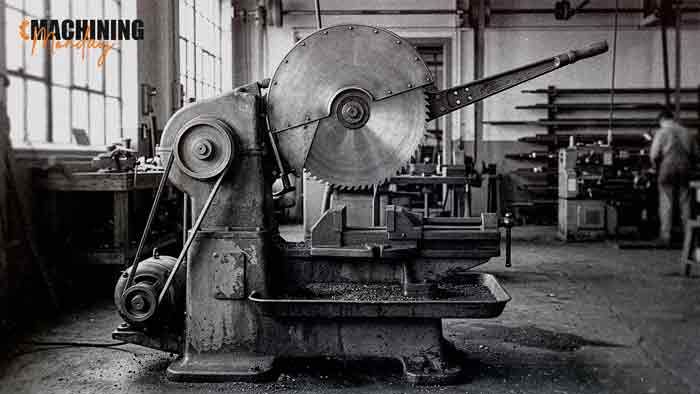
A cold saw is a metal cutting saw that drives a toothed circular blade at low speed through a gear reduction unit, so that each tooth shears off a chip thick enough to carry the heat of the cut away with it. The blade stays cool. The workpiece stays cool. You can pick the part up bare handed a few seconds after it drops. The machine gets there by being geared down rather than sped up, and that is exactly why it works.
You will also see the same machine sold as a cold cut saw, a cold cut off saw, a circular cold saw or a cold circular saw. They all describe the same thing.
You have watched an abrasive chop saw throw a rooster tail of sparks across the floor. You have seen the cut end come off blue, and you have felt how long it takes before you can touch it. You have probably also cleaned the grit off everything within ten feet.
Now watch a cold saw make the same cut. A slow, heavy, almost unhurried sound. A stream of bright curled chips going into the pan. No sparks worth mentioning, no dust, and an end face square enough that a lot of shops go straight from the saw to the next operation without facing it. The part is cool.
Here is the part most machinists never think about: that difference is not an accident of blade design. It is the result of a machine tool industry that spent a century chasing faster cutting, and one class of machine that took the same breakthroughs and used them to go slower.
We keep cold saws, carbide circular saws, bandsaws and blade sharpening equipment in inventory across our six U.S. locations.
See Our Saws
The Century of Going Faster
A great deal of machine tool history from the 1860s forward is a story about cutting speed, and about the tool materials that kept raising the ceiling on it.
In 1868 Robert Mushet produced a self hardening tool steel carrying roughly 2 percent carbon, 2.5 percent manganese and 7 percent tungsten. It hardened in air rather than in a quench, and it held an edge at temperatures that would have ruined plain carbon steel. That was the opening move.
The decisive one came at Bethlehem Steel between 1899 and 1900, when Frederick W. Taylor and Maunsel White worked out the heat treatment that produced true high speed steel. The numbers were startling at the time and they are still worth sitting with: cutting speed went from about 30 surface feet per minute to about 90. Three times the metal removal out of the same machine, the same operator and the same shift.
They demonstrated it at the Paris Exhibition in 1900 and it was a sensation. It was also a problem. Tripling the cutting speed meant tripling the forces, the vibration and the horsepower demand, and the machine tools of 1900 were not built for it. The whole industry had to get heavier and more rigid to use what Taylor and White had handed it. The modern machine tool, the massive cast iron thing bolted to the floor, is in large part a response to high speed steel, and cast iron is still winning that argument today.
So the pattern was set. Better tool material, more speed, heavier machine to hold it, repeat. That pattern runs straight through carbide, through ceramics, through coatings, and into the 12,000 rpm spindles sitting in shops today.
The cold saw runs against that current. It took the same high speed steel that tripled cutting speeds elsewhere in the shop and spent it on a bigger bite, taken more slowly.
Under 5,000 SFM, and 350 If the Blade Is Solid
Run the numbers on a cold saw and they look wrong at first.
| Parameter |
Cold saw |
What it means |
| Surface speed, general |
Under 5,000 SFM |
Low for a machine whose tool is a spinning disc |
| Surface speed, solid HSS blade |
Usually never above 350 SFM |
Roughly four times a 1900 lathe, and nothing like a modern mill |
| Chip load per tooth |
.001 to .003 inch |
A real bite, not a rub |
| Drive |
Gear reduction unit |
Drops blade rpm while holding torque constant |
| Cutting action |
Shearing |
The tooth cuts a chip, it does not abrade |
That gear reduction unit is the whole idea in one component. A motor that would happily spin the blade fast is deliberately geared down, and the torque that would have gone into speed goes into the tooth instead. The result is that every tooth in the cut is loaded heavily enough to lift a genuine chip rather than skate across the surface generating friction.
This matters more than it sounds. A tooth that rubs makes heat and puts almost all of it into the workpiece and the blade, because it produces almost no chip to carry the heat anywhere else. A tooth that cuts makes heat too, but the chip leaves the cut carrying most of that energy with it. Same physics, opposite outcome, and the difference is whether the tooth is loaded hard enough to cut.
That is why the cold saw is geared down. Not for gentleness. For load.
Where the Heat Actually Goes
The name confuses people, and it should, because cutting metal always generates heat. Nothing about a cold saw suspends thermodynamics.
What the machine controls is the destination. The energy of the cut has three places it can go: into the chip, into the workpiece, or into the tool. A cold saw is set up so that the overwhelming majority goes into the chip, and the chip then falls into the pan and takes the heat with it.
Compare the abrasive saw, which is doing something fundamentally different. An abrasive wheel does not have teeth that shear. It has bonded grit that wears the metal away in tiny fragments, and that process is enormously inefficient thermally. The heat has nowhere useful to go, so it goes into the workpiece and into the wheel. You get the sparks, the blue end, the discoloration, the burr, and the abrasive dust on every surface in the area.
The practical consequences of the cold saw approach stack up quickly:
- A square, clean end face, often good enough to skip a facing operation
- Minimal burr, because the tooth shears rather than tears
- No heat affected zone worth worrying about, which matters if the next operation is welding or heat treat
- No abrasive dust, and very few sparks, which changes what you can safely cut near
- A resharpenable blade instead of a consumable wheel
There is one more consequence that shops feel on the shop floor rather than on paper. A part that comes off the saw cold is a part that is the size you measured. Steel expands when it is hot. A hot cut measured hot and stacked to cool is a part that has moved by the time anyone checks it again. The cold saw hands back a part you can measure immediately and trust.
1913: The First Names in the Record
Here is where the honest version of this story has to diverge from the tidy one.
There is no cold saw equivalent of Henry Maudslay and the screw cutting lathe. No single inventor, no single year, no demonstration that changed everything. Circular blades were cutting metal, hot saws were cutting glowing stock in rolling mills, and the ideas accumulated in shops and foundries without anyone stopping to name the category or claim it.
What the patent record does give us is the point at which someone thought the idea specific enough to claim.
| Date |
Who |
What |
Filed Oct 10, 1913
Published Feb 24, 1914 |
Albert Rocour |
FR463500A, Circular saw blade for cold cutting metals |
Filed Nov 23, 1914
Published Dec 1, 1915 |
Leon Kellenberger |
CH71090A, Cold sawing machine for metalworking |
Rocour patented the blade. Kellenberger patented the machine. They filed thirteen months apart, in France and Switzerland, roughly a decade after high speed steel had made a blade capable of this kind of work commercially available. That timing is not a coincidence. You cannot build a practical cold sawing machine until you have a tooth that survives the cut, and Taylor and White supplied the tooth.
So the answer to "who invented the cold saw" is that nobody did, and that the earliest names anyone can put a verified date on are Rocour in 1913 and Kellenberger in 1914. That is a less satisfying answer than a single inventor. It is also what the record actually supports.
Carbide Changes the Arithmetic, Slowly
The next material jump arrived in Germany. Osram sold its sintered carbide license to Krupp in 1925, and in 1926 Krupp brought the material to market under the name WIDIA, from wie Diamant, meaning like diamond. Commercial introduction followed in 1927, and it reached the United States in 1928.
Carbide went on to reshape almost everything about metal cutting, and it is a large part of why most shops stopped grinding their own tools. It should have transformed sawing immediately too. It did not.
Through the 1930s, carbide tipped circular blades went to work on aluminum, brass, plastic and wood, and they worked well. Attempts to use the same blades on steel failed, and the reason was not the carbide. It was the machines. Carbide pays for itself mainly when you can run it fast, and running it fast through steel generates forces and vibration that the saws of that era could not hold. A carbide tooth in a saw that flexes does not cut faster. It chips.
This is the Taylor and White problem repeating itself thirty years later, in a different corner of the shop. The tool material got ahead of the machine, and the industry had to spend decades catching up.
Looking at a used saw? We can help you match blade type, capacity and rigidity to the material you actually cut.
Browse Saw Inventory
Rockford, Illinois, 1963 to 1969
The machines did eventually catch up to the material, and a surprising amount of that work happened in one mid sized Illinois manufacturing city.
According to the industry accounts, the chain runs like this. In 1963, Ingersoll Milling Machine Co. in Rockford, Illinois put circular blades with brazed carbide teeth to work cutting steel plate. That is generally cited as the first practical carbide plate saw.
Through the late 1960s, researchers at the University of Braunschweig in Germany worked out the tooth geometry that made carbide sawing of steel reliable rather than lucky: negative cutting angles around 18 degrees combined with chamfered edges. Horst Doepke of Braunschweig is credited with the notch grind geometry developed for tubing and profiles.
In 1969, Advanced Machine & Engineering, also of Rockford, built what is described as the first billet saw using that geometry. The performance claims attached to it, and these come from the company lineage rather than from an independent test, are roughly eight times faster than a band saw and four times faster than a high speed steel circular cold saw.
In 1984 Willy Goellner patented a notch grind design for cutting solid billets, the basis for what became the AMSAW line.
| Year |
Development |
Where |
| 1926 |
Krupp markets WIDIA sintered carbide |
Germany |
| 1930s |
Carbide tipped circular blades cut non-ferrous only |
Industry wide |
| 1963 |
First carbide plate saw, Ingersoll Milling Machine Co. |
Rockford, Illinois |
| Late 1960s |
18 degree negative angle and chamfer geometry, Horst Doepke |
University of Braunschweig |
| 1969 |
First billet saw, Advanced Machine & Engineering |
Rockford, Illinois |
| 1984 |
Notch grind patent for solid billets, Willy Goellner |
United States |
Worth noting where these claims come from. The 1963 to 1984 chain is documented primarily by Hennig Worldwide, the company that Advanced Machine & Engineering became, telling its own history, with the same account reflected on Wikipedia. It is a company history rather than an independently audited one. The dates are specific and consistent, and we have cited them as what the industry record says.
The Blade Is the Machine
Everything above comes down to what is bolted to the arbor. Two families of blade, two different operating philosophies.
|
Solid HSS |
Tungsten carbide tipped |
| Material |
M2, or M35 with cobalt |
Carbide tips brazed to a steel body |
| Hardness, ferrous work |
64/65 HRC |
Tips approximately 98 HRC |
| Hardness, non-ferrous work |
58/60 HRC |
Tips approximately 98 HRC |
| Body hardness |
Same as the blade |
38/42 HRC |
| Typical surface speed |
Usually never above 350 SFM |
Substantially higher |
| Heat tolerance |
Good, and brittle at high hardness |
Higher |
| Machine requirement |
Modest |
Rigidity and power |
| Resharpenable |
Yes |
Yes |
The hardness tradeoff on the HSS side is worth understanding before you buy. A blade hardened to 64/65 HRC resists heat and wear very well, and that same hardness makes it brittle. Run it in a saw with a worn spindle bearing, a sloppy vise or an operator leaning on the feed and the teeth will tell you about it.
The carbide side has the opposite failure mode. The tips will take the heat, but the steel body under them is deliberately softer at 38/42 HRC so the blade can absorb shock without cracking. What it cannot absorb is a machine that flexes. This is the same constraint that stalled carbide sawing for thirty years, and it has not gone away. It just moved from being an industry problem to being a used machinery buying decision.
Both families are resharpenable, which changes the cost picture against abrasive cutting. An abrasive wheel is gone when it is gone. A cold saw blade goes to the grinder and comes back.
What This Looks Like on a Used Machine
The useful thing about this history is that you can still see most of it in a single inventory list. Our own saw inventory happens to cover the chain described above from end to end.
| Machine |
Where it sits in the story |
| 2010 Baileigh CS-355M Manual Cold Saw |
The classic form. Hand fed, geared down, HSS blade, the machine this article is about |
| 2000 Eisele Behringer PSU 450 CNC 2 Cold Saw |
The same principle under CNC control, with automatic feed and repeatable length stops |
| 2018 Amada CMII75DG Automatic Carbide Circular Sawing Machine |
The carbide branch, the thing the 1963 to 1969 work made possible |
| 2019 Hyd-Mech CSNC-175 PLC Carbide Circular Saw |
Same branch, PLC controlled, production oriented |
| 2012 Vollmer CP200 CNC Saw Blade Sharpening Machine |
The resharpening side, and the reason blade cost behaves differently than wheel cost |
Three things are worth pulling out of that list if you are shopping.
First, the gap between a manual cold saw and a CNC one is not really about the cut. Both make the same kind of cut for the same reason. The gap is about repeatability, feed control and how many parts you need before someone has to touch the machine again. A hand fed saw with a good blade and a rigid vise will give you an excellent cut. It will just give you one at a time.
Second, if you are moving into carbide, look at the machine before you look at the blade. Carbide sawing of steel failed for three decades because the saws were not rigid enough, and a used carbide saw with a tired spindle or a worn guide will reproduce that failure faithfully. Check the spindle, check the blade guides, check the vise, and check whether the previous owner was cutting what you intend to cut.
Third, a cold saw is not a band saw replacement and was never meant to be. A band saw is limited by its throat, so it takes far heavier cross sections than a circular blade can reach, and blade diameter is a hard ceiling on cold saw capacity. The common arrangement is both machines: the band saw breaks down heavy stock, the cold saw makes the cut that has to be square.
And if you are running volume, price out a sharpening machine against a blade replacement cycle. That arithmetic surprises people.
The cold saw did not win by cutting faster. It won by putting the heat somewhere useful and handing back a part that is cold, square, and the size you measured.
Frequently Asked Questions
What is a cold saw?
A cold saw is a metal cutting saw that uses a toothed circular blade turning at low speed through a gear reduction unit. The teeth shear a thick chip out of the workpiece and the heat of cutting leaves with that chip, so the blade and the part both stay near room temperature. That is where the name comes from.
Why is it called a cold saw if the cutting still makes heat?
Cutting always makes heat. The difference is where the heat ends up. A cold saw is geared and fed so each tooth takes a chip thick enough to carry the heat away with it. An abrasive saw does the opposite: it rubs the metal away and dumps the heat into the workpiece, which is why an abrasive cut comes off hot, discolored and sparking.
How fast does a cold saw blade actually turn?
Slowly, by machining standards. Cold saws generally run under 5,000 surface feet per minute, and a solid high speed steel blade is usually never run above 350 SFM. Chip load sits between .001 and .003 inches per tooth. The gear reduction drops the speed while holding torque constant, which is what lets each tooth take a real bite instead of rubbing.
Who invented the cold saw?
No single person did. The record does not support a clean invention story. The earliest datable patents specific to cold cutting metal with a circular blade are Albert Rocour's French patent FR463500A, filed October 10, 1913, and Leon Kellenberger's Swiss cold sawing machine patent CH71090A, filed November 23, 1914. The machine was assembled over decades out of better steel, better gearing and better tooth geometry.
What is the difference between an HSS cold saw and a carbide circular saw?
Blade material and speed. A solid high speed steel blade is hardened to 64/65 HRC for ferrous work and runs slow. A tungsten carbide tipped blade has carbide brazed to the tooth tips at roughly 98 HRC on a softer 38/42 HRC body, tolerates more heat, and runs much faster, but it needs a saw rigid enough and powerful enough to use that speed. That rigidity requirement is why carbide sawing of steel did not become practical until the 1960s.
What is the difference between a cold saw and a band saw?
A band saw pulls a long flexible blade continuously past the work. A cold saw drives a rigid circular blade slowly through it. The band saw wins on cross section, because its capacity is set by the throat of the machine rather than by blade diameter, and a cold saw can only cut about as deep as its blade radius allows. The cold saw wins on finish and squareness, because a rigid blade in a rigid saw does not wander the way a band can. In practice a lot of shops run both: the band saw breaks down heavy stock, the cold saw makes the finish cut.
Are cold saw blades resharpenable?
Yes, and that is a real part of the operating cost case. Both solid HSS and carbide tipped blades can be reground. Shops running saws in volume often keep a blade sharpening machine in house rather than buying new blades on every cycle.
Sources
- Albert Rocour, Circular saw blade for cold cutting metals, French patent FR463500A, filed October 10, 1913, published February 24, 1914. Google Patents.
- Leon Kellenberger, Cold sawing machine for metalworking with a reciprocating saw blade, Swiss patent CH71090A, filed November 23, 1914, published December 1, 1915. Google Patents.
- Wikipedia, Cold saw. Blade materials, hardness ranges, surface speed and chip load figures.
- Wikipedia, Carbide saw. Krupp carbide, 1930s non-ferrous carbide sawing, and the 1963 to 1969 development chain.
- Hennig Worldwide, What Circular Saw Blade Tooth Geometry is Best for Sawing Steel Billets? Ingersoll Milling Machine Co. 1963, University of Braunschweig tooth geometry, Horst Doepke, Advanced Machine & Engineering 1969, and the Willy Goellner notch grind patent of 1984.
- Frederick W. Taylor and Maunsel White, high speed steel trials at Bethlehem Steel, 1899 to 1900, demonstrated at the 1900 Paris Exhibition.
About the Author
Bill Murphy is Marketing and Content Lead at Resell CNC, where he writes about machine tools, manufacturing history and the used equipment market. He works daily with the machines that pass through Resell CNC inventory and with the appraisers and technicians who inspect them.
About Resell CNC
Resell CNC is a used CNC machinery dealer and industrial auction company headquartered in Maitland, Florida, with six U.S. locations across four divisions: Retail, Auctions, Appraisals and Finance. Our appraisal team holds AMEA and CEA certifications. We buy, sell, appraise and finance pre-owned metalworking equipment nationwide.