CNC Family Breakdown
Doosan Lynx 2100 Explained: All 17 Models, and the Options That Cost You Capacity
What is the Doosan Lynx 2100?
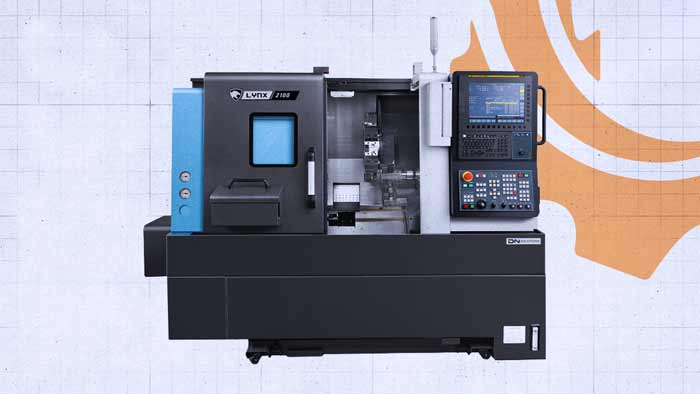
The Doosan Lynx 2100 is a compact CNC turning center introduced in 2016, now sold under the DN Solutions name. DN Solutions publishes 17 models in the family, built from seven configuration codes across three capacity classes. The configuration codes are the plain two axis machine, L for a long bed, M for driven tools, LM, LMS which adds a sub-spindle, LY which adds a Y-axis, and LSY which adds both. The trailing A, B or C is a chuck and spindle capacity class, not a generation marker: A is 6 inch, B is 8 inch, C is 10 inch. Reading that letter as a vintage is the single most common mistake buyers make on a used Lynx.
Ask three sources how many Lynx 2100 models there are and you will get three answers. The 2016 factory catalog lists ten. DN Solutions' current website lists seventeen. One authorized distributor lists twelve. All three are legitimate, none of them is lying, and the gap between them is the first thing a used buyer needs to understand, because it explains why the model on the tag in front of you may not appear in any document you can find.
The naming itself is not random. It is a two part code, and once you can read both halves the whole family lines up in order. But the Lynx 2100 has a second property that almost nobody writes about, and it matters more than the naming: on this machine, several options make the machine smaller. Adding driven tools costs you fifty millimetres of swing. Ticking one turret box costs you sixty four. Choosing the other control option costs you a fifth of your torque. This breakdown covers both halves of the name, and then it covers what each option quietly takes away.
The 17 models, and why nobody agrees on the number
Here is the complete list as DN Solutions currently publishes it, grouped the way the factory groups it.
| Group |
Models |
Count |
| Two axis |
2100A, 2100LA, 2100B, 2100LB, 2100LC |
5 |
| With driven tools |
2100MA, 2100LMA, 2100LMSA, 2100MB, 2100LMB, 2100LMSB, 2100LMC, 2100LMSC |
8 |
| With Y-axis |
2100LYA, 2100LYB, 2100LSYA, 2100LSYB |
4 |
Seventeen models from seven configuration codes across three capacity classes. The matrix is only partly filled: 17 of a possible 21. There is also a Lynx 2100G, but it sits in a separate Lynx 2000G/2100G gang type series with no turret and no capacity letter, so it is an adjacent machine rather than a 2100 variant.
Now the three counts. The factory catalog carrying publication code EN 160324 SU, dated 24 March 2016, lists ten models and contains no C class at all. On that document the 10 inch appears only as an option note and as the larger sibling Lynx 2600. DN Solutions' current regional sites, checked against each other for the United States, Europe and the global page, list all seventeen and agree with each other on every specification row. One authorized distributor lists twelve, omitting the 2100A, LA, MA, LC and LMC.
The reason the counts differ is timing, not secrecy. The C class simply arrived after the 2016 document. A third factory catalog, carrying publication code EN 230601 SU and dated 1 June 2023, publishes the LC, LMC and LMSC in a full 10 inch column with complete headstock data. So if you are looking at a C class machine and cannot find it in the catalog you were handed, you have the wrong catalog rather than an undocumented machine.
Which also tells you what is not a model. There is no plain 2100C, no 2100MC, no 2100LSA or LSB, no 2100LYC, no 2100LSYC, no 2100SY and no 2100Y. The C class exists only as LC, LMC and LMSC, always with the long bed. If a listing offers you something outside the seventeen above, the machine may still be real but the string is a dealer construction, and the tag plate is the only thing worth trusting.
A, B and C are chuck classes, not vintages
This is the correction that matters most, and the factory settles it. The 2016 catalog does not explain the letters in prose. It does something better: it groups the models under literal chuck size headings, printing "6 inch" above the A models and "8 inch" above the B models. The letter is a capacity designator, and A and B appear in the same catalog, in the same generation, at the same machine weight.
| Row |
A |
B |
C |
| Standard chuck |
6 in |
8 in |
10 in |
| Bar capacity |
51 mm |
65 mm |
81 mm |
| Spindle bore |
61 mm |
76 mm |
91 mm |
| Spindle nose |
ASA A2-5 |
ASA A2-6 |
ASA A2-8 |
| Front bearing |
90 mm |
110 mm |
130 mm |
| Max spindle rpm |
6,000 |
4,500 |
3,500 |
| Spindle motor |
15 / 11 kW |
15 / 11 kW |
18.5 / 15 kW |
| Max torque |
127 N.m |
169 N.m |
269 N.m |
| Machine mass, plain |
3,100 kg |
3,100 kg |
3,450 kg as LC |
A and B figures come from the factory catalogs carrying publication codes EN 160324 SU and EN 190613 SU. The C class figures come from the later catalog carrying publication code EN 230601 SU, cross checked against DN Solutions web spec tables. Note that DN Solutions does not publish bar capacity on its web spec tables at all, only in the catalogs.
Read the A and B columns side by side and the trade is clean. Same bed. Same 205 mm of cross travel and 340 mm of Z on the short bed versions. Same 15 kW motor. Same 3,100 kg. What changes is the headstock, and what you are actually choosing is 1,500 rpm against 42 newton metres. If your work is small in diameter and finish critical, the A is the faster machine. If you feed 65 mm bar, the B is the only one that swallows it.
The C is a different proposition and the common shorthand undersells it. Calling C "the 10 inch option" suggests a bigger chuck bolted to a B. It is not. The C runs 18.5 kW against 15, and 269 newton metres against 169. That is a different spindle class, and it is why the C exists only on the long bed.
One more thing the letter does not tell you, and this catches people. The chuck itself is optionable inside a class. The Y-axis catalog prints chuck size as "6 {8}" for the LYA and "8 {10}" for the LYB, with braces marking the option. So you can hang a 10 inch chuck on a B class machine. What you cannot do is buy a C class Y-axis machine, because DN Solutions does not publish one. The letter tracks the headstock, not the chuck someone bolted on. Verify the spindle nose and the bore, not the chuck currently fitted.
The rest of the code, and the order it comes in
The configuration letters are positional and strict: L, then M, then S, then Y, then the capacity letter.
L is the long bed. The catalog prints Z axis travel as 340 with 560 in brackets, and the bracket is the L version. Max turning length follows it, 330 becoming 550 on the two axis machines and 290 becoming 510 on the driven tool machines. The tailstock stroke grows with it, 360 mm to 580 mm.
M is driven tools. On a two axis Lynx 2100 the turret is a plain servo unit with a wedge clamp taking 25 by 25 mm shanks. On an M machine it becomes a 12 station BMT45P with 24 position half indexing at 0.11 seconds, 20 by 20 mm shanks, and a 6,000 rpm rotary tool spindle with 10,000 available as an option. On the Y-axis machines the 24 position half index is itself listed as an option rather than standard, so confirm it if you need it.
S is the sub-spindle. Published only on the LMS and LSY machines: a 5 inch chuck, 6,000 rpm, 5.5 over 3.7 kW, around 46 newton metres, a flat ø110 nose, a 75 mm front bearing and a ø43 through hole.
Y is the Y-axis. 105 mm of travel, published as plus or minus 52.5, at 10 metres per minute rapid. Present only on the LY and LSY machines.
Note what is missing from that list. There is no published LMY or LMSY, because on a Y-axis Lynx the M is dropped. Every LY and LSY is already a BMT45P driven tool machine, so the Y designation implies the milling. If you see "2100LMSY" on a listing, nobody at the factory wrote it.
On most machines you pay money for capability. On a Lynx 2100 several options are paid for in capacity, and the biggest one is disclosed in a footnote.
Adding driven tools costs you 50 mm of swing
Compare an LB to an LMB. Same bed, same 560 mm of Z travel, same spindle, same 15 kW. The only change is the turret. Here is what the turret change costs.
| Row |
2100LB, two axis |
2100LMB, driven tools |
| Max turning diameter |
ø350 mm |
ø300 mm |
| Max turning length |
550 mm |
510 mm |
| Tool shank |
25 x 25 mm |
20 x 20 mm |
| Max boring bar |
ø40 mm |
ø32 mm |
| Z travel |
560 mm |
560 mm, unchanged |
Fifty millimetres of diameter, forty of length, and a tooling downgrade in both shank size and boring bar capacity. The Z stroke is identical, so this is not a travel loss. It is turret envelope: the BMT45P deck occupies more of the work zone and holds smaller tools than the wedge clamp turret it replaces.
The practical read is uncomfortable but useful. A shop that buys an LMB "in case we need some milling" is paying fifty millimetres of swing and a tool size reduction for capability it may use on one job in twenty. If the milling is genuinely occasional, the two axis machine is the larger and better tooled lathe. If the milling is real, the LMB earns it. What you should not do is treat the driven tool version as a strict upgrade, because on the rows that decide whether your part fits, it is not.
The footnote that costs 64 mm
On the Y-axis machines DN Solutions offers a 16 station turret in place of the standard 12. The catalog discloses the consequence in a footnote, and it reads, verbatim, that maximum turning diameter is 236 mm in the case that the optional 16 station turret is mounted.
So the option takes the LYA, LYB, LSYA or LSYB from ø300 mm down to ø236 mm. That is sixty four millimetres, a twenty one percent reduction in the largest diameter the machine can turn, in exchange for four more tool stations.
There is nothing wrong with the option. For a shop running small diameter parts with a lot of tools in the cycle, four extra stations is worth more than swing it never uses. The problem is where the disclosure lives. This is the most consequential single option in the family and it is a footnote under a spec table, which means it is exactly the sort of thing that does not make it into a used listing. If you are buying a Y-axis Lynx 2100, count the turret stations and then decide which diameter figure applies to the machine in front of you.
The 10 inch machine turns a shorter part
The C class carries the biggest chuck, the strongest spindle and the most torque in the family. It also turns a shorter part than the B, and it does so on identical Z travel.
The LC publishes 537 mm of maximum turning length where the LA and LB publish 550. The LMC and LMSC publish 497 where the LMA, LMB, LMSA and LMSB publish 510. Z travel is 560 mm on all of them. The stroke has not changed; the fatter headstock and larger chuck consume more of it.
The C class also carries a turret count worth checking rather than assuming, because the sources disagree. DN Solutions' web page for the two axis 2100LC lists 10 tool stations, while the 2023 catalog gives the same machine as 12 with 10 as an option. The 2016 catalog muddies it further by giving the plain B and LB as 10 stations standard with 12 optional. So 10 stations is a turret option available across the two axis range rather than a property of the 10 inch machine, and the web pages and the catalogs do not agree on which is standard. Count the stations on the machine in front of you and do not infer them from the model.
One figure in the C class we could not resolve, and we would rather flag it than average it. DN Solutions publishes the LMSC at 4,100 kg against the LMC at 3,500, a 600 kg jump for adding a sub-spindle. The same swap on the B class costs 120 kg, from 3,480 to 3,600. An authorized distributor publishes the LMSC at 3,800 kg. Either the C class sub-spindle package is genuinely much heavier or one of those numbers is wrong. If you are planning a rigging job or a floor loading, get the weight from the machine's own plate.
Fanuc and Siemens are not the same machine
The factory catalogs give the control as Doosan-Fanuc i, named DN Solutions Fanuc i Plus from the 2023 document onward, or Siemens 828D. Two options, and the choice is usually presented as a preference: which control does your programmer know, which post processor do you have.
The Y-axis catalog publishes something most buyers never see. It gives separate motor rows for each control, on three different motors, and the answer is not a simple ranking.
On the main spindle, Fanuc wins. The Fanuc machine is rated 15 over 11 kW with 127 newton metres on the A class and 169 on the B. The Siemens machine is rated 12.6 over 10.5 kW with 100.8 newton metres on the A and 134.4 on the B. That is sixteen percent less rated power and twenty one percent less main spindle torque for choosing Siemens.
On the other two motors, Siemens wins, and by more. The sub-spindle is 5.5 over 3.7 kW and about 46 newton metres on Fanuc against 8.3 over 7 kW and 61 newton metres on Siemens, roughly a third more torque. The rotary tool spindle is 3.7 kW on Fanuc against 7.79 kW on Siemens, which is more than double.
So the honest framing is a trade rather than a downgrade. If your work is main spindle heavy turning, the Fanuc machine is the stronger one. If your work leans on the sub-spindle and on driven tool milling, the Siemens machine has considerably more behind those two spindles. Either way you are not comparing identical machines, and we have not seen a dealer listing that discloses any of it.
There is a second Siemens consideration on the used market, and it is about support rather than specification. A Siemens 828D Lynx needs different programming, a different post processor and a different service bench from the Fanuc majority, and it narrows the pool of buyers when you come to sell. Post processor availability for the Siemens variant is visibly thinner: we found a public request from an owner looking for a working Sinumerik 828D post for a Lynx 2100LSY. Verify the control brand before anything else on the machine.
On the Fanuc side there is a real control generation change inside the model's life, and the factory documents bracket it. The 2016 and 2019 catalogs name the control as Doosan-Fanuc i. The 2023 catalog names it DN Solutions Fanuc i Plus and specifies a 15.6 inch touchscreen, which is the iHMI interface. So the changeover happened somewhere between June 2019 and June 2023, and the catalogs do not pin it tighter than that. Confirm the interface on the machine rather than inferring it from the year. One distributor describes the control as "0i-Plus", which is not a string DN Solutions uses, so do not quote that as a factory designation.
On Siemens 840D, which turns up occasionally in listings: all three factory catalogs specify 828D only, and we found no manufacturer or authorized distributor pairing of the Lynx 2100 with 840D. Treat an 840D claim as a listing error until the tag plate says otherwise.
On an LMS or an LSY there is no tailstock
Every LMS and LSY machine gives up its tailstock, because the sub-spindle occupies that position. The plain, L, M, LM, LY and LC machines all have one: 360 mm of stroke on the short bed, 580 on the long, a ø65 quill and an MT No.4 live centre, with a CNC hydraulic tailstock on the Y-axis machines.
This creates a spec sheet trap that a table will not warn you about. An LMB publishes 510 mm of maximum turning length and so does an LMSB. Those are not the same number. On the LMB you can support a 510 mm shaft between centres. On the LMSB you cannot support it at all, because there is nothing at the far end to support it with. The figure describes the envelope, not the process.
So the sub-spindle is not a free addition either. It buys you back side work in one cycle and it costs you the ability to hold a long slender part at both ends. For a shop making short chucked parts complete, that is an obvious win. For a shop turning shafts, the LMS is the wrong machine no matter what the turning length row says.
The accuracy figure DN Solutions has never published
We checked all three factory catalogs, the 2016 series document read end to end, the 2019 Y-axis catalog and the 2023 combined 2100 and 2600 catalog, plus DN Solutions web spec tables for the United States, Europe and the global site across all seventeen models, two authorized distributor spec pages and an independent spec database. There is no positioning accuracy figure and no repeatability figure for the Lynx 2100 anywhere in the public literature. The web spec template runs capacity, travels, main spindle, turret, dimensions, and stops. There is no accuracy block in it at all.
What DN Solutions does publish gets mistaken for accuracy constantly, so it is worth being precise. The least command increment is 0.001 mm. That is the smallest number the control will accept in a command. It says nothing about whether the axis arrives there. The minimum spindle indexing angle on the C axis is 0.001 degrees, which is angular command resolution on a rotary axis, not linear positioning accuracy. Quoting either one as an accuracy specification is the most common error in Lynx 2100 write ups.
One figure specifically to reject. An authorized distributor page lists "positioning repeatability" for the 2100A as plus or minus 0.0005 degrees. It is expressed in degrees, so at best it describes turret or C-axis indexing rather than X and Z positioning, and it is a distributor figure rather than a manufacturer one. Do not let it stand in for an accuracy spec.
The consequence is the same one this series keeps arriving at, and it is not a criticism of the builder. Where no linear accuracy figure is published, a used buyer cannot verify a machine against the factory standard, because there is no published factory standard to verify against. You have to bring your own. For turning centers the applicable public standards are ISO 13041, with Part 1 covering geometric tests on a horizontal workholding spindle and Part 6 covering the accuracy of a finished test piece, and VDI/DGQ 3441. If you need numbers for a specific Lynx 2100, request them from DN Solutions directly, in writing, before you agree a price.
Where the Lynx 2100 came from
The series launched in 2016. The catalog carries publication code EN 160324 SU, dated 24 March 2016, and United States trade press covered the launch that September. The factory positions it in its own words as the next generation of the Lynx series, citing more than 25,000 sales worldwide for the line.
On what it replaced, be careful with the sourcing. Trade press reporting the 2016 launch states the Lynx 2100 evolved from the Lynx 220 series. The factory catalog itself never names a predecessor: it says next generation of the Lynx series and stops. So the 220 lineage is well attested but it is a press attribution, not a factory statement. If it matters to a deal, do not represent it as the builder's own claim.
The Y-axis machines arrived later. They were shown at IMTS in 2018 as a new generation of the Lynx 2100LY series, adding the Y-axis and an optional sub-spindle, and the LY catalog carries publication code EN 190613 SU, dated 13 June 2019. Trade coverage at the time said the LY kept the same compact footprint as previous models, and the catalogs do not support that: the Y-axis machines are 2,880 by 1,711 by 1,921 mm against 2,805 by 1,595 by 1,693 for the 2016 sub-spindle machines. The Y-axis costs floor space and a good deal of height.
One badge note for anyone reading listings. Doosan announced the DN Solutions rebrand on 26 May 2022, effective 2 June 2022. Identical machines exist under both names with unchanged specifications, and the same catalog PDF is served under both a Doosan Machine Tools path and a DN Solutions path. A Doosan badge and a DN Solutions badge on the same model tell you roughly which side of mid 2022 the machine shipped, and nothing about the machine.
As for what Lynx signifies, nobody at Daewoo, Doosan or DN Solutions has published it. We read both catalogs for a naming rationale, searched in English, and searched in Korean using the terms for Lynx and for name and meaning alongside Doosan machine tools. There is nothing. The naming set sitting alongside PUMA for the larger lathes and LEO does suggest a convention, but that is an observation about the pattern rather than a sourced explanation. Anyone who tells you the builder published a meaning for Lynx is guessing. This is the industry norm rather than a Doosan quirk: Haas has never explained ST, Okuma has never explained LB, and Mazak has never explained the C in Variaxis C.
What the used market actually has
Our survey put roughly 30 to 55 distinct used Lynx machines on offer in North America across all Lynx families, and 70 to 110 worldwide. Of those, the 2100 family accounts for roughly 12 to 20 distinct machines in North America, clustering 2016 to 2025 including near new dealer and demo stock. That is a real market, unlike some families we have looked at, but it is not deep.
Two ranges rather than figures, because two of the largest aggregators blocked automated access, so those counts are floors rather than ceilings. And the counting problem is worse than it looks. Aggregators crawl each other, so one dealer machine appears several times. Listings duplicate inside a single site: we found the same machine listed with and without a space in the model string, and one 2021 machine appearing five times on one site. And sold listings stay indexed and keep ranking, with eight machines in our sample explicitly marked sold or unavailable while still fully searchable. A search result count is not a supply count.
On configuration, the pattern is clear and it matters for planning. A plain two axis Lynx 2100 with a tailstock, a chip conveyor and a tool presetter is easy to find at almost any budget. Driven tooling is available in reasonable numbers. A Y-axis plus sub-spindle Lynx 2100 is effectively a 2020 or newer purchase in North America, because the LY generation only arrived in 2018 and those machines have not aged into the used market yet. Gantry and robot loaded units exist but are opportunistic finds you cannot build a plan around.
On price, treat everything you read with suspicion including this. We collected eleven usable published asking prices across the Lynx families, which is a small sample and not a market. Within the 2100 family the asks we found ran from about $54,900 for a 2018 LB with roughly 1,800 hours up to $129,500 for a 2021 LSYB described as like new, which was already marked sold. Those are asking prices from public listings, not transaction prices, and we are deliberately not averaging them. What is safe to say is that the Y-axis and sub-spindle premium is large and visible, with every LSY and LMS ask we found above $99,000.
Two numbers to actively distrust. One marketplace displayed a range of $90,000 to $170,000 for a 2020 LSYA, which is an algorithmic site estimate rather than a seller's price. Another displayed $150,000 base to $200,000 fully equipped for the LSYA while showing zero units in inventory, which is a new machine list estimate. Both are exactly the sort of figure that gets scraped into a claim about market value.
And the single most useful thing to know about Lynx listings: hours are the number sellers omit. Three listings out of roughly thirty in our sample disclosed hours at all. One of those, on an older Lynx, showed 11,181 cutting hours. The absence of an hours figure is not a neutral fact.
Resell CNC Take
The Lynx 2100 is a well built compact turning center and a genuinely good used buy, and it is one of the easiest families to shop wrong, because the model string rewards a confident misreading. The trailing letter is a chuck class and people read it as a vintage. The driven tool version looks like an upgrade and costs fifty millimetres of swing. The 16 station turret looks like more tooling and costs sixty four millimetres of diameter in a footnote. The Siemens machine looks equivalent and gives up a fifth of its main spindle torque, while quietly gaining on the sub-spindle and doubling the rotary tool power. The sub-spindle machine publishes the same turning length as the machine that can actually hold the part. None of that is the builder hiding anything, it is all in the catalogs, but almost none of it survives into a used listing. Price the configuration in front of you, not the badge, and get the hours in writing before you talk money.
What to demand before you wire funds
Index the turret, hard, and then feel it by hand. Turret alignment is the dominant service theme in the owner record for this line, with at least five separate discussion threads across the enthusiast forums. The alarms to watch for are 2047, which is the clamp and unclamp proximity switch, and 2023, which is an indexing timeout. Owners who have chased these report binding or imbalance during rotation as the number one cause of both, ahead of the switch itself. So index through every station repeatedly in both directions, then release the clamp and hand rotate the turret at 90 degree intervals feeling for binding or interference. Ask directly whether the turret has ever been opened or rebuilt, because a turret that has been reassembled slightly wrong is the specific failure mode here.
Cycle the tool presetter on multiple stations. Presetters show up as an included option on a large share of Lynx listings, and there are multiple owner reports of presetter faults. It is a swing arm mechanism living in chips and coolant. Test it, do not look at it.
Open the electrical cabinet and look at the contactor contacts. One documented case had a machine throwing alarms 607 and 613, which are X and Z single phase failures, plus 9004 for a spindle input fault. The cause was burnt contact points on the main contactor, which drops out and makes the control believe it has lost a phase. Cascading axis alarms on this machine can be a cheap part rather than a drive, and knowing which before you buy is worth the ten minutes.
Warm the machine up before you measure anything. Thermal growth on Doosan Y-axis lathes is a discussed topic among owners. A cold machine will flatter the seller. Run it, then test it.
Run your own repeatability test, because there is no factory number. Turn a diameter, then repeat the identical cut ten or more times across thirty or more minutes of continuous running, and measure the spread on your own gauge. Agree the acceptable spread in writing before the inspection. This is the test that substitutes for the accuracy specification DN Solutions does not publish, and it is the single most important thing in this list.
Turn a long test bar and check taper across the full Z travel, and bore and face a test piece to check X squareness and spindle face runout. On a Y-axis machine, prove the Y and the C axis with an actual milled feature while warm. On a sub-spindle machine, run a full transfer cycle and check concentricity across the transfer.
Cut something representative if you intend to part or groove hard. The Lynx is a compact machine rather than a heavy duty one. An owner of the previous generation documented torn finishes parting 3 mm and hitting 150 percent spindle load under constant surface speed, traced partly to tool pockets that clamp with set screws rather than a wedge. The 2100's two axis turret is a wedge clamp unit and the driven tool turret is a BMT45P, so that specific complaint belongs to the earlier machine, but the underlying point carries: if your work involves aggressive interrupted cuts, find out on the seller's floor rather than yours.
Then the paperwork. Photograph the hours screen yourself rather than accepting a number. Confirm the control brand and generation off the tag plate and the screen, not the listing. Confirm the trailing capacity letter against the plate, and verify the actual spindle nose and bore rather than the chuck someone bolted on. Count the turret stations. Verify every advertised option actually functions, especially the bar feeder, parts catcher and programmable tailstock. And confirm the listing is a live machine at all, since a meaningful share of what you find by searching has already sold.
Frequently Asked Questions
How many models are in the Doosan Lynx 2100 family?
DN Solutions currently publishes 17 models, built from seven configuration codes across three capacity classes, which fills 17 of a possible 21 combinations. The five two axis models are the 2100A, LA, B, LB and LC. The eight driven tool models are the MA, LMA, LMSA, MB, LMB, LMSB, LMC and LMSC. The four Y-axis models are the LYA, LYB, LSYA and LSYB. Expect to see other counts, because the 2016 factory catalog lists only ten models and no C class at all, and one authorized distributor lists twelve. There is also a Lynx 2100G, but it belongs to a separate gang type series rather than the 2100 family.
What do A, B and C mean on a Doosan Lynx 2100?
They are chuck and spindle capacity classes, not generation markers, and this is the most common misreading on a used Lynx. The factory catalog groups the models under literal chuck size headings: A is 6 inch with 51 mm bar capacity, a 61 mm spindle bore and an ASA A2-5 nose at 6,000 rpm and 127 newton metres, while B is 8 inch with 65 mm bar, a 76 mm bore and an A2-6 nose at 4,500 rpm and 169 newton metres. A and B share the same bed, the same travels, the same 15 kW motor and the same 3,100 kg mass, so the choice between them is 1,500 rpm against 42 newton metres. C is 10 inch and a genuinely stronger spindle class at 18.5 kW, 3,500 rpm and 269 newton metres.
What does LMSB mean on a Doosan Lynx 2100?
Reading the letters in their fixed order, L is the long bed giving 560 mm of Z travel against 340 on the short bed, M is driven tools on a 12 station BMT45P turret with a 6,000 rpm rotary tool spindle, S is the sub-spindle, and B is the 8 inch capacity class with 65 mm bar capacity. So an LMSB is a long bed, 8 inch class machine that mills and has a second spindle for back side work. Note that it has no tailstock, because the sub-spindle occupies that position, so its published 510 mm turning length is an envelope figure rather than a length of shaft it can support between centres.
Does adding live tooling reduce capacity on a Lynx 2100?
Yes, and by more than most buyers expect. Comparing a 2100LB to a 2100LMB, maximum turning diameter falls from 350 mm to 300 mm and maximum turning length falls from 550 mm to 510 mm, while Z travel stays identical at 560 mm. The tooling also gets smaller, with the tool shank going from 25 by 25 mm to 20 by 20 mm and the maximum boring bar from 40 mm to 32 mm, because the BMT45P driven tool deck holds smaller tools than the wedge clamp turret it replaces. The loss is turret envelope rather than stroke, so a driven tool Lynx 2100 is not a strict upgrade on the rows that decide whether your part fits.
Does a 16 station turret change the Lynx 2100 turning diameter?
Yes, and it is disclosed only in a catalog footnote. On the Y-axis machines, the LYA, LYB, LSYA and LSYB, DN Solutions offers an optional 16 station turret in place of the standard 12, and the footnote states that maximum turning diameter becomes 236 mm when the 16 station turret is mounted. That is a drop from 300 mm, so sixty four millimetres or twenty one percent of turning diameter, traded for four additional tool stations. It is a reasonable trade for a shop running small diameter parts with many tools in the cycle, but it almost never appears in a used listing, so count the stations on the machine and then work out which diameter figure applies.
Is a Fanuc or Siemens Lynx 2100 the same machine?
No, and the difference runs both ways. The factory catalogs list the control options as Doosan-Fanuc i, later DN Solutions Fanuc i Plus, or Siemens 828D, and the Y-axis catalog publishes separate motor ratings for each control across three motors. On the main spindle Fanuc is stronger: 15 over 11 kW with 127 newton metres on the A class and 169 on the B, against Siemens at 12.6 over 10.5 kW with 100.8 and 134.4, so sixteen percent less power and twenty one percent less main spindle torque. On the other two motors Siemens is stronger: the sub-spindle is 8.3 over 7 kW and 61 newton metres against Fanuc at 5.5 over 3.7 kW and about 46, and the rotary tool spindle is 7.79 kW against 3.7, more than double. So Fanuc suits main spindle heavy turning and Siemens suits sub-spindle and driven tool work. On the used market a Siemens machine also needs a different post processor and service support and has a narrower resale pool, so confirm the control brand before anything else. Siemens 840D appears in some listings but no factory catalog offers it.
What positioning accuracy does DN Solutions publish for the Lynx 2100?
None. We checked all three factory catalogs from 2016, 2019 and 2023, DN Solutions web spec tables for the United States, Europe and the global site across all seventeen models, two authorized distributor pages and an independent spec database. There is no positioning accuracy or repeatability figure in the public literature, and the web spec template has no accuracy block in it. Two published numbers get mistaken for accuracy: the least command increment of 0.001 mm, which is the smallest number the control accepts rather than the smallest error the machine makes, and the 0.001 degree minimum C-axis indexing angle, which is angular resolution on a rotary axis. Because there is no factory figure, a buyer has to set their own acceptance test, ideally referencing ISO 13041 or VDI/DGQ 3441.
What does Lynx stand for on a Doosan lathe?
Nothing that the builder has ever published. We read both Lynx 2100 factory catalogs for a naming rationale, searched in English across Doosan and DN Solutions material, and searched in Korean using the terms for Lynx and for name and meaning alongside Doosan machine tools. There is no manufacturer statement. The naming set alongside PUMA for the larger lathes and LEO suggests a convention, but that is an observation about the pattern rather than a sourced explanation, so treat any confident expansion you read elsewhere as invention. This is the industry norm rather than a Doosan quirk, since Haas has never explained ST, Okuma has never explained LB, and Mazak has never explained the C in Variaxis C.
Shopping a Used Lynx 2100?
See our Doosan inventory.
Tell us the parts you want to run and our team, with 200+ years of combined industry experience and four AMEA and CEA certified appraisers on staff, will match you to the right Lynx configuration and confirm a used one is built the way its tag claims.
See Used Doosan Machines
About the Author
Bill Murphy is the Marketing and Content Lead at Resell CNC. The CNC Family Breakdown series maps out entire machine families, decoding the model numbers, suffixes, and configurations so buyers can tell one version from the next. Every figure in this article is attributed to the source that publishes it, and figures that exist on only one source, or that no manufacturer publishes at all, are identified as such in the text.
About Resell CNC
Resell CNC has bought and sold used CNC machinery since 2008. Based in Maitland, Florida, with warehouses in Winter Springs and Longwood, the team brings more than 200 years of combined industry experience and four AMEA and CEA certified equipment appraisers on staff. Resell CNC has been an MDNA member since 2009 and is the only used CNC dealer in North America with Official Mazak Trade-In Center status.
Sources
- Lynx 2100 series catalog, DN Solutions, publication code EN 160324 SU, 24 March 2016. Chuck size groupings for the A and B classes, Z travel 340 and 560, bar capacity, spindle bore, nose, front bearing, turret and shank specifications, control options, least command increment.
- Lynx 2100LY series catalog, DN Solutions, publication code EN 190613 SU, 13 June 2019. Y-axis travel, the separate Fanuc and Siemens spindle motor and torque ratings, the 16 station turret footnote, sub-spindle specifications, optional chuck sizes in braces.
- Lynx 2100 and 2600 series catalog, DN Solutions, publication code EN 230601 SU, 1 June 2023. The C class 10 inch column including 91 mm spindle bore, ASA A2-8 nose, 130 mm front bearing and 18.5 over 15 kW motor, the 12 with 10 optional turret count, and the control named as DN Solutions Fanuc i Plus with a 15.6 inch touchscreen.
- DN Solutions product pages for the Lynx 2100 two axis, milling and Y-axis series, United States, Europe and global regional sites, cross checked against each other.
- DN Solutions product page, Lynx 2000G and 2100G gang type series.
- Mills CNC, authorized DN Solutions distributor, Lynx 2100 series and model pages. Source of the twelve model series list, and of a 3,800 kg LMSC mass that differs from the DN Solutions figure.
- Ellison Technologies, authorized Doosan distributor, Lynx 2100A and 2100LSYB model pages. Source of the plus or minus 0.0005 degree repeatability figure discussed and rejected in this article.
- Doosan Machine Tools press release announcing the change of name to DN Solutions, dated 26 May 2022, stating the new name would be used from 2 June 2022.
- Cutting Tool Engineering, 27 September 2016. Lynx 2100 series launch coverage and the attribution of its lineage to the Lynx 220 series.
- Industrial Machinery Digest, 12 June 2018. Lynx 2100LY series shown at IMTS 2018 as a new generation adding Y-axis and optional sub-spindle in the same footprint.
- Doosan Machine Tools corporate announcement of the DN Solutions rebrand, announced 26 May 2022 and effective 2 June 2022.
- ISO 13041, Test conditions for numerically controlled turning machines and turning centres. Part 1, geometric tests. Part 6, accuracy of a finished test piece. VDI/DGQ 3441, statistical testing of the operational and positional accuracy of machine tools.
- Marketplace survey conducted August 2026 across marketplaces and aggregators including MachineTools.com, Exapro, CNCMachines.com, Revelation Machinery, HGR, KD Machinery, MMI Direct and Kitmondo, deduplicated on model suffix, year, asking price, declared options and hours. Asking prices only, never transaction prices. Two of the largest aggregators blocked automated access, so supply counts are floors.
- Owner and technician discussion threads on CNC community forums covering Lynx turret alignment and alarms 2047 and 2023, tool presetter faults, the main contactor fault behind alarms 607, 613 and 9004, spindle warm up and Doosan Y-axis lathe thermal growth, parting rigidity on the preceding Lynx 220 generation, and Siemens 828D post processor availability. Cited in this article as owner anecdote, not as verified fact.
- Third party maintenance documentation aggregating Doosan service schedules for Lynx machines, covering lubrication filter, piping and bed level checks, wiper and strainer inspection, hydraulic oil replacement and spindle drive belt tension.