Next Shift
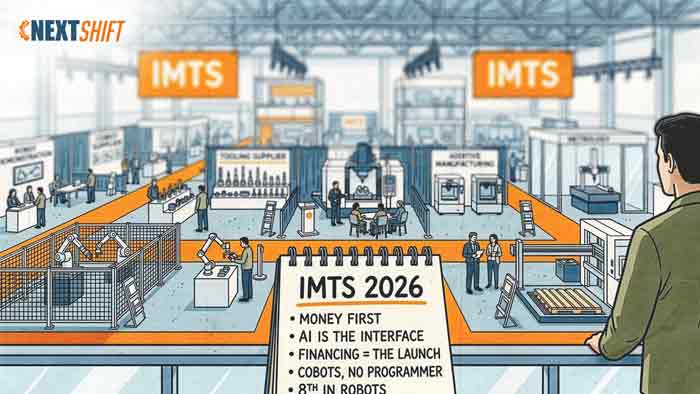
10 Takeaways from IMTS 2026
What happened at IMTS 2026?
IMTS 2026 runs September 14 to 19 at McCormick Place in Chicago with 1,788 exhibiting companies, 400 of them first-timers, across 1.17 million square feet. Registration passed 80,697 by opening morning with total attendance on pace to exceed 90,000, drawn from all 50 states and 113 countries. The dominant themes were industrial AI and automation built in rather than bolted on, anchored by an Industrial AI Arena with 32 exhibitors and Sandia National Laboratories, and an Automation Sector with more than 260 exhibitors. Behind the technology sat a strong order book: new metalworking machinery orders reached $4.03 billion through July 2026, up 37.1 percent over the same period in 2025. The quieter story was financing, with several major suppliers launching payment structures rather than machines.
Most IMTS recaps are written to make you feel like you missed something. This one is not. A trade show is a sales floor, and the gap between what gets demonstrated in Chicago and what shows up in a fifteen person job shop is usually five to eight years wide.
So here are ten things worth knowing out of IMTS 2026, sorted by whether they change anything for you this year, next year, or in the early 2030s when they hit the used market. Everything below is drawn from AMT's official show data and from trade coverage by outlets working the floor this week, with the sources listed at the bottom. Where a number came from a single report rather than the show organizer, we say so. We also wrote a preview two weeks ago about what would and would not reach small shops, and a few of these are the scorecard on that.
1. The money showed up before the machines did
The most important number at IMTS was not on any machine. New orders of metalworking machinery totaled $605.8 million in July 2026 alone, and $4.03 billion through July, up 37.1 percent against the same stretch of 2025.
That is the context for everything else on the floor. Builders did not bring this much equipment to Chicago on a hunch. They brought it because the order book already turned. Defense, aerospace, off-highway, power, oil and gas, semiconductor, medical and, newly prominent, AI infrastructure and data centers were all named as the demand drivers, which lines up with what we covered in reshoring and the race for machine capacity.
For a used buyer this cuts both ways. A hot new-machine market eventually feeds the used market with trade-ins. It also means the shops you are bidding against right now have work.
2. Three cloud companies bought booths at a machine tool show
Amazon Web Services, Google Cloud and Microsoft all exhibited at IMTS 2026. That is the single clearest signal of where the industry's center of gravity is being pulled.
This show started in 1927 as the National Machine Tool Builders' Exposition and moved to Chicago in 1947. The through line for a century was iron. In 2026 the companies selling compute rented floor space next to the companies selling spindles.
Take that as information about the next decade, not as a to-do item for Monday. None of those three sold anything a job shop needed to buy this week.
3. Most of the AI on the floor is a better interface, not a different machine
The Industrial AI Arena had 32 exhibitors plus Sandia National Laboratories, and a full-day Industrial AI Conference ran alongside it. Strip away the staging and look at what the AI is actually doing on a machine tool, and a pattern shows up across the reporting.
Heidenhain showed a TNC7 control with an AI chatbot built in. Hexagon put a tool called ProPlanAI inside Esprit Edge to help plan operations. Autodesk showed AI workflows inside Fusion. These are real and useful. They are also, almost without exception, improvements to how a human tells the machine what to do, not systems that decide what to do without one.
That is a meaningful distinction when you are deciding whether to feel behind. A control that answers questions in plain language is a training aid. We looked at the harder version, machines adjusting the cut themselves, in AI controls and the machine that tunes its own cut.
4. Deloitte says 81 percent of task hours stay human. The floor did not say that.
Here is the number nobody put on a banner. Deloitte's 2026 manufacturing outlook projects that more than 81 percent of task hours in manufacturing will remain human-driven.
The same outlook finds that 22 percent of manufacturers plan to use physical AI within two years, up from 9 percent today. That is a genuine doubling and it is worth respecting. It also means that two years out, roughly three in four manufacturers still will not be using it.
A trade show floor is the most concentrated version of the future you will ever stand in. It is not a measurement of the present, and it was never built to be one.
5. The real product launch was financing
This is the takeaway we did not predict, and it is the one most likely to change a small shop's math.
Universal Robots and Formic Technologies are both pushing financing models borrowed from the automotive industry, turning a capital purchase into a monthly number. Mazak promoted its own Mazak Capital Equipment Financing alongside the machines. Three separate suppliers, same move.
Automation has not been blocked by technology for years. It has been blocked by a shop owner looking at a six-figure quote for a cell that might pay back in three years, and deciding the money is better spent elsewhere. Changing that from a purchase to a payment does more for adoption than any demo in the AI Arena.
6. Cobots stopped needing a programmer
The Automation Sector ran more than 260 exhibitors, and collaborative robots dominated it. The pitch has shifted from what they can lift to how little expertise they need.
Hirebotics showed cobot setup driven from a smartphone. The broader argument made across the sector is that cobots succeed where traditional industrial automation failed in small shops precisely because they do not require programming expertise, can be reprogrammed quickly for high-mix work, and can be moved between machines.
Bar loading got the same treatment. Edge Technologies paired an FMB SL110 short loader with a KUKA robot for autonomous handling, covering bar from 10 to 110 mm with a magazine holding up to 56 bars at 10 mm.
Our preview called compact robot loading cells on single machines one of the few things that would genuinely reach small shops. The floor backed that up harder than expected.
7. The pallet pool came down-market
Pallet automation used to mean a large horizontal and a serious capital commitment. At IMTS 2026 it showed up further down the range.
Mazak paired an HCN-5000 NEO with a compact Multi-Pallet Pool, and showed a VC-Ez 20 vertical with an optional two-pallet changer and a SmoothG control. A QUICK TURN 350 ran with an Ez LOADER compact collaborative robot. The pattern across the coverage was the same: the automation is packaged with the machine and sized for a shop that does not have an automation engineer.
That also holds for the multi-tasking machines. The QTE-100MSY carries a second turning spindle, milling and an off-centerline Y axis on a 6 inch chuck with a 1.77 inch through hole, which is a job shop size, not an aerospace-tier machine.
8. America is eighth in robot density, and that is an opening
The United States sits at 307 industrial robots per 10,000 manufacturing employees, eighth in the world. South Korea is at 1,220. Singapore, Germany and Japan are all above 400.
The usual way to tell that story is as a scolding. Here is the other reading. Every shop in Korea already automated, so automation there is table stakes and no longer a competitive edge. In the United States it still is one, and the cost of entry just dropped, per takeaways five and six.
Being eighth is only a problem if you plan to stay eighth. It is an opportunity if you are the shop on your street that moves first.
9. The unattended numbers are the only ones that matter
Of everything reported out of the show, one set of figures is worth writing on the wall. Trade coverage out of the show put the gains from unattended operation this way:
Machine use rises from 8.5 hours a day to 15. Sales per machine go from $183,000 to $350,000. Scrap drops from 2.4 percent to 0.9 percent. First-pass yield improves from 90 percent to 95 percent.
Nearly doubling revenue per machine without buying another machine is the entire argument for automation, stated in money instead of adjectives. It is also the argument we made in the lights-out mandate, where the point was that you do not buy unattended hours, you earn them. Nothing at IMTS changed that. The machines got easier to automate. The discipline required to run them dark did not.
The same logic drives output per operator generally, which we covered in the answer to the labor shortage has two spindles.
10. Everything on that floor is a used machine eventually
This is the takeaway we care most about, and the reason a used dealer writes an IMTS recap at all.
A machine introduced in Chicago in 2026 typically reaches the used market in serious numbers five to eight years later. The INTEGREX i-200ST NEO, the VARIAXIS C-700, the SYNCREX Swiss machines running 0.393 to 1.5 inch bar, the pallet pools and the cobot cells: those are your early 2030s inventory.
Which makes the show useful to a shop with no budget to spend. Walk it as research. Note which control generations are being built now, because those are the ones that will still be supportable when the machine is eight years old. Note which builders are packaging automation as standard, because a used machine that shipped with a pallet changer is a very different asset from one that needs a retrofit. The programming language underneath is not the risk, as we argued in why G-code will still be running machines in 2050. The control hardware and the support contract are.
There is one more category worth watching without buying: additive as production. EOS brought its M4 Onyx to the North American market and Mazak showed a VC-Ez 20X with a wire arc additive cell developed with Oak Ridge National Laboratory. Our preview said additive would not displace machining for small shops on cost and post-processing, and nothing on the floor changed that. It did get more credible as a hybrid capability rather than a replacement.
What to Do With This on Monday
Ten takeaways is a lot to carry back to a shop that has parts due. Here is the same list sorted by what it asks of you.
Worth acting on this quarter. Two things on that floor got cheaper or easier in a way that is available to a small shop right now, and both came from takeaways five and six. Automation financing turned a capital decision into a monthly one, and three separate suppliers made that move at the same show, which means it is a market shift rather than one vendor's promotion. And cobot deployment stopped requiring a programmer, which removes the objection that actually killed most small-shop automation projects: not the robot's price, but the fact that nobody in the building could set it up again after the first job ran out. If you have looked at a loading cell before and walked away, the reasons you walked away may no longer apply. Get a current quote.
Worth watching, not buying. The AI on the floor is real but early, and most of it improves how a person instructs a machine rather than replacing the person. Pallet automation moving down-market matters, but it matters most to you secondhand, when a machine that shipped with a pallet changer comes up at a used price. Additive is more credible as a hybrid capability than it was two years ago and still is not displacing machining on cost. None of these are urgent. All of them are worth being able to speak about when a customer asks.
Context, not homework. The order book, the cloud companies exhibiting, the robot density ranking and the attendance figures tell you where the industry is heading. They do not tell you what to buy. Knowing that orders are up 37.1 percent is useful when you are negotiating, not when you are deciding whether you need a new machine.
And the one number to keep: a shop running unattended gets from 8.5 machine hours a day to 15, and from $183,000 in sales per machine to $350,000. Every other item on this list is either a way to get there or a distraction from it.
Resell CNC Take
If you walked IMTS and came home without buying anything, you did not waste the trip. Most of that floor was not built for a shop your size this year, and the two things on it that were, cheaper automation financing and cobots that set up from a phone, will still be there in six months when your quarter closes. The machines that will actually change your shop are the ones that came off the stand in Chicago five years ago and are sitting on a floor somewhere right now with a price on them. That is the market we work in every day, and it is a lot less crowded than McCormick Place was this week.
Frequently Asked Questions
When and where was IMTS 2026?
IMTS 2026 runs September 14 to 19, 2026 at McCormick Place in Chicago. It fills 1.17 million square feet with 1,788 exhibiting companies, including 400 first-time exhibitors, and drew visitors from all 50 states and 113 countries. Registration stood at 80,697 on opening morning with total attendance on pace to pass 90,000, including an estimated 15,000 students. AMT projected roughly $250 million in economic impact for Chicago and Illinois.
What was the biggest theme at IMTS 2026?
Industrial AI and automation built in rather than added on. The show hosted an Industrial AI Arena with 32 exhibitors plus Sandia National Laboratories, a full-day Industrial AI Conference, and an Automation Sector with more than 260 exhibitors. Amazon Web Services, Google Cloud and Microsoft all exhibited. In practice, most of the AI shown on machine tools improved how an operator instructs the machine rather than removing the operator.
Is the machine tool market actually growing in 2026?
Yes, sharply. New orders of metalworking machinery totaled $605.8 million in July 2026, and $4.03 billion through July, up 37.1 percent compared with the same period in 2025. Demand was attributed to defense, aerospace, automotive, off-highway equipment, power, oil and gas, semiconductor, medical, and AI infrastructure including data centers.
Does a small shop need to adopt AI now?
Not urgently. Deloitte's 2026 manufacturing outlook projects that more than 81 percent of task hours in manufacturing will remain human-driven, and that 22 percent of manufacturers plan to use physical AI within two years, up from 9 percent today. That is real growth, but it still leaves roughly three in four manufacturers not using it two years out. The higher-return moves for most small shops remain probing, tool setters, bar feeders, pallet changers and simple robot loading.
How far behind is the United States on robot adoption?
The United States ranks eighth globally at 307 industrial robots per 10,000 manufacturing employees. South Korea leads at 1,220, and Singapore, Germany and Japan all exceed 400. For an individual shop this is less a national failing than an open lane, because automation is still a differentiator in the American market rather than a baseline expectation.
When will IMTS 2026 machines reach the used market?
Typically five to eight years after introduction, which puts most of the 2026 floor into the used market in the early 2030s. That is why walking the show as research pays off even with no budget. The two details worth noting for later are the control generation, because that governs how supportable the machine will be at eight years old, and whether automation such as a pallet changer or robot interface shipped as part of the machine rather than as a retrofit.
Couldn't get what you needed at IMTS?
Check out our inventory.
No booth demo, no build slot, no waiting on a delivery date. Tell us the capacity you need and our team, backed by four AMEA and CEA certified equipment appraisers and 200+ years of combined industry experience, will tell you honestly what is out there and what it is worth.
Browse Used CNC Machines
About the Author
Bill Murphy is the Marketing and Content Lead at Resell CNC, covering used machine tools, the brands behind them, and the history of the trade.
About Resell CNC
Resell CNC has bought and sold used CNC machinery since 2008. Based in Maitland, Florida, with warehouses in Winter Springs and Longwood, the team brings more than 200 years of combined industry experience and four AMEA and CEA certified equipment appraisers on staff. Resell CNC has been an MDNA member since 2009 and is the only used CNC dealer in North America with Official Mazak Trade-In Center status.
Sources
- AMT, "IMTS 2026 Opens in Chicago as Manufacturing Takes Center Stage in Reindustrializing the United States," official press release, September 2026.
- Modern Machine Shop, IMTS 2026 manufacturing technology trends roundup.
- Modern Machine Shop, IMTS 2026 automation and robotics coverage.
- Modern Machine Shop, "The Numbers Behind a Century of IMTS."
- Deloitte, 2026 Manufacturing Industry Outlook.
- MarketScale, IMTS 2026 industrial AI and automation floor coverage.
- Mazak Corporation, IMTS 2026 exhibit press release.