 Next Shift
Lights Out Mandate: You Don't Buy Unattended Hours, You Earn Them | Next Shift
What is lights-out manufacturing?
Lights-out manufacturing is running CNC machines unattended, with no operator on the floor, often through nights, weekends, and holidays. FANUC has operated plants this way since 2001, with lines that run unsupervised for as long as thirty days at a time. It is not achieved by buying a robot. It depends on process reliability: a continuous loader such as a bar feeder or pallet pool, in-process probing, tool-load and breakage monitoring, redundant tooling, high-pressure coolant to clear chips, and fire suppression. The machine has to keep making good parts when no one is there to catch a problem. For most shops the real goal is not a thirty-day dark factory but the first dependable unattended hour after the lights go off, then the next.
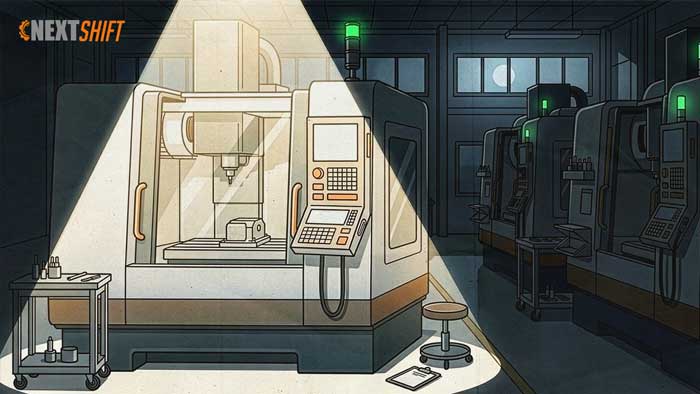
You have seen the footage. A factory floor in the dark, no people, no light, no air conditioning, and robots quietly building more robots through the night. FANUC has run plants like this since 2001, with lines that go unsupervised for as long as thirty days at a stretch. The story gets passed around the industry like a postcard from the future: this is where manufacturing is going, and if you are not automating, you are already behind.
So shops look at that postcard and reach the obvious conclusion. The future is robots. Buy the cell, bolt on the arm, and the night shift takes care of itself. This is a Next Shift look at why that conclusion is exactly backwards, and what the future of CNC machining actually asks of the person running the iron.
Here Is the Part Most Machinists Never Think About
The robot is not what makes lights-out work. Reliability is.
A machine that needs an operator standing next to it is a machine you do not fully trust yet. During the day that distrust is invisible, because someone is always there to catch it. A tool starts to dull and the operator hears it. A chip nest starts to build and someone clears it. A fixture creeps a few thousandths and a sharp eye catches the first bad part before it becomes forty. Daylight hides every weakness in your process because a human is constantly, quietly, paying for it.
Turn the lights off and there is no one to pay. Every shortcut you tolerate during the day runs unsupervised all night, multiplied by every part in the queue. Lights-out does not create reliability. It audits it.
Unattended hours are not something you purchase. They are something a process earns by proving it does not need you in the room.
What the Postcard Leaves Out
The FANUC version of lights-out looks like a clean-room science exhibit. The real version, the one a working shop actually builds, is a stack of unglamorous decisions that have nothing to do with a humanoid arm.
A continuous loader. A bar feeder on the lathe or a pallet pool on the horizontal, so the spindle never sits waiting for a hand to load the next part.
In-process probing. Measuring the part and the tool instead of assuming both are still good four hours into a run.
Tool-load and breakage monitoring. Watching the cut and stopping the machine before a dead tool turns raw stock into a tray of scrap.
Redundant tooling. When an insert fails, a sister tool steps in automatically and the program keeps running instead of dying at 2 a.m.
High-pressure coolant. Clearing chips off the cutting edge instead of letting them pack into a bird's nest that wrecks the next forty parts.
Fire suppression. A spark in an unattended machine is a very different problem than a spark with a person standing ten feet away.
None of that is exotic. All of it is boring. That is the point. Lights-out is not won by the flashiest piece of equipment on the floor. It is won by removing every reason a human had to intervene, one boring reason at a time. And the system is only as good as its weakest link: the best probing in the world does not help if the chips are not clearing, and redundant tooling does not matter if the bar feeder jams at part forty. Unattended running is a chain, and the night finds the loose link every time.
The Trust Ladder
Earning unattended hours is a ladder, not a switch. The shops that do it well treat it like a process qualification, because that is exactly what it is.
It starts with one job you already understand cold. A part you have run a thousand times, in a material that behaves, on a fixture you trust. You stay late and watch it run with no hands on it for one hour. You inspect every part that comes off. If the process held, you do it again the next night, and you push the window to two hours, then to the end of a shift. Each rung is earned by evidence, not optimism, and you do not climb to the next one until the current one stops surprising you.
What you are really building is data. Tool life you can predict to the part instead of guess at. A probing routine that has already caught a real problem and stopped a real machine before it made scrap. A chip-management setup that cleared a full cycle without a nest. Each of those is a reason to leave the room that used to be a reason to stay. Stack enough of them and the overnight run stops being a gamble and becomes a schedule. That is the unglamorous work the postcard never shows, and it is the actual product.
The Math That Forces the Issue
Call it a mandate because the economics no longer leave it optional. A CNC machine is one of the most expensive assets on the floor, and depreciation does not care whether the spindle is turning. An idle machine at night still costs exactly what it cost at noon: the payment, the floor space, the capital tied up in it. The only variable you actually control is how many good parts come off it before the next payment is due.
Run a machine one shift a day and it earns roughly a third of the hours it is physically capable of. The other two-thirds are paid for and thrown away. That is the real cost of treating unattended running as a luxury rather than a target. Add a labor market where filling a second and third staffed shift is genuinely hard, and unattended hours stop being a nice-to-have. They become the only realistic way to get full value out of iron you have already bought. The mandate is not ideology. It is the invoice.
Where This Leaves CNC Machining
For most of CNC history, the competitive question was whether you could cut the part. Could you hold the tolerance, hit the finish, make the geometry. That bar has largely been cleared. Capable machines are everywhere, on the used market and the new one alike.
The line is moving. The question is quietly shifting from "can you cut it" to "can you cut it while you sleep." Two shops can own the identical machine. The one that has earned its unattended hours runs that asset sixteen, twenty, twenty-two hours a day. The one that has not runs it eight and goes home. Same spindle, same purchase price, radically different output. Over a year, that is not a small edge. That is the whole business.
It also reshapes what a machine is worth on the used market. When raw capability is everywhere, the premium moves to the things that let a machine run alone: a complete pallet pool, a working bar feeder, probing that is actually installed and calibrated, a control with its documentation and passwords intact. Two identical models can carry very different value depending on whether that automation came with them. Capability is table stakes now. Automation-readiness is the asset, and it is the first thing worth checking on any used machine you are about to buy for unattended work.
This is what the next shift actually looks like for CNC, and for manufacturing more broadly. Not a sudden jump to a dark factory, but a slow, decisive separation between shops that treat reliability as a feature and shops that treat it as the product. The mandate is not coming from a vendor or a trend report. It is coming from the math on the machine you already own.
FANUC's Thirty Days, Your First Hour
It is easy to look at a plant that runs thirty days unmanned and decide the gap is too wide to bother. It is not. FANUC did not start at thirty days. Nobody does. They started by trusting a process for one hour after the operator left, then proving it, then trusting the next hour.
That is the real mandate, and it is one any shop can act on this quarter. You do not have to chase the dark factory. You have to earn the first unattended hour after the lights go off, then go earn the next one. Lights-out is not a machine you buy. It is a habit you build, in the daylight, on purpose, until the night shift no longer needs you in the room.
The shops that understand this are not waiting for a robot to save them. They are quietly qualifying jobs, tightening tooling, and proving their processes one rung at a time, so that the hours they already pay for actually produce. That is the next shift in CNC machining. It does not arrive in a press release or a forklift delivery. It shows up as a tray of good parts sitting at the machine when the first person walks in the next morning, made while nobody was watching, because the process had finally earned the right to be left alone.
Resell CNC Take
When a buyer asks us for a machine to run lights-out, the model matters less than what comes with it. A horizontal with a full pallet pool, working probing, and a documented control is a machine you can grow unattended hours on. The same machine stripped of its automation is just a day-shift spindle wearing a story. We push buyers to pay for the complete, automation-ready package, because that is the part that actually earns the night shift.
Frequently Asked Questions
What is lights-out manufacturing?
Lights-out manufacturing is running CNC machines unattended, with no operator on the floor, often through nights, weekends, and holidays. FANUC has run plants this way since 2001, with lines that operate unsupervised for as long as thirty days at a time. It depends less on robots than on a process reliable enough to keep making good parts with no one there to intervene.
What does a CNC machine need to run unattended?
A continuous loader such as a bar feeder or pallet pool, in-process probing, tool-load and breakage monitoring, redundant tooling so a sister tool can take over when one fails, high-pressure coolant to clear chips off the cutting edge, and a fire suppression system. The common requirement behind all of them is removing every reason a human had to step in.
Can a small shop do lights-out machining?
Yes. Lights-out is not all-or-nothing. Most shops start with one well-understood job and earn a single dependable unattended hour after the operator leaves, then extend it. The dark factory running thirty days is the far end of the spectrum, not the entry point.
How long can a CNC machine run unattended?
It depends entirely on material handling and reliability. A bar-fed lathe or a machine on a deep pallet pool can run a full overnight shift or longer, and the most automated plants run for weeks. The limit is not the spindle, it is how long the process can feed itself and catch its own problems.
Is lights-out manufacturing replacing machinists?
No. It shifts the work rather than removing it. The skill moves from standing at the machine to engineering a process trustworthy enough to leave alone: fixturing, tooling strategy, probing, and monitoring. Unattended hours are won during the day, by people, on purpose.
What is the biggest barrier to lights-out machining?
Process reliability, not equipment cost. Lights-out exposes every weakness a day shift quietly absorbs, from marginal tools to chip management to fixture repeatability. The barrier is earning enough trust in the process to walk away, which is why buying an automation-ready machine and proving it incrementally matters more than buying the most expensive cell.
How is lights-out machining different from full factory automation?
Lights-out is about a machine or cell running good parts without an operator present. Full factory automation adds the layers around it: automated guided vehicles moving material, robots tending multiple machines, and software scheduling the whole floor. Lights-out is the foundation. A shop earns reliable unattended hours on individual machines first, then connects them. You do not need the dark factory to capture most of the benefit.
What should I look for in a used machine meant to run unattended?
Confirm the automation is complete and functional, not just present on the spec sheet. That means the full pallet count on a pallet-pool machine, a bar feeder that actually cycles, an installed and calibrated probing system, working tool-load monitoring, and a control with its parameters, documentation, and passwords. A machine stripped of its automation is a day-shift spindle, and it should be priced like one.
Building Toward Lights-Out?
Resell CNC buys and sells used CNC machines built to run unattended, with four AMEA and CEA certified appraisers who know what a complete pallet pool, working probing, and a documented control are worth. See current automation-ready inventory or get help reading a machine before you buy.
See Inventory
About the Author
Bill Murphy is the Marketing and Content Lead at Resell CNC, where he writes about used machine tools, the brands behind them, and where manufacturing is headed.
About Resell CNC
Resell CNC has bought and sold used CNC machinery since 2008, with more than $1 billion in equipment transactions and over 200 years of combined industry experience. The company is headquartered in Maitland, Florida, with warehouses in Winter Springs and Longwood, and staffs four AMEA and CEA certified equipment appraisers. Resell CNC has been an MDNA member since 2009 and is the only used CNC dealer in North America with Official Mazak Trade-In Center status. Simple. Reliable. Trusted.®