 Meet the Machine
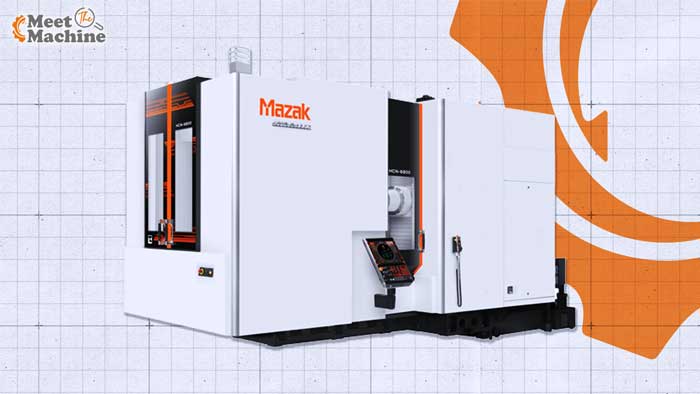
Mazak HCN-6800: The 50-Taper Production HMC American Shops Keep Buying
What is the Mazak HCN-6800?
The Mazak HCN-6800 is a 4-axis horizontal machining center built by Yamazaki Mazak Corporation of Oguchi, Japan, with a CAT 50 spindle, a 630mm by 630mm pallet, a twin-pallet automatic pallet changer, and a 360-degree NC rotary B-axis table. It is the smallest model in Mazak's HCN family that ships with a heavy 50-taper spindle from the factory and is engineered for high-volume 4-axis production of aerospace structurals, oil and gas valve bodies, hydraulic manifolds, heavy equipment castings, and defense components. The control is Mazatrol in one of three generations depending on build year: Matrix, Matrix 2, or SmoothG on Neo-series machines. The HCN-6800 has been in continuous production in some form since the late 1990s, has the deepest U.S. parts and service coverage of any imported HMC at this size class through Mazak's North American Technology Center network, and is one of the most widely installed heavy production HMCs in American manufacturing.
Walk into any high-volume production shop building tier-one aerospace structurals, oil and gas valve bodies, or heavy equipment gearbox housings, and you will eventually find a Mazak HCN-6800 on the floor. Often more than one. Often running lights-out. That is not coincidence and it is not brand loyalty. The HCN-6800 sits at the size and capability sweet spot where a 50-taper spindle, a 630mm pallet, and a twin-pallet changer combine into a single machine that can run Inconel at full depth of cut on Monday morning and grind through ductile iron pump housings all night Tuesday into Wednesday.
It is not a finesse machine. It is the machine American shops buy when the job is to remove a lot of metal, hold tolerance while doing it, and keep the spindle in the cut while the operator is loading the next pallet. This is a working machinist's breakdown of the HCN-6800: what it is, where it sits in the Mazak HCN family, how it stacks up against the competition, what an honest used unit costs, and the specific things to inspect before signing a purchase order. No marketing language. Just what shop owners, plant managers, and operators actually need to know.
Where the HCN Platform Came From
Yamazaki Mazak Corporation was founded in 1919 in Oguchi, Aichi Prefecture, Japan, and built its reputation through the post-war decades as one of the dominant global CNC builders. By the late 1990s, the heavy production HMC market was being carved up between Japanese, German, and domestic builders. Mazak's response was to design a new horizontal platform around three priorities at once: heavy 50-taper authority, pallet productivity that did not require a third-party automation vendor, and a control philosophy that let an operator program at the machine without writing G-code.
The HCN line was that platform. The HCN-6800 specifically replaced and absorbed work from the older HCN-6000 series, splitting the difference between Mazak's mid-size HCN-5000 and the larger HCN-8800. It has been in continuous production and revision since, which is why used examples are widely available at every price point and why Mazak's North American support coverage on this model remains among the deepest in the industry.
The Engineering Philosophy Behind the HCN-6800
The case for a horizontal machining center over a vertical comes down to three things, and the HCN-6800 was engineered around all three.
The first is chip evacuation. A horizontal spindle throws chips down and away from the work, where gravity and a chip conveyor handle them. A vertical spindle throws chips into the pocket the spindle just cut. On a 12-hour cast iron job, that difference is not academic. It is the difference between a clean part and a recut. Shops cutting ductile iron, gray iron, or high-volume aluminum learn this the hard way once. They never go back.
The second is the rotary B-axis. The HCN-6800's table indexes a full 360 degrees with 0.001-degree resolution, which means a single fixturing of a part can present four faces, or any angle in between, to the spindle. A part that would require three separate setups on a vertical gets cut in one setup on this machine. Every setup eliminated is one less chance to lose a tenth and one less chance to ship a scrap part.
The third is pallet productivity. Twin pallets mean the spindle never waits on the operator. On a well-fixtured production run, chip-to-chip time between pallets is measured in seconds. That is what separates an HMC from a VMC at the financial level. The HMC is not faster in the cut. It is faster between cuts. Over a 24-hour production day, that difference compounds into thousands of extra spindle minutes.
A used HCN-6800 with a clean spindle, a working APC, and a well-maintained B-axis is a production asset that can run another decade. A used HCN-6800 with a leaking spindle, a hesitant pallet changer, or a worn B-axis is a project. The Resell CNC inspection team confirms all three on every HCN-6800 appraisal we handle, because the gap between the two valuations is the entire purchase decision.
The HCN Family in Shop Language
Mazak's HCN line is a full family of horizontal machining centers built around a common architecture and scaled by pallet size and spindle taper. Knowing where the HCN-6800 sits in the lineup is the difference between buying the right machine and buying one that is too small or too much.
HCN-4000: 400mm pallet, CAT 40 spindle. Mazak's entry production HMC. Built for high-volume small to mid-size parts: automotive components, brackets, valve internals. The machine a shop buys to step from VMC production into pallet-fed horizontal work without going to 50-taper.
HCN-5000: 500mm pallet, CAT 40 standard with CAT 50 option. The mid-volume production workhorse. Valve bodies, hydraulic blocks, mid-size aerospace components. The HCN-5000 is also the most common HCN platform in tier-two automotive supply shops because it fits the part-size envelope for most production turning and milling work outside of heavy iron.
HCN-6800: 630mm pallet, CAT 50 spindle. The heavy production workhorse and the subject of this guide. Smallest HCN with a true 50-taper from the factory, largest model that still fits comfortably in most American job shop footprints. Aerospace structurals, oil and gas, heavy equipment castings, and defense components are the typical jobs.
HCN-8800: 800mm pallet, CAT 50 spindle. The step up when the parts get larger and heavier. Gearbox housings, mining and energy components, large hydraulic manifolds. The HCN-8800 covers work that exceeds the HCN-6800's pallet load or workpiece envelope.
HCN-10800: 1,000mm pallet, CAT 50 spindle. Mazak's largest HCN. Used for very large workpieces, pump and compressor housings, heavy industrial components that require a full meter of pallet real estate. Less common on the used market because fewer were built and the shops running them tend to keep them.
It is also worth knowing the generational variants of the HCN-6800 specifically. The original HCN-6800 was followed by the HCN-6800-II, then by the HCN-6800 Neo, which introduced the SmoothG control and updated rapid traverse rates to 50 m/min. Pricing on the used market tracks generation closely. A Neo-series machine with SmoothG and FMS-ready pallet pool integration sells for a meaningful premium over an early Matrix-control machine of similar age and hours.
The U.S. Service and Parts Footprint
Mazak's North American operation is headquartered at the Mazak Corporation campus in Florence, Kentucky, with regional technology centers in California, Texas, Michigan, and the Carolinas. That regional footprint gives the HCN-6800 some of the deepest parts and service coverage of any imported HMC sold in the United States. Field service technicians cover all major American manufacturing corridors, factory-trained Mazatrol specialists are reachable directly through Mazak Corp, and parts for HCN-6800 builds going back to the late 1990s remain supported.
For a used buyer, that support window matters more than it sounds. A heavy HMC that drops a spindle bearing or loses a B-axis encoder in the middle of a production run is a six-figure problem if parts and service are not local. Mazak's regional coverage on the HCN-6800 is one of the practical reasons used examples hold value the way they do, and it is a recurring point Resell CNC's appraisal team flags during pre-purchase inspections.
Where the HCN-6800 Fits Among 630mm-Class Production HMCs
American shops cross-shopping a heavy production HMC at this size class typically look at four machines: the Mazak HCN-6800, the Okuma MA-600HII, the Makino a61nx, and the DMG Mori NHX-6300. Each has earned its position with U.S. shops over decades. They are not the same machine, and the buying decision usually comes down to one or two specific arguments per brand.
| Brand |
HQ |
Standard Control |
Distinctive Strength |
| Mazak HCN-6800 |
Oguchi, Japan |
Mazatrol |
Twin-pallet productivity, deepest U.S. parts and service coverage at this size class |
| Okuma MA-600HII |
Niwa, Japan |
OSP |
OSP open control, thermal compensation strength on long unattended runs |
| Makino a61nx |
Aichi, Japan |
Pro 5 / Pro 6 |
Tighter base accuracy and faster rapids, the precision argument at this size class |
| DMG Mori NHX-6300 |
Bielefeld, Germany / Nagoya, Japan |
Celos / MAPPS |
Modern Celos connectivity and integrated automation roadmap |
The Okuma argument is OSP openness and thermal performance. The Makino argument is precision and rapid speeds. The DMG Mori argument is the newest connectivity stack. The Mazak argument is the combination of three things at once: twin-pallet productivity at this size class, parts and service availability across North America, and resale value strong enough that a shop can run an HCN-6800 for ten years and recover a meaningful percentage of purchase price on resale. For most production buying decisions in American shops, that third argument is the one that wins.
Why Used HCN-6800s Hold Their Value
Here is the part that matters for the bid sheet. Used HCN-6800s trade higher than most comparable used 50-taper HMCs of similar age and capability, and the gap holds across all three control generations. The build quality is one reason. The pallet productivity is another. The real reason is Mazak's North American support depth combined with the size of the installed base. A shop buying a used HCN-6800 is buying into a machine that other shops also know how to support, train operators on, and tool up.
Real pricing ranges from current U.S. market activity:
- Early Matrix control machines (early-to-mid 2000s): roughly $85,000 to $140,000 depending on hours and condition
- Matrix 2 era (late 2000s to early 2010s): roughly $130,000 to $210,000
- Neo-series with SmoothG (mid-2010s and newer): roughly $220,000 to $380,000+, with FMS-equipped and low-hour units pushing higher
For context, a new HCN-6800 Neo with standard equipment lands in the $550,000 to $700,000 range depending on options. A well-maintained used unit that delivers 80 percent of the new machine's productivity at 30 to 50 percent of the cost is the math that keeps the used market for these machines tight.
What to Check When Buying a Used HCN-6800
A used HCN-6800 is a serious purchase. The things that determine whether it is a good buy are not the things the listing photos show. From the inspections Resell CNC handles on HCN-6800s coming through retail and auction, here are the items that move the appraisal number the most.
Spindle hours and condition. A CAT 50 spindle on a heavy production HMC has a service life measured in tens of thousands of hours, but a machine that has been run hard with marginal maintenance can need a spindle rebuild that runs $25,000 to $45,000. Pull spindle hours through the control, listen for bearing noise at low RPM, and check spindle taper for fretting or wear with a test bar.
Pallet changer cycle count. The APC runs more often than anything else on the machine. Look for play in the pallet clamping, hesitation in pallet rotation, and inspect the kinematics of the changer arm. APC rebuilds are not catastrophic but they are not cheap either.
B-axis indexing accuracy. Put an indicator on the table and rotate through 90, 180, and 270 degrees. The B-axis on this machine should hold a couple of tenths repeatable. If it does not, the rotary table needs service.
Way cover condition. Torn or compressed way covers tell you the operator was driving the machine into the work or letting chips pile up. Either way, the ways underneath are at risk.
Chip conveyor and coolant tank. A clean coolant tank tells you the previous owner maintained the machine. A black, sludge-filled tank with chips packed in the bottom suggests the rest of the machine got the same treatment.
Control generation and software level. Confirm exactly which Mazatrol control is installed (Matrix, Matrix 2, or SmoothG) and what software version it is running. The difference between an early Matrix machine and a late Matrix 2 in terms of CAM systems and post-processor compatibility is meaningful.
Documentation and tooling included. Original operator and maintenance manuals, ladder diagrams, BT50 or CAT 50 holders, fixturing, and any custom pallet plates all add real value. Ask before you bid.
Who Actually Runs HCN-6800s in the U.S.
Aerospace tier-one and tier-two suppliers cutting landing gear components, gearbox housings, and actuator bodies in titanium, Inconel, and 7000-series aluminum. Oil and gas shops running large-bore gate valves, ball valve bodies, and frac pump components in 4140, 8620, and stainless. Hydraulic manifold producers cross-drilling and porting high-pressure blocks in single setups. Caterpillar, John Deere, and Komatsu tier-one suppliers cutting gearbox housings in ductile iron and steel. Defense and mil-spec contractors building armored vehicle components and weapon system housings with full traceability and process control. Energy component manufacturers turning wind turbine gearbox parts, pump housings, and compressor bodies.
The common thread is production volume and part size. The HCN-6800 is not a toolroom machine. It is not a job shop machine running 20-piece prototype lots. It is a machine for shops running the same heavy production parts every shift, every day, for years, where spindle utilization on a 630mm-class part envelope is the metric that determines whether the cell is profitable. Several large American job shops also run HCN-6800 FMS cells unattended overnight and on weekends with eight, twelve, or more pallets in the queue. That lights-out production model is the financial case the machine was built to enable.
Resell CNC Take
The HCN-6800 is one of the most reliable used HMC investments on the U.S. secondary market because Mazak's North American support depth keeps the machine serviceable for two decades after build. As an Official Mazak Trade-In Center, Resell CNC sees more HCN-6800s come through retail and auction than any other 50-taper HMC at this size class, and the math on a clean used unit at the right number has held up across every transaction we have closed.
Frequently Asked Questions
What is the Mazak HCN-6800?
The Mazak HCN-6800 is a 4-axis horizontal machining center built by Yamazaki Mazak Corporation of Oguchi, Japan, with a CAT 50 spindle, a 630mm by 630mm pallet, a twin-pallet automatic changer, and a 360-degree NC rotary B-axis table. It is engineered for heavy 4-axis production work in aerospace, oil and gas, heavy equipment, and defense industries, and runs Mazatrol control architecture in one of three generations (Matrix, Matrix 2, or SmoothG) depending on build year.
How is the HCN-6800 different from the HCN-5000?
The HCN-5000 is a 500mm pallet, typically 40-taper machine. The HCN-6800 is a 630mm pallet, CAT 50 machine. Different work envelopes and different spindle authority. Shops doing aluminum production and smaller parts often stay with the HCN-5000. Shops doing heavy steel, iron, or aerospace alloys step up to the HCN-6800 to get the 50-taper spindle and the larger pallet.
Can the HCN-6800 hold tight tolerance on hard milling?
For most production hard milling work, yes. For competition-grade die and mold work where positioning accuracy under 0.0001 inch is required, a Makino or a precision-class HMC is the better answer. The HCN-6800 is a production machine, not a precision finishing machine.
What does a used Mazak HCN-6800 cost?
Used HCN-6800 pricing ranges from roughly $85,000 for early Matrix-control machines from the early-to-mid 2000s to $380,000 or more for Neo-series machines with SmoothG and FMS-equipped pallet pools. New HCN-6800 Neo machines list in the $550,000 to $700,000 range depending on options. Pricing tracks closely to control generation, spindle hours, APC cycle count, and equipment level.
Where is Mazak headquartered in the U.S.?
Mazak Corporation's North American Technology Center is headquartered in Florence, Kentucky, with regional technology centers in California, Texas, Michigan, and the Carolinas. Field service coverage runs through all major U.S. manufacturing corridors. Parts for HCN-6800 builds going back to the late 1990s remain supported through the Mazak Corp network.
Is Mazatrol hard to learn for an operator coming from Fanuc?
There is a learning curve. Mazatrol's conversational programming lets an operator build a working program at the control without writing G-code, which most operators find faster for one-off and prototype work. The workflow differs from Fanuc, and most operators are productive within a few weeks. Most Mazatrol-trained operators do not want to go back.
Browse Used Mazak Inventory
The HCN-6800 and the full Mazak lineup at Resell CNC.
Browse the current Resell CNC inventory of used Mazak horizontal machining centers, twin-pallet HMCs, and 50-taper production cells. As the only Official Mazak Trade-In Center in North America, we see more HCN-6800s than any other dealer.
VIEW USED MAZAK MACHINES
About the Author
Bill Murphy is the Marketing and Content Lead at Resell CNC, where he covers used CNC equipment, auction strategy, and the buying side of the secondary machine tool market. He works directly with the appraisal, auction, and retail teams to translate machine-level detail into content for shop owners, plant managers, and acquisition buyers.
About Resell CNC
Founded in 2008 and headquartered in Maitland, Florida, Resell CNC carries 200+ years of combined industry experience, four AMEA/CEA Certified Equipment Appraisers on staff, MDNA membership since 2009, and is the only used CNC dealer in North America with Official Mazak Trade-In Center status. The company operates across retail, auction, appraisal, and finance divisions from warehouses in Winter Springs and Longwood, Florida.