Meet the Machine
Mori Seiki NLX2500: The Box-Way Production Lathe American Shops Keep Buying
What is the Mori Seiki NLX2500?
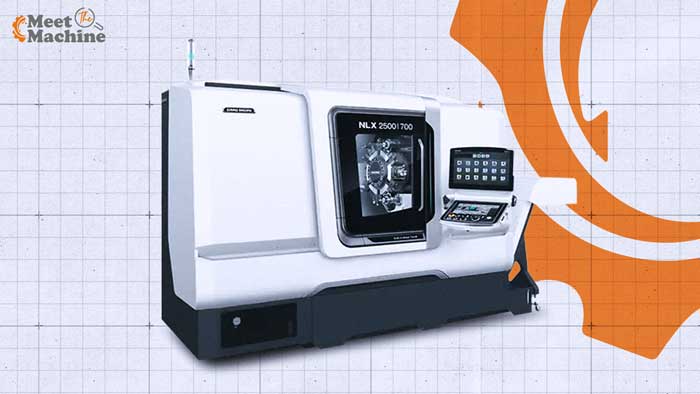
The Mori Seiki NLX2500 is a horizontal CNC turning center built by DMG MORI at the Iga Campus in Mie Prefecture, Japan. It runs an 8-inch or optional 10-inch chuck, a 2.56-inch (65mm) bar capacity standard with a 3.15-inch (80mm) option, a slant-bed box-way base, a 12-station BMT55 turret with built-in motor live tooling, and a Fanuc-based MAPPS control in one of three generations depending on build year: MSX-850III, MAPPS IV, or MAPPS V on Neo-era machines. It is offered in 500mm and 700mm bed lengths, with Y-axis (NLX2500MY) and sub-spindle plus Y-axis (NLX2500SY) variants. The NLX2500 replaced the older NL2500 platform around 2009 and has been in continuous production since, making it one of the most widely installed mid-class production turning centers in U.S. manufacturing and one of the deepest used-market platforms DMG MORI supports through its North American service network.
Walk into any U.S. job shop running bar work for aerospace, oil and gas, hydraulics, or defense, and there is a high probability that one of the lathes on the floor is a Mori Seiki NLX2500. Often two. Often with a bar feeder running unattended through the second shift. That is not coincidence. The NLX2500 sits at the exact intersection where 8-inch chuck capacity, box-way rigidity, BMT live tooling, and the option to add Y-axis and a sub-spindle combine into a single machine that can rough 4140 round stock at full depth of cut in the morning and finish a complex aerospace fitting in one chucking by the afternoon.
It is not a Swiss machine. It is not a heavy oil country lathe. It is the lathe American shops buy when the work calls for accuracy, rigidity, done-in-one capability, and a control that operators can be productive on inside a week. This is a working machinist's breakdown of the NLX2500: where it came from, where it sits in the DMG MORI lineup, how it stacks up against the competition, what a used unit actually costs, and the specific items to inspect before signing a purchase order. No marketing language. Just what shop owners, plant managers, and operators actually need to know.
Where the NLX Platform Came From
Mori Seiki was founded in 1948 in Yamatokoriyama, Nara Prefecture, Japan, and spent the next six decades earning a reputation as one of the most precise lathe builders in the world. The NL series, introduced in the mid-2000s, was Mori Seiki's answer to a market that wanted higher rigidity, tighter geometry, and a real live-tooling story without giving up the box-way construction that made the older SL and ZL series the references they were. The NLX series followed in 2009 and is the platform still in production today.
The same year the NLX2500 launched, Mori Seiki Co. Ltd. and Gildemeister AG of Bielefeld, Germany completed the cross-shareholding agreement that would eventually become DMG MORI. From 2013 forward, NLX machines have shipped under the DMG MORI brand, built at the Iga Campus in Mie Prefecture, Japan, on the same production line and engineering platform that produced the original Mori Seiki units. The change in name did not change the machine. Shops still call it a Mori Seiki on the floor.
The Engineering Philosophy Behind the NLX2500
The case for a slant-bed, box-way production lathe over a linear-guide machine comes down to three things, and the NLX2500 was engineered around all three.
The first is rigidity. The NLX2500 uses a 45-degree slant-bed cast structure with box-way slides on the X and Z axes. Box ways carry heavier cuts than linear guides at the same machine class because the contact patch is a sliding surface, not a ball bearing. On a 0.250-inch depth of cut in 4140 with a 1.25-inch round insert, the box-way construction is what keeps the part round and the finish clean. Shops running heavy stock removal in steel, stainless, or Inconel learn the difference between linear-guide lathes and box-way lathes the first week they run both.
The second is the BMT turret. BMT stands for Built-in Motor Turret, one of the engineering features Mori Seiki built its reputation on. Each live position in the turret has a direct-drive servo motor coupled to the tool holder with no gear train in between. The result is a 10,000-RPM live tool spindle with the rigidity and concentricity of a milling spindle, not a geared-down accessory. On a part with cross-drilled holes, milled flats, or off-center features, the BMT turret cuts those features at near-VMC quality without taking the part off the lathe. One setup. Finished part.
The third is thermal stability. The NLX2500 uses a symmetrical headstock casting, oil-cooled spindle bearings, and a thermal displacement compensation algorithm built into the control. On a 16-hour bar job, the machine holds geometry between the first part and the last part in a way that older lathe platforms do not. For aerospace work where the cert package requires every part to be within the same tolerance band, that thermal performance is the difference between a clean shipment and a sorted lot.
A used NLX2500 with a clean spindle, a healthy BMT turret, and tight ways is a production asset that can run another decade. A used NLX2500 with a tired spindle, a hesitant turret index, or a worn sub-spindle alignment is a project. The Resell CNC inspection team confirms all three on every NLX appraisal we handle, because the gap between the two valuations is the entire purchase decision.
The NLX Family in Shop Language
DMG MORI's NLX line is a full family of horizontal turning centers built around a common architecture and scaled by chuck size and bar capacity. Knowing where the NLX2500 sits in the lineup is the difference between buying the right lathe and buying one that is too small or too much.
NLX1500: 6-inch chuck, 1.65-inch bar capacity. The entry NLX. Built for small precision work, medical components, electronic connectors, and small aerospace fittings. The machine a shop buys when the part envelope is tight and the volume is high.
NLX2000: 8-inch chuck, 2.06-inch bar capacity. A step up in capacity with a smaller machine footprint than the 2500. Common in shops where floor space is the constraint and most parts fit inside a 2-inch bar envelope.
NLX2500: 8-inch standard or 10-inch optional chuck, 2.56-inch bar capacity standard, 3.15-inch option. The production workhorse and the subject of this guide. The most widely installed NLX in the United States and the model that covers the largest range of typical American job shop turning work. Aerospace fittings, hydraulic components, oil and gas adapters, defense parts, automotive prototype and short-run production.
NLX3000: 12-inch chuck, 3.5-inch bar capacity. The step up when chuck work exceeds the NLX2500's swing or when bar diameter pushes past 3 inches. Common in oil and gas shops, heavy hydraulic component producers, and large fitting manufacturers.
NLX4000 and larger: 15-inch chuck and up. Heavy oil country tubular goods, large pump shafts, energy components. Less common on the used market and outside the size envelope most American job shops need.
It is also worth knowing the configuration variants of the NLX2500 specifically, because pricing on the used market tracks the variant as much as the build year. The base NLX2500/500 and NLX2500/700 are 2-axis machines with a 12-station turret, distinguished by 500mm or 700mm bed length. The NLX2500MY adds a true Y-axis (typically plus or minus 50mm of travel) and live tooling for off-center milling work in a single setup. The NLX2500SY adds a programmable sub-spindle on top of the Y-axis, enabling complete part transfer and back-side work in one chucking. A used NLX2500SY/700 with low hours and clean sub-spindle alignment sells for a meaningful premium over a base NLX2500/500 of the same vintage.
The U.S. Service and Parts Footprint
DMG MORI's North American operation is headquartered in Hoffman Estates, Illinois, with major technology and service centers in Davis, California, Charlotte, North Carolina, Houston, Texas, Cincinnati, Ohio, and Detroit, Michigan. The Davis facility was originally Mori Seiki's U.S. headquarters before the merger and remains one of the most experienced service operations for legacy Mori Seiki and NLX-platform machines in the country. Field service coverage runs through all major U.S. manufacturing corridors. Parts for NLX2500 builds going back to 2009 remain supported through the DMG MORI USA network.
For a used buyer, that support window matters more than it sounds. A production lathe that drops a spindle bearing or loses BMT motor function in the middle of a bar-fed run is a five- or six-figure problem if parts and service are not local. DMG MORI's regional coverage on the NLX2500 is one of the practical reasons used examples hold value the way they do, and it is a recurring point Resell CNC's appraisal team flags during pre-purchase inspections.
Where the NLX2500 Fits Among 8-Inch-Chuck Production Lathes
American shops cross-shopping a mid-class production turning center typically look at four machines: the Mori Seiki NLX2500, the Mazak QT-250, the Okuma LB3000EX, and the Doosan Puma 2600. Each has earned its position with U.S. shops over decades. They are not the same machine, and the buying decision usually comes down to one or two specific arguments per brand.
| Brand |
HQ |
Standard Control |
Distinctive Strength |
| Mori Seiki NLX2500 |
Iga, Japan |
MAPPS (Fanuc-based) |
BMT turret, box-way rigidity, deepest used-market install base in its class |
| Mazak QT-250 |
Oguchi, Japan |
Mazatrol |
Conversational programming, broadest U.S. parts coverage of any Japanese builder |
| Okuma LB3000EX |
Niwa, Japan |
OSP |
OSP open control, thermo-friendly construction on long unattended runs |
| Doosan Puma 2600 |
Changwon, South Korea |
Fanuc |
Lowest entry price in the class with strong baseline turning performance |
The Mazak argument is conversational programming and parts coverage. The Okuma argument is OSP openness and thermal performance. The Doosan argument is price. The Mori Seiki argument is the combination of three things at once: BMT turret quality at this size class, box-way rigidity that outlasts linear-guide competitors on heavy stock removal, and resale value strong enough that a shop can run an NLX2500 for ten years and recover a meaningful percentage of purchase price on resale. For most production buying decisions in American shops, the BMT and the box-way story are what win the order.
Why Used NLX2500s Hold Their Value
Here is the part that matters for the bid sheet. Used NLX2500s trade higher than most comparable used 8-inch-chuck lathes of similar age and capability, and the gap holds across all three control generations. The build quality is one reason. The BMT turret is another. The real reason is DMG MORI's North American support depth combined with the size of the installed base. A shop buying a used NLX2500 is buying into a machine that other shops also know how to support, train operators on, and tool up.
Real pricing ranges from current U.S. market activity:
- Early MSX-850 control machines (2009 to 2012): roughly $45,000 to $80,000 for 2-axis bases, $70,000 to $115,000 for SY variants
- MAPPS IV era (2013 to 2018): roughly $80,000 to $140,000 for 2-axis, $130,000 to $185,000 for MY and SY variants
- MAPPS V and newer (2019 forward): roughly $145,000 to $225,000+, with low-hour SY machines and automation-equipped units pushing higher
For context, a new NLX2500SY/700 with standard equipment from DMG MORI lands in the $275,000 to $385,000 range depending on options. A well-maintained used unit that delivers most of the new machine's productivity at 40 to 60 percent of the cost is the math that keeps the used market for these lathes tight.
What to Check When Buying a Used NLX2500
A used NLX2500 is a serious purchase. The things that determine whether it is a good buy are not the things the listing photos show. From the inspections Resell CNC handles on NLX2500s coming through retail and auction, here are the items that move the appraisal number the most.
Spindle hours and condition. The NLX2500 main spindle has a service life measured in tens of thousands of hours, but a machine that has been run hard with marginal maintenance can need a spindle rebuild that runs $18,000 to $35,000. Pull spindle hours through the control, listen for bearing noise at low and high RPM, and check spindle nose runout with a test bar.
BMT turret health. The BMT55 turret is the most expensive single sub-assembly on the machine to repair. Index the turret through all 12 stations, listen for hesitation or grinding, and run a live tool at full RPM to check for vibration in the BMT motor. A turret rebuild on an NLX2500 is a five-figure expense and a long lead time.
Sub-spindle alignment (SY variants). Mount an indicator and check sub-spindle to main-spindle concentricity. The sub-spindle should hold a couple of tenths to the main spindle when properly aligned. If it does not, the bedway or sub-spindle slide needs service.
Box way condition. Pull the way covers and look at the box way surfaces. Scoring, gouging, or visible wear are warning signs. Box ways can be reground but it is not a same-week repair. Way oil delivery should also be checked at every lubrication point.
Chuck and jaw condition. A worn chuck on a production lathe is a quiet way to scrap parts. Inspect the chuck for jaw seating wear, check actuation pressure, and look at the draw tube condition. Chuck replacement is not catastrophic but it is real money on a 10-inch hydraulic chuck.
Tailstock body and quill. Run the tailstock the full length of the bed and check for play in the quill at extension. A worn tailstock on a between-centers job is the cause of taper that no offset will fix.
Control generation and software level. Confirm exactly which control is installed (MSX-850III, MAPPS IV, or MAPPS V) and what software version it is running. The difference between an early MSX machine and a late MAPPS IV in terms of CAM systems, post-processor compatibility, and networking is meaningful.
Coolant tank, chip conveyor, and high-pressure coolant. A clean coolant tank tells you the previous owner maintained the machine. A black, sludge-filled tank with chips packed in the bottom suggests the rest of the machine got the same treatment. If the machine has high-pressure coolant or through-spindle coolant, those pumps need to be cycled and verified.
Documentation and tooling included. Original operator and maintenance manuals, parameter sheets, BMT55 holders, live tool holders, chuck jaws, and any bar feeder integration all add real value. Ask before you bid.
Who Actually Runs NLX2500s in the U.S.
Aerospace tier-one and tier-two suppliers cutting fittings, bushings, and small structural components in titanium, Inconel, and aluminum. Oil and gas shops running couplings, adapters, and pressure fittings in 4140, 4340, and stainless. Hydraulics manufacturers turning manifold fittings, cylinder rods, and valve bodies. Defense contractors making barrel components, breech parts, and weapon system fittings with full traceability. Medical device suppliers running short-run titanium and 17-4 stainless work. Automotive prototype shops cutting development hardware before tier-one production tools up.
The common thread is mid-volume production turning where part complexity benefits from a sub-spindle and Y-axis, where stock removal is heavy enough to reward the box ways, and where the cert package demands the geometry the NLX2500 holds. It is not a Swiss machine for small precision parts. It is not a heavy oil country lathe for big tubular work. It is the lathe a shop buys when the typical part fits inside an 8-inch chuck or a 2.5-inch bar and the work needs to come off the machine finished, not partially done. Many U.S. shops run NLX2500SYs with bar feeders and gantry loaders unattended overnight, and the financial case for that lights-out turning model is exactly what the SY configuration was built to enable.
Resell CNC Take
The NLX2500 is one of the most reliable used turning investments on the U.S. secondary market because DMG MORI's North American support depth keeps the machine serviceable for two decades after build. Resell CNC sees more NLX2500s come through retail and auction than any other 8-inch-chuck Japanese turning center in this class, and the math on a clean used unit at the right number has held up across every transaction we have closed.
Frequently Asked Questions
What is the Mori Seiki NLX2500?
The Mori Seiki NLX2500 is a horizontal CNC turning center built by DMG MORI at the Iga Campus in Mie Prefecture, Japan. It runs an 8-inch or optional 10-inch chuck, a 2.56-inch bar capacity standard with a 3.15-inch option, a slant-bed box-way base, a 12-station BMT55 turret with built-in motor live tooling, and a MAPPS control in one of three generations (MSX-850III, MAPPS IV, or MAPPS V) depending on build year. Variants include the base 2-axis NLX2500, the NLX2500MY with Y-axis, and the NLX2500SY with Y-axis and sub-spindle.
What is the difference between the NLX2500 and the older NL2500?
The NL2500, introduced in the mid-2000s, was the predecessor platform. The NLX2500 replaced it in 2009 with an updated control architecture, the current BMT55 turret, refined thermal compensation, and a redesigned cast structure. NLX2500 parts and service support is broader and longer-lived than NL2500 support, which is the practical reason most U.S. shops upgrading from older Mori Seiki machines step up to an NLX rather than a used NL.
Is it a Mori Seiki or a DMG MORI?
Both names refer to the same machine and the same factory. Mori Seiki Co. Ltd. and Gildemeister AG completed their cross-shareholding agreement in 2009 and the combined brand became DMG MORI by 2013. NLX2500 machines built before the rebrand carry Mori Seiki badges, machines built after carry DMG MORI badges. The platform, factory, and engineering team are continuous across the change.
What does a used Mori Seiki NLX2500 cost?
Used NLX2500 pricing ranges from roughly $45,000 for early 2-axis MSX-850 machines from 2009 to 2012, up to $225,000 or more for MAPPS V SY-configured machines with low hours and automation. New NLX2500SY/700 machines from DMG MORI list in the $275,000 to $385,000 range depending on options. Pricing tracks closely to control generation, variant (base, MY, SY), spindle hours, BMT turret condition, and equipment level.
Where is DMG MORI headquartered in the U.S.?
DMG MORI USA is headquartered in Hoffman Estates, Illinois, with major technology and service centers in Davis, California, Charlotte, North Carolina, Houston, Texas, Cincinnati, Ohio, and Detroit, Michigan. The Davis facility was Mori Seiki's original U.S. headquarters before the merger and remains one of the deepest service operations for legacy Mori Seiki and NLX-platform machines in the country.
Is MAPPS hard to learn for an operator coming from Fanuc?
The learning curve is short. MAPPS is built on a Fanuc kernel, so an operator coming from a Fanuc-controlled lathe will recognize the underlying G-code structure within the first shift. The MAPPS overlay adds conversational programming, on-screen tool path simulation, and machine-specific operator pages on top of the standard Fanuc interface. Most operators are productive within a week.
Browse Used DMG MORI Inventory
The NLX2500 and the full DMG MORI lineup at Resell CNC.
Browse the current Resell CNC inventory of used DMG MORI and Mori Seiki turning centers, NLX-series lathes, and BMT-equipped production machines. Every appraisal is handled by our in-house team of AMEA and CEA Certified Equipment Appraisers.
VIEW USED DMG MORI MACHINES
About the Author
Bill Murphy is the Marketing and Content Lead at Resell CNC, where he covers used CNC equipment, auction strategy, and the buying side of the secondary machine tool market. He works directly with the appraisal, auction, and retail teams to translate machine-level detail into content for shop owners, plant managers, and acquisition buyers.
About Resell CNC
Founded in 2008 and headquartered in Maitland, Florida, Resell CNC carries 200+ years of combined industry experience, four AMEA/CEA Certified Equipment Appraisers on staff, MDNA membership since 2009, and is the only used CNC dealer in North America with Official Mazak Trade-In Center status. The company operates across retail, auction, appraisal, and finance divisions from warehouses in Winter Springs and Longwood, Florida.