Meet the Machine
Takamaz XW-200: The Twin-Spindle Production Lathe That Finishes Both Ends at Once
What is the Takamaz XW-200?
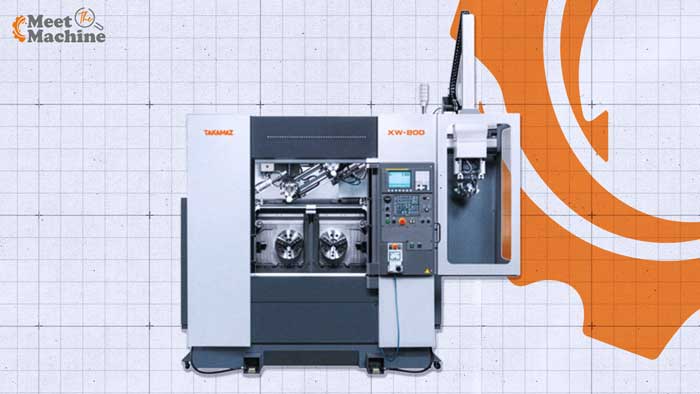
The Takamaz XW-200 is a parallel twin-spindle, twin-turret CNC production lathe built by Takamatsu Machinery Co., Ltd. in Hakusan City, Ishikawa Prefecture, Japan. It runs two independent 10-inch hydraulic chucks, a 120mm (4.72-inch) spindle bore on each side, an 18.5/15 kW (25 HP) spindle drive at up to 2,800 RPM, two 8-station turrets, a maximum turning diameter of 13.14 inches, a maximum turning length of 8.88 inches, and rapid traverse rates of 24 m/min on both X and Z. The machine is engineered to cut both ends of a part simultaneously instead of sequentially, almost always paired with a gantry loader between the two spindles for fully automatic two-op production. Takamatsu's published numbers show a 1.8x increase in cutting capacity over previous XW-class models, driven by the larger 120mm spindle bore and the higher-torque drive package. The XW-200 sits at the top of the Takamaz XW twin-spindle family, above the XW-50, XW-100, and XW-130, and is one of the most common twin-spindle parallel lathes on the U.S. used market, especially out of automotive tier-one and tier-two retirements.
Most of the dual-spindle lathes American shops buy are not actually dual-spindle. They are sub-spindle machines, also called pick-off lathes, where a main spindle does the heavy turning and a smaller sub-spindle handles the back side at reduced capacity. That works for a lot of parts. It does not work when both ends of the part need real chuck capacity, real horsepower, and real turret time. For that work, the architecture has to be different. Two full spindles. Two full turrets. Two operations happening in parallel, not in sequence. That is the Takamaz XW-200.
The XW-200 is the production lathe a shop buys when the typical part is a two-op turning job, the volume is high enough that cycle time decides the bid, and giving up half the capacity on one end of the part is not an option. Automotive driveline components. Hydraulic cylinder rod ends. Bearing races. Flange-type parts where both faces need finished surfaces, controlled bore work, and tight concentricity. With a gantry loader running between the two spindles, an XW-200 finishes parts at roughly twice the rate of a single-spindle lathe doing the same two ops sequentially. This is a working machinist's breakdown of the XW-200: where Takamaz came from, how the XW family is structured, what a used unit actually costs, and the specific items to inspect before signing a purchase order.
Where Takamaz Came From
Takamatsu Machinery began as Takamatsu Ironworks Co., Ltd., founded in 1948 by Kiichi Takamatsu in what is now Hakusan City, Ishikawa Prefecture, on Japan's west coast. The company entered the machine tool industry in 1960 with the T600 chamfering lathe and reorganized as a limited company in 1961. The original product was a high-precision lathe designed for a single, repetitive production task done at speed and at tight tolerance. That is still the company's design philosophy 65 years later, and it is the through-line that explains why a Takamaz looks and runs the way it does.
The head office plant moved to its current Matto City (now Hakusan City) location in 1985, where the company still designs and builds its lathes today. In 1976 Takamatsu introduced the TCC-8, an interactive CNC lathe with a CRT screen at the Tokyo International Trade Fair, one of the earlier conversational CNC lathes to ship in Japan. The TCC-8, the T-650, and the MERITER were later recognized by Ishikawa Prefecture as industrial heritage of manufacturing. The XW twin-spindle platform sits in a direct engineering line back to those early production-focused machines: built for one job, done fast, done right, repeatable across thousands of parts a shift.
The Engineering Philosophy Behind the XW-200
The XW-200 was engineered around a question most lathe buyers do not actually ask: what does the geometry of the machine need to look like if both ends of the part are getting real chucking work, not pickoff work? The answer drives three specific design choices that separate the XW-200 from sub-spindle production lathes.
The first is symmetry. The XW-200 is built around two structurally identical headstocks facing each other across a shared bed, with a turret on each side. The left spindle and the right spindle are the same casting, the same drive, the same 120mm bore, the same 10-inch chuck capacity. Either side can run roughing or finishing operations. Either side can carry the harder feature of the part. The machine is not biased toward a main op and a back op the way a sub-spindle lathe is.
The second is the drive package. Each spindle runs an 18.5/15 kW (25 HP, 30-minute rating) AC drive with infinitely variable spindle speed from 45 to 2,800 RPM. The high-torque low-RPM end of that range is what makes the machine work on large-diameter flange parts where the cut wants to stall a smaller drive. Takamatsu's published cutting capacity figure for the XW-200 is 1.8x previous XW-class machines, and the 120mm spindle bore combined with the 25 HP drive is where most of that gain came from.
The third is thermal stability. Each spindle has built-in cooling to minimize geometric drift during long unattended runs. On a production part where the cert package requires the first part of the shift and the last part of the shift to be within the same tolerance band, that thermal performance is what separates a clean shipment from a sorted lot. The compact body design also keeps the thermal path short, which matters more than most spec sheets credit.
A used XW-200 with healthy spindle bearings on both sides, two turrets that index cleanly through all 16 stations, and a working loader is a production asset that can keep paying for itself for another decade. An XW-200 with one tired spindle, a sticky turret, or a loader that the shop "is planning to fix" is a different machine on the bid sheet entirely. The Resell CNC inspection team checks all of the above on every XW appraisal, because the gap between the two valuations is the entire purchase decision.
The XW Family in Shop Language
Takamatsu's XW series is the company's twin-spindle, twin-turret parallel lathe family. Every XW machine has the same architectural idea: two spindles, two turrets, both ends of the part at once. The difference between models is chuck size, bar capacity, and horsepower. Knowing where the XW-200 sits in the lineup is the difference between buying the right machine for the part and buying one that is too small or one that is overkill.
XW-50: 5-inch chuck class. The small-part end of the XW lineup. Built for high-volume precision turning of small automotive components, electrical connectors, fastener heads, and bushings. The XW the shop buys when the part is small and the volume is large.
XW-100: 6-inch chuck class. A step up in capacity for slightly larger automotive and bearing work. Common in shops where most parts are still under 4 inches in diameter but the chuck and bar capacity of the XW-50 is too tight.
XW-130: 6-inch to 8-inch chuck class, higher horsepower than XW-100. Built for harder materials and heavier stock removal at mid-size diameter. Commonly used for hydraulic components, valve bodies, and bearing races where the cutting forces exceed what a smaller XW handles cleanly.
XW-200: 10-inch chuck, 120mm (4.72-inch) spindle bore, 25 HP per side. The production workhorse and the subject of this guide. The largest twin-spindle parallel lathe in the standard XW family and the model that covers the largest range of typical American job shop two-op turning work. Maximum turning diameter 13.14 inches. Maximum turning length 8.88 inches. Eight stations per turret, 16 tools total available across both sides without re-tooling.
All XW machines are designed to integrate with a gantry loader between the two spindles. The loader is what turns the architecture into a true automation cell: raw stock loads to spindle one, finished op-one parts transfer across the bed to spindle two, finished parts unload to a tray. One operator can run the cell while loading raw stock and pulling finished parts at the ends. Many XW-200s on the U.S. used market come with a Takamaz gantry loader already installed and tuned to the specific part family the previous owner was running. That loader integration is worth real money on the appraisal.
The U.S. Service and Parts Footprint
Takamatsu Machinery's primary U.S. distributor is Yuasa International, headquartered in Streetsboro, Ohio, with regional sales and service coverage across the United States. Yuasa has been the North American Takamaz channel since the 1980s and carries parts, service techs, and machine documentation for the XW family back through earlier builds. Regional Takamaz dealers cover specific U.S. territories with field service and installation support alongside the Yuasa channel.
For a used buyer, that channel matters. A twin-spindle production lathe that drops a turret motor or loses a spindle drive in the middle of an automotive PO is not a problem a generic CNC service company is going to solve quickly. Takamaz machines run a specific control architecture, specific drive packages, and specific loader integration logic. Yuasa-trained techs and the regional Takamaz dealer network are the practical reason used XW-200s hold value the way they do on the U.S. market, and it is a point Resell CNC's appraisal team flags directly on every XW pre-purchase inspection.
Where the XW-200 Fits Among Twin-Spindle Production Lathes
Shops cross-shopping a parallel twin-spindle production lathe at the 10-inch chuck class typically look at four machines: the Takamaz XW-200, the Mazak Multiplex 6200, the Nakamura-Tome WT-250II, and the Okuma 2SP-150H. They are not the same machine, and the buying decision usually comes down to one or two specific arguments per brand.
| Brand |
HQ |
Standard Control |
Distinctive Strength |
| Takamaz XW-200 |
Hakusan, Japan |
Fanuc |
True parallel architecture, integrated gantry loader, compact footprint per spindle |
| Mazak Multiplex 6200 |
Oguchi, Japan |
Mazatrol |
Conversational programming, broadest U.S. parts coverage of any Japanese builder |
| Nakamura-Tome WT-250II |
Hakusan, Japan |
Fanuc (NT Smart X) |
Tightest geometric tolerances in the class, multi-tasking options on top of twin-spindle base |
| Okuma 2SP-150H |
Niwa, Japan |
OSP |
Vertical twin-spindle layout, gravity-fed chip flow, thermo-friendly construction |
The Mazak argument is conversational programming and the largest U.S. service footprint in the category. The Nakamura-Tome argument is the highest-end build quality and multi-tasking extensions, which is also reflected in price. The Okuma argument is the vertical layout and OSP control, particularly for shops already standardized on Okuma. The Takamaz argument is the combination of three things at once: a purpose-built parallel twin-spindle architecture without compromise on either side, integrated gantry loader engineering that is already optimized for the machine rather than bolted on, and a meaningfully lower acquisition cost both new and used than the equivalent Nakamura or Mazak. For high-volume two-op production work, the Takamaz buying argument is the cycle-time math first and the total cost of ownership second.
Why Used XW-200s Hold Their Value
Twin-spindle parallel production lathes are not a category where every used machine trades cleanly. Most XW-200s on the U.S. used market come out of automotive tier-one or tier-two shops that bought the machine for a specific high-volume part program. When that program ends, the machine has been hard-run on one part family, often with a tuned loader cell. The valuation gap between a clean low-hour XW-200 with a working loader and a tired one with a parked loader is wider than the gap on a single-spindle lathe of comparable age.
Real pricing ranges from current U.S. market activity:
- Earlier builds (2005 to 2012): roughly $60,000 to $110,000 for base machines, $90,000 to $145,000 with a working gantry loader and clean tooling
- Mid-era builds (2013 to 2018): roughly $100,000 to $160,000 base, $135,000 to $195,000 with loader and full automation integration
- Newer builds (2019 forward): roughly $145,000 to $225,000+, with low-hour units carrying a Takamaz factory loader and an automotive-ready tooling package pushing higher
For context, a new Takamaz XW-200 with a factory gantry loader and standard automation lands in the $275,000 to $350,000 range depending on options and integration. A well-maintained used unit that delivers the same parallel-machining cycle time at 40 to 60 percent of new-machine cost is the math that keeps the used market for these lathes tight, particularly when the loader cell is already tuned for a part family that overlaps with the new owner's work.
What to Check When Buying a Used XW-200
A used XW-200 is a production asset purchase, not a hobby buy. The items below are what move the appraisal number on the inspections Resell CNC handles for XW-class machines coming through retail and auction.
Spindle hours on both sides. The XW-200 has two main spindles, and both have a service life measured in tens of thousands of hours. Pull spindle hours through the control on each side. A machine that has been run hard on a single part family will often show one spindle with substantially more hours than the other. Listen for bearing noise at 200, 1500, and 2,800 RPM on each spindle. Check spindle nose runout with a test bar on both sides. A spindle rebuild on an XW-200 typically runs $18,000 to $32,000 per side.
Turret health, all 16 stations. Index each turret through all 8 stations and listen for hesitation, grinding, or hydraulic noise. Both turrets should hit each station cleanly with no fault codes. A turret rebuild on a Takamaz XW machine is a five-figure expense and a multi-week lead time on parts from Japan through the Yuasa channel.
Gantry loader function. If the machine has a loader, run it through a full cycle: stock pickup, spindle one load, transfer to spindle two, finished part unload. The loader should hit positions cleanly with no shudder or missed grip cycles. A non-functional loader is the single most common reason used XW-200s sell below the price they should. Reactivating a parked loader can run $15,000 to $40,000 depending on what is wrong with it.
Spindle alignment, side to side. Mount an indicator across the bed and check that the two spindles are still concentric to each other within Takamatsu's specification. On a machine that has been moved or run hard, side-to-side alignment can drift, which shows up as concentricity errors between the op-one and op-two features on the same part.
Way condition on both axes pairs. Pull the way covers on both X and Z axes on each side and inspect for scoring, gouging, or visible wear. The XW-200 has more linear travel surface than a single-spindle lathe of equivalent size, and one neglected pair of ways on either side is a problem that shows up in part geometry.
Hydraulic chuck condition, both sides. Two 10-inch chucks means two sets of jaw seating surfaces, two actuation cylinders, two draw tubes. Inspect each chuck for jaw wear and check actuation pressure on both sides. Asymmetric chuck wear is common on machines that ran one part family for years.
Coolant system, chip handling, and through-spindle coolant. A clean coolant tank tells you the previous owner maintained the machine. Black sludge with chips packed in the bottom tells you the rest of the machine got the same treatment. If the XW-200 has through-spindle coolant on either side, cycle the pumps and verify pressure.
Control generation and parameter sheets. XW-200 machines have shipped with multiple Fanuc control generations over the years. Confirm the exact control and software version, and ask for the original parameter sheets. Parameter recovery on a machine that has lost its memory is a service call most shops do not want to fund.
Documentation and tooling included. Original Takamatsu operator and maintenance manuals, parameter sheets, both sets of turret holders, chuck jaws for both sides, loader gripper fingers, and any custom part-specific fixturing all add real value. Ask before you bid.
Who Actually Runs XW-200s in the U.S.
Automotive tier-one and tier-two suppliers running driveline components, transmission shafts, wheel hubs, and brake hardware where both ends of the part need real chucking work and the program volume justifies a dedicated cell. Hydraulic and pneumatic manufacturers producing cylinder rod ends, piston blanks, and fitting bodies. Bearing race producers turning inner and outer races where concentricity between the two ground surfaces is the cert spec. Aerospace second-tier suppliers running flange-type fittings in steel and aluminum where the part requires real metal removal on both faces. Industrial pump and motor shops cutting shaft ends and housing flanges.
The common thread is mid-to-high volume two-op turning where each end of the part is a real operation, not a pickoff. The shops running XW-200s are not job shops cutting prototype lots of 5 parts. They are production shops running thousands of parts per program with cycle time as the bid driver. Many U.S. owners run their XW-200s in fully automated cells with the Takamaz gantry loader, an inline gauging station, and a finished-part conveyor, with one operator covering two or three cells across a shift. That kind of unattended production economics is exactly what the XW-200 was built to enable, and it is what makes the math work against a single-spindle lathe doing the same two ops sequentially.
Resell CNC Take
A used XW-200 with a working gantry loader, tight side-to-side spindle alignment, and clean turrets on both sides is one of the most cycle-time-efficient production buys on the U.S. secondary market. Resell CNC has handled XW-200s coming out of automotive cell retirements, bearing producer line consolidations, and tier-two supplier program shutdowns, and the math on a clean unit at the right number has held up across every deal we have closed.
Frequently Asked Questions
What is the Takamaz XW-200?
The Takamaz XW-200 is a parallel twin-spindle, twin-turret CNC production lathe built by Takamatsu Machinery Co., Ltd. in Hakusan City, Ishikawa Prefecture, Japan. It runs two independent 10-inch hydraulic chucks, a 120mm (4.72-inch) spindle bore on each side, an 18.5/15 kW (25 HP) spindle drive at up to 2,800 RPM, two 8-station turrets, and a maximum turning diameter of 13.14 inches with a maximum turning length of 8.88 inches. The machine is designed to cut both ends of a part simultaneously rather than sequentially, typically paired with a Takamaz gantry loader for fully automated two-op production.
How is an XW-200 different from a sub-spindle lathe?
A sub-spindle lathe, often called a pick-off lathe, has one main spindle that does the bulk of the work and a smaller secondary spindle that handles the back side at reduced capacity. The XW-200 has two structurally identical main spindles, each with full 10-inch chuck capacity, a 120mm bore, and a 25 HP drive. Either spindle can run roughing or finishing operations at full capacity. That parallel architecture is what enables true two-op production without compromising either side of the part.
Is the XW-200 built for live tooling or straight turning?
The XW-200 is primarily a straight-turning production machine. The two 8-station turrets carry 16 tools total without re-tooling, which covers the vast majority of two-op turning jobs the machine is purchased for. Live-tooling options have been available on certain XW-series configurations, but the standard XW-200 is engineered for high-volume parallel turning rather than full multi-tasking work. For shops needing live tooling and Y-axis as the primary use case, Takamatsu's larger multi-tasking platforms or a competing multi-tasking machine are better matches.
What does a used Takamaz XW-200 cost?
Used XW-200 pricing ranges from roughly $60,000 for earlier base machines from 2005 to 2012, up to $225,000 or more for newer low-hour units with a factory gantry loader and full automation integration. New XW-200 machines with a factory loader list in the $275,000 to $350,000 range depending on options. Pricing tracks closely to build year, spindle hours on both sides, loader condition, side-to-side alignment, and the completeness of the tooling and documentation package.
Who is the U.S. distributor for Takamaz?
Yuasa International, headquartered in Streetsboro, Ohio, is the primary U.S. distributor for Takamatsu Machinery. Yuasa provides parts, service, and machine documentation for the XW family and has covered Takamaz machines in North America for decades. Regional Takamaz dealers handle specific U.S. territories with field service and installation support.
Can an XW-200 run without the gantry loader?
Yes, but it loses a meaningful part of the value proposition. The XW-200 will function as a manually loaded twin-spindle lathe with an operator chucking parts on both sides. The cycle-time advantage that justifies a twin-spindle architecture in the first place comes from automated transfer between the two spindles. Most U.S. owners run the XW-200 with the Takamaz factory loader, which is also what drives most of the resale value on the used market.
Browse Used Takamaz Inventory
The XW-200 and the full Takamaz lineup at Resell CNC.
Browse the current Resell CNC inventory of used Takamaz twin-spindle production lathes, XW-series machines, and gantry-loaded automation cells. Every appraisal is handled by our in-house team of AMEA and CEA Certified Equipment Appraisers.
VIEW USED TAKAMAZ MACHINES
About the Author
Bill Murphy is the Marketing and Content Lead at Resell CNC, where he covers used CNC equipment, auction strategy, and the buying side of the secondary machine tool market. He works directly with the appraisal, auction, and retail teams to translate machine-level detail into content for shop owners, plant managers, and acquisition buyers.
About Resell CNC
Founded in 2008 and headquartered in Maitland, Florida, Resell CNC carries 200+ years of combined industry experience, four AMEA/CEA Certified Equipment Appraisers on staff, MDNA membership since 2009, and is the only used CNC dealer in North America with Official Mazak Trade-In Center status. The company operates across retail, auction, appraisal, and finance divisions from warehouses in Winter Springs and Longwood, Florida.