Meet the Machine
Used DMG Mori CMX 1100 V : DMG Mori Build, Value-Line Price | Meet the Machine
What is the DMG Mori CMX 1100 V?
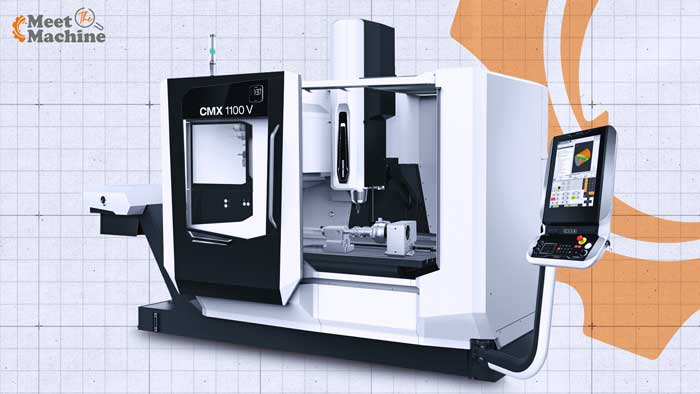
The DMG Mori CMX 1100 V is a 3-axis vertical machining center from DMG Mori's value-priced CMX V line, built for general production milling rather than 5-axis or turn-mill work. It offers travels of about 1100 by 560 by 510 mm (43.3 by 22 by 20.1 inches), a 1400 by 560 mm table rated near 2,200 pounds, and a 40-taper spindle running 12,000 rpm standard with a 15,000 rpm option, fed by a 30-tool changer. Buyers choose the control, typically Heidenhain, Siemens, or FANUC, on the DMG MORI SLIMline panel. The CMX V machines are built at DMG Mori's FAMOT plant in Pleszew, Poland, and the 1100 V is the large-envelope model in a lineup that also includes the CMX 600 V and CMX 800 V. On the used market it is valued as an affordable, rigid workhorse that carries DMG Mori engineering and global service at a price well below the company's flagship lines.
Not every shop needs a 5-axis machine or a turn-mill center. A lot of money gets made running brackets, plates, fixtures, and production parts on a dependable 3-axis vertical that holds tolerance, takes a cut, and does not break the bank. That is the entire job of the DMG Mori CMX 1100 V. It is the value-line workhorse, the machine you buy when you want DMG Mori build quality and a worldwide service network without paying flagship money for capability you will not use.
This is a working machinist's breakdown of the CMX 1100 V: where it sits in the DMG Mori lineup, what the iron actually does well, what it costs used, and what to check before you buy. If you are cross-shopping it against a Haas, an Okuma Genos, or a Doosan, this is the context that tells you when the DMG Mori wins the order and when it does not.
Where the CMX V Line Comes From
DMG Mori is the German-Japanese builder formed from the combination of Germany's DMG (Deckel Maho Gildemeister) and Japan's Mori Seiki, and its catalog runs from entry-level verticals up to five-axis, turn-mill, and additive machines. The CMX V series sits at the accessible end of that catalog. It is the value line, designed to deliver the build quality and support people associate with the brand at a price that competes with the high-volume production-VMC market.
The CMX V machines are built at DMG Mori's FAMOT facility in Pleszew, Poland, a plant the company has expanded and modernized specifically to produce this class of machine at scale. That European manufacturing base is part of how the CMX V hits its price without giving up the rigidity and accuracy the brand is known for. The 1100 V is the large-travel model in the family, sitting above the CMX 600 V and CMX 800 V.
What Defines the Machine
A large work envelope for the class. At roughly 1100 mm of X travel, the CMX 1100 V gives a 43-inch X axis on a value-priced 40-taper machine, with a 1400 by 560 mm table that takes around 2,200 pounds. That is real capacity. Long plates, multiple fixtures, and big tombstones fit on a machine that costs a fraction of a larger flagship VMC.
A 40-taper production spindle. The standard spindle turns 12,000 rpm with a 15,000 rpm high-speed option, on a 40-taper interface that matches the tooling most general shops already own. It is built for steady metal removal in steel, aluminum, and cast iron, not for exotic high-rpm micro-machining.
Your choice of control. The CMX V is offered with Heidenhain, Siemens, or FANUC controls on the DMG MORI SLIMline operator panel, with CELOS available on later machines. That flexibility matters on the used market, because a shop standardized on FANUC or on Heidenhain can find a CMX 1100 V that matches the rest of the floor instead of retraining operators.
Fast where it counts. Rapids around 36 meters per minute on X and Y keep non-cutting time down, and a 30-tool changer covers the tool count a general production job actually needs. The machine is also commonly offered 4th-axis ready for shops that want to add a rotary later.
Where It Sits in the DMG Mori Lineup
Understanding the CMX 1100 V means knowing what it is not. DMG Mori builds several families that get cross-shopped by mistake.
CMX V (this machine). The value-line 3-axis vertical, in 600, 800, and 1100 sizes. General production milling at an accessible price.
CMX U. The 5-axis universal sibling, for shops that need full simultaneous five-axis work. A different machine and a different price.
DMU monoBLOCK and DMC. The premium 5-axis universal machines, like the DMU 65, built for the highest accuracy and complex multi-sided parts.
CTX and NLX. The turning and turn-mill side of the catalog, not verticals at all.
If your work is 3-axis production milling and the budget is real, the CMX 1100 V is the model in the lineup built for exactly that. Reaching for a DMU or a CMX U means paying for axes the job does not use.
The Problem It Was Built to Solve
Most shops do not lose jobs because they lack five axes. They lose them on machine cost and reliability. A shop bidding production work needs a vertical that holds tolerance shift after shift, runs the tooling it already owns, and amortizes cheap enough to keep the part price competitive. Buy too much machine and the overhead sinks the bid. Buy too little and the machine cannot hold the tolerance or take the cut.
The CMX 1100 V is aimed straight at that middle. It is enough machine to hold real tolerances and take a meaningful cut in steel, with a brand name and a service network behind it, at a price that lets a shop bid production work and still make money. That is the proposition: not the most capable VMC on the floor, but the most defensible cost per good part for general milling.
U.S. Service and Support
DMG Mori runs one of the larger service and support footprints in the U.S. machine tool market, with its U.S. headquarters in the Chicago area and a national network of technology and service centers across the major manufacturing regions. For a used buyer, that breadth is part of the value. Parts availability, factory-trained service, and applications support are easier to reach for a DMG Mori than for many niche brands, and the FANUC, Siemens, or Heidenhain control on a given CMX 1100 V is also supported through its own control-maker network. That dual support path helps the machine hold value over time.
How It Compares
| Machine |
HQ |
Control |
Distinctive Strength |
| DMG Mori CMX 1100 V |
Germany / Japan |
Heidenhain, Siemens, or FANUC |
Big envelope and brand build at a value price, control of your choice |
| Haas VF-4 |
Oxnard, CA, USA |
Haas control |
Lowest entry cost and the densest U.S. parts and service network |
| Okuma Genos M560-V |
Niwa, Japan |
OSP |
Rigidity and the OSP control with thermal compensation |
| Doosan / DN Solutions DNM 5700 |
Changwon, S. Korea |
FANUC |
Strong value-to-capability ratio and a wide dealer network |
Each makes a real argument. The Haas VF-4 wins on the lowest cost of entry and the deepest U.S. service density, and it is the default for many shops for good reason. The Okuma Genos wins when a shop values rigidity and the OSP control, and wants to standardize on Okuma. The Doosan DNM is the value benchmark, hard to beat on capability per dollar. The CMX 1100 V wins the order for a shop that wants DMG Mori build quality and a global service network, the flexibility to pick its control, and a large work envelope, all at a price that sits below the company's flagship lines. It is the choice when a buyer wants the brand and the envelope without the flagship sticker.
What It Costs on the Used Market
The CMX 1100 V is a relatively modern machine, with most used examples spanning roughly 2016 to recent builds, so the secondary market is about late-model, low-to-moderate-hour units rather than decades-old iron. Price tracks year, spindle hours, spindle speed option, control, and whether extras like through-spindle coolant, a chip conveyor, or a 4th axis are included. Dealer listings are frequently request-price, and the figures below are close-to orientation, not quotes.
- Earlier units (roughly 2016 to 2018): close to $60,000 to $95,000, depending on hours, spindle option, and what extras are included.
- Late-model, low-hour units (2019 and newer): close to $95,000 to $140,000, with the spread driven by hours, the 15,000 rpm spindle, and options like through-spindle coolant and a 4th axis.
Treat these as orientation, not a quote. A clean, low-hour CMX 1100 V with the high-speed spindle and useful extras is a different purchase than a base machine with heavy production hours, and that is where the price spread lives.
What to Check Before You Buy
Confirm the control. Identify whether the machine has Heidenhain, Siemens, or FANUC, and make sure it matches what your shop runs. The control is a fixed part of the machine and retraining or re-posting around the wrong one is a real cost.
Spindle hours and condition. Pull spindle and cutting hours through the control, and check for play, noise, and heat. On a production VMC the spindle is the most important wear item, and a hard-run unit shows it here first.
Spindle speed option. Verify whether it is the 12,000 or 15,000 rpm spindle. It affects both capability and value, and it is not something you change cheaply later.
Way covers, ways, and backlash. Inspect the way covers and wipers, check the linear axes for wear and backlash, and look for crash history. A value machine that lived in heavy production deserves a close look here.
Tool changer. Cycle the 30-tool changer fully and watch for hesitation or missed tool pots. ATC repairs eat into the savings that made the machine attractive.
Coolant and chip systems. Confirm the coolant system, any through-spindle coolant, and the chip conveyor all work. These are common cost adders that should be priced into the deal.
4th-axis provisions. If you plan to add a rotary, confirm the machine has the wiring and control options to support it before you assume it is ready.
Parameter backup and service records. Get a full parameter backup and the maintenance history. A documented machine with its control access intact is worth more and easier to own.
Who Actually Runs Them
The CMX 1100 V lands in general machine shops, contract manufacturers, and job shops that run a broad mix of 3-axis production work in steel, aluminum, and cast iron. It suits shops making brackets, plates, manifolds, fixtures, baseplates, and mid-size production parts, and shops that want a brand-name machine with strong service behind it but cannot justify flagship pricing for 3-axis work. It is also a common pick for a shop adding capacity to an existing DMG Mori fleet, or one that wants its operators on a familiar control. The common thread is dependable, cost-effective production milling rather than exotic capability.
Resell CNC Take
The CMX 1100 V is an easy machine to recommend to a shop that wants DMG Mori build and service without flagship cost. The two things that make or break the buy are the control and the spindle, so match the control to your floor and check the spindle hard. Get those right and a clean used CMX 1100 V is a lot of dependable, brand-backed milling capacity for the money.
Frequently Asked Questions
What is the DMG Mori CMX 1100 V?
It is a 3-axis vertical machining center from DMG Mori's value-priced CMX V line, built for general production milling. It offers about 1100 by 560 by 510 mm of travel, a 1400 by 560 mm table rated near 2,200 pounds, a 40-taper spindle at 12,000 rpm (15,000 optional), and a 30-tool changer, with a choice of Heidenhain, Siemens, or FANUC control. The CMX V machines are built at DMG Mori's FAMOT plant in Poland.
Is the CMX 1100 V a 5-axis machine?
No. The CMX 1100 V is a 3-axis vertical machining center. DMG Mori's 5-axis universal machines are the CMX U value line and the premium DMU and DMC families. The CMX 1100 V is built for 3-axis production milling, and it is commonly offered 4th-axis ready for shops that want to add a rotary table.
What control does the CMX 1100 V use?
It is offered with a choice of Heidenhain, Siemens, or FANUC control on the DMG MORI SLIMline panel, with CELOS available on later machines. On the used market the specific control varies by machine, so confirm which one a given unit has and make sure it matches the rest of your shop.
Where is the CMX 1100 V built?
The CMX V series, including the 1100 V, is built at DMG Mori's FAMOT facility in Pleszew, Poland, a plant the company has expanded and modernized to produce this class of machine. The European manufacturing base is part of how the CMX V holds a value price while keeping DMG Mori build quality.
What does a used CMX 1100 V cost?
As a rough guide, earlier 2016 to 2018 units often fall close to $60,000 to $95,000, while late-model low-hour units from 2019 and newer run close to $95,000 to $140,000. Price depends on hours, the spindle speed option, the control, and extras like through-spindle coolant, a chip conveyor, and a 4th axis. Dealer listings are frequently request-price.
How does the CMX 1100 V compare to a Haas VF-4?
The Haas VF-4 wins on lowest entry cost and the densest U.S. service network, and it is a strong default. The CMX 1100 V wins for a shop that wants DMG Mori build quality, a choice of Heidenhain, Siemens, or FANUC control, and a large work envelope, at a price below DMG Mori's flagship lines. Both are capable 40-taper production verticals; the decision usually comes down to brand, control preference, and budget.
Buying or Selling a DMG Mori?
Resell CNC buys and sells used DMG Mori machining centers, with four AMEA and CEA certified appraisers on staff. If you are evaluating a CMX 1100 V, we can help you check the control, the spindle, and the options before you buy.
See DMG Mori Inventory
About the Author
Bill Murphy is the Marketing and Content Lead at Resell CNC, where he writes about used machine tools, the economics of the shop floor, and where manufacturing is headed.
About Resell CNC
Resell CNC has bought and sold used CNC machinery since 2008, with more than $1 billion in equipment transactions and over 200 years of combined industry experience. The company is headquartered in Maitland, Florida, with warehouses in Winter Springs and Longwood, and staffs four AMEA and CEA certified equipment appraisers. Resell CNC has been an MDNA member since 2009 and is the only used CNC dealer in North America with Official Mazak Trade-In Center status. Simple. Reliable. Trusted.®