Meet the Machine
Used Haas EC-400: The Same Spindle, Turned Sideways
What is the Haas EC-400?
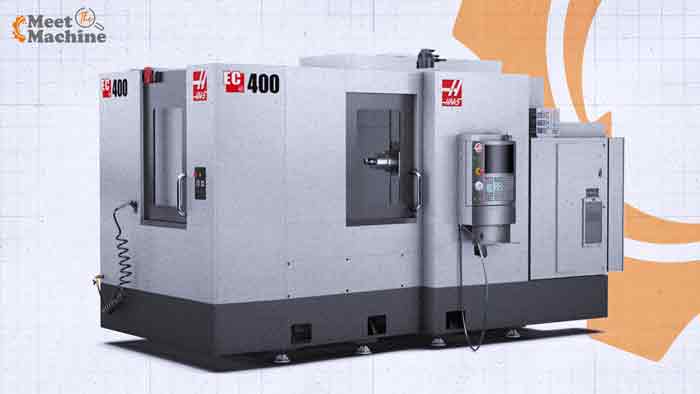
The Haas EC-400 is a 40 taper horizontal machining center, or HMC, with two 400 mm pallets and 22 by 25 by 22 inches of travel. Haas calls it a 400 mm twin-pallet HMC. It runs a 30 hp inline direct-drive spindle to 8,100 rpm with 90 ft-lbf of torque, a 30+1 side mount tool changer, and an integrated B axis that Haas publishes at plus or minus 15 arc-seconds of indexing accuracy. The spindle package is identical to the one in Haas's large VF verticals. What the horizontal adds is pallets, a rotary axis and rapids more than twice as fast.
Shops move from a vertical to an HMC expecting a bigger machine. On a Haas EC-400 that is not what happens.
The spindle is the same one Haas puts in its large VF verticals. Thirty horsepower, 8,100 rpm, 90 ft-lbf at 2,000 rpm, inline direct-drive, the same CT40, BT40 and HSK-A63 taper options, the same 30+1 side mount changer, even the same 95 gallon coolant tank. Not comparable. The same.
The work envelope is smaller too. Twenty two by twenty five by twenty two inches against eighty four by forty by thirty on a VF-9.
So what are you paying for. Two answers, and both are about time rather than capability.
It Is the Same Spindle as the Vertical
Put Haas's own published figures for the EC-400 next to the VF-9/40 and the overlap is exact.
| Specification |
EC-400 horizontal |
VF-9/40 vertical |
| Spindle rating |
30 hp |
30 hp |
| Max speed |
8,100 rpm |
8,100 rpm |
| Max torque |
90 ft-lbf at 2,000 rpm |
90 ft-lbf at 2,000 rpm |
| Drive system |
Inline direct-drive |
Inline direct-drive |
| Taper |
CT40, BT40, HSK-A63 |
CT40, BT40, HSK-A63 |
| Tool changer |
SMTC 30+1 |
SMTC 30+1 |
| Coolant capacity |
95 gal |
95 gal |
| Max cutting feed |
833 ipm |
500 ipm |
| Rapids, X and Y |
1,400 ipm |
600 ipm |
| Travels |
22 x 25 x 22 in |
84 x 40 x 30 in |
| Work holding |
Two 400 mm pallets, 880 lb |
84 x 36 in table, 4,000 lb |
Seven specifications identical, and they are the seven that determine what the machine can cut. If you are hoping a horizontal will let you take a heavier cut than your vertical does, this one will not, because it is the same spindle doing the cutting.
The three that differ are the interesting ones. Rapids more than double. Cutting feed two thirds higher. And an envelope a fraction of the size.
What the Horizontal Actually Buys
The case for a horizontal generally rests on two things: chips fall away from the cut instead of sitting in it, and a pallet changer means the operator loads the next part while the current one runs. We have written about both in our piece on the Mazak HCN-6000 and HCN-6800, so this article will not re-argue them.
What is specific to the EC-400 is the arithmetic underneath. Haas publishes a pallet change time of 15 seconds. The machine takes two 400 mm pallets rated at 880 lb each, or 500 lb apiece if a pallet pool is fitted.
Fifteen seconds is the entire interruption between finishing one part and starting the next. Everything else, the unclamping, the deburring, the gauging, the reload, happens on the pallet outside the machine while the spindle keeps cutting.
Then the rapids. Fourteen hundred inches per minute in X and Y against six hundred on the vertical. On a small envelope with short moves, the difference between a 600 ipm rapid and a 1,400 ipm rapid across twenty two inches is not dramatic on any single move. Across a few thousand moves in a lights out run it is the reason the machine exists.
Put a number on it and the case gets easier to test. If a part runs an eight minute cycle and takes four minutes to unload and reload, a vertical is cutting for two thirds of the shift. Move the same part to a machine where the reload happens outside and the interruption is fifteen seconds, and the spindle is cutting for something close to all of it. Whether that is worth the purchase depends entirely on how many of that part you have.
That is the honest summary of the premium. Same cutting power, less room, and a machine organized so the spindle is almost never waiting on a person.
Resell CNC Take
Do not buy a horizontal to cut harder. Buy one to stop paying a machinist to watch a spindle. If your parts already fit your vertical and your problem is cycle time between parts rather than during them, an EC-400 answers that. If your problem is that the cut is too heavy, the same 90 ft-lbf will be waiting for you on the other side of the purchase.
The B Axis Is Part of the Machine
On most verticals a fourth axis is a rotary table you bolt to the table, wire in and fixture around. On the EC-400 it is built in, and Haas publishes accuracy figures for it the way it does for the machine axes.
| B axis specification |
Published figure |
| Indexing accuracy |
plus or minus 15 arc-sec |
| Repeatability |
10 arc-sec |
| Backlash |
30 arc-sec |
| Minimum resolution |
0.001 degrees |
| Continuous rotational torque |
424 ft-lbf |
| Brake torque |
2,500 ft-lbf |
| Gear ratio |
106:1 |
| 90 degree rotation time |
3.0 sec |
| Rapids on B |
150 degrees per second |
| Max weight on platter |
880 lb |
Two things follow from that. The first is four sided machining in one setup as a normal way of working rather than a special arrangement, which on a part with features on multiple faces removes the largest single source of error, the second setup.
The second is the brake. Twenty five hundred ft-lbf of brake torque against a spindle making 90 means the B axis is not the weak link when you are cutting on an indexed face. A bolt on rotary is often exactly that.
Haas also lists the B axis as capable of synchronous motion rather than index only, so it can be used as a true fourth axis and not just a positioner. Confirm that on a used machine rather than assuming, because it depends on the build.
The Numbers Underneath
Specifications vary by year and build, so pull the sheet for the exact machine and serial number in front of you. These are the figures Haas currently publishes for the EC-400.
| Specification |
EC-400 |
| Travels, X / Y / Z |
22.00 / 25.00 / 22.00 in (559 / 635 / 559 mm) |
| Pallets |
Two, 400 x 400 mm (15.75 x 15.75 in) |
| Max pallet load |
880 lb (400 kg) |
| Max pallet load with pallet pool |
500 lb (227 kg) |
| Pallet change time |
15 sec |
| Spindle |
30 hp (22.4 kW), 8,100 rpm, inline direct-drive |
| Max torque |
90 ft-lbf at 2,000 rpm |
| Taper |
CT40, BT40 or HSK-A63 |
| Spindle cooling |
Air cooled, air and oil injection bearing lubrication |
| Max cutting feed |
833 ipm |
| Rapids, X and Y |
1,400 ipm |
| Axis thrust, X / Y / Z |
3,380 / 2,810 / 3,380 lbf |
| Tool changer |
SMTC, 30+1 standard |
| Coolant capacity |
95 gal |
| New starting price |
US$244,995 |
One line there deserves attention on a used machine. The pallet load drops from 880 lb to 500 lb when a pallet pool is fitted, because the pool has to shuttle the pallet as well as hold it. If you are buying a machine with a pool attached and sizing fixtures against the 880 lb figure, you are sizing against the wrong number.
Tool capacity is also worth asking about specifically. Thirty plus one is standard, and Haas offers considerably larger side mount changers across this family. On a machine bought for unattended running, the size of the magazine is often what actually limits how long it can run alone.
Four Hundred or Five Hundred, Forty Taper or Fifty
Haas splits its twin-pallet HMCs along two axes, and the useful thing is that they are separable. You pick a pallet size and you pick a spindle class, and the two decisions do not force each other.
| Model |
Pallet |
Travels |
Taper |
Spindle |
New starting price |
| EC-400 |
400 mm |
22 x 25 x 22 in |
40 |
8,100 rpm, 90 ft-lbf |
US$244,995 |
| EC-500 |
500 mm |
32 x 25 x 28 in |
40 |
8,100 rpm |
US$310,995 |
| EC-500/50 |
500 mm |
32 x 25 x 28 in |
50 |
7,500 rpm, 340 ft-lbf |
US$349,995 |
| EC-630 |
630 mm |
40 x 37 x 40 in |
50 |
50 taper |
US$447,995 |
The EC-500 in 40 taper and the EC-500/50 have the same travels and the same pallet. The difference is entirely the spindle: 8,100 rpm and 90 ft-lbf against 7,500 rpm and 340 ft-lbf through a two speed gearbox, for about thirty nine thousand dollars new.
That makes the decision unusually clean. Size the pallet to the part and the fixture. Size the taper to the cut. A shop running small steel parts with big cutters wants the 50 taper. A shop running aluminum or light steel with small tools is paying for torque it will not reach.
For the EC-400 specifically, the question to settle first is whether 400 mm of pallet and 22 inches of X is enough. The step up to an EC-500 is sixty six thousand dollars new and ten more inches of X. If your fixture is close to the edge of a 400 mm pallet, that is the conversation to have before the taper one.
Above that sits the EC-630, with 630 mm pallets and 40 by 37 by 40 inches of travel at US$447,995 new. That is a different class of machine and a different class of part. It is worth knowing the ladder exists, because on the used market all four turn up in the same search results and the pallet number is doing most of the work in telling them apart.
The Envelope Is Small, and That Is the Point
Twenty two by twenty five by twenty two inches sounds tight next to any modern vertical, and it is. A horizontal of this class is not a general purpose machine and it should not be bought as one.
The geometry is different in a way that is easy to miss on paper. On a horizontal the Y axis is vertical, so 25 inches of Y is height above the pallet, and the part hangs off a vertical pallet face rather than sitting on a table. That changes fixturing completely. Tombstones and angle plates are not accessories on a machine like this, they are the normal way of holding work, and the fixture is part of the purchase rather than something you sort out later.
The practical constraint is usually weight before it is size. Eight hundred and eighty pounds on the pallet has to include the tombstone, and a steel tombstone that fills a 400 mm pallet face is a meaningful fraction of that before a single part goes on it.
None of which is a criticism. It is the shape of the machine. A shop that already knows what it wants to run on a horizontal will read those numbers and know immediately whether the answer is yes. A shop that is not sure yet probably wants a vertical.
Which Control You Are Getting
Haas has built its own control since 1983. The boundary that matters on a used machine is the move to the Next Generation Control, which arrived around 2014 and brought a larger screen, Ethernet connectivity and a different interface.
On a horizontal that boundary carries a little more weight than it does on a vertical, because these machines are bought for unattended running and the control is what makes unattended running manageable: tool life management, probing routines, pallet scheduling. An older control does all of it, just with an older interface and an older networking story.
Confirm the control generation in writing along with the year and full model designation, and ask what options are actually enabled rather than fitted. Probing and through spindle coolant on a machine bought to run alone are close to essential rather than nice to have.
U.S. Parts and Service
Haas Automation was founded by Gene Haas in 1983 in Sun Valley, California and moved to Oxnard in 1997, where it builds machines on a campus of roughly one million square feet. It is the largest machine tool builder in the Western world.
The support picture is the same reason people buy Haas verticals, and it applies here: parts are domestic, the Haas Factory Outlet network is dense, and a large pool of American machinists already knows the control. On a machine expected to run with nobody standing in front of it, the speed of a service response is worth more than a spec sheet advantage.
Resell CNC carries 125 Haas machines. More on the company in our Haas brand profile.
Used-Market Value
Four things move the number on a used EC-400.
What is fitted for unattended running. Probing, through spindle coolant, a larger tool changer, a pallet pool and tool load monitoring are the difference between a machine that can run alone and one that needs watching. That is the entire reason for buying this machine, so it is the first thing to price.
The tooling and fixtures. Tombstones, fixture plates and the tooling package matter more on a horizontal than on a vertical, because you cannot run the machine without them and they are not cheap to assemble from scratch. A machine with a proven fixture set for parts like yours is worth substantially more than the same machine bare.
The control generation. NGC or pre-NGC, the clearest line in the used Haas market.
Pallet changer and B axis condition. These are the two mechanisms that do not exist on a vertical, they cycle constantly, and they are what a horizontal gets bought for. They are also the two things a quick inspection is most likely to skip.
What to Check on a Used EC-400
Start with the model plate: full designation, year, serial number, and whether a pallet pool is fitted.
Cycle the pallet changer repeatedly, not once. Twenty changes tell you things one does not. Listen at the clamp and unclamp, and watch whether the pallet seats consistently. A changer that works perfectly on the first cycle and hesitates on the fifteenth is telling you about the condition of something you cannot see.
Indicate a pallet face for squareness to the spindle, then index the B axis 90 degrees and indicate again. Doing it at several index positions is how you find out whether the rotary is still where Haas says it should be.
Check B axis backlash at reversal and confirm the brake actually holds under a cut rather than just in a jog.
Run the spindle through its range and check heat and noise at the top. Cycle every tool changer pocket rather than a sample.
Ask to see the machine run a real part from its own program, ideally through a pallet change. On a machine bought for uptime, watching a full cycle is worth more than any static inspection.
Confirm probing and through spindle coolant work rather than that they are present, and get the coolant system looked at properly, because 95 gallons of neglected coolant is its own problem.
Who Runs One
The EC-400 is a production machine for a shop with repeat work. It shows up in automotive and truck components, hydraulics and fluid power, valve and pump bodies, medical, and general contract work where the same part family comes back month after month.
The economics only work with volume or with lights out running. A job shop doing ones and twos will spend more time fixturing this machine than cutting on it, and the pallet changer will sit idle because there is no next part queued behind the current one.
It is also rarely a first machine. The shops that buy an HMC usually have verticals already and have worked out precisely which parts are eating their spindle hours in setup rather than in cutting. That is a specific piece of knowledge, and the machine is bought to act on it.
Looking for a used Haas?
See what we have on the floor.
Resell CNC carries 125 Haas machines, backed by a team with 200+ years of combined industry experience and four AMEA and CEA certified equipment appraisers on staff.
Browse Used Haas
Frequently Asked Questions
What is the Haas EC-400?
A 40 taper horizontal machining center with two 400 mm pallets and 22 by 25 by 22 inches of travel. It runs a 30 hp inline direct-drive spindle to 8,100 rpm with 90 ft-lbf at 2,000 rpm, a 30+1 side mount tool changer and an integrated B axis. Pallet change time is 15 seconds and each pallet is rated for 880 lb, or 500 lb with a pallet pool fitted. New starting price is US$244,995.
Is the Haas EC-400 spindle the same as a Haas vertical?
On the published figures, yes. Haas lists the EC-400 and the VF-9/40 with the same 30 hp rating, the same 8,100 rpm maximum, the same 90 ft-lbf at 2,000 rpm, the same inline direct-drive system, the same CT40, BT40 and HSK-A63 taper options, the same 30+1 side mount changer and the same 95 gallon coolant capacity. The horizontal does not cut harder. It has more than double the rapids and a pallet changer.
What is the difference between a Haas EC-400 and an EC-500?
Pallet size and travels. The EC-400 has 400 mm pallets and 22 by 25 by 22 inches of travel at a new starting price of US$244,995. The EC-500 has 500 mm pallets and 32 by 25 by 28 inches at US$310,995. Both are 40 taper at 8,100 rpm. There is also an EC-500/50, same pallets and travels as the EC-500 but with a 50 taper spindle at 7,500 rpm and 340 ft-lbf, at US$349,995.
Should you buy the 40 taper or 50 taper Haas horizontal?
Size the pallet to the part and the taper to the cut, because Haas lets you choose them separately. The 40 taper machines run 8,100 rpm and 90 ft-lbf. The 50 taper EC-500/50 runs 7,500 rpm and 340 ft-lbf through a two speed gearbox. Large diameter cutters in steel point to the 50 taper. Aluminium or lighter steel with smaller tools means paying for torque you will not reach.
How much weight can a Haas EC-400 pallet hold?
Haas publishes 880 lb per pallet, dropping to 500 lb if a pallet pool is fitted, because the pool has to shuttle the pallet as well as support it. That figure has to include the tombstone or fixture, not just the parts, and on a horizontal the fixture is usually a significant share of it. If you are buying a machine with a pool and sizing fixtures against 880 lb, you are using the wrong number.
What is the B axis on a Haas EC-400?
An integrated rotary axis built into the machine rather than a bolt on table. Haas publishes plus or minus 15 arc-seconds of indexing accuracy, 10 arc-seconds of repeatability, 30 arc-seconds of backlash, 0.001 degree resolution, 424 ft-lbf of continuous torque and 2,500 ft-lbf of brake torque, with a 90 degree rotation in 3 seconds. It enables four sided machining in one setup, which removes the second setup as a source of error.
Is a horizontal machining center worth it over a vertical?
It depends on whether your bottleneck is during the cut or between cuts. An HMC does not automatically mean more capability. A horizontal does not cut harder than a vertical with the same spindle, and on the EC-400 the spindle is literally the same one Haas puts in its large verticals. What it buys is chip evacuation and a pallet changer, so the spindle keeps running while the operator works on the part outside the machine. That pays off with repeat volume and unattended running, and it does not pay off on ones and twos.
What should you check on a used Haas EC-400?
Confirm the full designation, year, serial number and whether a pallet pool is fitted. Cycle the pallet changer twenty times rather than once. Indicate a pallet face for squareness, index the B axis 90 degrees and indicate again at several positions. Check B axis backlash and that the brake holds under a cut. Run the spindle through its range, cycle every tool pocket, and ask to watch a real part run through a full pallet change. Verify probing and through spindle coolant actually work.
About the Author
Bill Murphy is the Marketing and Content Lead at Resell CNC, where he writes about used CNC machinery, machine tool history and what the spec sheet does not tell a buyer.
About Resell CNC
Resell CNC has bought and sold used CNC machinery since 2008. Based in Maitland, Florida, with warehouses in Winter Springs and Longwood, the team brings more than 200 years of combined industry experience and four AMEA and CEA certified equipment appraisers on staff. Resell CNC has been an MDNA member since 2009.