Meet the Machine
Used Mazak VTC-800: The Column Moves So the Part Never Has To
What is the Mazak VTC-800?
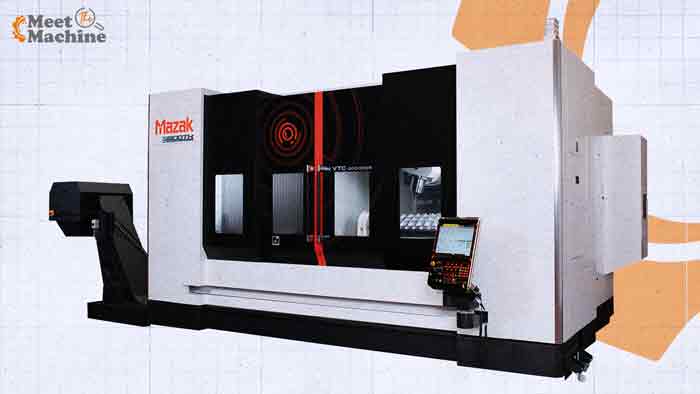
The Mazak VTC-800 is a travelling column vertical machining center built for long workpieces. VTC stands for Vertical Travelling Column, and the design inverts the usual arrangement: the table is fixed to the floor and the column carrying the spindle travels the length of it, so the workpiece never moves. The number after the slash is the X axis travel in hundreds of millimetres, so a VTC-800/20 has 2,000 mm of X and a VTC-800/30 has 3,000 mm, roughly 118 inches, on a table 3,500 mm long and 820 mm wide. An optional centre partition splits that table into two work zones so an operator can load and set up on one end while the machine cuts on the other, which Mazak calls pendulum operation. The badge covers several very different machines, including CAT 50 heavy duty versions, SR models with a swivelling B axis head, and SDR models with dual rotary tables.
Every vertical machining center you have ever run works the same way. The table carries the part and slides underneath a spindle that stays put in X. That is fine until the part is eight feet long, at which point the table has to travel eight feet in each direction and the machine needs a footprint about three times the length of the part.
The VTC-800 turns that around. The table is bolted down and the column walks. It is not a subtle difference, and it changes the floor plan, the fixturing, and how the operator spends his shift.
The Column Moves, the Table Does Not
Mazak's own description of the design is a compact travelling column that maximises working area in minimal floor space. That is the trade in one sentence, and it is worth unpacking because the benefit is not obvious until you draw it out.
On a conventional VMC, a 3,000 mm X travel means the table has to move 3,000 mm. Half of it hangs off one side of the machine at one end of the stroke and off the other side at the other end, so the machine needs roughly twice the travel in floor width, plus clearance for a person to stand there. On a travelling column machine the table never moves at all. The column covers the 3,000 mm, and the footprint is the table plus the column, not the table plus twice the stroke.
There are second order effects that matter more than the floor plan. Because the part is stationary, the mass on the table is not being accelerated and decelerated in X. A heavy fixture does not fight the axis, and it does not change the machine's dynamics as the part gets heavier. On a table-moving VMC, a 2,000 kg fixture is 2,000 kg the X axis servo has to start and stop thousands of times a shift.
The other effect is access. A fixed table with open sides means an operator can reach the work from the front along its whole length, load with an overhead crane without timing it around table position, and run coolant and air lines to a fixture that stays where he left it.
On a normal VMC you buy floor space to move the part past the tool. On a VTC you buy floor space to move the tool past the part. The second one is cheaper, and the part does not care which way it happened.
What the Number Actually Means
This is the part that trips people up in listings, and it decodes cleanly once you know the rule.
The number after the slash is the X axis travel in hundreds of millimetres. A /20 is 2,000 mm of X. A /30 is 3,000 mm, about 118 inches. The leading number tracks the Y axis class, so the VTC-800 family runs 800 mm of Y where a VTC-530 runs 530 mm and a VTC-760 runs 760 mm.
So a VTC-800/30 is an 800 mm Y machine with 3,000 mm of X. Read that way, the model number tells you the working envelope before you open the spec sheet, which is more than most Japanese model numbers do for you.
| Spec |
VTC-800/20 |
VTC-800/30 |
| X travel |
2,000 mm (78.7 in) |
3,000 mm (118.1 in) |
| Y travel |
800 mm (31.5 in) |
800 mm (31.5 in) |
| Z travel |
720 mm (28.3 in) |
720 mm (28.3 in) |
| Table |
2,500 x 820 mm |
3,500 x 820 mm (137.8 x 32.3 in) |
Those figures describe the standard and SR configurations. HD machines are specified slightly differently in places, so verify travels against the plate and the manual for the exact machine rather than against a family chart, this one included.
Pendulum Operation, and the Pallet Changer You Do Not Buy
Here is the feature that earns this machine its keep, and it is an option rather than standard, so check for it.
A removable centre partition splits the long table into two separate work zones. Mazak's language is direct: setup and workpiece loading and unloading can be performed on one side of the partition while machining is being performed on the other. Mazak calls this pendulum operation across the VTC line, and where it describes the partition feature it lists the uses as long workpieces, multiple-piece machining, or as a substitute for a two-pallet changer.
Think about what that replaces. A pallet changer buys you the same thing, load while cutting, but it buys it with a rotating or shuttling mechanism, hydraulics, clamping and unclamping cycles, pallet seating repeatability to maintain, and one more subsystem to fail on a machine that is already thirty feet of iron. The partition buys the same workflow with a piece of steel and a work offset.
The tradeoffs are real and worth stating. Zones are fixed by where the partition sits, not swappable in seconds like a pallet. The operator is working next to a running machine, so guarding and shop discipline matter. And you give up the ability to run a very long part while you have the partition installed, because the partition is the thing dividing the table.
That last point is the real decision. The same table either runs one part up to 137.8 inches long, or it runs two shorter parts in pendulum. It does not do both at once. Compare that against a dedicated pallet machine like the HCN-6000 and HCN-6800, where the pallet changer is the machine's whole reason for existing and the part size is fixed by the pallet.
One Badge, Four Different Machines
A listing that says VTC-800 and nothing else has told you the family and almost nothing else. The suffix is doing the work.
| Variant |
What Changes |
What It Is For |
| VTC-800 base |
Three axis, vertical spindle |
Long plates, rails, weldments, multi-part fixtures |
| VTC-800 HD |
CAT 50 taper, 10,000 rpm spindle |
Heavier cuts and bigger tools, trading spindle speed for torque |
| VTC-800 SR |
Swivelling B axis head, plus or minus 110 degrees, backlash free, CAT 40 at 18,000 rpm |
Contoured and angled features along a long part. This is a 5-axis machine |
| VTC-800 SDR |
Dual synchronised rotary tables |
Long round or blade-like parts supported at both ends |
| VTC-800G |
Newer generation, up to 20,000 rpm 40 taper, 48 tool magazine that travels with the column |
The current machine. Smooth control generation |
The SR is the one that catches people out. An SR is not a three axis VTC with an option bolted on, it is a five axis machine with a swivelling head, and the B axis indexes in 0.0001 degree increments across a 220 degree swing. If you are cross-shopping it against a trunnion machine, the geometry is different enough to change your fixturing and your CAM, the way we laid out in the VARIAXIS i-Series breakdown.
The Table Is Bigger Than the Travel
Two numbers on the /30 do not line up the way people assume, and both matter when you are laying out a fixture.
The table is 3,500 mm long. The X travel is 3,000 mm. You have 500 mm of table you cannot reach with the spindle. That is not a defect, it is deliberate: the extra length gives you somewhere to clamp, somewhere to set a stop, and somewhere for a part to overhang while it is supported. But if you plan a fixture assuming you can cut anywhere the table has T-slots, you will find out otherwise at the worst moment.
The same thing happens across the table. The table is 820 mm wide and Y travel is 800 mm. Twenty millimetres is not much, but it is exactly enough to put a clamp or a fixture edge somewhere the tool will not reach.
The practical version: lay out your work zones from the travel envelope, not from the casting. Then check where the column can physically go, because on a travelling column machine the column itself takes up space along the table at the ends of the stroke.
Mazatrol, and Which Control You Are Getting
The VTC-800 has been in production long enough to span several Mazatrol generations, and on a used machine the control generation drives more of the ownership experience than the year does.
A 2009 VTC-800/30 SR we found listed runs Mazatrol Matrix Nexus. Later machines carry SmoothG, and current ones including the VTC-800G run SmoothX, which brings the touch screen and 3D program visualisation. Older VTC machines in the wider family turn up on Fusion 640 generation controls.
None of these is a bad control, and Mazatrol has been conversational since 1981, which we covered in the story of the first conversational control. What changes across generations is processing speed on complex toolpaths, how much of your existing post-processor work carries over, and how easy it is to find an operator who already knows the screen. On a five axis SR running contoured work, control generation is not a footnote. Ask for it by name and get the exact version, not just "Mazatrol."
U.S. Parts and Service
This is the easy part of the ownership question, and it is a real advantage over most machines of this size and age.
Mazak builds machines in Florence, Kentucky, and runs a North American parts and service organisation that supports machines long past their production run. Operators and programmers who know Mazatrol are not hard to find in most industrial markets, which is not true of every builder's proprietary control. We went through the company and its approach in our Mazak brand profile.
Resell CNC is the only used CNC dealer in North America with Official Mazak Trade-In Center status, which means Mazak equipment moves through our hands constantly and our appraisers see these machines on shop floors rather than in brochures. If you want a second opinion on a specific VTC before you bid, that is a phone call.
How the VTC-800 Compares
The VTC-800 competes against three different things depending on what you are trying to do, and it wins against exactly one of them.
Against a large conventional VMC: the VTC wins on floor space for a given X travel and on not accelerating the workpiece. It gives up the ability to buy that same envelope from a dozen builders, because travelling column VMCs are a smaller market.
Against a pallet-changer machine: the VTC with a partition gets you load-while-cutting without the pallet mechanism, and with a longer maximum part. It gives up the fast, repeatable, operator-proof swap that a real pallet changer provides, and it gives up unattended running across a pallet pool.
Against a horizontal machining center: the VTC loses. If your parts need four-sided access and chips need to fall away from the cut, a horizontal is the right machine and no amount of table length fixes that. This is the case where we will tell you to buy something else.
Used-Market Value
We are not going to publish a price band on this machine, because the honest answer is that the spread between variants is wider than any band would be useful across. A three axis /20 on an older control and a 2018 SR with a swivel head and SmoothX are not the same purchase, and averaging them produces a number that describes nothing.
What holds value on a VTC-800 is specific and checkable. The SR head, because a five axis machine with 118 inches of X is not a common thing and there is no cheap substitute. The partition, because without it you have lost the pendulum workflow that justifies the machine over a normal VMC. The control generation. And the tool magazine size, since 30 versus 48 pockets changes what you can run without operator intervention.
One number for scale: a 2009 VTC-800/30 SR listed at 15,800 kg machine weight with a 2,500 kg table load rating, 26 kW at 18,000 rpm, a 30 pocket magazine and Matrix Nexus. That is a fifteen tonne machine, and the mass is doing the same work it does on any large machine, which we went through in why your next machine will still be iron. Treat published figures on individual listings as starting points and verify against the machine's own plate and manual.
What to Check on a Used VTC-800
Get the full model designation and the control version. VTC-800 alone is not an identification. You need the slash number, the suffix, and the exact Mazatrol generation before you can value the machine at all.
Ask whether the centre partition is included. It is an option, it is the reason many shops buy this machine, and it is a thing that gets left behind when equipment moves. Confirm it physically exists rather than appearing on a spec list.
Check the X axis way covers over their full length. On a travelling column machine the column runs the entire table length and the covers are long, exposed, and doing a hard job. Run the column end to end and watch them extend and collapse.
Indicate the table at both ends and the middle. A three and a half metre fixed table is a long casting. Check flatness and check that the T-slots have not been beaten up at the loading end, which is where years of crane work shows first.
On an SR, exercise the B axis fully. Swing it through the whole 220 degrees, listen at the extremes, and cut or at least indicate a test feature at an angle. The swivel head is the expensive part of an SR and the reason you are paying a premium.
Confirm the tool magazine count and cycle every pocket. On the G machines the magazine travels with the column, which is a different mechanism from a fixed magazine and worth watching through a full change at both ends of X travel.
Plan the rigging early. A fifteen tonne machine built around a table over eleven feet long is a real move with real cost, and rigging is the number that most often turns a good buy into a bad one when it shows up late. Get the crated dimensions, the disassembly requirement and the floor loading quoted before you bid, not after.
Who Runs One
The VTC-800 buyer is defined by part length or by batch rhythm, and usually both.
Long part work is the obvious case: machine bases and frames, rails and ways, long weldments and fabrications, extrusions, structural aerospace components, and press and mill parts that will not fit a normal VMC envelope. The SR variant pulls in aerospace structure and anything with contoured features running the length of the part.
The less obvious case is the shop that does not have long parts at all and buys it for the partition. If you run mid-size parts in batches with meaningful setup time, the pendulum workflow turns one operator and one machine into something closer to continuous cutting, and you get there without the cost and maintenance of a pallet changer. That shop is buying the table, not the travel.
The SDR draws a narrower crowd: parts that need to be held and rotated at both ends, blades and long round work, where dual synchronised rotaries do something no fixture can.
Resell CNC Take
Most people find this machine while shopping for travel and miss what it is actually good at. The long X gets you in the door, but the partition is what changes your day, because load-while-cutting is a throughput gain you feel every shift and a pallet changer is the expensive way to buy it. So ask three questions before you bid: which suffix, which Mazatrol, and is the partition physically on the machine. Those three answers separate a VTC-800 that transforms a bottleneck from one that is just a very long VMC you now have to find floor space for.
Frequently Asked Questions
What does VTC stand for on a Mazak?
VTC stands for Vertical Travelling Column. Unlike a conventional vertical machining center where the table carries the part past a fixed spindle position, the VTC has a table fixed to the floor and a column that travels the length of it. The workpiece never moves, which cuts the floor space needed for a given X travel and keeps heavy fixtures from loading the X axis servo.
What is the difference between a Mazak VTC-800/20 and a VTC-800/30?
X axis travel. The number after the slash is the X travel in hundreds of millimetres, so the /20 gives 2,000 mm and the /30 gives 3,000 mm, roughly 118 inches. Y and Z are the same on both at 800 mm and 720 mm. The tables differ to match, at 2,500 mm long on the /20 and 3,500 mm on the /30, both 820 mm wide.
What does the SR suffix mean on a Mazak VTC-800?
SR machines have a swivelling B axis spindle head, which makes them five axis machines rather than three axis ones. The head swivels plus or minus 110 degrees for a 220 degree total swing, is a backlash free design, and indexes in 0.0001 degree increments. SR machines typically run a CAT 40 spindle at up to 18,000 rpm. A separate SDR variant adds dual synchronised rotary tables, and HD machines use a CAT 50 taper at 10,000 rpm instead.
Can a Mazak VTC-800 work as two machines at once?
With the optional centre partition, effectively yes. The partition divides the long table into two work zones so an operator can load, unload and set up on one side while the machine cuts on the other. Mazak calls this pendulum operation, and where it describes the partition it lists the uses as long workpieces, multiple-piece machining, or as a substitute for a two-pallet changer. The tradeoff is that while the partition is installed you cannot use the full table length for one long part.
What control is on a used Mazak VTC-800?
It depends on the year. A 2009 example turns up with Mazatrol Matrix Nexus, later machines carry SmoothG, and current production including the VTC-800G runs SmoothX with a touch screen and 3D program visualisation. Older machines in the wider VTC family appear on Fusion 640 generation controls. Always get the exact control version rather than just "Mazatrol," because on a five axis SR it affects processing on complex toolpaths and how much of your post-processor work carries over.
How long a part will a Mazak VTC-800/30 hold?
The table is 3,500 mm long, about 137.8 inches, but X travel is 3,000 mm, about 118.1 inches. You can clamp a part longer than the spindle can reach, which is useful for support and workholding, but the machinable length is governed by the travel rather than the table. The same applies across the table, which is 820 mm wide against 800 mm of Y travel. Lay fixtures out from the travel envelope, not the casting.
Looking for a VTC or another Mazak?
Tell us the part length and the batch size.
We are the only used CNC dealer in North America with Official Mazak Trade-In Center status, backed by four AMEA and CEA certified equipment appraisers and 200+ years of combined industry experience. We will tell you honestly whether a VTC is the machine or whether you want something else.
See Used Mazak Machines
About the Author
Bill Murphy is the Marketing and Content Lead at Resell CNC, covering used machine tools, the brands behind them, and the history of the trade.
About Resell CNC
Resell CNC has bought and sold used CNC machinery since 2008. Based in Maitland, Florida, with warehouses in Winter Springs and Longwood, the team brings more than 200 years of combined industry experience and four AMEA and CEA certified equipment appraisers on staff. Resell CNC has been an MDNA member since 2009 and is the only used CNC dealer in North America with Official Mazak Trade-In Center status.