Meet the Machine
Used Tsugami B038T : The Swiss That Runs Big Bar
What is the Tsugami B038T?
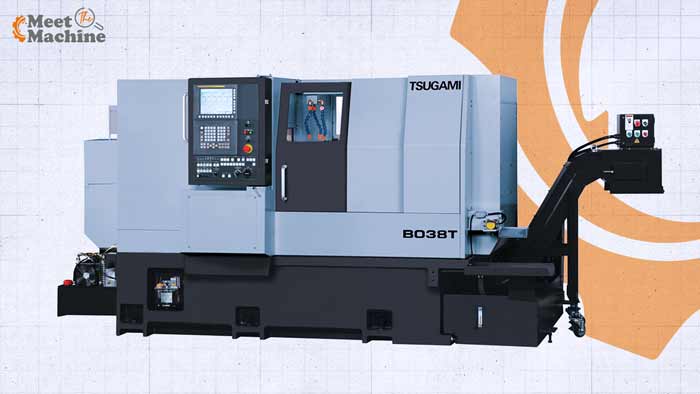
The Tsugami B038T is a Swiss-type CNC turning center with a 38 mm (1.49 inch) bar capacity, built heavier and more capable than a typical small-diameter Swiss lathe. It pairs sliding-headstock Swiss turning with a 32-station turret and gang and back-working tooling, so it can run as many as seven simultaneous machining operations across the front, back, and cross positions. It performs heavy milling, turning, drilling, tapping, hobbing, and long thread whirling, and carries a Fanuc 31i-B control. In practical terms, it is the machine a shop reaches for when parts are too big or too complex for a small Swiss but still need Swiss precision and complete, done-in-one machining from bar.
Say Swiss lathe and most machinists picture tiny parts: watch stems, bone screws, connector pins turned out of bar the size of a pencil. That picture is right for most of the class, and it is exactly why the Tsugami B038T surprises people. It runs bar up to 38 mm, carries a 32-station turret on top of its gang tooling, and is built rugged enough to take a heavy milling cut. It is a Swiss-type, but it does not act like the little sliders the name usually brings to mind.
That combination is the whole point of the machine. A shop buys a B038T when the work has outgrown a small Swiss but still wants everything a Swiss does well: turning long and slender without deflection, working the back side in the same cycle, and dropping a finished, complex part off the machine instead of moving it to a second operation. This is a working breakdown of what the B038T is, what it does, who runs it, and what to check before you buy a used one.
A Swiss-Type With a Turret
Most Swiss-type lathes are gang-tool machines. Tools sit in a row and the sliding headstock feeds the bar past them, which is fast and rigid for small parts but limits how many tools and how much power you can bring to a single feature. The B038T keeps the Swiss sliding headstock and adds a 32-station turret, the tooling arrangement you would expect on a full turning center, not a screw machine.
That turret is what makes the machine heavy-duty. It gives the B038T the tool capacity to machine genuinely complex parts in one setup and the rigidity to take a real milling or hobbing cut, not just light finishing passes. Tsugami describes it as combining the precision, accuracy, and speed of a high-performance Swiss-type lathe with the flexibility and rotary-tool capability of a turning center. In plain terms, it is a Swiss that can also do heavy work, and that is a narrower and more useful niche than either a plain Swiss or a plain turning center fills alone.
The Specs That Matter
Specs only matter when they tie to what the machine can produce. On the B038T, a handful of numbers carry the machine:
38 mm bar capacity. A 1.49 inch bar is well beyond the 20 mm and 26 mm range of common small Swiss lathes. That extra diameter opens up a class of larger fittings, shafts, and housings that a small Swiss cannot swing.
32-station turret plus gang and back tooling. With as many as 13 tools on the gang, front, and rear posts plus the 32 turret stations, the machine has the tool count to finish complex parts without a tool change stopping the job.
Seven simultaneous operations. The B038T can run as many as seven types of machining at once across the front, back, and cross positions, which is where Swiss-type cycle time comes from: cutting in several places on the part at the same moment.
Main and sub spindle. A main spindle of roughly 15 HP turning to about 5,000 RPM and a sub spindle around 7.5 HP to about 7,000 RPM give the machine the power for heavy cuts up front and full back-working behind.
Fanuc 31i-B control. The B038T runs a Fanuc 31i-B, a widely supported, high-axis-count control that most Swiss programmers and service techs already know.
The number that defines this machine is 38 mm. Everything else, the turret, the power, the rigidity, exists to do Swiss-quality work on bar that a small Swiss simply cannot hold.
Done-in-One: What It Actually Cuts
The reason a shop pays for a machine like this is to finish a complex part complete, in one cycle, from bar. The B038T is built for exactly that. It handles heavy milling, turning, drilling, and tapping, and it adds two operations that matter to specific trades: hobbing and long thread whirling.
Hobbing on the machine means the B038T can cut gear teeth and worms in the same cycle as the rest of the part, so a small gear or a splined shaft comes off finished rather than heading to a separate gear machine. Long thread whirling is the process behind precision lead screws and bone screws, cutting a long, accurate thread quickly and with a fine finish. Combine those with full back-working through the sub spindle, and a part that would take two or three machines and several handoffs on a conventional setup can come off the B038T done. Every handoff you remove is a chance for error and a queue you no longer wait in.
Why the Swiss Format Still Wins on These Parts
The sliding headstock is not a gimmick. On a Swiss-type, the bar is supported right at the cutting zone, so the tool works close to where the material is held. That is why a Swiss can turn long, slender parts that would deflect and chatter on a fixed-headstock lathe, and hold size down the whole length. The B038T brings that advantage up into 38 mm work, where parts are bigger but the demand for straightness and finish over length is just as real.
For a buyer, that is the case for the machine in one sentence: it is the format that holds tolerance on long parts, scaled up to bar most Swiss lathes cannot take, with the tooling and power to finish the part complete. If your work sits in that gap, too big for a small Swiss, too slender or too complex for a chucker, the B038T is aimed directly at you.
Where It Fits: Bigger Than a Small Swiss, Tighter Than a Chucker
The clearest way to understand the B038T is to put it between the two machines a shop would otherwise reach for. A small Swiss, a 20 mm or 26 mm slider, is fast and precise on little parts, but it runs out of bar capacity, tool count, and rigidity the moment a part gets larger or a feature needs a heavy cut. Push those jobs onto it and you are fighting the machine. The B038T picks up exactly where the small Swiss quits: bigger bar, a full turret, and the power to hog material and cut gears.
Come at it from the other direction and you have a fixed-headstock chucker or turning center. That machine has power and tooling, but it grips the part at one end and lets it cantilever out to the tool, so a long, slender part deflects, chatters, and drifts off size down its length. To hold tolerance on a long part, the chucker shop adds steady rests, extra operations, or a second machine, and every one of those is time and another chance to scrap the part. The B038T supports the bar right at the cut through the guide bushing, so it holds size over length that a chucker cannot, and its turret and back spindle let it finish the whole part in one cycle instead of three setups on three machines. That middle ground, big-bar Swiss support plus turning-center capability, is a narrow niche, and the B038T was built to own it.
The Value of Buying One Used
A new B038T is a serious capital machine, priced well into six figures once it is tooled the way a shop actually runs it. A well-kept used example can put that same capability on your floor for a meaningful discount, and because the machine runs a common Fanuc control and standard Swiss tooling, it drops into an existing programming and tooling environment instead of forcing a fresh learning curve.
The catch with any Swiss-type is that these machines earn their keep by running hard, often lights-out, so hours and maintenance history matter more than model year. A younger machine that was run without discipline can be a worse buy than an older one that was maintained by a shop that understood it. The value is real, but it lives in the condition, not just the nameplate.
What to Check on a Used B038T
Spindle and sub spindle condition. Check both spindles for runout, bearing noise, and heat. On a Swiss doing back-working, the sub spindle is as important as the main, and a tired spindle is an expensive fix.
Guide bushing and collets. Inspect the guide bushing area and the collets for wear. A worn guide bushing shows up directly as lost size control on long parts, which is the whole reason to run a Swiss.
Turret and live tooling. Index the turret and check the live-tool drives for backlash and noise. With 32 stations and rotary tooling, this is a lot of mechanism, and it needs to run tight.
Hours and maintenance records. Ask for spindle hours and service history. A documented maintenance record on a Swiss is worth paying for.
Tooling and accessories included. Confirm what tooling, collets, guide bushings, bar feeder, and options come with the machine. Swiss tooling packages are expensive, and an included package is significant value.
Control and support. Confirm the Fanuc control generation and that parts and service are available. A supported control keeps the machine earning.
Who Runs a B038T
The B038T lands wherever a shop needs complex, medium-diameter turned and milled parts in volume. Medical shops run it for larger implants, instruments, and bone screws where thread whirling and tight tolerance are the job. Aerospace and defense shops use it for fittings, valve bodies, and shafts that are too big for a small Swiss. Hydraulic and pneumatic manufacturers value the 38 mm capacity and back-working for fittings and spools. Firearms and connector work fit the profile, and the on-machine hobbing brings small gear and worm parts into the same cycle. The common thread is a part that is bigger and more complex than a small Swiss can handle, made in enough volume that finishing it complete in one cycle pays for the machine.
Resell CNC Take
The B038T sits in a sweet spot that a lot of shops do not know they need until they hit the wall on a small Swiss. When a job is too big for a 20 mm slider but too slender or too involved for a chucker, this is the machine that solves it, and finishing the part complete is where the money is. On the used market, buy the condition and the tooling package, not just the year. A well-maintained B038T with its collets, guide bushings, and options is worth far more than a cheaper one you have to re-tool from scratch. Tell us the parts you want to run and we will help you read whether a specific machine actually fits.
Frequently Asked Questions
What is the bar capacity of the Tsugami B038T?
The B038T handles bar stock up to 38 mm, or 1.49 inches, in diameter. That is well beyond the 20 mm and 26 mm range of common small Swiss lathes, which is why it suits larger fittings, shafts, and housings that a small Swiss cannot swing.
Is the Tsugami B038T a Swiss-type lathe or a turning center?
It is both. The B038T is a Swiss-type turning center that keeps the sliding headstock of a Swiss lathe and adds a 32-station turret and gang and back tooling. Tsugami describes it as combining the precision of a Swiss-type lathe with the flexibility of a full turning center.
What operations can the B038T perform?
The B038T performs heavy milling, turning, drilling, tapping, hobbing, and long thread whirling, and can run as many as seven simultaneous operations across the front, back, and cross positions. With full back-working through the sub spindle, many complex parts come off the machine finished in one cycle.
What control does the Tsugami B038T use?
The B038T comes standard with a Fanuc 31i-B CNC, a widely supported high-axis-count control that most Swiss programmers and service technicians already know, which helps with both training and long-term support on a used machine.
What should I check before buying a used B038T?
Check both spindles for runout and wear, inspect the guide bushing and collets, index the turret and test the live tooling, and ask for spindle hours and maintenance records. Confirm what tooling, guide bushings, bar feeder, and options are included, and verify the Fanuc control is still supported.
What industries use the Tsugami B038T?
Medical, aerospace and defense, hydraulic and pneumatic, firearms, and connector manufacturers use the B038T for complex, medium-diameter parts made in volume. Its on-machine hobbing and thread whirling also suit small gear, worm, and precision screw work.
Shopping a Used Tsugami?
See our Tsugami Swiss inventory.
Every machine we sell is inspected by a team with 200+ years of combined industry experience and four AMEA and CEA certified equipment appraisers on staff, spindles, guide bushing, and turret included.
See Used Tsugami Machines
About the Author
Bill Murphy is the Marketing and Content Lead at Resell CNC. The Meet the Machine series breaks down specific machines, what they do, who runs them, and what to look for when buying one used.
About Resell CNC
Resell CNC has bought and sold used CNC machinery since 2008. Based in Maitland, Florida, with warehouses in Winter Springs and Longwood, the team brings more than 200 years of combined industry experience and four AMEA and CEA certified equipment appraisers on staff. Resell CNC has been an MDNA member since 2009 and is the only used CNC dealer in North America with Official Mazak Trade-In Center status.
Sources
- Tsugami B038T Turning Center, Tsugami America
- Tsugami B038T, CNC automatic lathe, DirectIndustry
- Tsugami B038T machine details, cncmachines.com
- Tsugami B038T, Arizona CNC Equipment