Meet the Machine
Used Weiler E90 : Big-Bore Turning, Programmed at the Machine | Meet the Machine
What is the Weiler E90?
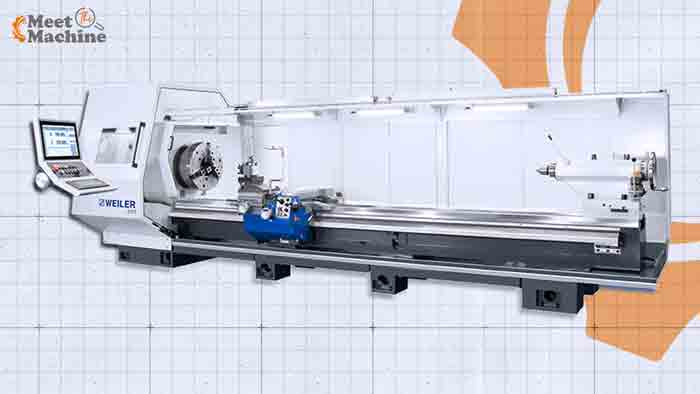
The Weiler E90 is the largest model in the German cycle-controlled E-series flat-bed lathe family, with roughly 900 mm (35 inches) of swing over the bed, a large spindle bore up to about 360 mm, and turning lengths that reach 3,000 to 4,500 mm and beyond. It pairs heavy cast-iron, German-built precision with Weiler's signature cycle control, a conversational system that lets an operator program common turning, facing, threading, and grooving cycles right at the machine, so a big lathe runs with the flexibility of a manual toolroom machine and the speed of CNC. The big bore and long bed make it a favorite for oil-country tubular work, long shafts, rolls, and large precision parts. Built by Weiler Werkzeugmaschinen in Emskirchen, Bavaria, it is sold and supported in North America through Weiler's service partners. On the used market the E90 holds value because heavy German lathes with this bore and length, and this kind of at-the-machine programming, are not easy to replace.
Big turning is usually a choice between two bad fits. A full production CNC lathe is fast but wants long runs and a programmer, which is overkill for the one-off shaft or the batch of five. A manual flat-bed lathe is flexible but slow and only as accurate as the hands on it. The Weiler E90 refuses that choice. It is a heavy, big-bore, long-bed German lathe that an operator programs at the machine through guided cycles, so a shop can chuck a large, long, expensive part and turn it accurately without writing a line of G-code or babysitting a handwheel.
This is a working machinist's breakdown of the E90 for the person about to spend real money on a used one: where it comes from, what defines it, what the E-series costs today, and exactly what to check before you buy.
Where the E90 Comes From
Weiler Werkzeugmaschinen was founded in 1948 by Willy Weiler in Emskirchen, Bavaria, Germany, and spent more than seven decades building a reputation as one of the world's premier makers of precision lathes. The company is still headquartered in Emskirchen, where it combines traditional German engineering with modern CNC manufacturing of its own machine tool components. Its defining contribution is the cycle-controlled lathe, a hybrid that bridges manual toolroom work and full CNC by letting operators program common turning cycles at the machine through conversational input.
The E-series is the flagship of that idea, and the E90 sits at the top of it. Where the smaller E30 and E50 cover toolroom and general turning, the E90 scales the same cycle-controlled, German-precision concept up to a machine that can swing 900 mm and turn parts several meters long. That is the unusual thing about it: most lathes this size are pure production or pure manual, and the E90 brings cycle programmability to heavy, large-part turning.
For a used buyer, the brand matters as much as the model. Weiler is still in business, still building in Emskirchen, and still supporting its machines through North American service partners. A used E90 is backed by a living company known specifically for lathe precision and longevity, which is what protects parts, service, and resale on a machine this heavy and this specialized.
What Defines the Machine
The cycle control. Weiler's conversational cycle control is the heart of the machine. An operator selects and fills in cycles for turning, facing, taper, thread, and groove right at the lathe, with no external CAM, so a complex one-off is programmed in minutes by the person running it. This is the feature that separates a Weiler from a plain manual lathe and from a full production CNC.
The big bore and long bed. Up to roughly 360 mm of spindle bore and turning lengths reaching 3,000 to 4,500 mm let the E90 take work most lathes cannot: long oil-country tubulars passed through the spindle, long shafts, rolls, and large fittings. The bore is the reason many of these machines end up in energy and heavy-industry shops.
Heavy German build. A heavy cast-iron bed, precision-ground ways, premium spindle bearings, and ground ballscrews are what hold accuracy on long, heavy parts and over decades of service. The mass is not incidental, it is what keeps a long, slender part from chattering.
Toolroom flexibility at scale. Steady rests, follow rests, a programmable tailstock, and a heavy carriage let the E90 support and turn long work accurately, while the cycle control keeps setup and programming fast. It is built to handle high part variety, not just one long production run.
The E-Series Family in Shop Language
E30 and E35. The compact end of the cycle-controlled line, for toolroom, prototype, and smaller precision turning where part variety is high and programming time must stay short.
E50. The mid-size workhorse, a common choice for general precision turning and repair work that still wants the cycle control.
E70. The large machine below the E90, for bigger shafts and longer parts, widely traded used as a heavy cycle-controlled lathe.
E90. The flagship and largest E-series, with the biggest swing and bore and the longest beds. The E90 is offered in length variants such as the E90/3000 and E90 x 4500, and in flat-bed oil-country configurations for tubular work. This is the machine for the largest and longest parts in the family.
All share the same cycle-controlled philosophy and German build, so moving up the E-series is a question of swing, bore, and length rather than a different machine to learn.
The Problem It Was Built to Solve
Large, varied turning is where production CNC and manual lathes both fall down. A production CNC turning center is built to repeat one part thousands of times and needs a programmer and a setup that only pays off over a long run, which makes it a poor fit for the one-off oil-country joint, the replacement roll, or the batch of five long shafts. A manual flat-bed lathe can take that work but ties up a skilled hand for hours and depends entirely on that operator's skill for accuracy. The E90 was built for the shop that lives in between: high part variety, large and long parts, and a need for accuracy without a programming department. The cycle control lets the operator program the job at the machine in minutes, and the heavy German build holds the tolerance. That combination, big-part capacity with at-the-machine programming, is the whole reason the E90 exists.
U.S. Service and Support
Weiler builds the E90 in Emskirchen, Bavaria, and supports it in North America through its sales and service partners, with parts backed by a manufacturer still actively building these machines. For a used buyer that footprint is part of the value: a big-bore spindle, a heavy carriage, and the cycle control are only worth what you can keep running, and a living German OEM with North American support is what protects uptime and resale. Because the E-series shares a control concept and many components across models, expertise and parts are not limited to a single machine, which helps keep an older E90 serviceable. Confirming a realistic parts and service path for the specific control generation on the machine you are buying is still part of the diligence.
How It Compares
| Machine |
Class |
Control |
Distinctive Strength |
| Weiler E90 |
Big-bore cycle lathe |
Weiler cycle / Siemens |
At-the-machine programming with German precision |
| Romi C 1100 |
Heavy flat-bed CNC |
Fanuc / Mach |
Heavy-duty value oil-country turning |
| Mazak Slant Turn (Oil Country) |
Big-bore production |
Mazatrol |
High-volume big-bore production and multitasking |
| DMG MORI NEF / CTX |
Universal CNC turning |
Fanuc / CELOS |
Broad modern CNC range and rigidity |
Each one has a real argument. A Romi C-series is the heavy-duty value play for big-bore oil-country turning, strong when the priority is rugged capacity at the lowest cost. A Mazak Slant Turn in an oil-country configuration is the production choice, built to run big-bore work in volume with Mazatrol and multitasking options, at a higher price. A DMG MORI NEF or CTX brings broad modern CNC turning and rigidity for a shop standardizing on full CNC. The Weiler E90 wins the order when the work is large, long, and varied and the shop wants the operator to program it at the machine, combining cycle-control flexibility with German toolroom precision on a heavy lathe. For one-offs and short runs of big parts, that is exactly the right tool.
The E90 turns oil-country-size parts with the flexibility of a toolroom lathe, because the operator programs it at the machine.
What the E-Series Costs on the Used Market
Weiler E-series lathes hold value well because heavy German precision lathes with cycle control stay in demand and do not turn over quickly. Pricing tracks size, length, control generation, and condition. As a rough guide to current secondary-market activity:
Smaller E-series (E30 to E50): typically the mid five figures for a clean, working cycle-controlled machine, the heart of the toolroom demand.
Large E70 and E90: generally the high five figures into the low six figures depending on turning length, bore, and condition, with the longest E90/4500 and oil-country machines at the top.
Accessories and length drive the number: steady and follow rests, large chucks, and a documented healthy spindle add real value, and length variants such as the E90/3000 versus E90 x 4500 change the price meaningfully. Many of these sell at auction or as request-price, so the real figure comes down to a careful read of the specific machine.
What to Check Before You Buy
Spindle and bearing health. Weiler spindles run on premium precision bearings and should show minimal runout. Indicate runout at the nose and across the large bore, and listen for bearing noise at low, mid, and high RPM. Confirm the spindle reaches rated speed without vibration and the brake engages cleanly.
The big bore. On an E90 the large spindle bore is a major part of the value, so confirm the actual bore size and that it is clean and true, especially on oil-country machines that have passed a lot of tubular through it.
Ways, ballscrews, and the long bed. Inspect the precision-ground ways for wear, scoring, or lifted cover seals along the full bed length, and measure X and Z backlash by reversing under load. Tight German ballscrews should show almost none, and on a long bed wear often shows toward the ends.
Cycle control and software. Walk through the on-board cycle library, turn, face, taper, thread, and groove, and verify every input screen loads. On Siemens-equipped machines confirm the CNC boots, all axes home, and the drives show no faults. Get parameter backups.
Tailstock and steady rests. On long-part turning the tailstock alignment and the steady and follow rests are essential. Verify alignment, that the rests are present, and that they fit the diameters you intend to run.
Carriage and chuck. Check carriage movement along the full bed, and confirm the chuck opens and closes smoothly under full hydraulic pressure with jaws in good condition.
Accessories and documentation. Weiler machines are often sold with steady rests, follow rests, live centers, chucks, and tooling that carry significant replacement cost. Verify everything on the spec sheet is present and request the machine file, schematics, and parameter backups.
Who Actually Runs Them
You find the E90 wherever large, long, varied turning is the work. Oil and gas shops run them on tubular joints, couplings, and long components that pass through the big bore. Energy, heavy-industry, and roll shops run them on shafts and rolls. Aerospace and defense toolrooms run them on large turned parts where accuracy and part variety both matter. Maintenance and MRO departments run them to make and repair big shafts on demand. The common thread is a shop that needs heavy, big-bore, long-part turning with the flexibility to program a different part at the machine every day.
Resell CNC Take
The E90 is a specialized machine, and that is exactly why a careful read pays off. The value lives in the spindle and big bore, the long bed, and the steady rests, and the cycle control is the reason to buy a Weiler over a plain heavy lathe, so confirm it works and is supportable. A clean E90 with a healthy spindle, true bore, tight ways, and its rests is a hard machine to replace and holds its value. We help buyers read all of that, and these often move through auction, where knowing what you are bidding on matters most.
Frequently Asked Questions
What is the Weiler E90?
The Weiler E90 is the largest model in Weiler's German cycle-controlled E-series flat-bed lathe family, with about 900 mm of swing over the bed, a large spindle bore up to roughly 360 mm, and turning lengths reaching 3,000 to 4,500 mm. It combines heavy German precision with Weiler's conversational cycle control for at-the-machine programming, and is used for big-bore, long-part turning such as oil-country tubulars, shafts, and rolls.
What is a cycle-controlled lathe?
A cycle-controlled lathe is a hybrid that bridges manual and full CNC turning. Weiler pioneered the concept: the operator programs common turning cycles such as turn, face, taper, thread, and groove directly at the machine through conversational input, getting the flexibility of a manual toolroom lathe with the speed and repeatability of CNC, without external CAM.
What are the E90's swing, bore, and turning length?
The E90 offers roughly 900 mm of swing over the bed, a spindle bore up to about 360 mm, and turning lengths that reach 3,000 to 4,500 mm and beyond, depending on the length variant such as the E90/3000 or E90 x 4500. That big bore and long bed are what make it suited to oil-country and large-shaft work.
What does a used Weiler E90 cost?
As a rough guide, smaller E-series lathes run in the mid five figures, while large E70 and E90 machines generally run from the high five figures into the low six figures depending on turning length, bore, control generation, and condition. Length variants and included steady rests and chucks move the number, and many sell at auction or as request-price.
How does the E90 compare to a Romi or a Mazak oil-country lathe?
A Romi C-series is the heavy-duty value option for big-bore turning, and a Mazak Slant Turn in oil-country form is the high-volume production choice. The E90's edge is at-the-machine cycle programming combined with German toolroom precision, which makes it the better fit for large, long, varied parts and one-offs rather than long production runs.
Is Weiler the lathe maker the same as Weiler Abrasives?
No. Weiler Werkzeugmaschinen GmbH, the lathe manufacturer in Emskirchen, Germany, is separate and unrelated to Weiler Corporation and Weiler Abrasives, which make industrial brushes and abrasives. The E90 and the rest of the lathe line are products of Weiler Werkzeugmaschinen.
Buying or Selling a Weiler E90?
Resell CNC buys and sells used Weiler lathes, with four AMEA and CEA certified appraisers who know how to read a big-bore spindle, a long German bed, and the cycle control before you commit. See current Weiler inventory or get help reading an E90 before you buy.
See Weiler Inventory
About the Author
Bill Murphy is the Marketing and Content Lead at Resell CNC, where he covers used CNC equipment, auction strategy, and the buying side of the secondary machine tool market. Working directly with the company's appraisal, auction, and retail teams, he translates machine-level detail into practical guidance for the shop owners, plant managers, and acquisition buyers who read it.
About Resell CNC
Founded in 2008 and headquartered in Maitland, Florida, Resell CNC has facilitated more than $1 billion in equipment transactions and carries over 200 years of combined industry experience across its team. The company staffs four AMEA and CEA Certified Equipment Appraisers, has been a Machinery Dealers National Association (MDNA) member since 2009 with a seat on its board of directors, is an active member of the Industrial Auctioneers Association (IAA), and is the only used CNC dealer in North America with Official Mazak Trade-In Center status. Resell CNC operates across four divisions, retail, auction, appraisal, and finance, from its Florida headquarters and warehouses in Winter Springs and Longwood. Simple. Reliable. Trusted.®