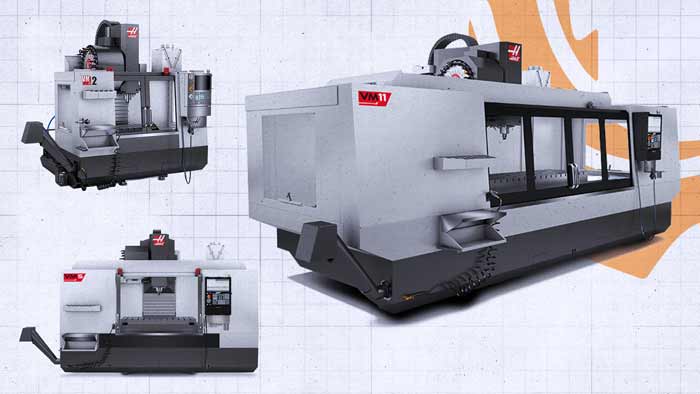
CNC Family Breakdown
Haas VM Series: You Are Not Buying a Spindle, You Are Buying a Table
What is the Haas VM series?
The Haas VM is a VF-series vertical machining center configured for mold work. Haas says so itself: its 2025 reference guide describes the VM as taking VF-Series machines and creating custom configurations for mould making and tool and die. VM stands for Vertical Mold Making Machine, which is the product name Haas prints, not a dealer expansion. The number sets the size class, running VM-2, VM-3, VM-6, VM-8 and VM-9, with a separate 50-taper branch. Every 40-taper VM carries the same 12,000 rpm inline direct-drive spindle, the same 30 hp, and the same 90 ft-lb of torque. What actually separates a VM from the VF underneath it is the table.
Almost every used Haas VM listing leads with the same two facts. Twelve thousand rpm inline direct-drive spindle. High Speed Machining with full look-ahead. Both are true. Neither is worth anything to you, because both are standard equipment on every VM Haas has ever shipped. A seller advertising them is advertising the catalogue.
The part that is genuinely different, the part you cannot option onto a VF at any price, is the casting you bolt the work to. And it is the one thing the listings almost never describe.
This breakdown works through the whole family, model by model, using Haas's own published figures. It covers what changes as you go up the range, the two specifications that get worse instead of better, why a VM-6 and a VF-6/40 are the same machine with one number different, and the four options that actually move a used VM's price while the listing stays vague about all four.
The table is the part you cannot buy your way to
Haas lists a multi-fixturing table as VM standard equipment. That phrase is doing more work than it looks like. On a standard VF-2YT the table carries three T-slots running one direction. On the VM the slots run in both axes, and Haas adds precision dowel-pin bores and drilled and tapped holes across the surface.
Haas publishes the counts on all four product pages. The VM-2 carries three T-slots across X and seven across Y. The VM-3 carries six across X and thirteen across Y on 100 mm centers. The VM-6 and VM-8 both carry five across X and twelve across Y, on 125 mm and 175 mm centers. Slot width is 5/8 inch, 16 mm on every one of them.
What that buys a mold shop is not glamorous and it is not on a spec sheet. It is dowel-located fixture plates that go back on the machine in the same place every time. It is clamping a mold base square without a tram-and-pray session. It is fixturing across the short axis without building a subplate first. For a shop whose work is repeat tooling plates, cores, cavities and inserts, that is recovered setup hours on every single job.
Now hold that against everything else the mold badge supposedly buys you:
| Supposed VM advantage |
Can you get it on a VF? |
| 12,000 rpm inline direct-drive spindle |
Yes. Standard on a VF-2SS or VF-3SS. |
| High Speed Machining with look-ahead |
Yes. A specifiable option. |
| Side-mount tool changer |
Yes. Optional on VF-2 and VF-3, standard on the VF-6/40. |
| Linear scales |
Yes, and they were never standard on a VM either. |
| Chip auger |
Yes. Catalogue option. |
| Through-spindle coolant |
Yes, and it was optional on the VM too. |
| Cross-pattern table with dowel bores |
No. This one is VM only. |
Every row but the last is an option somebody can check on an order form. The last row is a different casting. That is the whole argument, and it is why the mold premium on a used VM is really a table premium. Worth paying for a shop clamping mold bases. Worth close to nothing for a shop running vises.
What VM stands for, and where Haas actually publishes it
Dealers write that VM means Vertical Mill. It does not, and the reason is simple: Haas calls the whole vertical range vertical mills, VF included, so vertical mill cannot be what the M distinguishes.
Haas prints the actual product name in at least four places we could open. Its UK site describes the VM-3 and VM-6 as a Vertical Mould Making Machine. A capture of a Haas specification page dated 21 June 2012, with the source URL printed on the document, reads "Vertical Mold Making Machine; 40 x 26 x 25 in, 40 taper, 30 hp." The VM-series brochure carries the title "The Vertical Mold Making Machines." And Haas's own site taxonomy files the range under Mold Machines, with the legacy page parameter literally reading MOLD.
One caveat we will not paper over. Haas publishes the phrase Vertical Mold Making Machine as the product's descriptor. In nothing we could reach does Haas print a letter-by-letter expansion of the form "VM equals Vertical Mold." Reading V as vertical and M as mold is one inference off Haas's own product string, which is a very different thing from the dealer inventions that circulate around other model prefixes. The Haas operator and service manuals live behind bot protection that blocked every automated attempt, so whether one of those defines the abbreviation outright is not something we can confirm.
The family is bigger than VM-2, VM-3 and VM-6
Nearly every dealer page describing the VM series names three machines and stops. The current 40-taper range runs to five.
VM-2, VM-3, VM-6, VM-8 and VM-9. All five carry live product pages, and the VM-8's page is fully specified. The VM-9 appears on the Haas UK mould machine category page with travels of 2134 by 1016 by 762 mm, which is 84 by 40 by 30 inches, but its detail page sits on the domain that blocked us, so the rest of its specification is not something we can publish.
There is also a 50-taper branch, and it is where the family is currently growing. Haas pages confirm a VM-3/50 and a VM-9/50, and Haas publishes a pre-install guide for the VM-8/50. Then on 17 August 2026, days before this article was researched, Haas added four more 50-taper mold machines: the VM-10/50, VM-11/50, VM-12/50 and VM-14/50. Trade coverage carries the announcement date and a Haas product page for the VM-14/50 is live. That coverage is a press release rewrite with no travels, table or spindle figures in it, so we can tell you those machines exist and what taper they carry. We cannot publish their specifications.
Worth noting for anyone assuming this is a legacy line being wound down: it is not. The VM appears in the Haas CNC Reference Guide dated 2025, all five 40-taper models carry current product pages, and the 50-taper models did not exist in the 2010 brochure, and four of them launched this month. A builder extending a family is not retiring it. That matters for parts, and it is the single most under-reported fact in the used VM conversation.
One inconsistency inside Haas's own material, flagged because you will trip over it: the 2025 reference guide lists only VM-2, VM-3 and VM-6, while the UK category page lists VM-8 and VM-9 as well. Regional availability is the likely explanation. Confirm before you assume a model can still be ordered new in your market.
The spec ladder, model by model
Figures below are Haas published specifications retrieved in August 2026. Read the last four rows across before you read anything else.
| Spec |
VM-2 |
VM-3 |
VM-6 |
VM-8 |
| X travel |
30 in / 762 mm |
40 in / 1016 mm |
64 in / 1626 mm |
64 in / 1626 mm |
| Y travel |
20 in / 508 mm |
26 in / 660 mm |
32 in / 813 mm |
40 in / 1016 mm |
| Z travel |
20 in / 508 mm |
25 in / 635 mm |
30 in / 762 mm |
30 in / 762 mm |
| Table |
36 x 18 in |
54 x 25 in |
64 x 28 in |
64 x 36 in |
| Max weight on table |
3,000 lb |
4,000 lb |
4,000 lb |
4,000 lb |
| Coolant capacity |
55 gal / 208 L |
55 gal / 208 L |
95 gal / 360 L |
95 gal / 360 L |
| Spindle taper |
BT or CT 40 |
BT or CT 40 |
BT or CT 40 |
BT or CT 40 |
| Max rpm, standard |
12,000 |
12,000 |
12,000 |
12,000 |
| Spindle motor |
30 hp / 22.4 kW |
30 hp / 22.4 kW |
30 hp / 22.4 kW |
30 hp / 22.4 kW |
| Max torque |
90 ft-lb at 2,000 |
90 ft-lb at 2,000 |
90 ft-lb at 2,000 |
90 ft-lb at 2,000 |
| Rapids |
710 ipm / 18.0 m/min |
710 ipm / 18.0 m/min |
600 ipm / 15.2 m/min |
600 ipm / 15.2 m/min |
| Max cutting feed |
500 ipm |
500 ipm |
500 ipm |
500 ipm |
Tool changer capacity is the one row we will not put a single number against, because Haas's own current material disagrees with itself. The UK product pages list 24+1 side-mount on the VM-2 and VM-3. The 2025 reference guide lists 30+1. The VM-6 and VM-8 pages both say 30+1. Used listings resolve the contradiction the way you would expect: pre-2015 machines show 24+1, and 2021 and 2022 machines show 30+1, so this reads as a specification change across the production run rather than an error. The changeover year is not something we can pin down. Count the pockets on the machine.
One row is missing from that table on purpose, because it belongs in a sentence rather than a cell. Twelve thousand rpm is the standard spindle on every VM. Haas also sells a 15,000 rpm option, and on the VM-2, VM-3 and VM-6 it sells a 30,000 rpm 30-taper spindle with its own option page. That last one is a real factory configuration, not a listing typo, and it changes what the machine is for. Thirty thousand rpm through a 30 taper is a small-cutter finishing head for graphite and hardened steel. It is not a general-purpose spindle, and a machine carrying one was bought to do something specific.
Two specs that get worse as the machine gets bigger
Read the bottom of that table across and two things jump out that nobody selling these machines will point at.
Torque never improves. VM-2, VM-3, VM-6 and VM-8 all publish 90 ft-lb at 2,000 rpm, which is roughly 122 Nm. A VM-8 with 64 by 40 by 30 inches of travel and a 64 by 36 inch table has exactly the same cutting torque as the smallest machine in the family. Going up the range buys you room, not spindle. Anybody assuming the big one hogs harder has that backwards.
Rapids get slower. The VM-2 and VM-3 traverse at 710 ipm. The VM-6 and VM-8 traverse at 600. Buying up in size costs you 110 ipm of non-cutting motion, on machines with more than twice the travel to cover. On long tool-change-heavy mold programs that compounds across a shift.
There is one more, and it is the sharpest of the three, but it needs the VF next to it to see.
The number that surprises people
A Haas VM-2 rapids at 710 ipm. The VF-2 and VF-2YT it is built from rapid at 1,000. The mold machine gives up 290 ipm of traverse and 150 ipm of maximum cutting feed to the standard machine on the same casting. The VM's speed story is spindle rpm. It was never axis speed.
A VM-6 and a VF-6/40 are the same machine, minus one number
Put the two Haas product pages side by side and this is what you get.
| Spec |
VM-6 |
VF-6/40 |
| Travels |
64 x 32 x 30 in |
64 x 32 x 30 in |
| Table |
64 x 28 in |
64 x 28 in |
| Max weight on table |
4,000 lb |
4,000 lb |
| Taper |
BT or CT 40 |
BT or CT 40 |
| Motor |
30 hp / 22.4 kW |
30 hp / 22.4 kW |
| Torque |
90 ft-lb at 2,000 rpm |
90 ft-lb at 2,000 rpm |
| Spindle drive |
Inline direct-drive |
Inline direct-drive |
| Tool changer |
Side-mount 30+1 |
Side-mount 30+1 |
| Rapids |
600 ipm |
600 ipm |
| Max cutting feed |
500 ipm |
500 ipm |
| Max rpm |
12,000 (15,000 opt.) |
8,100 |
Ten rows identical. One row different. On the sixty-four inch machine, where both models already ship a side-mount changer as standard, the entire published difference between the mold machine and the general-purpose mill is the table pattern and a spindle that starts 3,900 rpm higher and options up to 15,000, where the VF-6/40 is fixed at 8,100.
The pairing holds further down the range too. The VM-2's envelope, table and 3,000 lb load rating match the VF-2YT exactly. The VM-3's envelope and table match the VF-3YT exactly, though the current pages differ on load rating, 4,000 lb against 3,500. The YT is the giveaway. It means extended Y travel, and it tells you the VM's footprint is not a mold-specific casting at all. It is the extended-Y VF frame Haas already sells.
Two other things the VF gets that the VM apparently does not. The VF-2 offers an optional gearbox rated 250 ft-lb at 450 rpm, nearly three times the VM's torque down where roughing lives. No such option appears on any VM page we could open, though absence from a page is not proof of absence. And the Super Speed VF machines carry a 12,000 rpm inline spindle while keeping the higher VF rapids, which means against a VF-2SS specifically the VM's spindle advantage disappears entirely and the argument comes back to the table.
There is no VM-2SS, and never was
Super Speed is a VF designation. Haas builds a VF-2SS, a VF-3SS, a VF-6SS and the extended-Y combinations VF-2SSYT and VF-3SSYT, each with its own product page. It has never built a VM-2SS or a VM-3SS. Neither appears on the Haas UK site, on the mould machine category page, in the 2025 reference guide, or in the 2010 VM brochure.
Structurally, that makes sense. Super Speed means a high-rpm inline spindle and quick rapids on a VF frame, which is most of what the VM already is. Haas had no gap to fill.
So a machine advertised as a VM-2SS is one of two things: a mislabelled VF-2SS, or a plain VM-2 with two letters a seller added. Read the data plate. If a listing invents a model designation, assume the option list is guesswork too.
The four options that move the price, and how listings hide them
Here is the used-market pattern, and once you see it you cannot unsee it. Every VM listing brags about the two things that are standard. Every VM listing goes vague on the four things that are not.
The clearest evidence sits in a single price pair. Two 2015 VM-3s, same model, same year. One asking 49,500 dollars, the other asking 72,500. Roughly 46 percent apart, and the expensive one carried through-spindle coolant and a probing package. Those are asking prices, not market values or transaction values, and no settlement figure is published for either. But the spread tells you what is actually being priced on this family, and it is not the year.
1. Through-spindle coolant, and the word "ready." This is the biggest gap on the family. Listings very often read "Through Spindle Coolant Ready" or "TSC ready," which means the prep and plumbing package. Not the pump. Not the rotary union. Not the tooling. Haas sold TSC at 300 psi and 1,000 psi levels and maintains separate troubleshooting documentation for each across both control generations, so this is a real serviced subsystem with real generational differences, not a checkbox. Experienced VM users on the forums recommend adding through-spindle coolant for deep drilling, which tells you the base machine shipped without it. Identify the pump physically or assume it is not there.
2. Linear scales, which are almost certainly not there. Scales were never standard on a VM. Haas sells X and Y linear scales as a catalogue option, and the 2010 brochure quotes improved accuracy only as a conditional, only for the VM-6. Across every platform we searched, marketplace aggregators and individual dealer pages alike, not one used VM listing stated the machine had them. Not one. If a seller claims scales, that claim gets verified at the control before it gets priced.
3. Probing, minus the probe. Roughly half the listings we read mention a probing package. One dealer itemised a wireless probing system at around 6,395 dollars of option value plus a riser block near 695. Another listing read, in its own words, "Wireless Intuitive Probing System (Probe Needed)." The interface is bolted to the machine. The probe left with the last operator. That happens constantly and it is an expensive thing to discover after delivery.
4. Fourth axis that exists versus fourth axis wiring. "4th axis ready" and "4th and 5th axis ready" appear on a large share of VM listings. Ready is wiring and a drive, itemised by one dealer at roughly 3,595 dollars. It is not a rotary table. Several listings advertise "5th axis ready" on a three-axis machine, which inflates perceived value for nothing you can cut with.
Two more traps worth naming because they will corrupt any price comparison you run. One marketplace displays 999 dollars in the price field on VM-3 and VM-6 listings; that is a reservation deposit, not the machine. And be careful which listings you throw out. One dealer page advertised a 2018 VM-2 at 109,900 dollars while describing it as "30,000 RPM, BT 30 taper." That reads like a typo until you check it, because it is a documented Haas option, and it goes a long way toward explaining the ask. On this family the specification that looks wrong is sometimes the one that costs the most.
Graphite, and the history that does not show on a spec sheet
This is the VM-specific risk almost nobody writes about, and it exists precisely because of what the machine was sold to do.
Mold shops cut graphite. They own sinker EDMs, they need electrodes, and cutting their own electrodes on a machine they already have is the obvious move. A VM is a flood-coolant machine with no dust containment, so when it happens, the machine is operating outside what it was built for.
Graphite dust does two separate kinds of damage. It is abrasive, and trade coverage of electrode machining is explicit that uncontrolled graphite dust can damage the spindle, way covers and ballscrews. And it is electrically conductive, which is the part buyers miss. Industry sources describe graphite dust shorting sensitive electronics, and one states directly that glass scales can give false measurements from settled dust. On a machine bought for accuracy, that is the worst possible failure mode: an instrument that is wrong rather than an instrument that is broken.
Purpose-built graphite mills answer this with full enclosure, large-capacity extraction and filtration, extra seals and special covers to keep dust out of the work zone. A stock VM has none of that.
How you detect it:
Look for retrofit scars. Ducting ports cut into the sheet metal, blanked-off holes, aftermarket door seals or brush strips. A VM with enclosure modifications has a story worth asking about.
Look where nobody wipes. The top of the electrical cabinet, behind the pendant, inside the tool changer carousel housing, the underside of way covers, cable track interiors, the flats on the spindle head casting. Coolant grime is brown-grey and greasy. Graphite residue is matte black, dry, and it smudges.
Open the electrical cabinet. Conductive black film on board surfaces or packed into cabinet fan filters is the tell, and it is also the direct explanation for intermittent alarms nobody can trace.
Check for a dry conversion. Coolant system drained, disabled or bypassed. Graphite is usually cut dry.
One honest limit on all of that. The mechanisms above are well documented in trade and industry sources and apply to machine tools generally. We found no VM-specific graphite failure documentation. Applying them to this family is reasoning, not a case file. It is sound reasoning, and on a heavily used unit with confirmed graphite history the exposure list runs to spindle bearings, ballscrews, ways, electronics and, if scales are fitted, the measurements themselves. That is a walk-away condition more often than it is a discount.
Buy the newest control you can afford, not the newest casting
The VM ran on the Haas Classic or Legacy control from the beginning of the family through roughly 2015. The Next Generation Control took over across 2015 and 2016, with trade coverage of NGC dated September 2016. The widely repeated claim that NGC was announced at IMTS 2014 is not something we could verify against a Haas document, so treat the changeover as a two-year band rather than a date. A VM built 2004 through 2014 is Classic. A 2017 or later machine is NGC. Verify anything in between on the machine itself.
What the generation buys you: NGC ships 1 GB of program memory as standard with 32 and 64 GB options, Ethernet standard with WiFi optional, a network share so programs run and edit from a desktop, a fifteen-inch colour screen, conversational programming through Haas VPS, and advanced macro and variable programming with dynamic work offsets and tool center point control. On a family bought for long three-dimensional finishing programs, memory and look-ahead capacity is not a convenience feature.
Two cautions. You cannot retrofit a Legacy control into an NGC; the accepted view in the trade is that the change means a new machine, though we could not corroborate that against Haas documentation. And do not identify the control from the listing's spec block. Fifteen-inch colour screen, 1 GB memory, USB and Ethernet appear in both late-Classic and NGC-era Haas literature. Identify it from the actual screen software in a photograph.
One practical wrinkle from the used supply. Model years cluster heavily from 2005 to 2012, thin out noticeably from 2013 to 2016, then pick up again from 2017 to 2022. Which means the window a buyer usually wants, old enough to be cheap and new enough for NGC, is exactly where the supply is thinnest. Most of the inexpensive machines are Classic-control units.
What the used market actually looks like
Supply is moderate to thin, and thinner than a search suggests, because aggregators republish the same dealer inventory. Counting what rendered on the pages we fetched in August 2026: the VM-2 is the volume model, appears on every platform we checked, and runs 2006 to 2022 with the same 2013 to 2016 hole in the middle. The VM-3 runs roughly half to two thirds of that density and skews older, with a real cluster of 2004 and 2005 units. The VM-6 is present but sparse, and what exists skews toward heavily optioned late machines. The VM-8 returned zero used listings. Treat it as effectively unavailable used.
We are not going to publish a total. De-duplicating the same stock across four marketplaces from public data is not possible, and any number would be invented.
The most telling data point is an absence. A search on one major auction platform returned 158 Haas lots and not one VM. Every Haas vertical in that result set was a VF, a VR, an OM or a TL. VMs are not moving through the liquidation channel in visible volume, which reads two ways at once: the installed base is small relative to the VF, and the shops that bought them are keeping them. Both are probably true. The practical consequence is that the cheapest acquisition route for most used Haas equipment is closed on this family. You are buying dealer inventory at dealer asking prices, and we have no verified VM auction results to offer as a counterweight.
Observed asking prices, and these are asking prices only. On the VM-2, a 2006 at 21,500 dollars, several 2008 machines between 29,900 and 38,000, a 2017 at 60,000, 2018 units at 58,500 and 68,500, an essentially unused 2020 with probing and TSC at 81,575, and 2022 machines from 69,750 up to 99,750. On the VM-3, a 2004 at 37,500, two 2005 machines at 27,600 and 28,800, and the 2015 pair discussed above. VM-6 asking data is genuinely scarce. The one figure we could read was 169,500 dollars on a heavily optioned 2019 machine carrying HSK-63, a thirty-tool changer, a dual trunnion fifth axis and 1,000 psi through-spindle coolant. Older VM-6s consistently list no price at all.
Note what happens at the bottom of that range. A 2006 VM-2 asking 21,500 and a 2008 asking 29,900 are inside plain VF money. At that level the mold table and the standard 12,000 rpm spindle come close to free, and the entire argument of this article stops being about premium and starts being about finding one.
The honest counter-case
A used VM is not automatically the right machine, and a dealer who tells you otherwise is selling, not advising.
The finish advantage is smaller than the marketing. Mold makers who ran identical programs on a VM-2 and a VF-2SS reported only a marginal surface finish difference, while noting the VM sounded quieter under a heavy cut, which implies more rigidity. If better finish than a VF is your entire buying rationale, that rationale is partly imported from a brochure.
The VM does not rough. This is the clearest owner-reported limitation on the family. Experienced operators report the VM-2 will not take big cuts, describe spindle stoppages attempting large cutter work, and put the practical ceiling for high-feed milling somewhere around a 1.5 inch cutter. Thirty horsepower in a 40 taper with a 12,000 rpm spindle is a finishing machine. If the plan is rough and finish on one spindle, this is the wrong machine or it needs a roughing partner.
A used VF-SS gives you the spindle and double the rapids. For a shop with mixed work, that is the more versatile machine, and the used VF supply is enormously deeper. Deeper supply means more comparables, a better negotiating position and an easier exit when you sell. One caveat that cuts hard the other way on this family: the VF-2SS is rated for 1,500 lb on the table against the VM-2's 3,000. If you are clamping mold bases, the Super Speed just halved your capacity.
Thin supply cuts both ways. Few used VM-3s and VM-6s means weak price discovery and a seller who knows your alternatives are limited.
Against that: the table does not exist on any VF, the mold-spec spindle is baseline rather than something you hunt for in an option list, the family is in current production so the parts outlook is healthy, and the precision claim is attested by working mold makers rather than only by Haas. Owners report holding roughly four tenths without much effort. One reported a quarter thou on a VM-3, but that was 6061 aluminium with a 0.093 inch extended-length carbide end mill, which is not the tool steel case this paragraph is about. Haas's own 2010 brochure published positioning accuracy of two tenths on the VM-2 and VM-3. Those are different measurements and the brochure figure is not a working tolerance. Use the owner numbers.
Resell CNC Take
The break-even on this family is simpler than the spec sheets make it look. If more than half your work is three-dimensional finishing in tool steel on plates that need dowel-located fixturing, the VM earns its keep, because the table is the one thing you cannot option onto anything else and it pays you back in setup hours on every job. If it is under half, and your work fits inside the Super Speed's 1,500 lb table rating, buy the VF, take the rapids and the deeper supply, and stop paying for a badge. Either way, the spindle and the High Speed Machining in the advert are not the deal. Real through-spindle coolant, a probe that is physically present, a rotary that exists rather than wiring that anticipates one, scales that are actually fitted, and the control generation are the deal. Ask about those five in writing before you talk price.
What to check before you wire funds
All three hour counters, photographed at the control. They will not agree and that is the point. A real example from a 2010 VM-6: servo time 58,439 hours, motion time 5,477, spindle time 5,404. Same machine. The 58,000 figure is powered-on time and tells you about electronics ageing, not wear. Spindle-on hours is the bearing clock and the number that prices your largest risk. Motion hours is the ballscrew and way clock. A machine with 5,400 spindle hours against 58,000 powered hours spent the overwhelming majority of its life energised and not cutting. One where spindle hours track motion hours closely has been cutting hard and continuously. Both can be fine. One number cannot tell you which.
Twelve thousand rpm, commanded and held, on a warm machine. Not a listing claim and not a ninety-second cold demo. Every VM advert says 12,000 rpm because that is the catalogue spec whether or not the machine can still get there. A control that caps below 12,000 has either had a non-VM spindle fitted or been parameter-limited by a shop nursing a failing bearing set. Run it warm, run it long, watch the load meter and listen.
Which generation of inline spindle it has. Haas publishes distinct replacement procedures for pin-drive and spider-coupling inline 40-taper spindles, plus a documented conversion from second to third generation motor and spindle. Multiple generations exist across the VM's production run and they are not freely interchangeable. That a factory conversion path exists is genuinely reassuring for an older machine. It also means an early VM may need a conversion rather than a like-for-like swap. Rebuild and conversion costs are quoted per job and not published anywhere, so do not accept a number from anyone who has not looked at the machine.
The table, physically. This is the asset. Check the T-slots in both directions for damage and previous over-clamping, and check the dowel bores for wallowing and burrs. A VM with a beaten table has lost the thing that made it a VM.
Scales: existence first, condition second. Confirm at the control that they are there before you evaluate whether they work. If fitted, check alarm history for following-error and position faults, and confirm the axis reads the same at the control as an indicator does on a known move.
Way covers and wipers, pulled if the seller allows. Look for impact dishing and for hardened grit embedded in the wiper lips. On a mold machine you are also reading what got past them, which is the graphite question above.
TSC run under pressure, with filtration confirmed. If it is there, put a TSC-capable holder in the spindle and confirm the pump builds and holds. Check the rotary union area and check for coolant in the spindle cavity. Confirm the filtration is present and has not been bypassed, because a shop running TSC on unfiltered coolant has been feeding grit through the spindle bore.
Shopping a Used Haas VM?
See our Haas inventory.
Tell us the parts you want to run and our team, with 200+ years of combined industry experience and four AMEA and CEA certified appraisers on staff, will match you to the right VM size, control generation and option set, and confirm a used one is built the way its tag claims.
See Used Haas Machines
Frequently asked questions
What does VM stand for on a Haas mill?
Vertical Mold Making Machine. That is the product name Haas itself prints, on its UK product pages, on a specification page capture dated 21 June 2012, and in the title of the VM series brochure. It does not mean Vertical Mill, which is what many dealer pages claim, because Haas applies vertical mill to its entire vertical range including the VF, so it cannot be the thing the M distinguishes. One honest limit: Haas publishes the descriptive phrase, not a letter-by-letter expansion, so reading V as vertical and M as mold is a single inference off Haas's own wording rather than a quotation.
What is the difference between a Haas VM and a Haas VF?
A VM is a VF configured for mold work, which Haas states plainly in its 2025 reference guide. The real differences are a 12,000 rpm inline direct-drive spindle as standard where the equivalent VF ships 8,100, a side-mount tool changer standard on the smaller models, High Speed Machining and a chip auger as standard, and a multi-fixturing table with T-slots running in both axes plus dowel-pin bores. The spindle motor, torque, travels and table size match the equivalent VF, and on the VM-3 the load rating actually goes the other way, 4,000 lb against the VF-3YT's 3,500. The table is the only difference you cannot option onto a VF, which makes it the one that carries the value case.
Is there a Haas VM-2SS or VM-3SS?
No. Super Speed is a VF designation only. Haas builds the VF-2SS, VF-3SS, VF-6SS and the extended-Y VF-2SSYT and VF-3SSYT, and has never listed a VM Super Speed model on its product pages, its category pages, its 2025 reference guide, or the VM series brochure. A machine advertised as a VM-2SS is either a mislabelled VF-2SS or a plain VM-2 that a seller added letters to. Check the data plate, and treat the rest of that listing's specifications with the same suspicion.
Does a Haas VM come with linear scales?
No. Scales appear in no VM standard equipment list. Haas sells X and Y linear scales as a catalogue option, and the 2010 VM brochure quotes improved accuracy only as a conditional and only in reference to the VM-6. Across every marketplace and dealer page we searched in August 2026, not a single used VM listing stated the machine had them. If a seller claims scales, verify at the control before that claim affects the price, and remember that scales on a machine with graphite history can read wrong rather than simply fail.
How many models are in the Haas VM series?
More than the three most dealer pages name. The current 40-taper range is VM-2, VM-3, VM-6, VM-8 and VM-9. There is also a 50-taper branch that is still growing: Haas pages confirm a VM-3/50, a VM-8/50 and a VM-9/50, and on 17 August 2026 Haas added the VM-10/50, VM-11/50, VM-12/50 and VM-14/50, which takes the family to at least twelve models. We can confirm the 50-taper machines exist but cannot publish their specifications, because those pages sit behind bot protection that blocked every automated attempt. Haas's own material is also internally inconsistent here, with the 2025 reference guide listing only three models while the UK category page lists five.
Which Haas VM has the most spindle torque?
None of them. The VM-2, VM-3, VM-6 and VM-8 all publish 30 hp and the same 90 ft-lb of maximum torque at 2,000 rpm, roughly 122 Nm. Going up the range buys travel, table size and in some cases tool capacity, but not spindle. A VM-8 with 64 by 40 by 30 inches of travel cuts with exactly the same torque as a VM-2. Worth noting the 2010 brochure published 75 ft-lb at 2,100 rpm where current pages say 90 at 2,000. That is not a contradiction inside Haas's literature, it is a spindle generation change on the same frame, so check the figure for your machine's vintage rather than reading the current page.
Is a used Haas VM good for roughing?
Not particularly, and this is the family's clearest limitation. Experienced owners report the VM-2 will not take big cuts, describe spindle stoppages attempting large cutter work, and place the practical high-feed ceiling around a 1.5 inch cutter. Thirty horsepower through a 40 taper geared for 12,000 rpm is a finishing configuration. The VF-2 even offers an optional gearbox rated 250 ft-lb at 450 rpm that no VM page lists. If the plan is to rough and finish on one spindle, either choose differently or budget for a roughing partner machine.
What should I check on a used Haas VM that I would not check on a VF?
Four things. Command and hold 12,000 rpm on a warm machine rather than trusting the listing, since every VM advert quotes the catalogue figure. Establish which generation of inline spindle it carries, because Haas documents multiple generations and a factory conversion path between them. Inspect the table itself, the T-slots in both directions and the dowel bores, because that casting is the asset. And look for graphite history in the electrical cabinet, behind the pendant and under the way covers, because mold shops cut electrodes and graphite dust is both abrasive and electrically conductive.
About the Author
Bill Murphy is the Marketing and Content Lead at Resell CNC. The CNC Family Breakdown series maps out entire machine families, decoding the model numbers, suffixes, and configurations so buyers can tell one version from the next. Every figure in this article is attributed to the source that publishes it, figures that exist on only one source are identified, and specifications no manufacturer publishes are named rather than filled in.
About Resell CNC
Resell CNC has bought and sold used CNC machinery since 2008. Based in Maitland, Florida, with warehouses in Winter Springs and Longwood, the team brings more than 200 years of combined industry experience and four AMEA and CEA certified equipment appraisers on staff. Resell CNC has been an MDNA member since 2009 and is the only used CNC dealer in North America with Official Mazak Trade-In Center status.
Sources
- Haas Automation UK product pages for the VM-2, VM-3, VM-6 and VM-8, retrieved August 2026. Travels, table sizes, maximum weight on table, spindle taper, standard and optional spindle speeds, motor rating, maximum torque, tool changer type and capacity, rapids, maximum cutting feed, coolant capacity, T-slot counts and center distances on all four models, standard equipment lists, and the Vertical Mould Making Machine product descriptor.
- Haas Automation UK mould machine category page, retrieved August 2026. Full 40-taper model roster including VM-9 travels of 2134 by 1016 by 762 mm.
- Haas CNC Reference Guide, Issue 17, 2025. The statement that the VM series took VF-Series machines and created custom configurations for mould making and tool and die work, the VM-2, VM-3 and VM-6 listing, 30+1 tool changer figure, and the 15,000 and 30,000 rpm spindle options.
- Haas VM series brochure, certified June 2010, retrieved from a dealer-hosted mirror. Brochure title The Vertical Mold Making Machines, the VM-2, VM-3 and VM-6 roster, published positioning accuracy of plus or minus 0.0002 inch on the VM-2 and VM-3 and 0.0003 inch on the VM-6, 75 ft-lb maximum torque at 2,100 rpm, VM-3 table load of 3,500 lb, 24+1 standard tool changer with 40+1 optional, linear scales referenced as a conditional accuracy improvement on the VM-6, and standard equipment including the multi-fixturing table with dowel-pin bores and drilled and tapped holes.
- Haas Automation specification page capture dated 21 June 2012, source URL printed on the document, rehosted by a third party. The wording Vertical Mold Making Machine, 40 by 26 by 25 inch travels, 40 taper, 30 hp, and T-slots on 100 mm centers.
- Haas Automation UK product pages for the VF-2, VF-2YT, VF-3YT and VF-6/40, retrieved August 2026. Comparison travels, table sizes, load ratings, taper, motor rating, torque, spindle drive type, tool changer, rapids of 1,000 ipm on the VF-2 and VF-2YT, maximum cutting feed of 650 ipm, 8,100 rpm maximum spindle speed on the VF-6/40, and the optional gearbox rated 250 ft-lb at 450 rpm.
- Haas Automation page titles and service documentation indexes. Existence of the VM-3/50, VM-8/50 and VM-9/50, the VM-8/50 pre-install guide, distinct replacement procedures for inline pin-drive and inline spider-coupling 40-taper spindles, the second to third generation inline motor and spindle conversion, separate TSC-300, TSC-1K and TSC-1000 troubleshooting documentation across both control generations, and the X and Y linear scales option listing.
- Haas Automation UK control feature documentation and trade press coverage of the Next Generation Control dated 23 September 2016. NGC program memory of 1 GB standard with 32 and 64 GB options, Ethernet standard and WiFi optional, network share, fifteen-inch colour display, Haas Visual Programming System, advanced macros, dynamic work offsets and tool center point control, and electronic thermal compensation documented as a general control feature rather than VM-specific hardware.
- Machining center specification aggregators, retrieved August 2026. HSK-A63 taper option on the VM-2 and VM-6, 50+1 tool changer option, older VM-6 rapids of 540 ipm in X, and Classic-era program memory figures. Third-party data, not Haas published.
- Used machinery marketplaces, aggregator model indexes and individual dealer inventory pages, surveyed August 2026. Model year spread from 2004 to 2022, per-model supply density, observed asking prices by model and vintage, standard versus optional configuration language including Through Spindle Coolant Ready, 4th and 5th axis ready, and Wireless Intuitive Probing System with probe needed, itemised option values for probing and fourth axis wiring, the reservation deposit displayed in a price field, the internally contradictory 2018 VM-2 listing, and the three hour counters read from a 2010 VM-6.
- Auction platform search returning 158 Haas lots with no VM among them, August 2026. Reported as an absence of verified auction results for this family, not as a price finding.
- Machinist forum thread on VM-2 mold making, opened 25 September 2012, accessed via a public mirror. Owner-reported working accuracy of approximately four tenths and one report of a quarter thou with extended tooling, the reported inability to take big cuts and spindle stoppages on large cutters, the practical high-feed ceiling around a 1.5 inch cutter, the marginal finish difference against a VF-2SS running the same program, the observation that the VM sounded quieter under heavy cut, and the recommendation to add through-spindle coolant for deep drilling.
- Trade press and mold industry technical sources on graphite electrode machining. Graphite dust described as abrasive and as damaging to spindle, way covers and ballscrews when uncontrolled, described as highly conductive and responsible for damage to machines and electronics, the statement that glass scales can give false measurements due to settling dust, and the enclosure, extraction, filtration, seal and cover provisions of purpose-built graphite machines. General to machine tools, not VM-specific.
- Haas Automation VM Series features page, retrieved August 2026, and trade press coverage dated 17 August 2026. The 30,000 rpm 30-taper spindle option alongside the 12,000 rpm standard and 15,000 rpm optional spindles, and the announcement of the VM-10/50, VM-11/50, VM-12/50 and VM-14/50 fifty-taper mold machines.
- Not established from any source and therefore not stated in this article: the VM series introduction year, discontinuation dates for any model, specifications for the VM-9 beyond travels and for all 50-taper models, spindle rebuild or conversion costs, new machine list prices, verified auction results, unique unit counts on the used market, and any VM-specific documented case of graphite damage. Haas Automation's US domain served its mold machine category and features pages but returned 403 on individual model pages and option pages, and one major machinist forum returned 403 throughout, so most Haas figures above came from the Haas UK site, the Issue 17 reference guide, and a mirrored copy of the 2010 brochure.