CNC FAMILY BREAKDOWN
How to Read a Haas SL Model Name: When Haas Put the Options in the Name
How do you read a Haas SL model name?
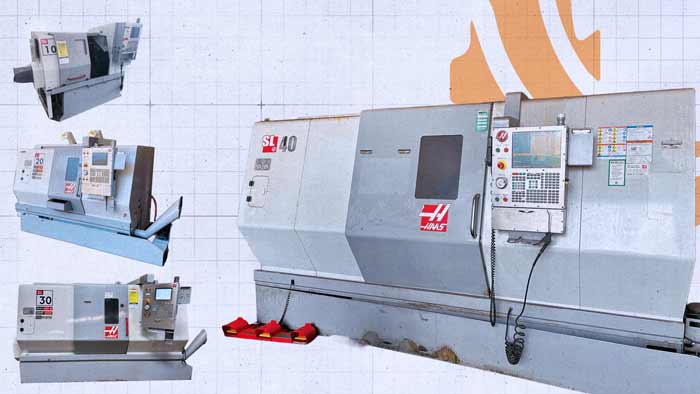
A Haas SL model name has three parts: the SL series designation, a number that identifies a size class, and optional letter suffixes. The line used only four numbers, SL-10, SL-20, SL-30 and SL-40, and the number is a class index rather than a chuck size. The suffixes are where the SL differs from every other Haas lathe family, because several of them describe factory options rather than machine geometry. T marks a tailstock, B marks a big bore, APL marks an automatic parts loader, L marks a long bed, and M appears on some live tooling machines. The successor ST series still sells every one of those options, but none of them appear in an ST model name.
Haas has built lathes under three series names. The HL series arrived first, in 1994. The SL series ran from about 1998 to June 2011. The ST series took over and is still in production. Look at how the three of them handled model names and something odd sits in the middle.
On an HL, a tailstock was just a tailstock. Machines are listed as "HL-4 with tailstock," and no HL-4T appears anywhere. On an ST, a tailstock is still an option, and Haas will still sell you one as a field install kit, but it never touches the model name. In between, for roughly twelve years, Haas put it right in the designation. SL-10T, SL-20T, SL-30T. Big bore got a letter too, and so did the automatic parts loader. That habit opened around 1999 and closed around 2011, and the SL is the only Haas lathe family that lived entirely inside it. Which makes the SL name genuinely more informative than an ST name, right up until the point where it misleads you. Both halves of that are worth understanding before you bid.
The three parts of the name
SL is the series, and what it stands for is undocumented. This is worth stating carefully, because it is a documented absence rather than a failed search. Haas's own SL-Series Service Manual, part number 96-8710, contains a section headed "Common Abbreviations Used in Haas Machines." That glossary spells out VF as Vertical Mill, VMC as Vertical Machining Center, APL as Automatic Parts Loader and TS as Tail Stock. It does not define SL. Haas decoded its mill prefixes inside the glossary of its lathe manual and skipped the lathe prefix entirely. Slant bed lathe is the common industry reading and these machines are slant bed, but no Haas document says so.
The number is a size class. Only 10, 20, 30 and 40 were ever used. There is no SL-15, SL-25 or SL-35; those sizes arrived later with the ST series.
The suffixes are a mix of geometry and options: T, B, L, M and APL. Two more letter combinations show up constantly in listings and were never Haas designations at all.
The number is a size class, and two false patterns will fool you
Line the SL machines up and two clean rules appear to emerge. Neither is real.
The swing pattern. The SL-30 has a 30 inch swing over the bed. The SL-40 has a 40 inch swing. Both exact. Then the SL-20 has 23 inches and the SL-10 has 16.25, and the rule collapses.
The horsepower pattern. The SL-20 is 20 horsepower, the SL-30 is 30, the SL-40 is 40. Three for three, exact. Then the SL-10 is 15 horsepower, not 10, and that one collapses too.
Two coincidences that each hold for most of the line and break at the same machine. Treat the number as a class index and read the published specs for the specific model, which look like this.
| Model |
Chuck |
Swing |
Cut length |
Bar cap. |
Max rpm |
Motor |
Nose |
| SL-10 |
6.5 in |
16.25 in |
14 in |
1.75 in |
6,000 |
15 hp |
A2-5 |
| SL-20 |
8.3 in |
23 in |
20 in |
2.0 in |
4,000 |
20 hp |
A2-6 |
| SL-30 |
10 in |
30 in |
34 in |
3.0 in |
3,400 |
30 hp |
A2-6 |
| SL-40 |
15 in |
40 in |
44 in |
4.0 in |
2,400 |
40 hp |
A2-8 |
Standard machines, before options. SL-30 figures are the post-2002 specification. Some sources give the SL-10 an 11 inch maximum cutting diameter and a 6 inch chuck at launch, and dealers commonly list the SL-30 at 17 inches against Haas's own published 16.3, so confirm against the specific machine. Maximum spindle torque is essentially undocumented across the SL line; the only published figure found is 850 ft-lb for the big bore SL-30, and even that is given without a stated rpm.
Worth knowing that the SL-30 changed mid-life. In May 2002 Haas enlarged the spindle bore, taking bar capacity from 2.5 to 3.0 inches, raised maximum part diameter from 14.5 to 16.3 inches, and made the bolt on turret standard. Haas attributed the diameter gain directly to adopting the bolt on turret. So a 2001 SL-30 and a 2004 SL-30 are meaningfully different machines wearing the same name.
The options that made it into the name
T is a tailstock. Haas never printed the expansion in a document we could reach, but the option status is documented plainly: Haas's own May 2002 SL-30 announcement lists the "programmable hydraulic tailstock available as optional equipment," and the Haas steady rest instruction sheet refers to "the tailstock option." So the tailstock was a line item, and Haas offered both SL-20 and SL-20T, SL-30 and SL-30T.
B is big bore, and this one is confirmed Haas nomenclature rather than dealer shorthand. Haas instruction manual ES0381 prints the model list "SL-20, SL-20L, SL-20B, SL-30, SL-30L, SL-30B, SL-40, SL-40B, SL-40L" and captions a drawing "SL-40, SL-40B, SL-40L Base Pattern." What big bore bought you varied by frame. On the SL-20 it meant a 10 inch chuck instead of 8.3 and 2.5 inch bar capacity instead of 2.0. On the SL-30 it meant 4 inch bar capacity, a 40 horsepower vector drive with a two speed gearbox, and that 850 ft-lb figure. On the SL-40 it meant an 18 inch chuck, 6.5 inch bore and an A2-11 spindle nose.
APL is an Automatic Parts Loader, and this is the clearest case of all, because Haas defined it in its own glossary: "APL Automatic Parts Loader." A bolt on automation accessory that got promoted into a model designation, as in SL-20APL.
L is a long bed, and unlike the others this is pure geometry. The SL-20 cuts 20 inches and the SL-20L cuts 40. The SL-30 cuts 34 and the SL-30L cuts 60. The SL-40 cuts 44 and the SL-40L cuts 80. Roughly double in every case, which is the same logic Haas still uses on the ST today.
M is live tooling, and it is the one suffix Haas applied inconsistently. Documented SL-40LM machines carry a full servo C axis and a live tool turret. But plenty of live tooling SL machines never got an M, and you will find SL-20T listings with C axis and live tooling fitted. Read M as a letter that shows up on some live tooled SLs rather than a systematic code.
The SL name tells you more than an ST name does. It is also less reliable. Both of those come from the same decision.
BB and TB are not Haas designations
Search the used market and you will find SL-20BB, SL-30BB, SL-20TB and SL-30TB everywhere. Search Haas's own publications and you will find none of them. Haas used a single B.
What is happening is that a seller is compressing a spec sheet into a model number. A machine with a tailstock and a big bore becomes "SL-30TB" because that is faster to type than describing it. The machine is real and usually the description is accurate, but the designation is not something Haas ever stamped on anything. That matters in two practical ways. If you search for an SL-30TB you will miss correctly labeled SL-30B machines that have tailstocks. And if you call a Haas Factory Outlet for parts quoting a model that does not exist in their system, you will spend the first five minutes of that call establishing what you actually own. Give them the serial number.
And no T does not mean no tailstock
Here is where the informative naming turns against you. Plain SL-10 and SL-20 listings exist with tailstocks clearly fitted and described. Sometimes that is a seller writing the base model name out of habit. Sometimes it is a tailstock added later. Either way, the rule you would like to apply, that a missing T means a missing tailstock, does not survive contact with the used market.
The same caution runs the other direction on live tooling, given how loosely M was applied. So use the suffixes as a strong hint about what the machine probably left the factory as, and then verify the hardware with your eyes. On a machine that is now between fifteen and twenty seven years old, the name describes an original configuration, not necessarily the current one.
The twelve year window, bracketed by Haas's own paperwork
The nicest documentary detail in this whole family is a part number. Haas's HL-Series Service Manual is document 96-8710, dated January 1996, with revisions in 1997 and 1998. Haas's SL-Series Service Manual is document 96-8710, dated January 1999. Same document number, new series name. That brackets the HL to SL rename to somewhere between June 1998 and January 1999.
The other end is bracketed just as cleanly. Every Haas turret parts diagram for the SL line carries a printed effective date range ending in the same month: SL-20 and SL-20L, January 1999 to June 2011. SL-30 and SL-30L, January 1999 to June 2011. SL-10, January 2001 to June 2011. Haas's spindle replacement procedure for the SL lathes gives its own span as January 1997 to June 2011. And the Haas turning centers catalog dated December 2011 contains no SL models at all.
So: HL from 1994, no suffix letters. SL from 1998 to June 2011, options in the name. ST from roughly 2009 onward, options out of the name again. The changeover was staggered by size class rather than happening on one date, with the small and mid machines going first and SL-40 units still being built into 2011 and 2012 alongside ST-40s.
One assumption to correct while we are here, because it is the natural one to make and it is wrong by about five years. The control did not change at the SL to ST transition. Late SL machines and early ST machines both ran the Classic Haas control. The Next Generation Control arrived in 2016.
The control break is inside the SL run, not at the end of it
Every SL carries the Classic Haas control, since the whole production run ended five years before NGC existed. But two SLs can still be very different machines to live with, and the dividing line sits in the middle of the series.
Compare Haas's own manuals. The January 1999 SL-Series Service Manual describes a control that loads programs by floppy disk and RS-232, with a maximum of 200 programs in memory. The June 2005 SL-10 Operator Manual shows a USB memory device in the control box diagram, raises the cap to 500 programs, and documents RS-232 from 9,600 to 115,200 baud plus drip feeding for programs too large to hold.
That is the same series, six years apart, and it changes your daily workflow completely. On an early SL you are running a floppy or drip feeding over serial. Practical fix if you buy one: USB floppy emulators are a standard retrofit that present themselves to the control as the original floppy drive, so the same load and save buttons work. Two constraints worth knowing before you order one. Files must be under about 1.3 MB, and the USB stick has to be formatted FAT rather than FAT32.
Memory is the related constraint. The 2011 Haas electrical service manual describes the processor board as a 68ECO30 running at 40 MHz with 128K of EPROM and 1 to 16 MB of CMOS RAM. Owners report roughly 1 MB usable as standard with a paid upgrade to expand it, which is a common source of irritation because the capacity is physically present and software limited. Whatever the machine has, check it and check the program count against how you actually program.
Identifying which control you are looking at takes about thirty seconds. Check Setting 143. On the Classic control it is a simple on and off value. On NGC it is numeric. Classic shares data over RS-232 serial; NGC uses Ethernet, and NGC has a wired connection page under network settings that Classic does not. A ten inch monochrome CRT marks the earlier machines, though that is a weaker tell than the setting, because Haas publishes an official CRT to LCD replacement procedure and plenty of machines have had it done.
Does Haas still support these? Yes, and here is the evidence
Haas has a reputation for long parts support. On the SL it is not just reputation, it is checkable at the part number level. Haas's own parts store currently catalogues SL specific items including a tailstock read head encoder for the SL-20 and SL-30, a turret unclamp cylinder assembly for the SL-20 and SL-30, a parts catcher air cylinder for the SL-20 and SL-30, and a die spring retainer catalogued for "SL-10 through SL-40, TL-15, ST-10."
Haas also still publishes the documentation. The SL spindle replacement procedure carries an effective date covering the entire production run and a 2015 copyright, and names the specific Haas belt tensioning tools by part number. Exploded view turret diagrams for the SL-10, SL-20 and SL-30 are live on Haas's document server, as are the 1999 and 2004 service manuals.
The structural reason it holds up is visible in the titles of Haas's own troubleshooting guides, which span both series: "Turret Replacement, HL, SL, ST-10." "Turret Indexer Assembly, SL-10/20/30, ST-10/15." "Motor Coupling Alignment, SL-10/20/30, ST-10/10Y." Haas maintains shared procedures across the old and current lathes because the hardware lineage is shared.
The honest counterweight: independent repair shops describe Haas parts channels for Classic control machines as still good but thinning, and there is a long running owner campaign on the machining forums pushing for better support of older Haas machines. Both things are true at once. Parts are demonstrably available today, and the trend line is not in your favor forever.
What to inspect on a machine this age
The memory battery, first and above everything else. A 3.3 volt lithium cell on the processor board backs up the CMOS RAM that holds your programs, parameters, offsets and settings. Haas raises Alarm 124 when it goes low and states it requires replacement within 30 days. Let it die on a twenty year old machine whose parameter backup may not exist anywhere, and you have a very expensive problem. Ask whether the battery has ever been changed, and get a parameter backup in your hand before money moves.
The turret, which is the most reported SL failure cluster. Alarm 114 is a turret lock failure, and owners report three common causes. The turret can be knocked out of time by a crash, which requires repositioning through the machine's hidden A axis. The solenoid valve can fail, and this is a genuine consumable: one technician reported changing them about twelve times over eight years. Useful number for that conversation, an individual solenoid runs about ten dollars against roughly four hundred for a complete valve assembly, so make sure the diagnosis is specific before you approve the quote. And contaminated or wet shop air causes slow indexing and lock failures, which is a plant problem rather than a machine problem. Index the turret through every station repeatedly, cold and warm, and look at the air dryer.
The two speed transmission, on the big frames only. The SL-30 and SL-40 carry a dual speed gearbox, and Haas's service manual states that a damaged unit requires complete unit replacement. That is a large financial exposure that simply does not exist on an SL-10 or SL-20. Listen to it shift.
The spindle. SL spindle bearings are air mist lubricated at one cubic centimeter per hour, so confirm the mist system is actually delivering. For reference on what a proper rebuild looks like, Haas specifies bearing face axial runout at or under .0004 inch and final runout at or under .001 inch.
Hours, which you will probably have to find yourself. Across the listings surveyed for this piece, almost none published an hour meter reading. US dealers routinely substitute the phrase "average cutting time," which is not a number. The hours are readable on the control. Read them.
Your tool blocks carry forward to the ST
This is the piece of good news that changes the math for a lot of shops. The SL uses bolt on tool blocks, and the blocks map to the current ST series by frame size.
The SL-10 uses BOT10, shared with the ST-10, ST-10L, ST-15 and ST-15L. The SL-20 and SL-30 use BOT20, shared with the ST-20 through ST-35 including the long bed variants, plus the DS-30 and the TL-15 and TL-25. The SL-40 uses BOT50, shared with the ST-40, ST-45, ST-50 and ST-55. Tooling vendors organize their entire Haas catalog around this, selling single part numbers listed for both series, and one turret face wedge clamp is described as fitting "DS-30, SL-20, SL-30, ST-20, ST-25, ST-30, ST-35 or BOT20" machines.
Two caveats, stated plainly because getting this wrong is expensive. Haas itself publishes no SL to ST interchange statement; its current bolt on tooling pages list only ST models, most likely because Haas lists machines it still sells. The claim rests on vendor evidence and shared Haas internal part numbers, not an OEM compatibility statement. And turret station counts differ: Haas's own SL-20 diagram is titled "Turret, 10 to 12 Station," so both were built, while the ST-20 is twelve. A shop moving between the two should confirm station count and layout, and should treat live tooling and coolant blocks as a separate question we could not resolve.
SL or ST
Buy the SL for price and simplicity. Public asking prices put usable SL-20T machines in a wide but comprehensible band: a 2003 advertised at $18,000, a 2005 at $21,000, a 2008 at $27,500, a 2009 at $30,000, with a 2006 SL-10 at $20,500 and a 2002 SL-40 at $45,000. Those are asking prices from third party listings, not transaction prices, and we found no verified auction hammer prices because the results are login gated. Beyond price, the Classic control is widely called the easiest control to learn, the machine is fully documented, and parts are demonstrably still flowing.
Buy the ST for rigidity, tool capacity and runway. Owners who have run both report the ST-20 is noticeably more rigid than the SL-20 and considerably quieter above 2,500 rpm, and that twelve turret stations solve real fixturing problems that ten stations do not, particularly on castings. The ST is also the current platform, which means a support horizon measured in decades rather than years, modern data handling instead of floppies and drip feeding, and a path to NGC. We found no confirmed NGC retrofit path for an SL lathe, so do not buy one expecting to modernize the control later.
The short version: an SL is a good machine at a used price with a known and manageable set of age related risks. Buy it deliberately, with the battery, the backup and the turret checked, and it will earn its keep. Buy it casually and the control will teach you something.
Reading a real listing, one piece at a time
Take "2005 Haas SL-20TB" and work through it. The year puts it inside the Classic control era by definition, and close enough to the 2005 manual revision that USB may be present, so check the control box rather than assuming. SL places it in the 1998 to 2011 family. The 20 sets the frame: 8.3 inch chuck standard, 23 inch swing, 20 inch cutting length, 20 horsepower to 4,000 rpm, A2-6 nose, BOT20 tool blocks that will also fit an ST-20 through ST-35 if you ever move up.
Then the suffix, carefully. The T says the machine originally had a tailstock. The B says big bore, which on this frame means a 10 inch chuck and 2.5 inch bar capacity rather than the standard 8.3 and 2.0. But TB together is not a Haas designation, so what you are reading is the seller's summary, not a factory model. Confirm both the tailstock and the bore against the machine.
What the string cannot tell you at all: whether the memory battery has ever been replaced and whether a parameter backup exists. Whether the turret indexes and locks cleanly through every station warm. Whether the spindle mist lubrication is working. The hour meter reading. Whether the control loads by floppy or USB. And whether the tooling in the deal is complete, which on a BOT20 machine is worth more than it looks.
RESELL CNC TAKE
The SL is the machine we get asked about most by shops buying their first CNC lathe, and the honest answer is that it is a reasonable entry if you go in with your eyes open. The iron is fine. The control is old, and old does not mean bad, it means you inherit whatever the last owner did or did not do about the memory battery and the backups. That is the whole deal in one sentence.
The other thing we tell people is not to over-read the model name. T and B are genuinely useful, and then someone types TB and now you are chasing a model Haas never built. We work from the serial number and what is actually bolted to the machine, and we would rather confirm a tailstock with a photograph than a letter. If you already run an ST, ask about the tool blocks before you dismiss an SL on age. Those blocks are worth real money and they cross over.
Frequently asked questions
How do you read a Haas SL model name?
A Haas SL model name has three parts: the SL series designation, a number that identifies a size class, and optional letter suffixes. The line used only four numbers, SL-10, SL-20, SL-30 and SL-40, and the number is a class index rather than a chuck size. The suffixes are where the SL differs from every other Haas lathe family, because several of them describe factory options rather than machine geometry. T marks a tailstock, B marks a big bore, APL marks an automatic parts loader, L marks a long bed, and M appears on some live tooling machines. The successor ST series still sells every one of those options, but none of them appear in an ST model name.
What does the T mean on a Haas SL-20T?
T indicates a tailstock. Haas never printed that expansion in the documents available to us, but the option status is documented directly: Haas's May 2002 SL-30 announcement lists a programmable hydraulic tailstock as optional equipment, and Haas's steady rest instruction sheet refers to the tailstock option. Important caveat for used buyers: the absence of a T does not reliably mean the absence of a tailstock, because plain SL-10 and SL-20 listings exist with tailstocks fitted, whether through seller shorthand or later retrofit. Verify the hardware rather than the letter.
Is there a difference between an SL-30B, an SL-30BB and an SL-30TB?
Haas used a single B for big bore. Its own instruction manual ES0381 prints the model list as SL-20, SL-20L, SL-20B, SL-30, SL-30L, SL-30B, SL-40, SL-40B and SL-40L. BB and TB appear only in dealer and auction listings, never in a Haas publication, and they are sellers compressing a spec sheet into a model number, usually meaning big bore and big bore plus tailstock respectively. The machines are real, the designations are not factory. Search both spellings so you do not miss listings, and quote the serial number rather than the model when ordering parts.
Does Haas still make parts for the SL series?
Yes, and it is verifiable rather than a matter of reputation. Haas's own parts store currently lists SL specific part numbers including a tailstock read head encoder for the SL-20 and SL-30, a turret unclamp cylinder assembly, a parts catcher air cylinder, and a die spring retainer catalogued for SL-10 through SL-40 along with the TL-15 and ST-10. Haas also still publishes SL exploded view turret diagrams, the 1999 and 2004 service manuals, and troubleshooting procedures that span both the SL and ST series. Independent repair shops describe the Classic control parts channel as still good but thinning, so treat availability as real today and finite over time.
Do Haas SL tool blocks fit an ST lathe?
By frame size, yes. The SL-10 uses BOT10 blocks shared with the ST-10 and ST-15, the SL-20 and SL-30 use BOT20 blocks shared with the ST-20 through ST-35 plus the DS-30 and TL-15 and TL-25, and the SL-40 uses BOT50 blocks shared with the ST-40 through ST-55. Tooling vendors sell single part numbers listed for both series. Two caveats: Haas itself publishes no SL to ST interchange statement, since its current tooling pages list only machines it still sells, and turret station counts differ, with some SL-20 machines built as 10 station against the ST-20's 12. Confirm station count and layout, and treat live tooling and coolant blocks as a separate question.
Should I buy a used Haas SL or a used Haas ST?
Buy the SL for price and simplicity. Public asking prices have put SL-20T machines from roughly $18,000 for a 2003 to about $30,000 for a 2009, the Classic control is widely considered the easiest to learn, and parts and documentation are still available. Buy the ST for rigidity, twelve turret stations instead of ten, quieter running above 2,500 rpm, modern data handling instead of floppy disks and drip feeding, and a longer support horizon. One point that decides it for some shops: there is no confirmed path to upgrade an SL lathe to the Next Generation Control, so do not buy one planning to modernize the control later.
VERIFY THE MACHINE, NOT THE LETTERS
See what Haas turning centers we have on the floor now
Every machine is evaluated by a team that includes four AMEA and CEA certified equipment appraisers, so you get the configuration, the tooling standard, and the control generation confirmed before you commit.
Browse Used Haas Machines
SOURCES
- Haas Automation, SL-Series Service Manual, document 96-8710, January 1999, including the Common Abbreviations Used in Haas Machines glossary.
- Haas Automation, SL-Series Service Manual, revision J, June 2004.
- Haas Automation, HL-Series Service Manual, document 96-8710, January 1996, with 1997 and 1998 revisions.
- Haas Automation, SL-10 Operator's Manual, document 96-8700 revision L, June 2005.
- Haas Automation, Electrical Service Manual, document 96-0284D, June 2011.
- Haas Automation, SL lathe spindle replacement procedure, effective date January 1997 to June 2011.
- Haas Automation, exploded view turret diagrams for SL-10, SL-20 and SL-20L, and SL-30 and SL-30L, with printed effective date ranges.
- Haas Automation, instruction manual ES0381 revision P, January 2008, steady rest option, model list for SL-20, SL-30 and SL-40 machines.
- Haas Automation press release announcing increased SL-30 capacities, 30 May 2002.
- Haas Automation press release announcing the SL-10 lathe.
- Haas Automation, CNC Turning Centers catalog, December 2011.
- Haas Automation replacement parts store, SL series part listings, accessed August 2026.
- Haas Automation service troubleshooting and how-to guides spanning the HL, SL and ST series, accessed August 2026.
- Haas Automation, tailstock field install kit documentation for the ST-10 and ST-15, service document AD0587.
- Haas Automation, monitor CRT to LCD replacement procedure, service document AD0156.
- Tooling and Production, Haas Automation cover feature, February 2008, on the introduction of the HL-1.
- Bolt on tooling manufacturer catalogs listing BOT10, BOT20 and BOT50 machine compatibility across the SL and ST series, accessed August 2026.
- MachineMetrics, guidance on identifying Haas Next Generation, Classic, Serial and I/O controls, accessed August 2026.
- Shop Floor Automations, Haas floppy drive emulator documentation, accessed August 2026.
- Independent CNC service provider documentation on Haas Classic control repair scope and parts availability, accessed August 2026.
- CNCArena machining forum threads on buying older Haas machines, SL-20 turret problems, Haas memory options, and ST-20 owner impressions, 2009 to 2016.
- Public dealer and marketplace listings for used SL machines, model year, configuration and asking price, accessed August 2026.
ABOUT THE AUTHOR
Bill Murphy is the Marketing and Content Lead at Resell CNC. The CNC Family Breakdown series decodes model families so buyers can read a listing the way a dealer reads it.
ABOUT RESELL CNC
Resell CNC has bought and sold used CNC machinery since 2008. Based in Maitland, Florida, with warehouses in Winter Springs and Longwood, the team brings more than 200 years of combined industry experience and four AMEA and CEA certified equipment appraisers on staff. Resell CNC has been an MDNA member since 2009 and is the only used CNC dealer in North America with Official Mazak Trade-In Center status.