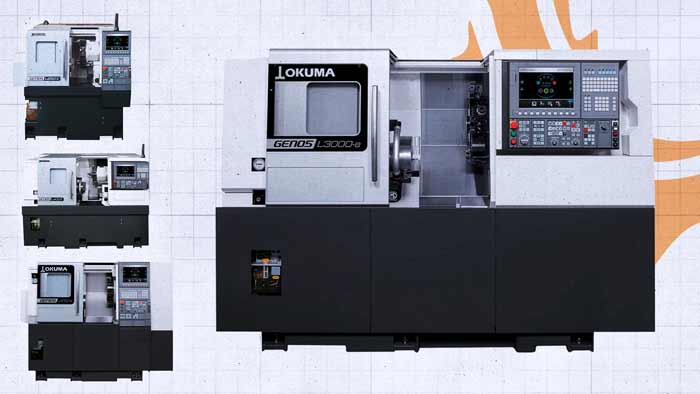
CNC FAMILY BREAKDOWN
Okuma GENOS L Model Numbers Explained: L200 to L400, and Why the Mill-Turn Has the Lower Number
How do you read an Okuma GENOS L model name?
A GENOS L model name has four parts: the GENOS brand, which marks Okuma's value line; the letter L for the lathe family; a number that identifies a capacity and configuration class rather than any single dimension; and suffixes describing the turret and spindle configuration. The number is not the chuck size, and it runs in a direction most buyers do not expect. On the original lineup an 8 inch chuck bought either a turning only L250 or a live tooling L200-M, and a 10 inch chuck bought either an L400 or an L300-M, because the multitasking turret costs turning diameter. M means live tooling with a C axis, Y adds a Y axis, W adds a sub-spindle, and bed length is written separately as C by a millimeter figure.
Okuma's GENOS L is one of the most common used Okumas on the market and one of the hardest to read. The family has been renamed twice, it splits into two sub-lines that renamed themselves in two different directions, it carries two separate letter E designations Okuma has never defined in print, and its four digit numbers look exactly like the four digit numbers on Okuma's premium LB series while meaning something entirely different. A buyer who assumes a GENOS L3000 is the GENOS version of an LB3000 is off by a full chuck class.
The machines themselves are straightforward, and Okuma says plainly what they are. A 2018 corporate statement confirmed GENOS is built by Tatung-Okuma in Taiwan and provides the basic functions and performance of machine tools at affordable price levels, while its Japan plants build the premium ranges. Okuma America markets the L250II as an affordable entry level lathe that is anything but basic. That is an honest description of a well built value machine. This breakdown is about the label on the front of it, because on a used listing the label is most of what you get.
The four parts of the name
GENOS is the brand, covering lathes and machining centers both. Okuma filed the trademark in February 2010, the GENOS L won a 2010 Monozukuri Prize, and the English launch announcement is dated January 2011. As with several builders, the acronym itself is folklore: a distributor page offers Global, Efficient, No.1, Standard, but that expansion appears nowhere on Okuma's own corporate, U.S., or European sites. Treat it as unofficial.
L is the lathe family. The parallel line is GENOS M for machining centers, and it is worth knowing that the M line numbers work completely differently: a GENOS M460-VE has 460 mm of Y travel, an M560-V has 560, an M660-V has 660. On the machining centers the number is a real dimension. On the lathes it is not.
The number is a capacity and configuration class. It sorts roughly by maximum turning diameter, but only inside one sub-line, and it is not the chuck, the swing, or the bore.
The suffixes describe the turret and spindle: L or nothing for two axis turning, M for live tooling, Y for a Y axis, W for a sub-spindle, stacking into MY and MYW. Bed length is not a letter. It is written separately as C by a number in millimeters, so C×500 or C×1100, which dealers usually shorten to "x 500."
The number runs backwards, and Okuma's own launch lineup proves it
Here is the single most useful thing to know about this family. In the original GENOS L lineup, the same chuck size gave you two different model numbers depending on whether the machine could mill, and the machine that could mill got the lower number.
An 8 inch chuck bought either a GENOS L250, turning only, or a GENOS L200-M with a live tooling turret. A 10 inch chuck bought either a GENOS L400 or a GENOS L300-M. The pattern tracks the turret. A live tooling turret is a larger assembly than a bolt-on turret, and on the original lineup the mill-turn machine on a given chuck turned a smaller diameter than its two axis sibling. Okuma numbered them in that order.
Which means the intuition every buyer brings to a model number, that bigger is bigger, is actively wrong here. An L300 is not a step up from an L250. It is a differently configured machine on a larger chuck. Compare the two current families side by side and the pattern holds.
| Model |
Chuck |
Max turn dia. |
Spindle bore |
Max rpm |
Spindle |
Nose |
Live tool |
| L250II |
6 or 8 in |
11.02 in / ø280 |
2.60 in / ø66 |
3,000 |
15/10 hp |
A2-6 |
No |
| L400II |
10 in |
12.99 in / ø330 |
3.15 in / ø80 |
3,000 |
15/10 hp |
A2-8 |
No |
| L2000-e |
8 in |
9.06 in / ø230 |
2.44 in / ø62 |
5,000 |
20/15 hp |
A2-6 |
M, MY |
| L3000-e |
10 in |
13.39 in / ø340 |
3.15 in / ø80 |
3,800 |
30/20 hp |
A2-8 |
M, MY, MYW |
Figures are Okuma published U.S. specifications for the base machine. Horsepower is shown as 30 minute rating over continuous. Spindle bore is the published figure; see the note on bar capacity below. Turning length is specified separately by bed length, from 290 mm on the shortest L250II up to 1,100 mm on the long bed L400II and L3000-e.
The 8 inch pair still shows it plainly: the multi-function L2000-e turns 9.06 inches where the turning only L250II turns 11.02, on the same nominal chuck. Be careful with the 10 inch pair, though, because the current figures have converged and even crossed, with the L3000-e at 13.39 against the L400II's 12.99. The 2018 redesign that brought the integral spindle motor also reworked that envelope. The numbering was set by the original generation and carried forward untouched, which is exactly why it still reads backwards on a listing today.
On a GENOS L, a higher number does not mean a bigger machine. It means a different job.
One family, two sub-lines, two different renamings
The GENOS L family split early, and understanding the split is what makes a used listing legible.
The turning only sub-line is the L250 and L400, now the L250II and L400II. Compact, belt driven, mass production machines with a V8 bolt-on turret standard and V12 optional, tailstock standard, and no live tooling, C axis, Y axis or sub-spindle available at all. Okuma Japan describes the LII series as specialized in turning, built on a one piece cast iron base with a horizontal way system and hand scraped headstock and tailstock mounting surfaces. When these went to a second generation Okuma added a Roman numeral, and brochure revision history brackets that change between June 2020 and July 2023.
The multi-function sub-line is the L200 and L300, now the L2000-e and L3000-e. These are the machines that can be ordered with live tooling, a C axis, a Y axis, and on the larger frame a sub-spindle. When these went to a new generation Okuma did not add a numeral, it multiplied the number by ten. L300 became L3000-e in October 2018, and Okuma's own press release attributes the change to real engineering: an integral spindle motor in place of the belt drive, more rigid guideways, thermal compensation standard, an optional NC tailstock, and a jump in spindle power from 15/11 kW on the L300 to 22/15 kW on the L3000-e.
So a four digit GENOS number means the newer multi-function machine, and a three digit number with a Roman numeral means the newer turning machine. A bare three digit number, L250 or L300 or L400 with no numeral and no extra zero, means a pre-2018 machine, and that is your fastest age check on a listing.
The suffix stack
M is live tooling, and it is a package. Okuma describes it as milling tools on the revolver, and it brings a C axis with 360 degree positioning to a minimum index of 0.001 degrees, plus a driven tool spindle running roughly 45 to 6,000 rpm. It also changes the turret from a hydraulic clamp unit to an NC servo turret, which indexes faster and is a different maintenance item.
Y adds a Y axis, and the travel is modest. Okuma publishes 80 mm of total Y travel on the L2000-e MY and 100 mm, plus or minus 50, on the L3000-e MY. That is real capability for a flat, a slot, or an off center hole, and it is not a milling machine. An owner on a machining forum put the practical range at three inches or less and framed it exactly that way, which matches the published numbers.
W is a sub-spindle, an opposed second spindle whose Z motion is the W axis, running to 6,000 rpm with its own C axis and roughly 520 mm of W travel on the L3000-e. Two things to know. First, on the current line only the L3000-e offers it; the L2000-e does not, which surprises people shopping the 8 inch class for done in one work. Second, a sub-spindle machine has no tailstock, because the sub-spindle occupies that space. If a listing claims both, ask.
MYW is the top of the family, live tooling plus Y axis plus sub-spindle, and on the used market it commands a large premium over the same year two axis machine. Public dealer asking prices illustrate the spread cleanly: for 2016 model year machines, a two axis GENOS L400 has been advertised in the low seventies while a GENOS L300-MYW from the same year has been advertised around $129,500. Those are asking prices from third party listings, not transaction prices, but the ratio is the point.
The two letter E's that Okuma never defined
There are two different E's in this family and they are not the same thing.
Capital E inside the name, as in GENOS L250E, L200E-M, or L300E-M, belongs to the original three digit generation and was sold alongside the non-E models in the same catalog. Okuma has published no definition. Dealer spec sheets point toward a lower specified build in the same size class, one listing showing an L250E with a ø66 bore and 3,000 rpm against a GENOS L250 with a ø76 bore, but that is inference from listings rather than a stated meaning. If you are looking at an E machine, get the spec sheet.
Lowercase -e at the end, as in L2000-e, L3000-e, or L250II-e, is the current export designation and it tracks the control: these carry the OSP-P300LA-e. Okuma does not publish what the letter stands for, and it is regional. Okuma America sells the machine as GENOS L250II while Okuma Europe sells the identical machine as GENOS L250II-e, and the same U.S. site does use the suffix on the L2000-e and L3000-e. A missing or present lowercase -e tells you which market's literature you are reading, not which machine you are buying.
One more regional trap, and this one costs real money. Published specifications for the same model differ by market. Okuma's U.S. page lists the L250II at 3,000 rpm and 11/7.5 kW, while Okuma Europe and the Taiwan builder list the L250II-e at 4,500 rpm, and the L400II is 11/7.5 kW in U.S. literature against 15/11 kW elsewhere. Maximum turning diameter is quoted two entirely different ways as well, with brochures giving a large swing over bed figure and product pages giving the smaller real working diameter. Never compare a number from one source against a number from another.
Bar capacity is not published, so every figure you see is a guess
This one deserves its own heading because it appears in nearly every listing. Okuma does not publish a bar work capacity for GENOS L machines. No brochure, no product page, and no builder spec table contains that row. Every bar capacity figure circulating on dealer sites is a restatement of the spindle bore, and bore is not usable bar diameter once you account for the collet or bar tube.
The published bores are worth memorizing instead: ø66 mm on the L250II, ø62 mm on the L2000-e, and ø80 mm on both the L400II and the L3000-e. If a listing tells you an L3000-e has 3.15 inch bar capacity, what it is actually telling you is that the bore is 80 mm. Size your bar work off the bore and your bar feeder's own specification, not off a listing bullet.
A GENOS number is not an LB number
Okuma's premium two axis lathe line, LB, uses the same four digit convention, and the classes are offset by a full chuck size. This is the most expensive misreading in the family.
A GENOS L2000-e is an 8 inch machine. An LB2000 EX III is a 6 inch machine. A GENOS L3000-e is a 10 inch machine. An LB3000 EX III is an 8 inch machine. Matching numbers across the two families will put you one class off in whichever direction you guessed.
They are also genuinely different machines, not trim levels of each other. At the same nominal chuck size the LB is a substantially larger casting: against the GENOS L2000-e's ø62 mm bore and ø450 mm swing, the 8 inch LB3000 EX III carries ø80 mm and ø580 mm. Against the GENOS L3000-e's ø80 and ø520, the 10 inch LB4000 EX III carries ø91 and ø670. Y travel tracks the same order, 100 mm on a GENOS L3000-e MY against 120 mm on an LB3000 EX III MY. Okuma Europe calls the LB EX III its flagship two axis lathe. One generational marker worth knowing while you shop: LB EX II machines run the OSP-P300 control and EX III machines run the OSP-P500. The LB family is its own breakdown and gets one.
Your static tooling follows you up the range. Your live tooling does not.
This is the GENOS L's quiet advantage and its quiet trap in the same paragraph.
On the good side, the bolt-on block system on two axis GENOS L machines is shared across a large slice of Okuma's catalog. Tooling manufacturers group the two axis GENOS L250, L400, L2000 and L3000 together with LB3000, LB4000, LU3000, LU4000 and MULTUS turning machines as taking the same L turret holder family. Okuma publishes a 25 mm square OD tool shank with boring bars to ø32 mm on a V12 turret and ø40 mm for ID work. A used GENOS L that comes with a full set of Okuma OD and ID blocks is worth more than the blocks cost separately, and they move with you if you buy up the range later.
On the bad side, live tooling does not travel. The L200 and L2000-e M and MY machines use VDI30. The L300 and L3000-e use VDI40. The LB EX machines use Okuma's BMT bolt mount turret. Nothing crosses. And for the sub-spindle L300-MW and MYW specifically, the published sources genuinely disagree: two tooling catalogs list those machines as BMT, another lists them as VDI40, and Okuma's own LB brochures describe a V12 turret as VDI bolt clamp, which muddies the vocabulary further.
So the practical instruction, and we mean this literally: photograph the turret face before you buy a single live tool holder, and match the photograph to a holder catalog. Getting this wrong on a mill-turn is a five figure mistake, and it is not the kind of thing a listing will get right for you.
What Okuma technology you actually get
Okuma markets several proprietary technologies heavily, and on a value line machine you get some of them and not others. The spec sheets are clear if you read them side by side with the premium line.
Thermal compensation, partially. Okuma's Thermo-Friendly Concept dates to 2001 and has two active parts: TAS-S watches spindle temperature along with rotation, speed changes and stoppage, and TAS-C uses temperature sensors and feed axis position to compensate structural deformation as ambient temperature moves. GENOS L brochures list TAS-C as standard. They do not list TAS-S, and the phrase Thermo-Friendly Concept does not appear in the GENOS L2000 and L3000-e brochure at all, while the LB EX brochures state it is used on every LB EX machine. Read that as a GENOS L getting the structural half of the toolkit, not the spindle half.
Absolute position, yes, and this one is a genuine advantage. GENOS L spec sheets read "full range absolute position, zero point return not required." No zero return routine after a power up or an emergency stop. Owners also note the encoders do not need battery replacement.
Absolute scale, no. AbsoScale is a different feature and it lives on LB EX and above as a high accuracy option. It matters more than it sounds: Okuma notes that ball screw wear can be detected in the AbsoScale detection specification, which means on a GENOS L you cannot ask the machine about its own ball screws. Measure backlash and reversal the old way, with an indicator, and bring a ballbar or laser if the deal is large enough to justify it.
Collision avoidance, check which one. The Collision Avoidance System is listed as an option on the L250 and L400-e, while the L2000 and L3000-e brochure describes standard collision detection. Detection reduces damage after contact. Avoidance prevents it. Also worth money if fitted: Machining Navi for chatter and threading optimization, and Advanced One-Touch IGF-L conversational programming, both options, and the IGF matters because the base machine has no conversational programming at all.
The OSP control ladder, and why it outranks the model year
The model name says nothing about the control, and on an Okuma the control generation shapes the ownership experience more than the casting does.
First, decode the letters. Okuma's suffix identifies machine type, not spec level: P300LA is the lathe control, P300MA is for machining centers, P300SA is for multitasking machines, P300GA for grinders. A genuine GENOS L should show an L. If a listing says a GENOS L has an OSP-P300S, that is either a typo or not the machine described.
The generations, roughly: the OSP-P200 platform was developed in the early 2000s and is what you find on GENOS machines up to about 2012. The OSP-P300 was introduced at IMTS in September 2012, and it is the real dividing line. Okuma's own white paper describes the shift from mode based to process based operation, with one screen consolidating what previously took five or six, a shared tool database so tool data is entered once, and One-Touch IGF auto programming. The P300A generation, on lathes as P300LA and P300LA-e from roughly 2016, added a 19 inch multi-touch panel, faster computation and graphics, and onboard diagnostics that flag axis drive disturbance and bearing condition without a cloud connection.
The OSP-P500 arrived in the Americas in September 2023, but it went to the higher LB EX III line first, and dealer listings for 2023 build GENOS L400II-e machines still show the OSP-P300LA. Assume a used GENOS L will be P200L, P300L, or P300LA, and confirm the exact string from the control's own identification screen or the cabinet nameplate rather than from the year on the tag.
And treat the control as a computer, because it is one. Every OSP generation is a Windows PC with a hard drive. Owners of P200 era machines have discussed drive failure as a matter of when rather than if, and independent repair houses list the hard drive as the most common single P200 failure item, followed by board faults from thermal cycling, keypads, monitors and fans. That is manageable, and the mitigation is not exotic: before you buy any OSP machine, get a current full backup of parameters, ladder data, tool data and programs, plus a drive image, and power cycle the control properly while you are standing in front of it.
If your shop runs Fanuc, budget for the habits
The OSP is well liked by the people who run it daily and genuinely different from what a Fanuc programmer expects. A GENOS L250E owner writing on a machining forum praised the touchscreen and menu navigation, then listed the friction points precisely: no conversational programming on the base machine, no U, W, or V incremental address letters so you work in G91 instead, programs are activated rather than run straight out of edit mode, and inline arithmetic is legal in the code, so something like G0X2.0-.125 will run exactly as typed. That last one is a real feature and a real fat finger hazard. Plan on post processor work in your CAM system too, since OSP needs its own post.
The offsetting good news is support depth. Okuma America's service directory lists roughly three dozen locations across the United States, Canada and Mexico through its distributor network, and the Global Repair Center in Charlotte, North Carolina explicitly provides legacy parts support. Okuma's training academy still runs courses covering OSP-7000, OSP-5000 and OSP-E100 controls, which is reasonable evidence that the support tail on a 2013 machine is long. The common counterpoint from owners is parts pricing rather than parts availability.
Reading a real listing, one piece at a time
Take "2016 Okuma GENOS L300-MYW" and work through it. The year puts it after the September 2012 P300 changeover, so expect an OSP-P300L or P300L-R, verified at the machine. GENOS places it in the value line, built in Taiwan, not the premium LB. The three digit 300 with no Roman numeral and no extra zero marks the pre-2018 generation, so a belt driven spindle rather than the integral spindle motor that arrived with the L3000-e. It also puts the machine in the multi-function sub-line on a 10 inch chuck, not a step above an L250.
Then the suffixes do the work. M means a live tooling turret with a C axis and an NC servo index. Y means roughly 100 mm of total Y travel. W means an opposed sub-spindle to 6,000 rpm, which also means there is no tailstock on this machine. This is the top configuration in the family, and it should be priced accordingly.
What the string still cannot tell you: the turret interface, which on this exact configuration is the one point where published sources conflict, so photograph it. Whether the bar feeder is a bar feeder or only a barfeed interface, which are different line items and often confused. Whether collision avoidance or only collision detection is fitted. Whether One-Touch IGF is on the control. Turret repeatability across all twelve stations, indexed hot, which is the classic Okuma lathe wear item and shows up as size scatter rather than an alarm. And all three hour counters, spindle, cutting and operating, not just whichever one the seller quoted.
RESELL CNC TAKE
The GENOS L is one of the better value propositions on the used floor, and the naming is the reason people misbuy it. We watch buyers reach for the higher number thinking they are getting more machine, when on this family the higher number in the multi-function line often means less turning diameter and more capability. Decide what the parts need first, then read the suffix. The number is the last thing to look at, not the first.
The other thing we would tell any shop shopping this family: buy the backup and buy the tooling. On an Okuma the control is a Windows computer, so a machine that comes with a current parameter backup and a drive image is worth more than one that does not, and it costs the seller nothing to produce. Same with the bolt-on blocks, which carry across to LB, LU and MULTUS if you ever move up. Photograph the turret face before you order live tooling. We have seen that one bite good shops.
Frequently asked questions
What does the lowercase -e mean on an Okuma GENOS L250II-e?
It is a regional export designation rather than a specification. The lowercase -e, as in GENOS L2000-e, L3000-e or L250II-e, tracks the control, and those machines carry the OSP-P300LA-e. Okuma has never published what the letter stands for. The practical consequence is that Okuma America sells the machine as GENOS L250II while Okuma Europe sells the identical machine as GENOS L250II-e, so a missing or present lowercase -e tells you which market's literature you are reading rather than which machine you are buying. Do not confuse it with a capital E inside the name, as in L250E or L300E-M, which belongs to the original three digit generation and appears from dealer spec sheets to denote a lower specified build in the same size class.
Does the number in a GENOS L model name mean the chuck size?
No. The number is a capacity and configuration class, and Okuma's original lineup proves it: an 8 inch chuck was available as both a GENOS L250 and a GENOS L200-M, while a 10 inch chuck was available as both an L400 and an L300-M. Two different numbers on the same chuck, with the live tooling machine getting the lower number because its turret reduces turning diameter. Read the number as a class, then check the published chuck, bore and maximum turning diameter for that exact model and market.
What do M, MY, and MYW mean on an Okuma GENOS L?
M means a live tooling turret, which Okuma describes as milling tools on the revolver, and it includes a C axis positioning through 360 degrees to a minimum index of 0.001 degrees plus a driven tool spindle. Y adds a Y axis, published at 80 mm of total travel on the L2000-e MY and 100 mm on the L3000-e MY. W adds an opposed sub-spindle running to 6,000 rpm with its own C axis, and a W axis sub-spindle machine has no tailstock because the sub-spindle occupies that space. MYW stacks all three and is the top configuration in the family.
Is an Okuma GENOS L2000 the same as an LB2000?
No, and the numbers are offset by a full chuck class. A GENOS L2000-e is an 8 inch machine while an LB2000 EX III is a 6 inch machine, and a GENOS L3000-e is a 10 inch machine while an LB3000 EX III is an 8 inch machine. They are separate families rather than trim levels: at the same nominal chuck size the LB is a larger casting, with the 8 inch LB3000 EX III carrying a ø80 mm bore and ø580 mm swing against the GENOS L2000-e's ø62 mm bore and ø450 mm swing. Okuma builds GENOS at Tatung-Okuma in Taiwan and its premium ranges in Japan.
What does the lowercase -e mean on a GENOS L3000-e?
Okuma does not publish a definition. In practice it is the current export designation and it tracks the control generation, since these machines carry the OSP-P300LA-e, and it is regional: Okuma America sells the machine as GENOS L250II while Okuma Europe sells the identical machine as GENOS L250II-e. It is also a different thing from the capital E inside older names like L250E or L200E-M, which belonged to the original three digit generation and which Okuma also never defined. Neither letter should be read as a spec level without checking the actual spec sheet.
Which OSP control will a used GENOS L have?
Most likely the OSP-P200L on machines up to about 2012, the OSP-P300L or P300L-R from roughly 2013 to 2016, and the OSP-P300LA or P300LA-e from about 2016 onward. The OSP-P500 arrived in the Americas in September 2023 but went to the higher LB EX III line first, and 2023 build GENOS L400II-e machines have been listed still carrying the OSP-P300LA. The letter in the suffix identifies machine type rather than spec level, so a lathe should read L. Confirm the exact designation from the control identification screen or the cabinet nameplate rather than inferring it from the model year.
READ THE SUFFIX, NOT THE NUMBER
See what Okuma turning centers we have on the floor now
Every machine is evaluated by a team that includes four AMEA and CEA certified equipment appraisers, so you get the configuration, the turret interface, and the control generation confirmed before you commit.
Browse Used Okuma Machines
SOURCES
- Okuma America, GENOS L250II, L400II, L2000-e and L3000-e product pages, accessed August 2026.
- Okuma America, GENOS L2000 and L3000-e brochure, August 2019.
- Okuma America, GENOS L250 and L400-e brochure, June 2020.
- Okuma America, GENOS L250II and L400II brochure, July 2023.
- Okuma America, press release announcing the GENOS L3000-e integral spindle motor, October 2018.
- Okuma America, press release introducing the OSP-P500 control, August 2023.
- Okuma Corporation, corporate announcement on Tatung-Okuma production and GENOS positioning, August 2018.
- Okuma Corporation, GENOS L launch announcement and 2010 Monozukuri Prize, January 2011.
- Okuma Corporation, GENOS LII series product pages, accessed August 2026.
- Okuma Corporation, Thermo-Friendly Concept technology pages, accessed August 2026.
- Okuma Europe, GENOS L series and LB EX III series product pages including specification codes, accessed August 2026.
- Okuma America, LB EX III series brochure and LB2000 EX III, LB3000 EX III and LB4000 EX III product pages, accessed August 2026.
- Okuma America, OSP-P300 control page and white paper on process efficiencies, 2013.
- Tatung-Okuma, GENOS L two axis and four axis series specification pages, accessed August 2026.
- Tatung-Okuma, GENOS L series catalog, December 2010.
- Gosiger, coverage of the OSP-P300 control introduction at IMTS, December 2012.
- Live tooling manufacturer catalogs for Okuma lathes, turret interface and holder compatibility listings, accessed August 2026.
- Okuma America, service locations directory and support and training pages, accessed August 2026.
- Independent CNC control repair provider, OSP-P200 failure mode listing, accessed August 2026.
- CNCArena machining forum threads on GENOS L ownership, OSP control experience and P200 hard drive failure, 2011 to 2016.
- Public dealer listings for used GENOS L machines, model year, control designation and asking price, accessed August 2026.
ABOUT THE AUTHOR
Bill Murphy is the Marketing and Content Lead at Resell CNC. The CNC Family Breakdown series decodes model families so buyers can read a listing the way a dealer reads it.
ABOUT RESELL CNC
Resell CNC has bought and sold used CNC machinery since 2008. Based in Maitland, Florida, with warehouses in Winter Springs and Longwood, the team brings more than 200 years of combined industry experience and four AMEA and CEA certified equipment appraisers on staff. Resell CNC has been an MDNA member since 2009 and is the only used CNC dealer in North America with Official Mazak Trade-In Center status.