Next Shift
Humanoid Robots Are Clocking In
What Do Humanoid Robots Do in Manufacturing?
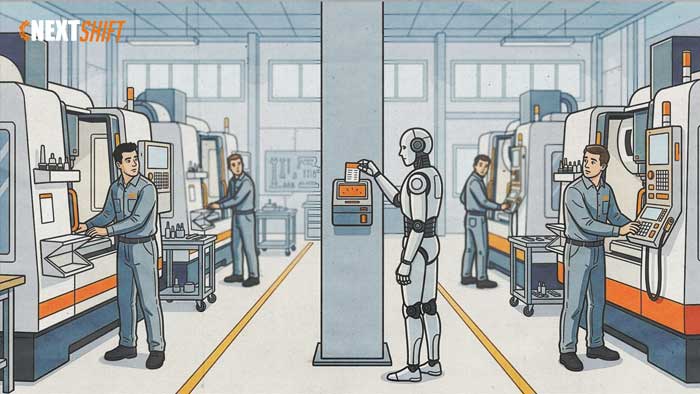
Humanoid robots in manufacturing perform structured material handling: moving totes, ferrying components to production lines, loading pre-staged parts, and running basic visual quality checks. As of 2026, the major deployments are Figure at BMW Spartanburg (11 months on the line, contributing to 30,000+ vehicles), Agility Robotics' Digit at GXO (100,000+ totes moved under a robots-as-a-service contract), Apptronik's Apollo at Mercedes-Benz (component transport and initial quality checks), and Tesla's Optimus, now in mass production at Fremont with a target price of $20,000 to $30,000 per unit. Humanoids do not perform machining, setup, programming, or diagnostic work, and at CNC machine tending they remain slower and less repeatable than fixed 6-axis robotic arms. Their advantage is flexibility: they work in spaces built for humans without facility modification.
Somewhere in a Georgia warehouse right now, a two-legged robot named Digit is picking up a plastic tote, walking it across the floor, and setting it down. It has done this more than 100,000 times. It works the full shift, takes no breaks, and bills by the hour under a robots-as-a-service contract.
If you run a machine for a living, you have heard for ten years that this thing was coming for you. In 2026 it finally clocked in. So it is worth looking, honestly and specifically, at what job it actually took. Because it wasn't yours. And the reason it wasn't tells you exactly which skills to sharpen for the next decade. This is a machinist's breakdown of where the humanoids actually are, what they can and cannot do, and what it means for the person at the spindle and the person signing the checks.
The Humanoids Are Real Now
This is no longer a demo reel. Figure's humanoids worked 11 months on BMW's Spartanburg line and contributed to more than 30,000 vehicles, with a full pilot phase starting this summer at BMW's Leipzig plant. Apptronik's Apollo is moving components and running first-look quality checks at a Mercedes-Benz plant. Agility's Digit has more than a year of continuous full-time deployment at GXO Logistics. And Tesla has started mass production of Optimus at Fremont, targeting six figures of units in 2026 at a price somewhere between $20,000 and $30,000 each.
Twenty grand. That is less than a tool presetter. For the price of a nice pickup, a plant can deploy a machine that walks, sees, picks things up, and never calls in sick. Take it seriously, because the people funding it certainly do.
And the scale is about to change. Tesla is not building hundreds of these. The Fremont target is 100,000 to 300,000 units this year, with the stated goal of producing them the way Tesla produces cars. China's Unitree is selling general-purpose humanoids at price points that would have sounded like typos in 2023. Whatever you think of the timelines, and the timelines in this industry are always wrong, the direction is not in question. The hardware is becoming a commodity. The question that matters for anyone in manufacturing is not whether the robots show up. It is which work they show up for.
Now Read the Job Description
Look at what every one of those robots is actually doing. Moving totes. Carrying components to the line. Loading parts in controlled, pre-staged configurations. Basic visual checks. That is the entire list. Across the best-funded robotics programs on earth, with billions of dollars behind them, the 2026 state of the art is: pick up the thing, walk it over there, put it down.
That is not machining. It is not close to machining. It is the job shops have struggled to hire for years precisely because nobody wants it: the tote runner, the parts ferry, the third-shift load-and-unload. The work that burned out the new hire by Thursday. The humanoid is taking the job that has been open on your shop's Indeed listing since 2021.
The humanoid didn't come for the machinist. It came for the job nobody applied for. The robot wars of 2026 are being fought over the lowest-skill work in the building, while the top of the skill ladder has never been more understaffed or better paid.
And here is the part the headlines skip: at the one task closest to your world, machine tending, the humanoid is not even the best robot for the job. A fixed 6-axis arm beats it on cycle time, repeatability, and uptime, and has for a decade. The humanoid's only advantage is that it can walk between machines and work in a space built for humans, with no fencing, no integration project, no rearranged floor. It is a flexible, slower, less reliable version of automation your shop could already buy.
What the Robot Cannot Do
Stand at your machine and inventory one hour of your shift. You heard the finish go off before the surface ever showed it, and you knew it was the insert, not the holder, before you opened the door. You caught the part that measured fine but felt wrong coming out of the vise. You looked at a setup sheet and knew the third op would fight you, so you re-fixtured before it cost the afternoon. You picked up a datum scheme from the model because the print didn't exist, which, if you read last week's Next Shift, is increasingly the whole job.
None of that is locomotion. None of it is grip strength or computer vision. It is judgment, built from thousands of hours of cause and effect that no training dataset contains, because nobody ever wrote it down. The robotics companies themselves are clear on this: humanoids in 2026 handle structured, repetitive material movement. The unstructured, diagnostic, this-doesn't-sound-right work is untouched, and there is no announced roadmap on which it gets touched.
The labor data says the same thing. The shortage in manufacturing is not general-purpose hands. It is concentrated exactly where judgment lives: setup people, multi-axis machinists, CAM programmers, maintenance techs, the people who keep spindles cutting. Robots are arriving at the bottom of the skill ladder while the top of the ladder goes unfilled.
There is a deeper reason the diagnostic work stays human, and it is worth understanding because it tells you how durable your position actually is. These robots learn from training data: millions of recorded examples of a task done correctly. Tote moving has clean training data, because the task is visible, repeatable, and easy to label. The machinist's judgment has almost no training data at all. Nobody recorded the ten thousand hours of you learning that a certain pitch of chatter means the part is lifting in the jaws. Nobody labeled the dataset of setups that almost went wrong but didn't. The knowledge that makes a machinist valuable was never written down, which means it cannot be scraped, and a model cannot be trained on what was never captured. Your experience is not just hard to automate. It is invisible to the thing doing the automating.
The Machinist's Move
So what do you actually do with this, standing at the spindle on a Thursday? You climb. The robots are eating the ladder from the bottom, which means the only bad position is standing on the bottom rung. The moves are specific and most of them are free.
Learn the probing and on-machine inspection cycles your control already has, because the tended cell of the next decade runs on probing routines somebody has to write and trust. Learn to read model-based definition callouts, because as last week's Next Shift covered, the tolerance language is moving onto the model and the machinist who reads it keeps the job. Get comfortable supervising more than one machine, because that is the actual shape of the role the automation creates: one skilled person running a cell that used to take four people, at a rate that reflects it. The title that is quietly replacing "operator" on the org chart is "cell technician," and shops post those two roles at very different rates.
And if you are early in your career, understand what the robots just did for you: they deleted the dead-end jobs and left the skilled ones. The path that used to start with two years of loading parts on third shift now starts at setup, probing, and programming, because the loading is spoken for. The trade got more interesting at exactly the moment everyone said it was dying.
What Dies, What Survives
What dies: the tote run. The parts ferry. Third-shift load-and-unload. The "warm body" job posting. The idea that showing up and standing near a machine is a career. The robot is taking the work that was never going to feed a family anyway.
What survives: the machinist who diagnoses, sets up, and saves jobs. The setup tech who turns a model into a process. The programmer who knows why the toolpath chatters before the machine does. Everyone whose value is in what they know before the cut, not where they stand during it. If your skills live above the robot's job description, the humanoid is not your replacement. It is your new coworker, and it got hired for the part of your day you hated.
The Part Owners Should Read Twice
Here is the quiet math under all of it: a robot tends a machine. It does not replace one. Every dollar spent automating material handling makes spindle capacity the bottleneck, because the robot's entire purpose is to keep machines fed more hours per day. A $25,000 humanoid, or a $60,000 cobot cell doing the same job better, only pays for itself if there is a machine worth feeding around the clock.
Which means the asset that matters in the humanoid era is the same one that mattered before it: the machine, and the person who knows how to run it. A shop that pairs one skilled machinist with tended, probed, well-bought iron is the configuration every one of these robotics pilots is quietly building toward. The robots are getting cheap. Skilled people are getting scarce. Proven spindle capacity on the used market is the one piece of that triangle you can go buy this week.
Resell CNC Take
Every automation wave we have watched since 2008 ends the same way: the shop that automated needs more spindle capacity, not less, because the bottleneck moves from labor to machine hours. Bar feeders did it, pallet pools did it, cobots did it, and humanoids will do it at a bigger scale. The smart capex play is not waiting for the perfect robot. It is securing proven, probed, production-ready iron at used prices while the rest of the market is distracted by the robot demos. A robot tending a $90,000 used machining center produces the same parts as one tending a $400,000 new one.
Frequently Asked Questions
What do humanoid robots do in manufacturing today?
As of 2026, humanoid robots in manufacturing perform structured material handling: moving totes, transporting components to production lines, loading pre-staged parts, and running basic visual quality checks. Active deployments include Figure at BMW Spartanburg, Apptronik's Apollo at Mercedes-Benz, Agility Robotics' Digit at GXO Logistics, and Tesla's Optimus inside Tesla's own factories. None performs machining, setup, programming, or diagnostic work.
Will humanoid robots replace CNC machinists?
No. Humanoid robots handle repetitive material movement, the lowest-skill work in a plant. The machinist's core value, diagnosing problems by sound and feel, building setups, establishing datum schemes, and saving jobs before they scrap, is judgment work that no current humanoid platform performs or has a published roadmap to perform. The manufacturing labor shortage is concentrated in exactly those judgment-heavy roles: setup techs, multi-axis machinists, and CAM programmers.
How much does a humanoid robot cost in 2026?
Tesla's target price for a mass-produced Optimus is $20,000 to $30,000 per unit. Most commercial humanoid deployments today, including Agility's Digit at GXO, run under robots-as-a-service contracts where the customer pays by the hour or by task rather than purchasing the robot outright. By comparison, a fixed cobot machine-tending cell typically runs $50,000 to $100,000 installed.
Are humanoid robots good at CNC machine tending?
Not yet. For machine tending, a fixed 6-axis industrial robot or cobot beats a humanoid on cycle time, repeatability, and uptime. The humanoid's advantage is flexibility: it can move between machines and work in spaces designed for people without fencing or facility modification. Shops that need machine tending today are better served by a cobot cell; the humanoid case is plants that cannot modify their floor layout.
Does automation reduce demand for CNC machines?
The opposite. Automation exists to keep machines fed more hours per day, which moves the bottleneck from labor to spindle capacity. Every automation wave since bar feeders has increased demand for machine tools, and especially for used machines, because a tended machine produces the same parts whether it cost $90,000 used or $400,000 new. The robot is an argument for more iron, not less.
What skills should machinists build as robots enter the shop?
The skills above the robot's job description: setup and workholding strategy, multi-axis programming, probing and on-machine inspection, reading model-based definition callouts, and process diagnosis. Machinists who can turn a model into a running process, and who can supervise automated cells rather than compete with them, are the ones whose rates rise as automation spreads.
The Bottom Line
The humanoids are real, they are cheap, and they are multiplying. And after all the years of warnings, the job they showed up for is the one nobody wanted: the tote run, the parts ferry, the load-and-unload. The work below the skill ladder, not the work on it.
The next shift is not the robot taking your job. It is the robot taking the job below yours, and making the one you actually do worth more. The machinist with judgment, and the shop with well-bought iron worth feeding, are both on the right side of this one.
Feed the Robot Something Worth Tending
Spindle capacity is still the asset. People and robots just keep it fed.
Browse the current Resell CNC inventory of used CNC machining centers, lathes, and production-ready equipment. Every appraisal is handled by our in-house team of AMEA and CEA Certified Equipment Appraisers.
BROWSE USED CNC MACHINES
SOURCES
- Figure AI. "Figure 02 Deployment Results at BMW Group Plant Spartanburg."
- BMW Group. "Humanoid Robot Pilot Program, Plant Leipzig, 2026."
- Agility Robotics. "Digit at GXO Logistics: Robots-as-a-Service Deployment Milestones."
- Apptronik. "Apollo Pilot at Mercedes-Benz Digital Factory Campus."
- Tesla, Inc. "Optimus Production Update, Fremont Factory, 2026."
- Standard Bots. "Automated Machine Tending in 2026: A Field-Tested Outline."
- Modern Machine Shop. "Key Growth Opportunities to Boost the CNC Machining Workforce."
- Fictiv. "Humanoid Robots in Manufacturing: Transforming Industrial Automation."
About the Author
Bill Murphy is the Marketing and Content Lead at Resell CNC, where he covers used CNC equipment, auction strategy, and the buying side of the secondary machine tool market. He works directly with the appraisal, auction, and retail teams to translate machine-level detail into content for shop owners, plant managers, and acquisition buyers.
About Resell CNC
Founded in 2008 and headquartered in Maitland, Florida, Resell CNC carries 200+ years of combined industry experience, four AMEA/CEA Certified Equipment Appraisers on staff, MDNA membership since 2009, and is the only used CNC dealer in North America with Official Mazak Trade-In Center status. The company operates across retail, auction, appraisal, and finance divisions from warehouses in Winter Springs and Longwood, Florida.