 CNC Family Breakdown
Mazak VARIAXIS j: The Suffix Is the Machine, and the Spec Table Is a Decoy
What is the Mazak VARIAXIS j series?
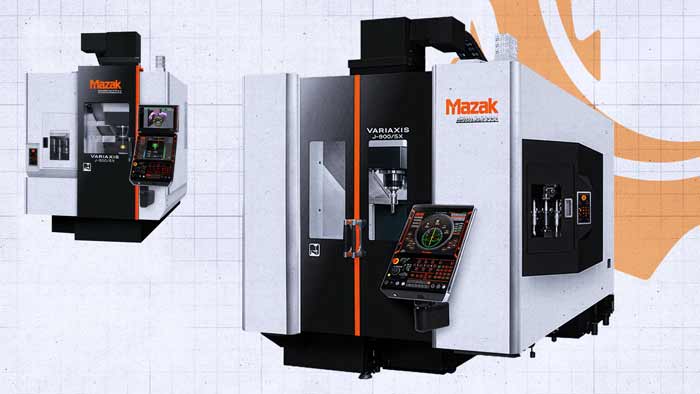
The VARIAXIS j is Mazak's entry tier of 5-axis vertical machining center, and it contains two machines that share a name. Mazak's own wording: the VARIAXIS j-500 does simultaneous 4-axis work with the A-axis indexed, while only the VARIAXIS j-500/5X does simultaneous 5-axis control for three-dimensional curved surface machining. Same casting, same travels, same table, same spindle, same magazine, different capability. The family also included a larger j-600/5X, discontinued around 2020 and replaced by the VARIAXIS C-600. Mazak labels the tier a Compact Entry Model and has never published what the letter j stands for.
Most used-machine articles teach you to read the spec table. On this family, the spec table will lie to you, and it will do it twice.
A VARIAXIS j-500 and a VARIAXIS j-500/5X publish identical travels, identical table dimensions, identical work envelopes, identical spindles and identical tool magazines. One of them cannot perform simultaneous 5-axis machining. That capability lives entirely in three characters at the end of the model name.
And a VARIAXIS j-500 and a VARIAXIS i-500 publish identical travels, an identical table and an identical maximum workpiece. The i-500 has twice the spindle. So the numbers in a used listing cannot tell you which machine you are looking at, or what it can do once it gets there.
This breakdown works through the whole family using Mazak's own published figures, then covers what to demand from a seller. Because on the VARIAXIS j, the model name and the spec block are the two least informative things in the advert.
The three characters that separate two different machines
Mazak's product pages describe the base VARIAXIS j-500 as doing simultaneous 4-axis machining with A-axis indexing at 0.0001 degree increments. The VARIAXIS j-500/5X is described as offering simultaneous 5-axis control for three-dimensional curved surface machining.
In plain terms: the base machine positions the trunnion, clamps it, and cuts with three linear axes plus the rotary table. That is 3+2 work, and it is genuinely useful. It kills setups on prismatic parts and it machines five sides in one clamping. What it will not do is move all five axes at once while the tool is in the cut, which is what people are picturing when they say 5-axis.
Both machines are in the used market. A 2020 j-500 on SmoothG with 30 tools and a two-pallet changer, and a 2023 j-500, both surfaced in this survey alongside the /5X units. Both will be returned to a buyer searching for a used Mazak 5-axis machine, because both technically have five axes.
One heuristic that helps, though it is not proof: Mazak pairs SmoothG with the base j-500 and SmoothX or SmoothAi with the /5X. A listing advertising SmoothG on a machine sold as simultaneous 5-axis deserves a serial-plate photograph before anything else happens.
Whether a base j-500 can be converted to a /5X is not something Mazak publishes. We found no upgrade path documented anywhere. Treat the suffix as fixed at build date.
Same envelope as the i-500, half the spindle
This is the second place the spec table fails you, and it is worse than the first, because at least the /5X suffix is visible in the model name.
| Spec |
VARIAXIS j-500 |
VARIAXIS i-500 |
| X / Y / Z travel |
350 / 550 / 510 mm |
350 / 550 / 510 mm |
| Table |
Ø500 x 400 mm |
Ø500 x 400 mm |
| Max workpiece |
Ø500 x 350 mm |
Ø500 x 350 mm |
| A-axis range |
-120 to +30 degrees |
-120 to +30 degrees |
| Max table load |
200 kg / 441 lb |
300 kg / 661 lb |
| Spindle motor, 40% ED |
11 kW / 15 hp |
22 kW / 30 hp |
| Max torque, 40% ED |
65.1 Nm / 48 ft-lb |
71.6 Nm / 53 ft-lb |
| Spindle speed options |
12k standard, 18k optional |
12k, 18k, 25k, 30k |
| Tool magazine |
18 std, 30 optional |
30 std, to 120 optional |
| Rapids X / Y |
30 m/min (1,181 ipm) |
60 m/min (2,362 ipm) |
| Rapids Z |
30 m/min |
56 m/min |
| Factory automation ceiling |
Two-pallet changer |
None listed by Mazak |
| Machine width x length |
101 x 127 in |
94 x 127 in |
| Mass |
7,000 kg |
8,000 kg |
Four rows identical, and they are exactly the numbers a used listing prints. Travels, table, maximum workpiece, tilt range. A seller who quotes 350 by 550 by 510 with a 500 millimetre table has told you nothing about which machine is sitting on the floor.
One row in that table runs against the grain, and we checked it twice because it surprised us. Mazak offers the VARIAXIS j an optional two-pallet changer. It lists no pallet changer at all on the i-500, and its MPP pallet cell page states MPP compatibility for the VARIAXIS i-700T only. On factory automation the entry machine has more available than the machine above it, not less.
Note where the real gap is, because it is not where most people look. Peak torque differs by only ten percent, 48 against 53 ft-lb. The i-500's advantage is not peak torque, it is the constant-torque band. Working from Mazak's published power and torque figures, the j-500's standard spindle holds maximum torque to roughly 1,614 rpm while the i-500 holds it to roughly 2,930 rpm. That is our arithmetic off Mazak's numbers, not a Mazak specification, but it explains why the i-500 pulls a heavier cut at working speeds when the peak figures look close.
Do these two share a casting? Mazak has never said so, so the honest answer is that we do not know. The circumstantial case is strong: identical travels to the millimetre, identical tables, identical envelopes, identical maximum tool diameter, machine lengths within 10 millimetres of each other, linear roller guides on X, Y and Z on both, roller gear cams on both rotaries. Everything that differs is drivetrain and content. But the 1,000 kilogram mass difference and the five inch height difference say they are not the same machine top to bottom. Call it shared architecture, not a shared casting.
And one number in that table is odd: the cheaper, lighter machine is seven inches wider than the more capable one, 101 inches against 94. Both figures come from current Mazak detail pages. Worth flagging that Mazak's own i-Series brochure gives a different i-500 floor space, 2,400 by 3,060 mm, which would change the comparison in the other dimension. We cannot reconcile the two Mazak figures from anything published, so we are reporting the discrepancy rather than theorising about it.
What the j means, and what Mazak declines to say
Mazak does not define the letter. Not on any of the six regional product pages we checked, not on the model detail pages, not in the October 2013 launch release, not on the MAZATROL technology pages, not on the INTEGREX j pages.
What Mazak does publish is the tier. Its products index labels the VARIAXIS j a Compact Entry Model and the VARIAXIS i Best Selling Machines. Worth knowing the VARIAXIS C carries that same Compact Entry Model label, so the phrase marks a price tier rather than a specific series. The INTEGREX j carries the same treatment, described as the entry model for multi-tasking machines. So j is Mazak's house letter for the value tier of a family, and i is the mainstream tier.
Worth knowing that Mazak does spell out its letters when there is something to spell out. A Mazak blog post on the NEO series states that NEO means new, and that for Mazak it stands for Next, Excellent and Optimal. That they published one and not the other is the strongest available evidence that there is no expansion behind the j. Anyone telling you it stands for Junior, or Japan, or job shop is inventing it.
There is also an axis-letter trap sitting between the branches of this family. The j and i series call the trunnion tilt axis A, running -120 to +30 degrees. The C series calls it B, running -30 to +120, the mirror convention. A listing that describes a B-axis on a VARIAXIS j is using terminology Mazak does not use for that machine, which usually means the specification was typed from memory rather than read off the plate.
The spec ladder, model by model
j-500 and j-500/5X figures are Mazak published. j-600 figures are Mazak published where marked and dealer-sourced where noted, because Mazak's own archived j-600 page omits table size, table load and machine mass entirely.
| Spec |
j-500 / j-500/5X |
j-600/5X |
| X travel |
350 mm / 13.78 in |
850 mm / 33.46 in |
| Y travel |
550 mm / 21.65 in |
550 mm / 21.65 in |
| Z travel |
510 mm / 20.08 in |
510 mm / 20.08 in |
| A-axis (table tilt) |
-120 to +30 degrees |
Not published by Mazak |
| C-axis |
plus or minus 360 degrees |
Not published by Mazak |
| Indexing increment |
0.0001 degrees |
Not published by Mazak |
| Table |
Ø500 x 400 mm |
600 x 500 mm (dealer) |
| Max workpiece |
Ø500 x 350 mm |
Ø730 x 450 mm |
| Max table load |
200 kg / 441 lb |
500 kg / 1,102 lb (dealer) |
| Spindle taper |
BIG-PLUS No.40 / BT40 / CAT40 |
No.40 |
| Max rpm |
12,000 std, 18,000 optional |
12,000 and 18,000, not split by Mazak |
| Spindle motor, 40% ED |
11 kW / 15 hp |
11 kW / 15 hp, no duty rating given |
| Spindle motor, continuous |
7.5 kW / 10 hp |
Not published |
| Max torque, 40% ED |
65.1 Nm / 48 ft-lb |
Not published |
| Tool magazine |
18 std, 30 optional |
18 std, 30 optional |
| Max tool diameter |
Ø90 mm, Ø130 mm with adjacent pocket empty |
Not published |
| Rapids |
30 m/min / 1,181 ipm |
Not published |
| Machine width x length |
2,565 x 3,225 mm / 101 x 127 in |
94.5 x 123.4 in (2,400 x 3,134 mm, our conversion) |
| Mass |
7,000 kg / 15,432 lb |
11,000 kg (dealer) |
| Control at launch |
MAZATROL Matrix 2 |
MAZATROL Matrix 2 |
| Status in 2026 |
Current |
Discontinued |
Read the top of that table across. Going from a j-500 to a j-600 buys you X travel and table capacity, and nothing else. Y and Z are identical. The spindle is identical. The tool magazine is identical. The indexing increment is identical. The rotary architecture is identical. You are buying 500 more millimetres of one axis and 300 more kilograms of table rating.
Three specs that go the wrong way
1. The 18,000 rpm option costs you torque. The standard 12,000 rpm spindle is rated 11 kW and 65.1 Nm, which is 48 ft-lb. The optional 18,000 rpm spindle is rated 15 kW and 59.7 Nm, which is 44 ft-lb. That is 36 percent more power and 8 percent less torque, both from Mazak's own spindle table. A used j-500 fitted with the high-speed spindle is the worse machine for steel roughing, and it is being sold as the upgrade. We could not find a single listing that mentions this.
2. The j-500's X travel is shorter than its own table. X is 350 mm. The table is 500 mm across and the maximum workpiece is 500 mm in diameter. This is not a transcription error. It appears on Mazak's US inch page as 13.78 inches, on the European and Indian metric pages as 350 mm, and in Mazak's own October 2013 launch release. Y is the long linear axis at 550 mm, not X. Practically, you cannot traverse a 500 millimetre face in a single linear pass. The C-axis rotation covers the rest of the part, which is fine when you plan for it and a surprise when you do not.
3. The j-600 has a smaller published footprint than the j-500. The j-600 is 94.5 by 123.4 inches. The j-500 is 101 by 127. The machine with 2.4 times the X travel takes up six and a half inches less width. One caveat we will not bury: Mazak labels the j-500 footprint row as measured with the MAZATROL SmoothG cabinet, while the j-600 figure dates from its Matrix 2 era page, so some of that gap may be control cabinet rather than casting. Directionally it is still documented, and it is still the opposite of what anyone assumes.
The number nobody checks
A solid steel billet filling the j-500's maximum work envelope, 500 millimetres across and 350 tall, weighs roughly 539 kilograms. The table is rated for 200, and that rating includes your fixture. The envelope is nearly three times the load limit. That gap is not a space limit, it is a rotary drivetrain limit, and it is the single most useful question to ask about a used one: how close to that ceiling did the last owner run it.
The 600 is the table, and the machine is discontinued
Two things about the larger half of this family that used listings routinely get wrong.
First, the 600 refers to the table, not the travel. X travel on a j-600 is 850 mm. Any listing quoting 600 millimetres of X on a j-600 is wrong. And because the VARIAXIS i-600's X travel is only 510 mm, the number in a Mazak 5-axis model name tells you nothing consistent about the work envelope across the i and j lines.
Second, the j-600 has been out of production for roughly six years. Mazak's own launch material for the VARIAXIS C-600 in May 2020 describes it as the successor machine to the highly successful VARIAXIS j-600/5X. The spec evidence backs that up: the C-600 publishes a maximum workpiece of 730 by 450 mm, which is exactly the j-600 figure Mazak published, and a 500 kg table load, which matches the number dealers quote for the j-600 but which Mazak itself never published for that machine. It inherited the envelope and the price tier. We checked six Mazak regional sites in August 2026 and no j-600 appears anywhere in the 5-axis machining center roster. One exception is worth knowing about, because it is two clicks away on mazak.com: the current Die and Mold pages still carry the VARIAXIS j-600/5X AM, the wire-arc additive version, under mold repair by wire-arc AM. The machining center is out of the lineup. The additive variant is still being promoted.
That matters for parts, and the honest read is mixed. The j-500 and j-500/5X are still current products, which is unusual for a used 5-axis purchase and genuinely reassuring on rotary and spindle supply. The j-600 is a discontinued model on a discontinued control, mitigated by a successor that uses the same roller gear cam rotary architecture and the same 40-taper 12,000 rpm spindle class. Whether part numbers actually interchange between the j-600 and the C-600 is something we could not verify. Ask a Mazak parts desk with the serial number in hand before you bid, not after.
The roller gear cam trunnion, and why a zero backlash reading proves nothing
Mazak's product pages describe a rigid trunnion table supported on both sides, linear roller guides on X, Y and Z, and a rotary axis equipped with roller gear cams. The successor C-600 brochure states the same thing more directly, that both rotary axes use a roller gear cam to eliminate backlash.
That architecture changes what you are inspecting, and most used-machine checklists have not caught up.
A worm and wheel table wears the wheel and opens measurable circumferential lash, which you can read and compensate in a parameter. A roller gear cam is a preloaded assembly, cam follower rollers riding a globoidal cam track. It does not develop lash in the same way. It degrades as loss of preload, cam track pitting and brinelling, and follower bearing wear, which shows up as lost motion under reversing load, a notchy feel when you hand-rock the axis, and witness marks on the part at reversal points.
The practical consequence: a screenshot of a zeroed backlash parameter is not evidence of anything on this machine. You have to measure motion, not read a number.
Warm the machine fifteen to twenty minutes before you measure, because preload and lube state both change the reading. Then mount a test indicator on a rigid stand, tip against a ground surface on the table at the largest usable radius, since radius amplifies angular error. Command the axis half a degree one way, stop, zero the indicator, then reverse in the smallest increment the control accepts and record how far the control travels before the indicator breaks. Do it at several positions around the full C rotation and across the A range, because cam wear is local and a single position check will walk right past a worn sector. Three passes per position, averaged.
Then do it again with the axis clamped, applying a repeatable hand load to a bar at a known radius. Movement under brake is telling you about the clamp, not the drive. Do the same test with the brake released and the servo on to separate the two.
We are deliberately not publishing a pass or fail threshold in thousandths. The commonly quoted backlash tolerances are linear-axis guidance and no Mazak rotary acceptance figure for this family is published anywhere we could reach. Use the readings to compare positions against each other on the same table. That comparison is the finding, not the absolute number.
MAZA-CHECK is standard, and inert without the probe
MAZA-CHECK is Mazak's on-machine kinematic calibration. It calibrates the distance between the spindle centre line, the A-axis centre of rotation and the C-axis centre of rotation, and it is standard equipment on the j-500/5X. Mazak footnotes the catch on the VARIAXIS j page itself: the wireless touch probe RMP600 is optional equipment. The C-600 documentation spells it out further, requiring the probe plus a reference sphere.
So if the probe and the sphere do not come with the machine, the feature you are buying is a menu item you cannot run. Get both listed on the invoice, in writing, before funds move.
There is a subtler trap here too. Automated rotary health checks of this class can correct pivot point parameters on the machine, and some do it automatically. A machine whose kinematics have been corrected back into tolerance will pass a test cut while the mechanical wear that caused the error is still there and still progressing. So the question is not only whether the machine passes. It is when it was last corrected, and by how much. Ask for a dated rotary health check report or ballbar plot. If a seller has run a simultaneous 5-axis machine for years and has never produced one, that is itself information.
Has it been crashed in 5-axis, and would you know
A 5-axis crash puts its energy somewhere different than a 3-axis crash. It usually goes into the trunnion cheeks, the C-axis face, the way covers or the enclosure rather than the spindle alone. What to look at:
Way covers and enclosure. Replaced, repainted, mismatched or binding telescoping sections. A distorted door frame, a replaced or crazed window, splash guarding cut and re-welded to clear something. New covers on an old machine tell a story, and so do old covers on a machine with a suspiciously fresh trunnion.
Trunnion cheeks and yoke. Weld repair, filler, paint that does not match the casting texture, fresh fasteners in an otherwise oxidised bolt pattern.
The C-axis face. Gouges, T-slot damage, evidence the face has been skimmed. Tram it.
Indicated eccentricity. Sweep the C-axis face and the A-axis trunnion bore. A bent trunnion shaft reads as periodic runout that repeats once per revolution.
Parameter history. Ask whether axis home or grid shift parameters have been changed and when. A crash that moved an encoder coupling or a limit gets papered over with a parameter edit, and that edit is the only surviving record of it.
3+2 history is not low rotary wear, it is different rotary wear
Buyers treat a 3+2 service history as reassuring. It is more complicated than that.
In 3+2 the rotary axes are positioning devices. They index, they clamp hard, and the cutting load goes through the brake and the cam preload statically. The machine accumulates a great many clamp and unclamp cycles and comparatively few loaded rotations. In simultaneous work the load goes through the cam and its servo dynamically, with reversals, continuously.
So the wear signatures differ. A 3+2 machine tends toward brake and clamp wear, seal wear, and localised cam track damage at the three or four angles the shop actually used. A simultaneous machine tends toward distributed cam and follower wear that a ballbar or rotary health check will surface. The 3+2 failure is the sneakier of the two, because a brake that no longer holds under cut passes every static test you can throw at it.
That is reasoning from how the two duty cycles load the parts, not a sourced wear study. We found no source that quantifies the difference, so we will not put a percentage on it. What we will say is that A-axis drift under cut is the specific thing to test for on a machine with a 3+2 history: run a positioned test cut at a steep A angle with real depth, and check for angular walk between passes.
Can you tell which life a machine had? On a base j-500, definitively yes, because it cannot have run simultaneous. On a /5X, the tells are indicative rather than conclusive. A control memory full of conversational MAZATROL programs points to prismatic and 3+2 work. A directory of long EIA and ISO programs with continuously interpolated A and C points to real simultaneous work. Tombstones and vises in the tooling package say 3+2. A central chuck or a trunnion-mounted subplate with clearance for a swung tool says simultaneous. And ask plainly, because a shop that ran true 5-axis has a part photograph and a CAM file, and a shop that did not usually says so.
The control generation is a bigger decision than the year
The VARIAXIS j launched into the Matrix 2 era. The 2013 press release names Matrix 2 explicitly, every 2015 machine we found is Matrix 2, and the j-600 appears to have run Matrix 2 for its entire life. SmoothX shows up on /5X machines from roughly 2016. The current pairing is SmoothG on the base j-500 and SmoothAi on the j-500/5X.
A listing claiming plain first-generation Matrix on a VARIAXIS j is either shorthand or wrong, and a listing claiming Smooth on a 2013 to 2016 machine deserves a photograph of the screen.
Here is the part that costs real money. A Matrix 2 machine sits outside Mazak's current CAM-to-machine integration path. Mazak's add-in for the mainstream cloud CAM package requires Smooth Project Manager to be running, and its own documentation states the controller must support an MTConnect agent at version 1.8 or later for full support. Neither Mazak nor the CAM vendor names Matrix 2 as unsupported in those words, but a 2013 era control is not going to clear that bar. If your workflow depends on that integration, the difference between a 2015 machine and a 2018 machine is not a nicer screen, it is whether your programming pipeline works at all. That, rather than condition, may be the actual reason to skip the cheaper unit.
And there is a broader programming point that catches Mazak shops specifically. Mazak is explicit that conversational MAZATROL is aimed at prismatic and two-and-a-half dimensional work, and that five-axis machining of highly contoured surfaces needs an advanced CAM program. The MAZATROL fluency that makes a Mazak shop fast on lathes and 3-axis mills does not transfer to the reason you are buying a /5X. You are buying a CAM and post-processor problem.
That problem is documented. On the CAM vendor's own support forum, a user could not find a VARIAXIS 5-axis post in the library and was advised by a vendor employee to take the generic Mazak VC-500 5-axis post and modify it, configuring the machine kinematics and changing the axis designation from B to A in the retract block. A later user on a specific post version reported that simulation looked right but the machine did not travel the way the software showed. So: no drop-in factory post, a hand-edited generic one, and at least one reported mismatch between simulation and reality. Budget for a paid post and budget the proving time. It is the line item most often left out of a used 5-axis purchase.
One thing we will not repeat, because we could not stand it up: there is no published Mazak restriction on service, parts or parameters for machines that changed hands. Mazak's parts terms define the buyer broadly with no original-owner clause and no machine registration gate, and its parts support page guarantees lifetime parts support on every Mazak machine, states nearly 195,000 unique part numbers at 97 percent same-day shipping, and runs an extended-hours call centre six days a week. The counter-evidence is a set of forum posts from 2009 describing slower response for machines not bought new from Mazak. Whether any of that reflects 2026 practice is unverified, and writing that Mazak locks out used buyers would be a claim a reader could check and disprove.
Why there is no price band in this article
Because there is not enough data to build one honestly.
Across every readable platform in this survey, exactly one published asking price for a VARIAXIS j surfaced: 89,000 dollars on a 2015 j-500/5X with Matrix 2, a 31-station changer, high-pressure through-spindle coolant and a Renishaw probe. That is an asking price on one machine. It is not a market value, it is not a transaction value, and one data point is not a range.
Everything else was price on request. Two UK auction lots for what appears to be the same 2018 j-500/5X sold eleven months apart both closed without a published hammer price, so we have no auction evidence either.
The supply picture explains why. Counting distinct physical machines across every platform we could read, the number is roughly a dozen worldwide, and we will not sharpen that, because three major aggregators returned 403 to every attempt. Model years observed run 2015, 2017, 2018, 2019, 2020 and 2023. We found no 2013 or 2014 unit anywhere despite the /5X debuting in 2013.
Duplication across platforms is severe and worth understanding before you count anything yourself. One 2015 j-600/5X in the Netherlands, Matrix 2, 7,155 hours, on a third-party twenty-position pallet cell, appears as four separate listings across four sites. One machine, four adverts. A search that looks like it returned eight or ten available machines is probably showing you three or four, and some of those are already sold.
Anyone publishing a used VARIAXIS j price range is extrapolating from adjacent models, not reporting. We would rather tell you the data is not there.
The listings themselves are unreliable, and we can prove it
This is not a general grumble about seller copy. These are specific, verified mismatches found during this survey.
A marketplace URL slugged as a VARIAXIS j-600 resolves, on the live page, to a 2003 VARIAXIS 630-5X on a MAZATROL 640M control. Different machine, different decade, different control generation. Verified by re-fetching the page and reading its heading.
A second URL on the same platform, slugged j-500-5ax, resolves to a 2018 VARIAXIS i-500 with a 22 kW spindle and a 60-station magazine. Also verified the same way. Note that this one favours the buyer, and it is still a reason to distrust the field. Two further mismatches turned up on the same platform while we were checking these, one slugged as a VARIAXIS C-600 that resolves to a 630-5X and one slugged as an i-500 that resolves to a Mazak CV5-500.
Model strings Mazak never used are circulating. j-500A/X, J-500 5AX, J600-5X. Mazak's designations are VARIAXIS j-500, VARIAXIS j-500/5X, the discontinued VARIAXIS j-600/5X, and the additive VARIAXIS j-600/5X AM. Lowercase j, hyphen before the number, slash before 5X. And we could find no Mazak source at all for a base VARIAXIS j-600 without the 5X suffix, so if you see one advertised, that is a plate photograph question before it is anything else.
Spindle power quoted as 7.5 kW. That is the continuous rating. Mazak's headline figure is 11 kW at 40 percent duty. Both numbers are real, and quoting only the lower one makes the machine look a third weaker than Mazak rates it.
Hours figures that are not comparable. Listings in this survey quoted 7,155 working hours, 4,300 hours, and 792 spindle cut hours interchangeably. Power-on hours and spindle cutting hours are different numbers, often by a factor of two or more, and the gap between them is the actual story about how the machine lived. Ask which one, and ask for the screen.
One more, because it is spreading. There is no VARIAXIS j AWC. Mazak's Auto Work Changer is a VARIAXIS i-300 feature with a work stocker holding up to 40 positions. The j series factory automation option is a two-pallet changer and nothing beyond it. PALLETECH and MPP pallet cells list the i-600 NEO, i-700 NEO, i-700T and i-800 NEO, the HCR-5000S, the HCN horizontals, the C-600 and C-700, and no VARIAXIS j at all. Every heavily automated used j we found was carrying somebody's third-party cell, which is not a defect, but it is not Mazak automation and it is not Mazak supported.
The additive machines, which are two different things
Worth clearing up because these get merged constantly.
The VARIAXIS additive machine is the VARIAXIS j-600/5X AM, introduced around 2016, using a wire-arc metal deposition head mounted on the machine's headstock. Trade coverage from 2017 describes it depositing faster than powder systems because it feeds wire. It does not appear on Mazak's additive products page, but it is carried on Mazak's Die and Mold pages, so treat it as current for mold repair rather than retired. Note the exact string too: Mazak writes j-600/5X AM, while the 2016 trade coverage wrote j-600AM.
The machine people confuse it with is the VC-500A/5X AM HWD, where HWD stands for Hot Wire Deposition. That is a different machine on the VC-500 platform, using an arc torch and a laser to melt wire, and it is a current product. Different platform, different process, different name. If a listing or an article puts HWD on a VARIAXIS j, it has merged two machines.
Who it suits, and who it does not
It suits a 3-axis shop making its first move into five-sided done-in-one, where the win is eliminating three setups rather than machining impellers. It suits a shop already fluent in MAZATROL on lathes and mills, because operator familiarity, the service relationship and holder standardisation all carry over. It suits prismatic and semi-prismatic parts inside the envelope: pump and valve bodies, hydraulic manifolds, gearbox housings, aerospace brackets and fittings, medical instrument bodies, robotics joints, small mould cores. Aluminium comfortably, steel and stainless in moderate cuts.
It does not suit heavy metal removal in stainless, Inconel or titanium. Eleven kilowatts and 65 Nm is modest, and a used i-500 gives you 22 kW in the identical envelope, which makes the choice between them a real one rather than a budget question. It does not suit a shop with no 5-axis CAM seat and no working post, because that is a four or five figure line item plus weeks of calendar. It does not suit anyone planning a pallet pool, since the ceiling is two pallets forever. It does not suit heavy parts, since 200 kg on the j-500 table includes your fixture and heavy fixtures eat that fast. And it does not suit a buyer who needs to comparison shop, because with roughly a dozen readable machines worldwide you do not get to inspect three and pick the best. You inspect what appears.
Resell CNC Take
On most machine families the spec table is where you start. On this one it is where you get fooled, because the six numbers a listing prints are identical across a machine that does simultaneous 5-axis, a machine that does not, and a machine from the tier above with twice the spindle. Everything that determines what you are actually buying sits somewhere else: the suffix on the model name, the serial plate, the installed-option screen, and whether the probe and reference sphere are in the crate. The good news is that this is a well-built entry 5-axis with a properly supported trunnion and a roller gear cam drive, and the j-500 half of the family is still in production in 2026, which is rare and worth something on parts. Get the option screen photographed before you discuss price. On this family that single screenshot is worth more than the entire advert.
What to demand before you wire funds
The installed-option list, photographed at the control. This one screen settles the /5X question, the magazine size, the through-spindle coolant question and the probe question at once. Ask for it first, before you book travel.
The serial plate. Not the listing title, not the URL slug, not the seller's typed model string. All three have been demonstrably wrong on live listings during this research.
Power-on hours and spindle cutting hours, separately, on camera. The gap between them is the machine's biography.
Alarm history. Servo overload and following-error alarms on A or C point to sustained loaded rotary motion. A clean history on a machine sold as a hard-working 5-axis is its own kind of question.
The probe and the reference sphere, itemised on the invoice. Without them MAZA-CHECK does not run, and neither does any kinematic verification you were planning to do after delivery.
A dated rotary health check or ballbar plot, plus when the pivot point was last corrected and by how much. A corrected machine can pass a test cut with the underlying wear intact.
Reversal readings on A and C at several positions, on a warm machine, at the largest usable radius. Compare positions against each other rather than against a published tolerance that does not exist for this family.
The rotary gearbox oil. Pull the level plug or get a photograph of the sight glass. Milky or emulsified oil means water in a preloaded cam drive, and that destroys followers and cam track. The trunnion on this layout sits in the coolant stream, so seals are a wear item. We found no VARIAXIS-specific documented case of this, so treat it as a prudent check rather than a known defect.
Spindle taper runout with a test bar, and drawbar force with a gauge. Independent spindle rebuilders publish case work on Mazak spindles citing taper runout above 10 microns from a failed rear roller bearing, and cracked gripper assemblies from minor crash damage. The second one is exactly what an undisclosed crash leaves you holding.
A written answer on the post processor. Which post, from whom, proved on which machine. If the answer is that the seller does not know, that is a cost you are absorbing and you should price it now rather than discover it in week three.
Shopping a Used VARIAXIS j?
See our Mazak inventory.
Tell us the parts you want to run and our team, with 200+ years of combined industry experience and four AMEA and CEA certified appraisers on staff, will match you to the right VARIAXIS size, suffix and control generation, and confirm a used one is built the way its tag claims.
See Used Mazak Machines
Frequently asked questions
What is the difference between a Mazak VARIAXIS j-500 and a j-500/5X?
The suffix is the capability. Mazak describes the base j-500 as doing simultaneous 4-axis machining with A-axis indexing, which is 3+2 positioning work, while only the j-500/5X offers simultaneous 5-axis control for three-dimensional curved surface machining. Everything else matches: travels of 350 by 550 by 510 mm, a 500 mm table, the same 12,000 rpm 40-taper spindle, the same 18-tool standard magazine. Both machines are in the used market and both will surface in a search for a used Mazak 5-axis. Mazak publishes no upgrade path from one to the other, so treat the suffix as fixed at build date.
What does the j mean in Mazak VARIAXIS j?
Mazak does not define it. We checked six regional product pages, the model detail pages, the products index, the MAZATROL technology pages, the INTEGREX j pages and the October 2013 launch release, and none of them expands the letter. What Mazak does publish is the tier: its products index labels the VARIAXIS j a Compact Entry Model and the VARIAXIS i its best selling machines. Mazak spells out its letters when there is something to spell out, as with its published statement that NEO stands for Next, Excellent and Optimal, so the absence here is meaningful rather than an oversight.
Is the VARIAXIS j-500 the same machine as the VARIAXIS i-500?
No, but a used listing cannot tell them apart. Both publish travels of 350 by 550 by 510 mm, a 500 by 400 mm table, an identical maximum workpiece and an identical A-axis range. The i-500 carries a 22 kW spindle against the j-500's 11 kW, 300 kg of table rating against 200, a 30-tool standard magazine expandable to 120 against 18 expandable to 30, and double the rapids. Mazak has never stated whether they share a casting, and a 1,000 kg mass difference suggests they are not identical, so the honest phrasing is shared architecture rather than shared casting.
How many tools does a Mazak VARIAXIS j hold?
Eighteen as standard, with 30 available as a factory option, on both the j-500 and the j-600. Every used listing in this survey that stated a magazine size showed 30 or 31 pockets, which suggests the option was ordered almost universally, but an 18-pocket machine is a legitimate factory build and will limit how many operations you can consolidate into one setup. Do not read the common configuration as the standard one. Count the pockets on the machine or read the option screen.
Is the Mazak VARIAXIS j-600 still made?
Not as a machining center. Mazak's launch material for the VARIAXIS C-600 in May 2020 describes it as the successor machine to the VARIAXIS j-600/5X, and the C-600 carries the same 730 by 450 mm maximum workpiece. No j-600 appears in the 5-axis roster on any of the six Mazak regional sites we checked in August 2026. One exception: Mazak's current Die and Mold pages still carry the VARIAXIS j-600/5X AM, the wire-arc additive version. The j-500 and j-500/5X remain current products, so this family is split between machines still in production and a machining center that is not.
Does the 18,000 rpm spindle option make a VARIAXIS j faster?
Faster at the top and weaker in the middle. Mazak rates the standard 12,000 rpm spindle at 11 kW and 65.1 Nm, which is 48 ft-lb, and the optional 18,000 rpm spindle at 15 kW and 59.7 Nm, which is 44 ft-lb. That is 36 percent more power and 8 percent less torque. For small cutters in aluminium at high speed the option earns its keep. For steel roughing with larger tools the standard spindle is the better machine, and a used unit fitted with the high-speed option is usually advertised as the upgraded one without that caveat attached.
Can you add an AWC pallet changer to a VARIAXIS j?
There is no VARIAXIS j AWC. Mazak's Auto Work Changer is a VARIAXIS i-300 feature with a work stocker holding up to 40 workpiece positions. The VARIAXIS j's entire factory automation offering is an optional two-pallet changer, and Mazak's PALLETECH and MPP pallet cell listings cover the i-600 NEO, i-700 NEO, i-700T and i-800 NEO, the HCR-5000S, the HCN horizontals and the C-600 and C-700, with no VARIAXIS j among them. Heavily automated used j machines carry third-party cells, which is not a defect but is a separate spares, software and support problem.
What should I check on a used VARIAXIS j that I would not check on a 3-axis mill?
The rotary group, and not by reading a parameter. This is a roller gear cam trunnion, so it degrades as lost preload and cam track damage rather than as measurable lash, which means a zeroed backlash reading proves nothing. Warm the machine, then take reversal readings at several positions around C and across A at the largest usable radius, and compare positions against each other. Test A-axis hold under a real cut. Confirm the probe and reference sphere are included, since MAZA-CHECK will not run without them. And ask when the pivot point was last corrected, because a corrected machine passes a test cut with the wear still there.
About the Author
Bill Murphy is the Marketing and Content Lead at Resell CNC. The CNC Family Breakdown series maps out entire machine families, decoding the model numbers, suffixes, and configurations so buyers can tell one version from the next. Every figure in this article is attributed to the source that publishes it, figures that exist on only one source are identified, and specifications no manufacturer publishes are named rather than filled in.
About Resell CNC
Resell CNC has bought and sold used CNC machinery since 2008. Based in Maitland, Florida, with warehouses in Winter Springs and Longwood, the team brings more than 200 years of combined industry experience and four AMEA and CEA certified equipment appraisers on staff. Resell CNC has been an MDNA member since 2009 and is the only used CNC dealer in North America with Official Mazak Trade-In Center status.
Sources
- Mazak VARIAXIS j product pages, United States, Europe, United Kingdom, Japan, India and Singapore, retrieved August 2026. Model roster of j-500 and j-500/5X, the simultaneous 4-axis with A-axis indexing description of the base machine and the simultaneous 5-axis description of the /5X, rigid trunnion table supported on both sides, linear roller guides on X, Y and Z, rotary axis equipped with roller gear cams, optional two-pallet changer, MAZA-CHECK and Ai Thermal Shield, and current control assignment of SmoothG to the j-500 and SmoothAi to the j-500/5X.
- Mazak VARIAXIS j-500 and j-500/5X model detail pages, inch and metric versions cross-checked, retrieved August 2026. Travels of 350 by 550 by 510 mm, table of 500 by 400 mm, maximum workpiece of 500 by 350 mm, maximum table load of 200 kg, A-axis range, C-axis range, 0.0001 degree indexing increment, spindle taper, 12,000 and 18,000 rpm ratings, 11 kW and 7.5 kW and 15 kW motor ratings, 65.1 Nm and 47.7 Nm and 59.7 Nm torque ratings, magazine capacities, maximum tool diameter of 90 mm and 130 mm without an adjacent tool, maximum tool length of 300 mm and maximum tool weight of 8 kg, rapid traverse of 30 m/min, machine width and length and height, and machine mass of 7,000 kg.
- Mazak press release, 8 October 2013, announcing the VARIAXIS j-500/5X at DISCOVER 2013. Full simultaneous 5-axis, 12,000 rpm and 15 hp CAT-40 standard spindle with an optional 18,000 rpm spindle, 18-tool magazine, table and travel dimensions in inches, A-axis and C-axis ranges in 0.0001 degree increments, rapids of 1,181 ipm, and MATRIX 2 as the control at launch.
- Mazak VARIAXIS j-600/5X specification page, recovered from a Mazak-owned staging host still serving the retired regional page. Travels including 850 mm of X, maximum workpiece of 730 by 450 mm, No.40 spindle at 12,000 rpm standard with 18,000 optional and 11 kW, 18-tool magazine standard with 30 optional, optional two-pallet changer, MATRIX 2 control, and machine width and length. Table size, maximum table load and machine mass are absent from this page and are dealer-sourced in this article. Also absent, and therefore left unfilled rather than borrowed: the A-axis range, the C-axis range, the indexing increment, maximum tool diameter, rapid traverse rates and machine height.
- Mazak VARIAXIS C-600 brochure, form 99J289120E0. Maximum workpiece of 730 by 450 mm and 500 kg matching the j-600, the B and C axes both using a roller gear cam to eliminate backlash, 0.0001 degree minimum increment, and the requirement for a wireless touch probe and reference sphere to run the on-machine kinematic calibration.
- Mazak VARIAXIS i-Series brochure, form 99J274115E0, and the VARIAXIS i-500 model detail page. Travels, table, maximum workpiece and A-axis range matching the j-500, 300 kg table load, 22 kW and 15 kW motor ratings, 53 ft-lb and 39 ft-lb torque ratings, 12,000 through 30,000 rpm spindle options, 30-tool standard magazine with 40, 60, 80 and 120 options, rapids of 60 m/min in X and Y and 56 m/min in Z, machine width and length, and mass of 8,000 kg.
- Mazak product index and automation pages, retrieved August 2026. The Compact Entry Model label on the VARIAXIS j and Best Selling Machines on the VARIAXIS i, the INTEGREX j entry model positioning, the Auto Work Changer listed against the VARIAXIS i-300 with a work stocker of up to 40 positions, and the PALLETECH and MPP compatibility lists covering the i-600 NEO, i-700 NEO, i-700T and i-800 NEO, the HCR-5000S, HCN horizontals, C-600 and C-700 with no VARIAXIS j, and the statement that MPP is compatible with the VARIAXIS i-700T only.
- Mazak corporate blog posts on the NEO series naming and on G-code against conversational programming. The published statement that NEO stands for Next, Excellent and Optimal, and the position that five-axis machining of highly contoured surfaces requires an advanced CAM program while conversational programming targets prismatic and two-and-a-half dimensional work.
- Mazak MAZATROL brochure, publication code 03_22_MAZATROL, March 2022, and Mazak parts and support pages. Control family timeline through MATRIX in 2005 and the Smooth generations, storage and networking capabilities by generation, the guarantee of lifetime parts support on every Mazak machine, nearly 195,000 unique part numbers, 97 percent same-day shipping, an extended-hours call centre operating six days a week, and parts terms that define the buyer without an original-owner clause or machine registration gate.
- Mazak VARIAXIS C-600 launch coverage, May 2020, carried by trade press and by a Mazak regional distributor. The statement that the C-600 is the successor machine to the VARIAXIS j-600/5X and its positioning at an attractive price point.
- Trade coverage of the VARIAXIS j-600 AM, 2017. Wire-arc metal deposition with the head mounted on the machine headstock, and its introduction the previous year. Mazak product pages for the VC-500A/5X AM HWD, current, describing Hot Wire Deposition using an arc torch and laser on a separate platform.
- CAM vendor official support forum threads on VARIAXIS 5-axis post processors. The absence of a factory VARIAXIS 5-axis post in the library, a vendor employee recommending the generic Mazak VC-500 5-axis post with machine kinematics configured and the axis designation changed from B to A in the retract block, and a later user report that the machine did not travel the way the software simulated. Also the vendor blog describing the Mazak add-in as built for Smooth generation machines working through Smooth Project Manager.
- Used machinery marketplaces, aggregator model indexes, auction platforms and individual dealer inventory pages, surveyed August 2026. Model years observed, per-platform counts, the single published asking price of 89,000 dollars on a 2015 j-500/5X, the price on request pattern across all other listings, two auction lots for an apparently identical 2018 j-500/5X with no published hammer price, magazine sizes and through-spindle coolant and probing configurations observed, quoted hour figures of 7,155 working hours and 4,300 hours and 792 spindle cut hours, and the third-party twenty-position pallet cell and robot cell installations.
- Marketplace listing verification performed during this research. Two live URLs indexed as VARIAXIS j models resolving on the page itself to different machines, one to a 2003 VARIAXIS 630-5X on a MAZATROL 640M control and one to a 2018 VARIAXIS i-500 with a 22 kW spindle and a 60-station magazine, both confirmed by re-fetching the page and reading its heading. Also observed model strings that match no Mazak product, and spindle power quoted at the 7.5 kW continuous rating rather than the 11 kW headline rating.
- Rotary and 5-axis metrology references. ISO 10791-6 as the standard covering kinematic accuracy verification on four and five axis machines, ballbar and calibration-sphere rotary health checks including automatic pivot point parameter correction, manual centreline verification methods using test indicators and gauge blocks, and general CNC reversal measurement methodology. Independent spindle rebuilder case notes citing taper runout above 10 microns from a failed rear roller bearing and cracked gripper assemblies from minor crash damage.
- Not established from any source and therefore not stated in this article: the VARIAXIS j-600 launch year, the exact discontinuation date of either j-600 variant, the launch year of the non-5X j-500, rotary clamping torque and indexing accuracy in arc seconds for any j model, through-spindle coolant pressure ratings offered by Mazak for this family, whether j-600 and C-600 part numbers interchange, whether a Matrix 2 machine can be upgraded to a Smooth control, whether a base j-500 can be converted to a /5X, any comparative rotary wear rate between 3+2 and simultaneous duty, any market or transaction value, any auction hammer price, and any unique unit count on the used market. One major machinist forum and three major listing aggregators returned 403 to every automated request during this research, which is the reason the supply and practitioner picture in this article is deliberately hedged rather than quantified.