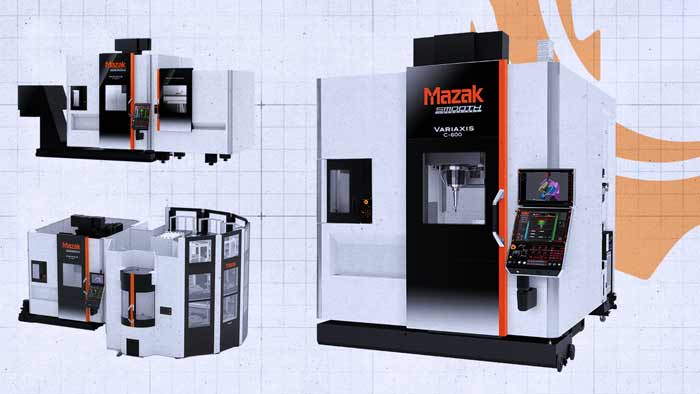
CNC FAMILY BREAKDOWN
Mazak Variaxis C Explained: C-600, C-700, and the Rotary Drive That Changes the Inspection
What is the Mazak Variaxis C?
The Mazak Variaxis C is a two model family of simultaneous 5-axis vertical machining centers, the C-600 introduced in 2020 and the C-700 introduced in 2024. Both use a trunnion style tilting rotary table supported at both ends, and the number in the name is the table diameter in millimeters, so the C-600 carries a 600 mm table and the C-700 carries a 700 mm table. Mazak positions the line as its economical entry into full 5-axis machining, and the C-600 replaced the discontinued Variaxis j-600/5X. Both ship with the Mazatrol SmoothAi control. The defining mechanical feature is that Mazak uses a roller gear cam on both the B and C axes to eliminate backlash, which changes what a used buyer should inspect.
Most 5-axis buying advice tells you to check the trunnion for backlash. On a Variaxis C that advice will pass a machine that has been crashed, because there is no backlash to find. Mazak states it plainly in the C-600 brochure: the B axis and C axis both use a roller gear cam to eliminate backlash. Zero backlash is the design goal and the design achieves it, which is genuinely better than the worm drives it replaced, and which quietly invalidates the standard inspection.
That is the thread running through this breakdown. The Variaxis C is a well engineered machine sold into a used market so thin that a buyer has almost no bargaining power, with a rotary architecture that ages differently from what most people are used to and a manufacturer that publishes no rotary accuracy specification to hold anyone to. All three of those facts point the same direction, toward a buyer who has to create the standard rather than verify against one. Start with what the name tells you, then get to what it does not.
The two machines
This is a small family, and being straight about that is more useful than padding it out. There are two models.
| Spec |
VARIAXIS C-600 |
VARIAXIS C-700 |
| Introduced |
2020 |
2024 |
| Table |
ø600 x 500 mm |
ø700 x 500 mm |
| X / Y / Z travel |
650 / 550 / 530 mm |
860 / 600 / 530 mm |
| B axis (tilt) |
-30 to +120 degrees |
-30 to +120 degrees |
| C axis (rotate) |
plus or minus 360 degrees |
not published |
| Max workpiece |
ø730 x 450 mm, 500 kg |
ø850 x 500 mm, 700 kg |
| Standard spindle |
12,000 rpm, 11 kW, 70 Nm |
12,000 rpm, 11 kW, 70 Nm |
| Spindle options |
15,000 / 18,000 / 20,000 rpm |
15,000 / 18,000 / 20,000 rpm |
| Taper |
No.40, BBT-40, HSK-A63 |
No.40 std, others optional |
| Tool changer |
30 std, 60 / 90 / 120 opt |
30 std, 60 / 90 / 120 opt |
| Pallet changer |
2 pallet standard |
2 pallet standard |
| Mass |
10,000 kg |
11,200 kg |
| Control |
Mazatrol SmoothAi |
Mazatrol SmoothAi |
Figures as published by Mazak. Both machines use a cam driven double arm tool changer at 4.5 seconds chip to chip, accept tools to ø80 mm by 300 mm and 8 kg, index the rotary axes to a minimum increment of 0.0001 degrees, and include Ai Thermal Shield thermal compensation. On pallet automation, be careful what you assume from the model number. Mazak shows four and six pallet configurations on its C series pages without attributing them to a specific model, and Mazak also publishes a VARIAXIS C-600 with MPP page, the Multi Pallet Pool being offered in 6, 12 and 18 pallet capacities. Confirm the pallet configuration in writing against the serial number.
The practical gap between them is bigger than the 100 mm of table suggests. The C-700 adds 210 mm of X travel and 50 mm of Y, and carries 200 kg more workpiece. If the plan is a bigger part or a longer unattended cycle, those travels and that workpiece capacity are the whole decision.
The number is the table, and Mazak's own page contradicts itself
Unlike most of the model names in this series, this one is refreshingly literal. The number is the table diameter in millimeters. C-600 is a 600 mm table, C-700 is a 700 mm table. No decoding required.
Which makes the following worth knowing before you compare spec sheets. Mazak's own U.S. summary listing for the C-700 shows the pallet as 23.74 inches, which works out to 603 mm, essentially identical to the C-600. Every other Mazak regional site, and Mazak's own U.S. detail page for the machine, give ø700 by 500 mm, or 27.56 inches. The 700 mm figure is the correct one and the summary figure is a data error. It is worth knowing why this is a typo rather than a units problem, because that tells you how much of the page to distrust. Every other figure on that same U.S. page converts correctly, 33.47 inches for the 850 mm maximum workpiece diameter and 1,543 lb for the 700 kg maximum workpiece mass. And 23.74 inches sits within a hundredth of an inch of the C-600's correct 23.62. The error is confined to that one pallet dimension.
We flag it not to score a point against Mazak, whose documentation is generally excellent, but because it is a useful reminder for anyone shopping from spec sheets. Manufacturer pages contain typos, dealer listings contain more of them, and a number that looks odd against the rest of the family usually is odd. Check a second source before you plan a fixture around it.
What C, i and j actually designate
Mazak sells Variaxis machines under three letters, and does not publish what any of them stand for. Not C, not i, not j, and not Variaxis itself. That is the fourth builder in this series whose marquee letters turn out to be undocumented, so treat any confident expansion you read elsewhere as invention.
What Mazak does publish is positioning, and that is more useful anyway. The C series is described in Mazak's own European material as an economical simultaneous 5-axis vertical machining centre, and the C-600 brochure opens with the line that it is your new portal to simultaneous 5-axis machining, designed to provide maximum value. The launch material describes the C-600 as the successor to the Variaxis j-600/5X and repeatedly uses phrases like attractive price point and cost effective. Mazak has told the trade press it is meant as an easy way into full 5-axis capability.
So read C as the entry tier of the Variaxis platform rather than as a technical designation. The i series sits above it as the flagship, the j series was the previous value line that the C replaced, and the legacy 500, 630 and 730 machines predate all three. On the used market the practical hierarchy matters more than the letters: i and j are where the supply is, and the C is where it is not.
The tilt axis runs the other way from the rest of the family
This one catches people who already run a Variaxis and assume the new machine works like the old one.
On the Variaxis i machines the tilting axis is designated A and its published range runs from -120 degrees to +30 degrees, with the i-800T an exception at -130 to +30. Mazak publishes no axis ranges at all for the current j series, so a j figure quoted on a dealer listing came from that dealer and not from Mazak. On the Variaxis C the tilting axis is designated B and its range runs from -30 degrees to +120 degrees. Set against the i series that is not a renaming exercise, it is a different trunnion orientation with an inverted tilt window, and it changes which side of vertical your work naturally presents to the spindle.
For a shop with existing Variaxis programs and fixtures, that means posts and workholding do not simply carry across. For a buyer evaluating a used machine, it means the extremes of tilt are in a different place than the family habit suggests, and the extremes are exactly where you want to test cut. An owner of an earlier Variaxis reported on a machining forum that the machine demanded excessively long tools once the tilt axis reached its limit, and that rigidity suffered when reaching near the machine's boundaries. That is the general behavior of trunnion machines rather than a defect, and it is why a demonstration cut taken near vertical proves less than the seller would like you to think.
A zero backlash rotary drive will not develop backlash when you crash it. It will develop a bump.
The roller gear cam, and why it changes what you inspect
Mazak states in the C-600 brochure that the B axis and C axis both utilize a roller gear cam to eliminate backlash, and describes the tilting rotary table as rigidly supported on both ends. Those are two genuinely good things and they deserve explaining properly, because the second order consequence is where the money is.
What a roller gear cam actually is. A conventional rotary table uses a worm and wheel: a steel worm slides against a bronze wheel, the bronze is the sacrificial part, and wear shows up as backlash that grows over time and grows unevenly, worst in the sector of the wheel that does the most work. A roller gear cam replaces that with a barrel shaped cam carrying a helical groove and a ring of hardened rollers on bearings that roll into and out of the groove. The rollers are preloaded into the groove, so there is no gap to open up, and motion transfers through rolling contact rather than sliding contact.
The durability difference is real and quantified, by the mechanism maker. Sankyo, which manufactures roller gear cam drives, publishes a comparison at five million operations: the roller gear cam showed 0.9 arc seconds of accuracy change with zero backlash, while a worm gear under identical conditions lost 42.1 arc seconds and opened up 18 microns of backlash. That is a vendor claim from a component supplier rather than an independent test or a Mazak figure, and we cite it as such, but the mechanism is well understood and the direction is not controversial.
Now the consequence. If there is no backlash to develop, there is no backlash to adjust out, and no adjustment path. A worn worm drive is a known and relatively cheap problem: shim it, reset it, replace a bronze wheel. A preloaded roller gear cam has no equivalent field adjustment published anywhere we could find, which means a damaged one is not adjusted, it is replaced as a precision matched assembly, realistically through Mazak.
So the failure mode shifts from gradual wear to impact. And impact damage does not present as growing backlash. A brinelled roller or a damaged patch of cam groove presents as a repeating positional error at one specific angular location, a bump that appears every revolution in the same place, which a standard backlash check will not find.
The buying rule that falls out of this is worth stating as directly as we can: on a Variaxis C, ask for crash history, not just hours. A 792 hour machine that was crashed at hour 40 is a worse purchase than a 4,000 hour machine that never was. The mechanism barely wears, so nearly all of its risk is impact, and an hour meter cannot see impact.
Mazak publishes no rotary accuracy specification for this machine
Here is the fact that should shape the entire transaction. Across the Variaxis C product page and the C-600 brochure, Mazak publishes no rotary indexing accuracy figure, no rotary repeatability figure, no clamping torque and no brake specification for either the B or the C axis.
On a three axis machine you can usually find a positioning and repeatability number and hold a seller to it. Here there is nothing to test against. Which means a buyer cannot verify rotary accuracy by comparison, and independent measurement stops being a nice to have and becomes the only option. If you take one thing from this article, take that.
How to actually verify a used 5-axis machine
Three methods, and they do different jobs. A serious purchase uses all three.
Renishaw AxiSet Check-Up is the rotary specific test, and it is built for precisely the question a used 5-axis buyer is asking. Renishaw describes it as identifying poor machine alignment, geometry and pivot point errors, and it reports four values: axis centre point error, which is the total error between the nominal and actual measured pivot point; form error, the residual after best fitting, which exposes bearing and drive irregularity through the rotation rather than a fixed offset; path error, the combined effect that predicts real part error; and alignment path error, the deviation of the static axis. Renishaw's published claim is that it runs in a few minutes. It needs a calibration sphere on a magnetic base, a spindle probe and the controller macros. Worth noting that a well specified used C-600 will already carry a Renishaw probe and Set and Inspect software, so the machine is usually ready to run it.
A ballbar test to ISO 10791-6 is the standards grade document. ISO 10791-6 specifically covers machines with three linear and one or two rotary axes, and assesses contouring accuracy across simultaneous coordinated motion. A standard test runs two circles, one clockwise and one counter clockwise. This is what exposes a machine whose XYZ is fine but whose 5-axis contouring is not, along with squareness, backlash, reversal spikes, servo mismatch and ball screw wear.
A cut NAS 979 cone frustum is the one that proves the whole system. The circle, diamond and square test with an inverted cone in the centre is the aerospace machine tool acceptance artefact. The cone is the 5-axis element: cutting a truncated cone requires continuously coordinated rotary and linear motion, so a rotary centreline offset, a pivot point error or a tilt axis squareness error shows up as measurable form and taper deviation on the cone wall. Metrology measures the machine. A cut cone measures the result, including the control, the kinematic model, the clamping, the thermal behavior and the tool.
Two conditions on all of it. Run everything at operating temperature after a warm up cycle, because the machine carries Ai Thermal Shield thermal compensation and a cold result is not the result you will live with. And be more suspicious of a machine calibrated the week before sale, not less, because a fresh kinematic calibration can make a mechanically worn machine measure beautifully.
Clamps and brakes, which matter more here than most people think
Mazak publishes no clamping torque or brake specification, so this is another comparative rather than absolute test. And on this machine specifically it deserves extra weight, for a reason that follows from the drive.
A worm drive has a natural tendency to self lock, which quietly backs up the clamp. A preloaded roller gear cam plus servo is doing more of that holding work, so a degraded clamp can hide behind a drive that holds position tightly, right up until a real cut loads it.
How to test it. Clamp the B axis at a loaded angle, and remember this machine tilts to +120 degrees, so test near the extremes and not just near vertical. Put an indicator on the table or on a test bar in the spindle and apply firm force in the direction of tilt. Movement that springs back is elastic deflection and expected. Movement that does not fully recover, or a needle that jumps and settles somewhere new, is the clamp slipping. Repeat across the B range and at several C positions, because a clamp can hold at one angle and slip at another. Then cycle clamp and unclamp repeatedly on both axes and listen for a crisp, consistent action rather than a soft or inconsistent one.
The symptom to recognize, because shops routinely misdiagnose it: chatter or a stepped surface that appears only in positional 5-axis work at a particular attitude, and never in three axis work. That is why a seller can demonstrate a flawless facing cut on a machine with a failing tilt clamp. Owners burn weeks chasing toolholders for this.
Which connects to something an experienced Variaxis owner said on a machining forum that is worth more than most spec sheets: 99 percent of what his shop machined was positional 5-axis rather than simultaneous. If that is true of your work too, then clamp and brake integrity matters more to you than simultaneous contouring accuracy, because positional work loads the clamps hard and then holds them there.
The used market is smaller than the listings make it look
We checked ten marketplaces for used Variaxis C machines. The honest answer is that there are somewhere between two and four used C-600 machines on the open market worldwide, most likely three, and zero used C-700 machines anywhere, which is expected for a model launched in late 2024.
More instructive is what we found while counting. A single 2021 C-600 with 792 cutting hours appears as four separate listings across four different sellers, with matching year, matching hour count, matching Renishaw probe model and matching coolant unit model. That is one physical machine being co-brokered, not four machines. Anyone searching casually would conclude the market is four times deeper than it is.
One published asking price exists for that machine, $239,900, for a 2021 with a dual pallet changer, SmoothAi, a Renishaw RMP600 probe with Set and Inspect, a high pressure coolant unit, a spindle chiller, a 60 tool changer and the base 12,000 rpm No.40 Big Plus spindle. That is an asking price from a third party listing, now archived, not a transaction price, and one data point is not a market. Note also that the base spindle is the entry option of four, so a buyer paying near new money should know what they are not getting.
By contrast, the Variaxis i and j series together offer roughly 20 to 40 distinct machines on the world market at any time, and the legacy 500, 630 and 730 generation offers well over a hundred. That difference is not academic. On a two to four machine market with one archived asking price, a buyer has no comparables, no room to negotiate and no second machine to walk to, which is exactly the situation in which a seller can decline an AxiSet report and a witnessed cone frustum and still make the sale. On the i and j pool you can walk away and look at the next thirty.
SmoothAi, and the backup question
Both C machines ship with Mazatrol SmoothAi, identifiable by a large touchscreen with Ai branding. For reference on the rest of the ladder, T-Plus and M-Plus era machines use small CRTs with membrane keypads, Fusion 640 uses a 10 to 12 inch color LCD, and Matrix and Matrix 2 use 15 inch panels with softkeys.
We want to be careful here, because there is a real risk and an unfair accusation sitting close together. We found no documented SmoothAi storage failure, hang or backup incident. The drive corruption and parameter loss reports that circulate in Mazak forums are from the Fusion 640 and M32 era, and it would be wrong to transfer them.
What is current and documented is narrower: if a machine sits unused long enough for the parameter memory battery to run down, parameters can be corrupted, and the recommended remedy is to check live parameters against the shipped data sheets. On a 5-axis machine those parameters include the kinematic model, which is not a nuisance to lose. It is a service call to re establish the machine's 5-axis geometry.
So the questions to ask are due diligence on a known architectural dependency rather than an accusation. Has a full parameter and kinematic data backup been taken, and can you have it on media before the machine is disconnected. Do the original shipped parameter data sheets exist. When was the parameter memory battery last changed, and has the machine had extended idle periods. Are all programs, tool data and work offsets exported into your hands. Has the control ever had a software reload or a drive replacement.
What Mazak support actually looks like
This is the strongest argument for buying Mazak used, and it is checkable rather than atmospheric. Mazak publishes a $450 million replacement parts and unit inventory, nearly 195,000 part numbers in stock, and 97 percent same day shipping, with North American headquarters in Florence, Kentucky and U.S. production facilities.
Two honest qualifications. Mazak's lifetime parts support language is a marketing statement with no published terms, exclusions or lead time commitment, so the right move is to convert the slogan into data: phone the parts line with the actual serial number and ask for availability and price on the trunnion assembly, the B axis drive unit and the spindle before you buy. And on the ownership side, the recurring owner complaint about Mazak 5-axis machines is not mechanical, it is a training and self service gap. Owners on machining forums have described getting started with limited factory training support and figuring the machine out alone, and there is a visible pattern of obscure alarms whose practical resolution path is a Mazak service call. A shop with a Mazak service relationship does well here. A shop planning to self support a used 5-axis is taking on more than the hardware suggests.
One last note on the fleet. We found no user report of a roller gear cam failure on a Variaxis C. That is a function of a young, small fleet rather than proof of a clean record, and it would be dishonest to present it as the latter.
RESELL CNC TAKE
Our honest read is that the Variaxis C-600 is a good machine in a bad used market. The roller gear cam architecture is a real improvement on the worm drives it replaced, a low hour example almost certainly has an unworn rotary drive, and Mazak's parts operation is among the best reasons to buy this brand secondhand at all. None of that is in question.
What is in question is bargaining power. Two to four machines worldwide, one archived asking price and no used C-700 means the seller sets the number and can decline your inspection conditions. If you want a Mazak 5-axis with real choice and real negotiating room, look at the i series and j series where the supply actually is, and spend what you save on an AxiSet report, a ballbar test and a witnessed cone frustum. If it has to be a C, then make the rotary check a condition of sale in writing, get a Mazak parts quote on the trunnion assembly before you commit, and ask about crashes rather than hours. We would rather lose a deal than hand someone a 5-axis machine nobody verified.
Frequently asked questions
What is the Mazak Variaxis C?
The Mazak Variaxis C is a two model family of simultaneous 5-axis vertical machining centers, the C-600 introduced in 2020 and the C-700 introduced in 2024. Both use a trunnion style tilting rotary table supported at both ends, and the number in the name is the table diameter in millimeters, so the C-600 carries a 600 mm table and the C-700 carries a 700 mm table. Mazak positions the line as its economical entry into full 5-axis machining, and the C-600 replaced the discontinued Variaxis j-600/5X. Both ship with the Mazatrol SmoothAi control. The defining mechanical feature is that Mazak uses a roller gear cam on both the B and C axes to eliminate backlash, which changes what a used buyer should inspect.
What is the difference between the Variaxis C-600 and the C-700?
The C-700 has a 700 mm table against the C-600's 600 mm, 210 mm more X travel at 860 mm against 650 mm, 50 mm more Y at 600 mm against 550 mm, and takes a larger and heavier workpiece at ø850 by 500 mm and 700 kg against ø730 by 450 mm and 500 kg. Z travel is 530 mm on both, as is the standard 12,000 rpm spindle and the 30 tool changer. Pallet automation is not the clean dividing line between them that spec summaries imply. Mazak shows four and six pallet configurations on its C series pages without naming a model, and publishes a separate VARIAXIS C-600 with MPP page, the Multi Pallet Pool coming in 6, 12 and 18 pallet capacities. Confirm the pallet configuration in writing against the serial number.
How is the Variaxis C different from the Variaxis i and j series?
The C is the entry tier of the Variaxis platform, described by Mazak as an economical simultaneous 5-axis machine and introduced as the successor to the Variaxis j-600/5X, with the i series positioned above it. There is also a mechanical difference that surprises existing Variaxis owners: on the i machines the tilting axis is designated A and travels from -120 to +30 degrees, the i-800T excepted at -130 to +30, while on the C machines it is designated B and travels from -30 to +120 degrees. Mazak publishes no axis ranges for the current j series. That inverted tilt window and different trunnion orientation mean programs, posts and fixtures do not simply carry across from an i series machine.
What is a roller gear cam, and why does it matter on a used machine?
A roller gear cam replaces the sliding worm and bronze wheel of a conventional rotary table with a barrel shaped cam carrying a helical groove and a ring of preloaded hardened rollers that roll into and out of it. Mazak uses one on both the B and C axes of the Variaxis C to eliminate backlash. It wears far more slowly than a worm drive, but because there is no backlash by design there is also no backlash to adjust out and no published field adjustment, so a damaged unit is replaced rather than reset. That shifts the risk from gradual wear to impact damage, which presents as a repeating positional error at one angular location rather than as growing backlash. Ask for crash history, not just hours.
How do you verify rotary accuracy on a used 5-axis machine?
Use three methods together, because Mazak publishes no rotary indexing accuracy, repeatability, clamping torque or brake specification for the Variaxis C, leaving nothing to test against. Renishaw AxiSet Check-Up is the rotary specific diagnostic and reports axis centre point error, form error, path error and alignment path error, which covers pivot point and centreline location. A ballbar test to ISO 10791-6 provides the standards grade document for simultaneous rotary and linear contouring. A cut NAS 979 cone frustum, machined under witness and inspected, is the only test that proves the machine, control, kinematic model, clamping and thermal behavior work together. Run all of it at operating temperature after a warm up.
How many used Mazak Variaxis C machines are available?
Very few. A survey of ten marketplaces found somewhere between two and four distinct used C-600 machines worldwide, most likely three, and no used C-700 machines at all, which is expected for a model launched in late 2024. The apparent supply is also inflated by cross listing, with one 2021 machine appearing as four separate listings across four sellers with identical year, hours, probe model and coolant unit. By comparison the Variaxis i and j series offer roughly 20 to 40 distinct machines at any time and the legacy 500, 630 and 730 generation well over a hundred, which is where a buyer will find comparables and room to negotiate.
VERIFY THE ROTARY BEFORE YOU COMMIT
See what Mazak machines we have on the floor now
Resell CNC is the only used CNC dealer in North America with Official Mazak Trade-In Center status, and every machine is evaluated by a team that includes four AMEA and CEA certified equipment appraisers.
Browse Used Mazak Machines
SOURCES
- Mazak, VARIAXIS C product page, accessed August 2026.
- Mazak, VARIAXIS C-600 brochure, 2020.
- Mazak, VARIAXIS C-600 launch announcement and North American introduction, 2020.
- Mazak, VARIAXIS C-700 announcement and JIMTOF introduction, October and November 2024.
- Mazak Europe, VARIAXIS C series positioning pages, accessed August 2026.
- Mazak, VARIAXIS i series and j series product pages, tilting axis designation and travel, accessed August 2026.
- Mazak, Parts Support page, inventory value, part number count and shipping performance, accessed August 2026.
- Mazak, North American headquarters and production facilities pages, accessed August 2026.
- Renishaw, AxiSet Check-Up product page and brochure, error categories and test procedure, accessed August 2026.
- Renishaw, ballbar testing explained, and QC20 ballbar for the ISO 10791-6 standard, accessed August 2026.
- ISO 10791-6, test conditions for machining centres, accuracy of feeds, speeds and interpolations.
- ISO 230-7, geometric accuracy of axes of rotation.
- STEP Tools, AP-238 five axis machining test documentation describing the NAS 979 circle diamond square with inverted cone test.
- Sankyo Seisakusho, RollerDrive roller gear cam technology page, including the five million operation accuracy comparison against worm gear.
- Peer reviewed research on optimum error design of preloaded roller gear cam mechanisms, Measurement, 2024.
- High Speed Technologies, Mazak VARIAXIS spindle repair and rebuild service documentation, accessed August 2026.
- Mazak service and parameter reference documentation on parameter memory battery behavior during extended idle periods, accessed August 2026.
- CNCArena machining forum, Mazak VARIAXIS owner discussion thread, 2010 to 2024, including reports on training support, tilt extreme tool length, pallet change faults and positional versus simultaneous usage.
- Public dealer and marketplace listings for used VARIAXIS C-600 machines, year, hours, configuration and asking price, accessed August 2026.
- Marketplace inventory surveys across Surplus Record, Exapro, Kitmondo, Equipt, Premier Equipment, Liberty Machinery, Machineseeker, used-machines.com, Revelation Machinery and Asset Exchange, accessed August 2026.
ABOUT THE AUTHOR
Bill Murphy is the Marketing and Content Lead at Resell CNC. The CNC Family Breakdown series decodes model families so buyers can read a listing the way a dealer reads it.
ABOUT RESELL CNC
Resell CNC has bought and sold used CNC machinery since 2008. Based in Maitland, Florida, with warehouses in Winter Springs and Longwood, the team brings more than 200 years of combined industry experience and four AMEA and CEA certified equipment appraisers on staff. Resell CNC has been an MDNA member since 2009 and is the only used CNC dealer in North America with Official Mazak Trade-In Center status.