Next Shift
Generative Design and the Death of the Blueprint
What is Generative Design?
Generative design is an algorithmic engineering method where software uses finite element simulation to produce part geometry optimized for a specified load case, material, and manufacturing constraint. Unlike traditional CAD, where the engineer draws the part, generative design produces the part through thousands of iterative simulations, typically resulting in organic, lattice-based, or topology-optimized shapes that hold the same structural loads with up to 40% less material. The output is a STEP file with no traditional 2D dimensions, requiring 5-axis CNC machining, conformal workholding, model-based definition (MBD) tolerance callouts, and blue-light or scanner-based inspection. Major platforms include Autodesk Fusion, nTopology nTop, PTC Creo, and Siemens NX. Generative parts are now in production at GE Aerospace, Boeing, Bugatti, and most tier-one aerospace suppliers, and every generatively designed part still requires CNC finish work on critical surfaces.
The print on your bench has no dimensions. It has no datum surfaces. It does not look like a bracket. It looks like a bone, or a coral, or something the cat coughed up. You look for the title block out of habit. There is no title block. There is a STEP file name and a note that says "geometry is the spec, do not edit." The engineer who emailed it does not know how to draw it any other way. The software designed it overnight while he was asleep.
This is a generative design part. In the next five years, you are going to be holding more of them than blueprints. This is a machinist's breakdown of what they are, where they came from, what they actually demand from a shop floor, and what changes about the work you do every day. No marketing language. Just what the operator at the spindle needs to know.
What You Are Actually Looking At
Generative design is not CAD. CAD draws what the engineer imagined. Generative design draws what the algorithm calculates is structurally optimal given a load case, a material, and a manufacturing constraint. The engineer types in the rules: this bracket has to handle 4,500 N in this direction, fit inside a 180 mm envelope, be made of Ti-6Al-4V, and weigh less than 220 grams. The software runs thousands of iterations overnight using finite element simulation. By morning, it spits out a part that looks like nothing a human would have drawn, but holds the load with 40% less material.
The geometry is not arbitrary. Every curve, every internal void, every variable wall thickness is the algorithm finding the path of stress. You are looking at a finite element analysis turned into a solid.
Why It Is Here Now
Generative design has existed in research since the 1990s. It went mainstream in the last seven years because three things happened at once.
Software got cheap. Autodesk Fusion has had generative design built in since 2018, included in the standard subscription. nTopology released nTop, a dedicated implicit-modeling platform that handles lattices and internal structures traditional CAD cannot describe. PTC Creo and Siemens NX both added generative modules between 2020 and 2022.
Compute got cheap. A generative run that took 14 hours on a workstation in 2017 now finishes in 90 minutes on a cloud GPU. The cost per design iteration dropped from hundreds of dollars to under five.
Additive went production. GE Aerospace 3D-prints the LEAP fuel nozzle as a single piece. It used to be 20 parts welded together. Bugatti printed a titanium brake caliper that weighs 41% less than the original. Boeing prints titanium brackets for the 777X. Every one of those parts was designed generatively. Every one of those parts also gets CNC-finished after printing.
That last part is the one the trade press keeps missing. Additive does not replace CNC. It moves the rough geometry off the spindle and onto the printer, then the finish work, the critical surfaces, the bearing bores, the threads, the seal grooves, all come back to the spindle. Generatively designed parts are not anti-machining. They are a CNC problem the printer cannot solve.
A generative part is not a part that escaped the CNC. It is a part where the CNC does the work that matters most. The roughing moves to the printer or the bandsaw. The finish work, the tolerances, the critical surfaces, all of it comes back to the spindle. The machinists who understand that are the ones quoting the work.
The Workholding Problem
The first thing you notice when a generative part lands on your bench is that none of it is flat. Brackets without parallel sides. Housings with organic external surfaces. Mounting flanges that curve in two directions. The first question every machinist asks is the same one, and there is no good answer to it. Where do I put the vise?
Traditional workholding assumes datum surfaces. A flat A, a perpendicular B, a parallel C. Generative parts have none of these. The algorithm did not preserve flat surfaces because flat surfaces did not help the load case.
The shops actually handling these parts are doing one of three things. Soft jaws machined to match the generative external contour, which is expensive and burns setup hours. 3D-printed conformal fixtures designed alongside the part, where the CAM team prints a cradle that matches the part shape, then bolts the cradle to the table. Or low-melt fixturing alloys like Cerrolow 117 that cast around the part and lock it in place, then melt off after machining at 117 degrees F.
If you are bidding a generative job with standard parallels and a vise, you are bidding to lose money.
5-Axis Stops Being Optional
You cannot machine an organic shape on a 3-axis machine. You can rough it. You cannot finish it. Every critical surface on a generative part sits at a compound angle to every other critical surface. You either rotate the part six times in fixtures and stack tolerance every time, or you tilt the head and table to reach every face in one setup.
5-axis stops being a premium capability and starts being a baseline requirement. The shops winning generative work are running Hermle C-series, DMG MORI DMU and DMC, Mazak Variaxis, or Matsuura MAM72. Trunnion-table 5-axis is the floor. Full simultaneous 5-axis with head tilt is where the high-margin work lives.
This is also part of why the used 5-axis market has not softened the way 3-axis has. A 2014 DMU 50 with a probing package and a 32-position toolchanger still sells well above its book value because there are not enough of them on the floor to meet generative demand.
GD&T Dies, MBD Takes Over
ASME Y14.5 geometric dimensioning and tolerancing assumes flat surfaces, axes, and centerlines you can reference. Generative parts have none of those. So the tolerance language is changing under the machinist's feet.
Model-based definition is the replacement. ASME Y14.41 defines it. Instead of a 2D print with dimensions, MBD embeds tolerance, surface finish, and inspection requirements directly into the 3D model. The CAD file is the spec. There is no separate drawing.
For the machinist, this means the model on the screen is no longer a reference for the print on the bench. The model IS the print. There is no flat sheet to thumb tack to the wall. There is a STEP file or a 3D PDF, and every callout floats next to the feature it applies to.
The shops handling MBD work have a screen at every machine. They train their operators to read model annotations the way old machinists read prints. Boeing, Lockheed Martin, Pratt and Whitney, and most tier-one aerospace suppliers stopped issuing 2D drawings on new programs years ago. The transition is real, and the shops that have not made it are losing the work to shops that have.
The Inspection Problem Nobody Solves with a CMM
Here is where the whole thing breaks for shops still using 2010-era inspection. A CMM measures discrete points. A discrete point assumes you know where to put the probe. On a generatively designed organic surface, every probe location is a judgment call, and the CMM cannot tell you whether the surface between the points is in tolerance.
The answer is full-surface scanning. Blue light scanners like the GOM Atos Q and the Hexagon AbsoluteScan capture millions of points per second and compare the scanned cloud against the CAD model. Creaform and FARO sell handheld scanners for shop-floor inspection in the $40,000 to $90,000 range. The output is a color map of the part with deviation from nominal shown in millimeters at every point.
The shops that bought a CMM in 2010 and assumed it would handle inspection forever are about to be priced out of generative work. The shops that added a scanner are billing inspection at $200 an hour and getting paid for it.
What Does Not Change
The machinist's judgment does not go away. Tool selection still matters. Feeds and speeds still matter. Surface finish still matters. The math of cutting forces still applies whether the part looks like a bracket or a kelp forest.
What changes is the toolpath strategy. CAM programmers writing 5-axis simultaneous paths for generative parts have to think about tool reach, holder collision, and surface scallop in three dimensions instead of two. Fusion, Mastercam Multiaxis, NX CAM, and Autodesk PowerMill all rewrote their 5-axis modules in the last three years specifically for generative geometry. The software is catching up faster than the workforce is.
The machinist who learns to read MBD callouts, who can program a 5-axis tilt strategy, who understands probing and scanning, is the machinist whose rate goes up. The machinist who only runs 2D prints from a sheet of paper is the machinist whose work disappears.
Resell CNC Take
The shops winning generative design work are running used 5-axis equipment in the $80,000 to $250,000 range, not new $600,000 machines. The capability barrier is lower than the new-machine quotes show. A clean used DMU 50, Variaxis, or Hermle C22 with a probing package and a refreshed control puts a shop in the game for half the capex. Resell CNC sees that exact trade pattern moving through retail and auction every quarter, and the demand on used 5-axis has not softened the way 3-axis has.
Frequently Asked Questions
What is generative design in manufacturing?
Generative design is an algorithmic engineering method where software produces part geometry by running thousands of finite element simulations against a specified load case, material, and manufacturing constraint. The output is typically an organic, lattice-based, or topology-optimized shape that holds the structural load with significantly less material than a traditionally designed part. Output is delivered as a STEP file with model-based definition callouts rather than a 2D drawing.
Will generative design replace traditional CAD parts?
Not for everything. A bracket that bolts to a standard frame still has flat datum surfaces, holes on a pattern, and standard tolerances. Generative is winning in aerospace, motorsport, medical implants, and any application where weight, stress, or material cost matters more than fitting standard tooling. General job-shop work will keep seeing traditional prints for years.
Do generative parts always require additive manufacturing?
No. Many generative parts are billet-machined when the geometry allows. The manufacturing constraint the algorithm receives in the software determines whether the output is CNC-friendly or printer-only. Engineers who select "5-axis CNC" as the constraint get parts the spindle can cut from solid stock. Engineers who select "additive" get parts that have to print first, then come back to the spindle for finish work.
How do I quote a generative part?
Quote setup and workholding separately from cycle time. Conformal fixtures, soft jaws, or low-melt alloy fixturing can cost more than the part itself. Inspection time on an organic surface runs three to five times longer than on a prismatic part. Build those into the quote up front or you will lose money on every job.
Do I need a new 5-axis machine to take generative work?
No. A used 5-axis machine with a probing package and a current control is the standard entry point for shops taking on generative parts. A 2014 DMG MORI DMU 50, a Mazak Variaxis, a Matsuura MAM72, or a Hermle C-series in the $80,000 to $250,000 range puts a shop in the game at roughly 30 to 50 percent of a new machine's cost. The capability matters more than the build date.
What inspection equipment do generative parts need?
Generative parts need full-surface scanning, not point-probe CMM measurement. Blue light scanners (GOM Atos Q, Hexagon AbsoluteScan) and handheld scanners (Creaform, FARO) in the $40,000 to $90,000 range are the standard. The output is a color deviation map comparing scanned surfaces to the CAD model. CMMs still work for the prismatic features on generative parts, but they cannot validate the organic surfaces.
The Bottom Line
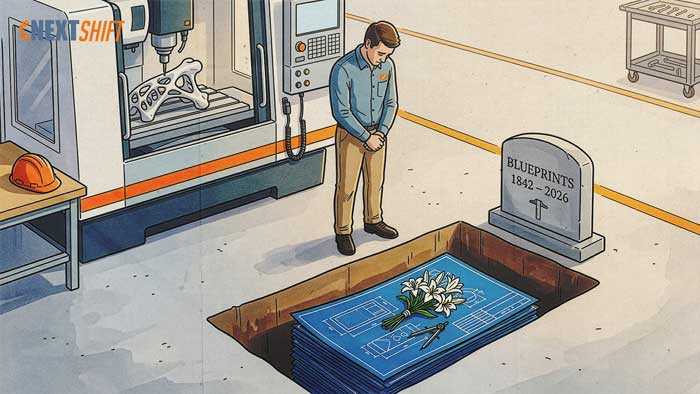
The blueprint is dying. Not next year, not in 2030, but a little more every quarter. The shops that figure out how to hold the part, how to reach every surface, how to read the model, and how to inspect the result are the shops winning the work. The shops waiting for the prints to come back to flat paper are waiting for a moment that is not coming.
The print is dying. The machinist is not. The machinist who learns the new language is the one who runs the spindle for the next 30 years.
Browse Used 5-Axis Inventory
Get into generative work without paying new-machine prices.
Browse the current Resell CNC inventory of used 5-axis machining centers, multi-axis VMCs, and probing-equipped production machines. Every appraisal is handled by our in-house team of AMEA and CEA Certified Equipment Appraisers.
BROWSE USED CNC MACHINES
SOURCES
- Autodesk. "Fusion Generative Design Documentation and Aerospace Case Studies."
- nTopology. "nTop Platform: Implicit Modeling for Generative Design and Lattice Structures."
- GE Aerospace. "LEAP Engine Fuel Nozzle Additive Manufacturing Production Brief."
- Boeing. "777X Titanium Bracket Generative Design Implementation."
- Bugatti Automobiles. "3D-Printed Titanium Brake Caliper Technical Brief."
- ASME. "Y14.41 Digital Product Definition Data Practices (Model-Based Definition)."
- Hexagon Manufacturing Intelligence. "AbsoluteScan and Blue Light Scanner Inspection White Paper."
- SME. "Generative Design Adoption in Precision Manufacturing: 2024 Industry Survey."
About the Author
Bill Murphy is the Marketing and Content Lead at Resell CNC, where he covers used CNC equipment, auction strategy, and the buying side of the secondary machine tool market. He works directly with the appraisal, auction, and retail teams to translate machine-level detail into content for shop owners, plant managers, and acquisition buyers.
About Resell CNC
Founded in 2008 and headquartered in Maitland, Florida, Resell CNC carries 200+ years of combined industry experience, four AMEA/CEA Certified Equipment Appraisers on staff, MDNA membership since 2009, and is the only used CNC dealer in North America with Official Mazak Trade-In Center status. The company operates across retail, auction, appraisal, and finance divisions from warehouses in Winter Springs and Longwood, Florida.