Meet the Machine
Used Doosan DMP 500/2SP: Two Spindles, Twice the Parts, One Operator
What is the Doosan DMP 500/2SP?
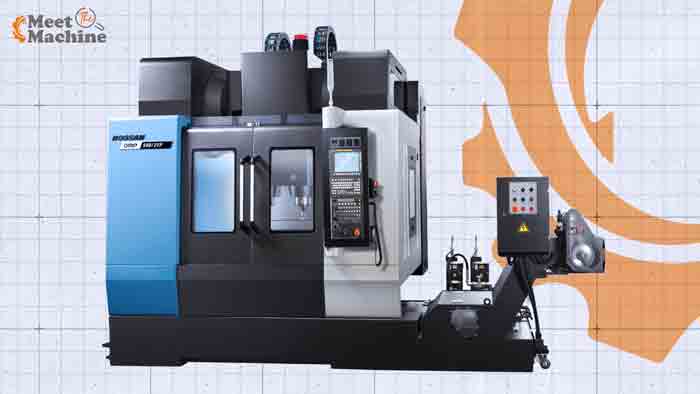
The Doosan DMP 500/2SP is a twin-spindle vertical machining center, meaning it carries two independent spindles and two automatic tool changers in one machine, so it cuts two identical parts at the same time and roughly doubles output in the footprint and with the labor of a single machine. Built by Doosan Machine Tools, now DN Solutions, it runs dual 12,000 RPM BT40 direct-drive spindles with an 8,000 RPM high-torque option, has around 41 by 20 by 24 inches of travel per spindle, and uses a W-axis on the right spindle to compensate for fixture-height differences between the two sides. It is a production machine, built for shops running high volumes of the same part, where making two per cycle instead of one changes the cost per piece.
There is an old problem in high-volume machining: how do you double your output without doubling your floor space, your operators, and your capital. The usual answers are to buy a second machine, add pallet automation, or bolt a robot onto a cell. The Doosan DMP 500/2SP answers it a different way. It puts two complete spindles in one machine, side by side, each with its own tool changer, and runs them together. Load two blanks, hit cycle start, and two finished parts come off at once. It is a simple idea executed well, and for the right shop it is one of the most efficient ways to make parts in pairs.
This is a working machinist's breakdown of the DMP 500/2SP: where it comes from, how the twin-spindle design actually works, the specs that matter, how it compares to the other ways of doubling output, the U.S. support picture, and what to check before you buy a used one. If your work is high-volume production of identical parts, this is the machine, and this is the piece that tells you whether it fits.
Where the DMP 500/2SP Comes From
Doosan Machine Tools built a strong global reputation for reliable, well-priced CNC machines: the Puma and Lynx turning centers, the DNM and Mynx verticals, and horizontals and 5-axis machines. In 2022 the machine tool business was sold and renamed DN Solutions, but the machines and the reputation carried straight over, and the used market still overwhelmingly calls them Doosan, which is how buyers search for them. When you shop a used DMP 500/2SP, you are buying into that Doosan lineage of dependable production iron.
The DMP series is the mass-production vertical machining center line, and the 2SP is the twin-spindle version of it. Doosan built it for a specific customer: the production job shop or parts manufacturer running the same part in volume, where the machine's job is not to do anything fancy but to make good parts, two at a time, all day, at the lowest cost per piece. That focus shows up in every design decision on the machine.
Two blanks in, cycle start, two finished parts out. The DMP 500/2SP does not double your output by working faster. It doubles it by working twice at once, in one machine's footprint, under one operator.
How the Twin-Spindle Design Works
The core of the machine is two independent spindles mounted side by side, each with its own automatic tool changer and tool magazine, running the same program in unison over two identical workholding setups. The operator fixtures a blank under each spindle, and both machine the same part at the same time. One cycle produces two parts. Because both spindles share the machine's structure and controls, you get that doubling without the cost, footprint, or second operator that a whole second machine would require.
The clever detail is the W-axis. In the real world, two fixtures are never perfectly identical in height, and two raw blanks can vary. The DMP 500/2SP puts a W-axis adjustment on the right spindle, a small independent vertical movement of about 20 mm, so any difference in fixture or part height between the two sides can be dialed out and both parts still come out to size. That is the kind of practical engineering that separates a twin-spindle machine that actually works in production from one that fights you every setup. Both spindles are 12,000 RPM BT40 direct-drive units as standard, with an 8,000 RPM high-torque option for heavier cutting, so the machine can be matched to the material and the part.
The Numbers That Matter
The DMP 500/2SP is sized for small-to-medium production parts, two at a time. Per spindle, travels run about 41 inches in X, 20 inches in Y, and 24 inches in Z, over a table around 47 by 20 inches that carries the two workholding stations. The spindles are 12,000 RPM direct-drive with roughly 87 lb-ft of torque, or 8,000 RPM with about 211 lb-ft for heavier work, driven by a motor in the range of 25 HP on its short-time rating. Each spindle has its own tool magazine, commonly around 30 tools per side, and the machine runs a Doosan-Fanuc i control, a widely known and well-supported platform. The whole machine weighs in around 18,700 pounds, which is a lot of mass for its envelope and part of why it holds up under continuous production.
None of those numbers are exotic on their own. That is the point. The DMP 500/2SP is not chasing a spec record. Everything about it is aimed at one outcome: two good parts per cycle, reliably, at low cost per piece.
The Problem It Was Designed Around
Think about a shop running fifty thousand of the same bracket, housing, or plate a year. On a single-spindle machine, every part carries the full cycle time, and the operator loads and unloads one part at a time. Labor and machine time per part are fixed, and the only ways to make more are to run faster, run longer, or add machines. The DMP 500/2SP attacks the math directly: for nearly the same cycle time and the same operator, it produces two parts instead of one. Loading, unloading, and idle time get cut roughly in half per part, and the cost per piece drops accordingly.
That is a narrow but powerful proposition. If your work is genuinely high-volume and made in identical pieces, the twin-spindle approach is hard to beat on cost per part and floor space. If your work is one-offs, short runs, or big varied parts, this is the wrong machine, and a flexible single-spindle VMC is the better buy. The DMP 500/2SP is a specialist, and knowing whether your work fits it is the whole decision.
U.S. Parts and Service
Doosan, now DN Solutions, has a large and established presence in North America, with a distribution and service network that has long supported these machines through dealers across the country. That matters to a used buyer in two ways. First, the machines are common, so operators who know them and parts to keep them running are widely available. Second, the control is a Doosan-Fanuc i, part of the most supported control family in the world, so service and control parts are not a barrier. A DMP 500/2SP is a mainstream production machine with mainstream support, not an orphan, which is exactly what you want when the machine is central to a production line.
How It Compares: Four Ways to Double Output
The DMP 500/2SP is really cross-shopped not against one machine but against the different strategies for making twice as many parts. Here is how they line up.
| Approach |
What It Is |
Trade-off |
| Doosan DMP 500/2SP |
Twin spindles in one machine |
Doubles output in one footprint and operator, but only for parts made in identical pairs |
| Two single-spindle VMCs |
Two separate machines |
Most flexible, but double the floor space, and usually more operator time |
| One VMC + pallet changer |
Automated part swapping |
Great for unattended running, but does not increase parts per cycle |
| One VMC + robot cell |
Automated load/unload |
Cuts labor and runs lights-out, but adds cost and complexity |
Two separate machines give you the most flexibility, because they can run different parts, but they cost more in floor space and usually labor. A pallet changer keeps a single machine fed for unattended running, but it does not make more than one part per cycle. A robot cell cuts the labor and enables lights-out work, at the cost of added complexity and capital. The DMP 500/2SP wins when the work is high-volume and identical, because it is the cheapest and most compact way to actually double the parts coming off per cycle. When your production is a steady diet of the same part in quantity, it is hard to beat. When you need flexibility, one of the other approaches is smarter.
Used-Market Pricing
The DMP 500/2SP is a relatively modern machine, so the used pool skews newer, and pricing reflects year, hours, spindle option, and tooling. The following ranges are orientation from current secondary-market activity, not quotes, and dealer listings are frequently request-price.
- Higher-hour or older examples: often close to $45,000 to $70,000, depending on condition and configuration.
- Recent, low-hour machines with desirable spindle and tooling options: often close to $70,000 to $110,000 and up.
- Included workholding and fixturing for the two stations adds real value, since matched twin fixtures are part of what makes the machine productive.
Because this is a production machine, hours and how hard it was run matter more than year alone. A well-maintained higher-hour machine from a clean shop can be a better buy than a neglected newer one.
What to Check When Buying a Used DMP 500/2SP
Both spindles, condition and hours. This machine has two spindles, so check both for runout, bearing noise, and heat, and get hours on each. A twin-spindle machine with one tired spindle is only half a machine.
Both tool changers. There are two ATCs and two magazines. Run both repeatedly and confirm reliable tool changes on each side, since a production machine leans hard on the changers.
W-axis function. Verify the W-axis on the right spindle moves and holds, because it is what lets the machine make two good parts despite fixture and blank variation. If it does not work, the twin-spindle advantage suffers.
Matched accuracy between spindles. Confirm both spindles produce parts to the same size and finish. The whole point is two identical parts, so check that the two sides actually agree.
Control generation. Confirm the Doosan-Fanuc i control is a supported generation with parts and documentation available. It is a common, well-supported platform, but verify the specific vintage.
Ways, ballscrews, and axis wear. A high-volume production machine covers a lot of cycles. Check for backlash and wear in the axes, which is where hard production hours show up.
Included workholding. Confirm what fixtures and workholding come with the machine for both stations. Matched twin fixtures are expensive and slow to source, and they are part of what makes the machine immediately productive.
Coolant and chip handling. Confirm the coolant system, any through-spindle coolant, and chip evacuation work, since a production machine generates chips fast on both sides.
Rigging and installation. At around 18,700 pounds, this is a heavy machine. Budget professional rigging, leveling, and requalification into the real cost, not just the purchase price.
Who Actually Runs Them
The DMP 500/2SP lives in high-volume production shops. Automotive and its suppliers run them on brackets, housings, covers, and other parts made by the tens of thousands. Contract manufacturers use them on any steady, high-quantity job where cost per part is the whole game. Hydraulics, fluid power, electronics, appliance, and general production shops making the same component in volume all fit the profile. What they share is a production reality where the same part runs long enough to justify a machine dedicated to making two of it at a time. For a job shop that lives on variety and short runs, this is not the machine, but for a shop with a steady high-volume part, it is one of the most cost-effective ways to make it.
Resell CNC Take
The DMP 500/2SP is a machine you buy when you know exactly what you are going to run on it. For a shop with a steady, high-volume, identical part, it is one of the smartest cost-per-part plays we see, because you double output without doubling floor space or operators. The two things we tell buyers to nail down are the health of both spindles and the W-axis, since those are what make the twin-spindle idea actually work. Confirm both sides make matching parts, get the twin fixturing, and this machine will earn its keep on a production line for a long time.
Frequently Asked Questions
What is the Doosan DMP 500/2SP?
It is a twin-spindle vertical machining center with two independent spindles and two tool changers in one machine, so it cuts two identical parts per cycle and roughly doubles output in one machine's footprint and with one operator. Built by Doosan Machine Tools, now DN Solutions, it runs dual 12,000 RPM BT40 spindles and is aimed at high-volume production of identical parts.
How does a twin-spindle VMC double production?
Both spindles run the same program over two matching fixtures at the same time, so every cycle produces two parts instead of one, for nearly the same cycle time and the same operator. Loading, unloading, and idle time drop by roughly half per part, which lowers the cost per piece.
What is the W-axis on the DMP 500/2SP for?
The right spindle has a W-axis, a small independent vertical adjustment of about 20 mm, that compensates for differences in fixture or blank height between the two sides. It lets both parts come out to size even when the two setups are not perfectly identical, which is essential for the twin-spindle design to work in real production.
Is Doosan the same as DN Solutions?
Yes. Doosan Machine Tools was sold and renamed DN Solutions in 2022, but the machines and their reputation carried over unchanged. The used market still largely calls them Doosan, which is how most buyers search for them, so a DMP 500/2SP may be listed under either name.
Is the DMP 500/2SP right for a job shop?
Only if the job shop runs high volumes of identical parts. The machine is a production specialist that shines when the same part runs in quantity. For one-offs, short runs, or large varied parts, a flexible single-spindle VMC is the better choice.
How much does a used DMP 500/2SP cost?
As orientation, higher-hour or older examples often land close to $45,000 to $70,000, while recent low-hour machines with desirable options often run close to $70,000 to $110,000 and up. Hours and included twin workholding matter more than year alone, and dealer listings are frequently request-price.
Looking for a Doosan?
See what we have on the floor.
Every machine we sell is backed by a team with 200+ years of combined industry experience and four AMEA and CEA certified equipment appraisers on staff. Browse our used Doosan inventory.
See Used Doosan Machines
About the Author
Bill Murphy is the Marketing and Content Lead at Resell CNC, covering used machine tools, the brands behind them, and the history of the trade.
About Resell CNC
Resell CNC has bought and sold used CNC machinery since 2008. Based in Maitland, Florida, with warehouses in Winter Springs and Longwood, the team brings more than 200 years of combined industry experience and four AMEA and CEA certified equipment appraisers on staff. Resell CNC has been an MDNA member since 2009 and is the only used CNC dealer in North America with Official Mazak Trade-In Center status.
Sources
- DN Solutions, DMP 500/2SP twin-spindle vertical machining center specifications
- Doosan Machine Tools, DMP 500/2SP product brochure and technical documentation
- Industrial Machinery Digest and MoldMaking Technology, DMP 500/2SP dual-spindle coverage
- Doosan Machine Tools renamed DN Solutions, 2022