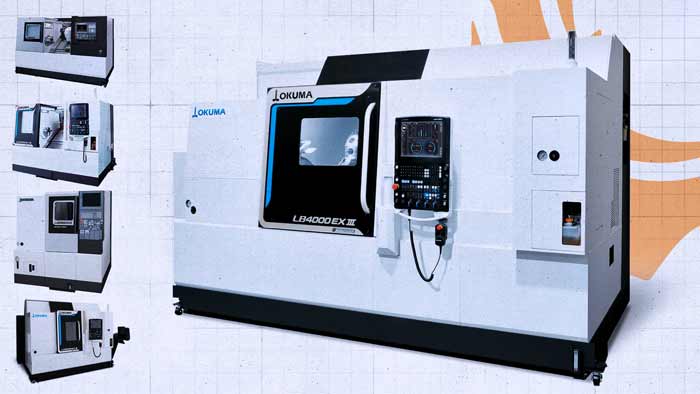
CNC FAMILY BREAKDOWN
Okuma LB Model Numbers Explained: LB2000 to LB45, and the Two Specs Okuma Has Never Published
What is the Okuma LB series?
The Okuma LB series is Okuma's single saddle CNC turning center line, running from the LB15 of 1982 to the current LB EX III machines. Six models make up the current range: the LB2000, LB2500, LB3000 and LB4000, sold as EX II and EX III generations, plus the larger LB35 III and LB45 III, which never adopted the four digit naming. The number in a model name is a nominal chuck size class rather than a measurement, and all six sit on one size ladder running from a 6 inch chuck to a 15 inch chuck. Okuma also publishes its spec letters plainly: M for milling, Y for Y-axis, W for sub-spindle. Okuma builds its own OSP control for these machines, which makes the control designation a second date on a used listing.
Most builders in this series have made us work to decode a model name. Haas never published what ST stands for. Mori Seiki never explained NL. Mazak never said what the C in Variaxis C means. Okuma is the exception. It publishes its spec letters in plain language, in both English and Japanese, on its own product pages.
So an LB listing looks readable, and that is exactly the trap. Reading the name is the easy part. The hard part is that the six machines in this family look far more similar on paper than they are in practice. Two of them share a chuck size, a turning diameter, a spindle motor, a torque figure and a turret, and differ by a factor of nine in the length of part they can hold. One turns a larger diameter than the machine above it. Two generations of the most popular model in the range have identical capability on every published row. And the two numbers a buyer most wants, bar capacity and positioning accuracy, are the two Okuma has never published for this line.
This breakdown works through the family properly: what each machine actually is, what genuinely separates it from its neighbours, and then what the name does and does not tell you.
The six machines, side by side
| Spec |
LB2000 |
LB2500 |
LB3000 |
LB4000 |
LB35 III |
LB45 III |
| Std chuck |
6 in |
8 in |
8 in |
10 in |
12 in |
15 in |
| Max turning dia |
ø430 |
ø410 |
ø410 |
ø480 |
ø460 |
ø660 |
| Max turning length |
300, 500 |
150 |
500, 1000, 1300 |
750, 1500, 2150 |
600, 850, 1500, 2000 |
750 to 4000 |
| Max spindle rpm |
6,000 |
5,000 |
5,000 |
4,200 |
3,200 |
2,800 |
| Spindle motor kW |
11 / 7.5 |
22 / 15 |
22 / 15 |
30 / 22 |
30 / 22 |
37 / 30 |
| Max torque N.m |
160 |
427 |
427 |
700 |
1,308 / 959 |
4,136 / 3,352 |
| Spindle bore mm |
62, opt 80 |
80 |
80 / 91 / 110 |
91 / 112 / 185 |
90 |
110 |
| Spindle nose |
ø140 flat |
A2-6 |
A2-6 / 8 / 11 |
A2-8 / 11 / 15 |
A2-8 / 11 / 15 |
A2-11, opt 20 |
| Tailstock |
MT No.4 |
none |
MT No.5 |
MT No.5 |
MT No.5, quill 120 |
MT No.5, quill 130 |
| Rapid X / Z m/min |
25 / 30 |
25 / 30 |
25 / 30 |
25 / 30 |
15 / 20 |
15 / 20 |
| Variants offered |
L, M, MY, W, MW |
L, M only |
L, M, MY, W, MW, MYW |
L, M, MY |
L, M, MY |
L, M, MY |
Figures as published by Okuma. Motor and torque ratings are 30 minute over continuous, except the LB2000 which is rated 20 minute over continuous. Bore and nose entries give standard, then Big-Bore, then Super Big-Bore. Turret is a 12 station V12, or M-V12 on the milling variants of the four digit machines; Okuma gives the LB35 III and LB45 III as V12 without an M-V12 designation. Variant and length columns are the EX II generation for the four digit models. On sourcing: chuck size, turning diameter, length options, spindle speed, motor output and variant lists are corroborated on Okuma HTML spec tables, and the LB35 III and LB45 III torque and tailstock figures come from Okuma Japan product pages. Bore, nose ladders and the four digit torque figures exist only inside Okuma brochure spec tables, whose multi column layout extracts unreliably, so treat those three rows as indicative and confirm against the machine.
Two things jump out of that table before you read a single word of analysis, and both are worth chasing down.
The LB2500 has no tailstock, no Y-axis and no sub-spindle, exists only as L or M, and holds a part 150 mm long, while sharing a chuck size, a turning diameter, a motor, a torque figure and a turret with the LB3000. And the LB2000 turns a larger diameter than the LB3000 despite a smaller chuck, while the LB4000 turns a larger diameter than the LB35 III despite a smaller chuck. The family is not ordered the way the numbers suggest.
The one ladder every LB sits on
Start with the number, because it explains the shape of the whole family. Okuma publishes a row called Standard chuck size, and every model in the range maps to it.
What makes this genuinely useful is that the legacy two digit models sit on the same ladder, extended downward. The LB15 is an 8 inch machine, the LB25 a 10 inch machine, the LB35 a 12 inch machine and the LB45 a 15 inch machine. Chuck size, spindle bore, cross travel, motor power and machine mass all rise with the number, and maximum spindle speed falls. The four digit models slot into the same scheme: LB2000 at 6 inch, LB2500 and LB3000 at 8 inch, LB4000 at 10 inch.
So the two naming schemes are not two systems. They are one ladder written two ways, which is why Okuma could keep selling LB35 III and LB45 III alongside the four digit machines without anything looking odd.
What the number is not, in either scheme, is a measurement. It is not inches of anything: the LB35 is a 12 inch machine and the LB45 a 15 inch machine, so 35 and 45 do not describe the chuck. It is not swing, and Okuma does not publish swing on its spec tables anyway. We found no Okuma statement anywhere defining what the digits mean. Treat it as a class index.
The number also collides. The LB2500 and LB3000 are both 8 inch machines with an identical ø410 mm turning diameter, so two numbers point at one class. And two more things distort it further, one on each side of the ladder.
The first is the bore option tree. Big-Bore and Super-Bore options move chuck and bore enormously inside a single model number. An LB35 II can be a 12 inch machine, or it can be the LB35SBB with an 18 inch chuck and a bore near 7 inches. The model number alone does not tell you the machine's capacity, and on the legacy machines that variation is barely documented.
The second is the milling turret, which is the answer to the diameter inversions.
Why the LB2000 turns a bigger part than the LB3000
The LB2000 publishes a ø430 mm maximum turning diameter on a 6 inch chuck. The LB3000 publishes ø410 mm on an 8 inch chuck. Those two headline figures are each verified on three Okuma sources and they are not typos. The smaller machine turns the larger diameter.
The reason is that maximum turning diameter on these machines is set by what the chuck and the turret leave clear, not by the size of the spindle. The LB2000 carries a 6 inch chuck on a ø140 flat spindle nose. The LB3000 carries an 8 inch chuck on a JIS A2-6 nose. Less workholding in the way, more diameter available.
Okuma proves the point on the LB2000 itself, and this is the part worth remembering. On the plain turning machine the figure is ø430 mm. On the M variant, with the M-V12 milling turret in place of the V12, it drops to ø360 mm. Seventy millimetres of diameter, lost to nothing but turret geometry, on an unchanged spindle. The LB2500 does the same thing, ø410 mm as an L and ø340 mm as an M, and the LB4000 EX II shows it again with ø480 mm on the L and M against ø430 mm on the MY. One caveat on those variant figures: they come from Okuma brochure spec tables rather than the web spec pages, so the mechanism is consistent across three machines but the individual numbers carry the brochure caveat.
Two consequences for a buyer. First, if you are checking whether a part fits, get the turning diameter for the variant in front of you, not the headline number for the family. A milling spec machine loses real capacity. Second, the ordering reverses once you compare milling machines. Okuma publishes ø410 for every LB3000 EX II variant column including the M, so an LB3000 M turns ø410 against an LB2000 M at ø360. The LB2000 turns bigger is a plain turret fact, not a universal one.
One honest limit, and one warning that comes out of it. Okuma does print swing over bed and swing over saddle rows in its LB brochure spec tables, so the mechanism is dimensioned somewhere, but those rows sit in exactly the multi column blocks that extract unreliably and Okuma does not repeat them on any regional web spec table. So we are not quoting a swing number. The warning is what that ambiguity does in the wild: Okuma Europe publishes 470 mm as the maximum turning diameter for the LB2000 EX II, and 470 is the figure the brochure gives for swing over saddle. A swing dimension is being published under a turning diameter label. That is very likely why dealer listings for these machines disagree with each other.
The LB2500 and the LB3000 share a chuck, a turning diameter, a spindle motor, a torque figure and a turret. One holds a part 150 mm long. The other holds one 1,300 mm long.
LB2500 against LB3000, the question the spec sheet does not answer
This is the comparison people get stuck on, because on the rows most buyers check first the two machines are the same machine.
Identical on both: the 8 inch standard chuck, the ø410 mm maximum turning diameter, the ø80 mm spindle bore, the JIS A2-6 nose, 5,000 rpm, 22 kW over 15 kW on a 30 minute and continuous rating, the same 30 over 22 kW high power option, 427 N.m of torque, the V12 and M-V12 12 station turret, the same 6,000 rpm milling spindle and the same rapids. Both brochures specify the OSP-P300LA, though Okuma America now footnotes its LB2500 EX II page as showing figures for an OSP-P500 configuration, so confirm the control on the specific machine.
So the entire cutting package is common. Here is where they part.
| Row |
LB2500 EX II |
LB3000 EX II |
| Max turning length |
150 mm, one fixed option |
500, 1000 or 1300 mm |
| Tailstock |
None. Cannot support a shaft |
NC tailstock standard, MT No.5 |
| Variants |
L and M only. No Y-axis, no sub-spindle, ever |
L, M, MY, W, MW, MYW |
| Bore options |
ø80 only. No published Big-Bore |
ø80, ø91, ø110 |
| Machine mass |
3,400 kg as L, 3,500 as M |
4,400 to 7,400 kg by configuration |
| Machine length |
1,880 mm |
2,340 to 4,344 mm |
Read as a ratio, the length difference runs from three times to nearly nine times. And the LB2500 gives up the tailstock, the Y-axis, the sub-spindle and the bore ladder to get there.
So why did Okuma sell both? Because the LB2500 is a floor space product rather than a capability product. Okuma's own page for it makes the argument directly, positioning the machine for shops that need a large work envelope in a very small footprint, where floor space is at a premium. You get the LB3000's spindle, its torque and its turning diameter inside a machine 460 mm to two and a half metres shorter, on the condition that your parts are 150 mm long or less.
Put plainly: the LB2500 is the LB3000's spindle on a stub bed. It is a dedicated short chucking machine, for parts where diameter dominates length. Discs, flanges, hubs, gear blanks, brake rotors. The ø80 bore is academic when there is only 150 mm of Z, so it was never a bar machine either.
Which also tells you how to shop it. If you find an LB2500 priced against LB3000 comparables, the price is wrong in one direction or the other, because they are not substitutes. And if a listing describes an LB2500 with a tailstock or a sub-spindle, something is wrong with the listing.
LB4000 against LB35 III, where power stops being the answer
The LB4000 turns ø480 mm on a 10 inch chuck. The LB35 III turns ø460 mm on a 12 inch chuck. Same inversion as before, same cause, bigger chuck eating radial envelope.
On the row most buyers check first, these are the same machine. Both carry a base spindle motor of 30 kW over 22 kW on a 30 minute and continuous rating, and both carry the same spindle nose range of A2-8, A2-11 and A2-15.
Then look at torque, which Okuma publishes on its Japanese product pages, and the picture changes completely. The LB4000 publishes 700 N.m. The LB35 III publishes 1,308 N.m on a 30 minute rating and 959 N.m continuous. Identical kilowatts, nearly twice the torque.
The reason is the spindle drive, and it connects straight back to the gearbox difference in this family. The LB4000 runs a PREX motor built into the spindle with no gears at all, so there is nothing in the driveline to multiply torque with. The LB35 III runs a VAC motor through four automatic ranges, two gear steps by two motor windings, which trades speed for torque at the bottom of the range. That is what a gearbox buys, and it is why the LB35 III stops at 3,200 rpm against the LB4000's 4,200 while pushing far more into the cut.
Everything else lines up behind that. The LB35 III's rapids are 15 and 20 metres per minute against 25 and 30. Its minimum footprint is 4,015 by 2,663 mm against roughly 3,100 by 1,921 mm, so it wants somewhere between half again and nearly twice the floor depending on which Okuma figure and generation you compare. It is the heavier, slower, stiffer machine.
So read the pair this way. The LB4000 turns the larger diameter. The LB35 III pushes the heavier cut into a slightly smaller one. If your parts are large in diameter but light in the cut, the LB4000 is the machine. If they are a little smaller and you are hogging, the 20 mm of diameter you give up buys you roughly 600 N.m.
The LB45 III takes the same logic further than most buyers expect. Fifteen inch chuck, ø660 mm turning diameter, which is the largest in the range by 180 mm, turning lengths to 4,000 mm, an A2-11 nose with A2-20 optional, 37 over 30 kW, and a spindle ceiling of 2,800 rpm with four gear ranges. Its published torque is 4,136 N.m on a 30 minute rating and 3,352 N.m continuous, which is nearly six times the LB4000 on a motor only 7 kW larger. Machines in that family run up to 8,570 mm long. It is a long heavy shaft machine and the torque and between centers figures are the whole story.
What each machine is actually for
All of this is grounded in published figures rather than application claims Okuma does not make.
LB2000, small precision parts and small bar
A ø62 mm standard bore with ø80 optional caps bar work. Six thousand rpm paired with only 160 N.m and 11 over 7.5 kW is a high speed, low torque combination, which means small diameters and light chips rather than roughing. Turning length is 300 or 520 mm. Okuma's own EX III release describes it as designed to create finely tuned small parts or complex components when paired with the optional MYW package, which is Okuma's language and a fair summary.
LB2500, short chucking work in minimum floor space
One hundred fifty millimetres of length against ø410 mm of diameter is the defining ratio: a diameter dominant part envelope with real cutting capability behind it at 427 N.m. No tailstock, no Y, no sub-spindle, in a machine 1,880 mm long. Not a bar machine, not a shaft machine.
LB3000, the generalist and the production cell machine
The only model with the full option tree of M, W, MY, MW and MYW. The bore ladder of ø80, ø91 and ø110 with matching A2-6, A2-8 and A2-11 noses means bar work up to ø110 in Super-Bore form. Turning lengths to 1,300 mm with an MT No.5 tailstock cover real shaft work. Add the sub-spindle and it becomes a done in one production machine. This combination is why it is the volume seller and why it is the deepest pool on the used market.
LB4000, heavy chucking, long shafts and large tube
The standout published figure in the whole family is the ø185 mm Super-Bore on an A2-15 nose, by far the largest bar and tube capacity in the range. Combine that with 700 N.m, 30 over 22 kW, turning lengths to 2,150 mm and an MT No.5 tailstock and you have the oil country and coupling argument, plus genuine long shaft capability.
LB35 III, heavy roughing at low rpm
Twelve inch chuck, ø460 mm, lengths to 2,000 mm, 30 over 22 kW geared through four automatic ranges for 1,308 N.m, rapids held to 15 and 20 metres per minute, and a footprint of 4,015 by 2,663 mm. Big depth of cut at low speed on shafts and heavy chucked parts. Okuma publishes a ø90 mm bore and an A2-8 nose in its brochure for this machine, though not on its web spec tables.
LB45 III, long heavy shafts
Fifteen inch chuck, ø660 mm, up to 4,000 mm between centers, 37 over 30 kW geared for 4,136 N.m, four gear ranges. Rolls, axles, large spindles, big tubulars. Okuma publishes a ø110 mm bore and an A2-11 nose in its brochure, with A2-20 optional.
EX II to EX III, and why it matters what you pay for it
Okuma publishes a dated lineage: LB15 in 1982, LB300 in 1998 with the slanted box bed adopted for low thermal deformation, LB3000 EX in 2006, EX II in 2012, and LB3000 EX III in March 2023, with the LB2000 and LB4000 EX III launching in the US in September 2024. Okuma's brand story says 2006 for the EX while the EX III brochure says the series was released in 2007, so 2006 to 2007 is the honest way to write it.
The generation jump is not the same story on every model, and this is the most directly useful finding in this article for anyone shopping a used machine.
On the LB3000, the EX III changed no capability row at all. Chuck size, turning diameter, turning lengths, spindle speed, motor output, torque, bore, nose, front bearing, turret and index time, milling spindle and the full variant list are identical between EX II and EX III. What changed is the control, from OSP-P300LA to OSP-P500, plus small shifts in machine dimensions and roughly 100 to 150 kg off the base mass. If the disputed X rapid figure of 25 against 30 metres per minute is real, that is the only performance gain in the generation. One thing to know if you go checking: Okuma America's EX III page lists fewer length options than its EX II page, showing 500 and 1,000 where the EX II shows 500, 1,000 and 1,300. Okuma Europe still lists 1,300 for the EX III, so that reads as a truncated page rather than a deleted option.
Which means an LB3000 EX II removes metal exactly as well as an EX III. The premium on the newer machine buys you the OSP-P500 control and its software, not capability. On a used purchase, that is a decision you can make on price rather than on capability, and it is worth knowing before somebody sells you a generation gap.
On the LB4000, the EX III is a real capability change. It gained MW and MYW variants, so a machine that existed only as L, M and MY became available with a sub-spindle, which turns a single spindle lathe into a done in one machine. That is a genuine generational step. Two cautions, both from Okuma contradicting itself. Okuma Europe still lists only L, M and MY for the same machine, so confirm the sub-spindle against the specific serial number. And the X rapid is disputed: the EX III product page and brochure give 30 metres per minute where Okuma America's own September 2024 launch release gives 984 inches per minute, which is 25 and unchanged from the EX II. Do not pay for a rapid traverse gain without checking it.
On the LB2000, the EX III is mostly the control plus one option. Same 6 inch chuck, same ø430 mm, same 300 mm length, same 11 over 7.5 kW. New OSP-P500 control, and an MYW variant added where the EX II offered M, W, MY and MW. Okuma publishes very little else for the EX III, so a stronger claim is not supportable.
On the LB2500, there is no EX III. Okuma publishes the LB2500 only as an EX II, on all of its regional sites, and the model does not appear in the EX III series brochure. So a buyer searching the current catalogue and failing to find an LB2500 has not found a misdescribed listing. The model simply was not carried forward.
Worth noting that the EX II run was long. Okuma kept the badge from 2012 to 2023, and Japanese trade press reported Okuma describing the EX III as the first model change in sixteen years. Add the EX and one near identical name spans 2006 to 2023. There was also a mid life change in August 2016, when Okuma added an optional bed 30 percent longer on the L, M and MY versions of the LB3000 EX II. Two machines both honestly listed as LB3000 EX II can be a decade and one bed length apart.
The legacy machines, which is what the used market actually has
A buyer shopping an LB is far more likely to be looking at a 1990s or 2000s machine than a current one, so these deserve proper treatment. They also come with a documentation problem that is itself the most important thing to know about them.
LB10, LB12 and LB15, the original generation
One Okuma programming and operations manual, publication 2446-E of February 1985, covers LB10, LB12 and LB15 together under the OSP5000L-G control, which is strong evidence of a single family. The LB15 is the volume machine and the origin of the name, launched in 1982, with Okuma reporting more than 15,000 units sold in its first ten years. The LB10 is the small end, roughly a two thirds scale LB15.
The LB12 is a genuine curiosity and a warning. It appears in that Okuma manual title and effectively nowhere else. No spec sheet, no listing, no photograph that we could find. If someone shows you an LB12, there is no manufacturer or market reference to check it against.
What the II designation changed, and what it does not tell you
On the LB15 the II was a real platform change, not a facelift. Cross travel went from 150 to 260 mm, a 73 percent increase. Maximum turning diameter went from 250 to 340 mm. Top speed went from 3,800 to 4,500 rpm. The spindle became a variable AC motor rated 15 over 11 kW on a 20 minute and continuous basis. The control moved to OSP7000L, and a long bed option and a milling variant appeared.
On the LB35 the II tells you almost nothing, and this is the correction worth carrying into a listing search. Three separate LB35 II machines we examined carried three different controls: a 1994 machine on OSP5020L, a 1995 machine on OSP7000, and a 2007 machine on OSP-P200L. So the LB35 II badge spans roughly 1990 to 2008 and three control generations. A 2007 LB35 II is a THINC machine with an open architecture PC based control. A 1994 LB35 II is a CRT and bubble memory machine. Both are advertised as LB35 II.
And on the LB35 and LB45, the III was not a size change either. The 2007 LB35 II's core geometry, at ø460 mm turning diameter, 330 mm of cross travel and 3,200 rpm, matches the current LB35 III exactly. The 1998 LB45 II at ø660 mm, 440 mm of X, 2,800 rpm and a ø110 bore matches the LB45 III's published figures. The III on these machines is a control and feature generation over an unchanged working envelope, which is a useful thing to know when you are pricing one.
LB300 and LB400, the generation with no paperwork
The LB300 is real, well attested, sold as Space Turn LB300 from about 1998 to 2006, in the 8 to 10 inch chuck class, with variants including M, MC, MY and W, on the OSP-U100L and then the OSP-E100L control. It matters because it is the direct ancestor of the LB3000 EX and shares its cross travel of 260 mm and its standard bore of 80 mm.
The problem is that its specification cannot be pinned down. Okuma hosts no spec sheet, and the dealer figures in circulation contradict each other badly: spindle bore quoted at 65, 80 and 100 mm, machine mass at 4,300, 6,000, 6,200 and 7,500 kg, top speed at 3,800 and 4,500 rpm. Some of that is genuine variant spread across the M, MC and MY machines and the big bore option, but a buyer cannot tell which figure applies to the machine in front of them. On a forum thread asking for LB300 specs, the answer reported from Okuma itself was that manuals are not adapted to a specific machine and you need to ask Okuma. That is the right advice. On an LB300, get the nameplate and have Okuma confirm the build. Do not buy off the listing.
The LB400 needs a correction to what we said in an earlier draft. We could find no Okuma source for it, and that remains true: searches confined to Okuma's own domains return only the LB4000 EX. But the machine is real. Six independent dealers list it consistently as Space Turn LB400-M, year 2000, a 12 inch chuck machine with roughly ø420 mm turning diameter, 300 mm of X, 3,500 rpm and 30 horsepower. So it is not a mistyped LB4000 and not a regional name. It is a real Okuma model with, as far as we can establish, zero surviving manufacturer documentation, which makes it the highest documentation risk on this list.
Keep the pairs strictly separate when you search. LB300 is not LB3000 EX, and the extra zero is eight years, a control generation, and both of the dividing lines in the next section. LB400 is not LB4000 EX. And LB3500 is not a machine at all: two separate research passes found no evidence of any kind that Okuma ever built one.
The two dividing lines that decide what a legacy machine is worth
Moving up the generations, two changes matter more than any spec row.
The first is THINC. The OSP-P200 was Okuma's first THINC control, arriving in 2004 to 2005, with the API published in 2007. It is PC based, open architecture and extensible. In LB terms, an LB3000 EX or later has it and an LB300 or LB400 does not, and we observed a P200L on a 2007 LB35 II as well. That boundary decides how you get programs on and off the machine and what third party software will run.
The second is Thermo-Friendly Concept, Okuma's thermal deformation control, developed in 2001 and first fitted to a vertical machining center. It becomes a marketed feature of the LB line with the EX generation, quantified as dimensional change over time held under 5 microns in diameter, and on the EX III Okuma states that holds across an 8 degree Celsius ambient swing with no warm up and no dimensional compensation. An LB300 does not have it. Its slanted box bed is the structural ancestor rather than the same thing.
There is a third gain that nobody markets and a used buyer should weigh: documentation still exists. Okuma currently publishes full spec sheets for the LB2500, LB3000 and LB4000 EX II and for the LB35 III and LB45 III. It publishes nothing at all for the LB10, LB12, LB15, LB25, LB35, LB45, LB300 or LB400. The ability to check a listing against a live manufacturer document is a concrete, checkable benefit of buying up a generation, and it is exactly what an LB300 or LB400 buyer loses.
On which legacy machines hold up best, the strongest documented position belongs to the LB35 II and LB45 II, because their working envelopes match the still current LB35 III and LB45 III almost exactly, Okuma still publishes a brochure covering those size classes, and later examples shipped with the P200L THINC control. That is an argument from continuity of the product line. It is worth being clear that it is not an argument from any Okuma parts support statement, because we could find no Okuma statement of a support cutoff for any control, in either direction.
What is documented on the oldest generation is a real obsolescence exposure. At least six independent vendors sell CRT to LCD retrofit kits specifically for the OSP5000, OSP500L-G, OSP5020L and OSP7000, and the existence of that aftermarket is the evidence that the original displays fail and that an Okuma original is not the practical fix. Okuma's own OSP5000 electrical maintenance material documents a bubble memory board on the main processor, which is a long obsolete storage technology and a manufacturer documented risk on that control generation. Owners also report that on those controls the machine software lives with the parameters, so a control that loses parameters can lose its software too. The single most valuable thing to get from a seller of an older LB is a parameter backup taken while you watch, before the machine is powered down for rigging.
Now the name itself
With the family straight, the letters are quick. Okuma publishes them: M is milling, W is sub-spindle, Y is Y-axis, and L is the turning only base machine. They combine as MY, MW and MYW, all of which appear as spec table column headers in Okuma's own brochures.
Two things are not Okuma's. C is not a variant letter, it is the prefix on the length designation, as in C by 500 for centers by 500, which is why MC and MYC appear on listings and in no Okuma document. And the critical buying point: a Y-axis and a sub-spindle are offered only on the MY and W family specs and cannot be added afterwards, because they are turret and bed architecture decisions. An L or M machine will never become an MY or an MYW.
BB is not an Okuma word
Search any marketplace and you will find machines titled LB3000EX-BB or LB25 BB or LB4000 EX SBB. Those strings look like factory designations and are not.
Okuma does not use letters for big bore at all. It names the spindle by nose and bore diameter and distinguishes the three levels typographically in the spec table, with curly brackets for Big-Bore and angle brackets for Super Big-Bore. On the LB3000 EX II that reads as bore ø80, ø91, ø110 against noses A2-6, A2-8, A2-11. Okuma does use the letters BB in its literature, but only as a BB kit in the chucking and tooling kit tables, meaning a tooling package rather than a machine variant. SBB does not appear in Okuma literature at all. So confirm the bore and the nose rather than trusting the abbreviation.
The trailing number, and the strings that cannot exist
Everyone calls the trailing number distance between centers, including our headline. What Okuma actually prints is that the designation equals the maximum turning length, with the distance between centers row printed slightly larger. On an LB3000 EX II ordered as C by 500 the turning length is 500 mm. If you are comparing listings the distinction rarely matters. If you are checking whether a part fits, it does.
The useful finding is that the legal set of trailing numbers differs by variant, for a mechanical reason: a Y-axis carriage takes travel, and a sub-spindle machine has no tailstock and uses a different bed set.
| Model |
Variant |
Published options |
| LB3000 EX II |
L and M |
C x 500, C x 1000, C x 1300 |
| MY |
C x 450, C x 950, C x 1200 |
| W and MW |
500, 800 |
| MYW |
450, 800 |
| LB2000 EX II |
L and M |
C x 300, C x 500. One Okuma Japan page prints 520 rather than 500 |
| MY |
C x 250, C x 450 |
| W and MW |
C x 500. No MYW in the EX II |
| LB4000 EX II |
L, M and MY only |
C x 750, C x 1500, C x 2000, the last giving 2,150 mm of work length |
Note the pattern: every MY option is exactly 50 mm shorter than its L and M sibling, which is the Y-axis carriage taking its share. Regional sites differ on some options, so check the site for the region the machine was originally sold into. Okuma Japan lists the LB35 III at 850, 1500 and 2000 while Okuma America and Okuma Europe add a 600, Okuma America adds a 750 to the LB45 III, and Okuma Europe adds a 250 to the LB3000 EX III and a 380 to the LB4000 EX III.
Read as a validity check, that table earns its keep. LB3000 EX II MYW/1000 is impossible, because the MYW never had a 1000. LB3000 EX II MY/500 is wrong, because the MY option is 450. LB4000 EX II M/1000 is impossible, because Okuma published 750, 1500 and 2000 on that model and no 1000 at any point. And any LB4000 EX II described as a sub-spindle machine is misdescribed, because Okuma published it only as L, M and MY.
None of that means the seller is lying. It usually means someone typed the machine from memory or copied a competitor's listing. But it costs you one look at a table to find out whether the person selling you a two hundred thousand dollar machine knows what it is.
Two specs Okuma has never published
There is no Okuma bar capacity figure for the LB series. We checked six Okuma brochures and ran site searches across Okuma's three main regional domains. Okuma publishes spindle bore and spindle nose. It publishes no bar capacity, bar work or maximum bar diameter figure for these machines anywhere we could find.
So every bar capacity number on every LB listing is derived rather than official, typically bore minus an allowance for draw tube and collet. That derivation is usually reasonable and sometimes optimistic, and either way it is not a figure Okuma will back. If your job depends on a specific bar diameter, get the bore and the nose from the machine, get the draw tube and collet actually fitted, and do the arithmetic yourself.
There is no Okuma positioning accuracy or repeatability figure for the X or Z axis. The spec tables have no such rows. What Okuma publishes instead is roundness, labelled as actual data: 0.2 micron at 1,800 rpm on the LB3000 EX II, 0.3 micron at 1,800 on the LB3000 EX III, 0.3 micron at 2,000 on the LB4000 EX III, and 0.8 and 0.9 micron at 2,000 on the LB35 III and LB45 III.
Read Okuma's own footnote in the LB EX III brochure, because it is unusually candid. The actual data, it says, are values obtained by testing methods in accordance with ISO 230-2 in Okuma's factories, and their accuracy is not guaranteed. A second note adds that the figures are examples and may not be obtained given differences in specification, tooling and cutting conditions. The older EX II and the LB35 III and LB45 III brochures carry a weaker version of the same warning, noting only that catalogue data are actual data, with no standard cited at all.
So ISO 230-2 appears, but only as the method behind non guaranteed demonstration data on a new machine in a factory. It is not a tolerance you can hold anyone to. The one genuine positioning accuracy figure Okuma publishes on this line is for the C-axis on the LB3000 EX III, at 20 arc seconds or better, which is rotary rather than linear. If a listing quotes you an X or Z positioning accuracy for an LB, that number did not come from Okuma.
The consequence is the one this series keeps arriving at, and it is not a criticism of Okuma. Where a builder publishes no linear accuracy specification, a used buyer cannot verify a machine against the factory standard, because there is no factory standard. You bring your own. For turning centers the applicable public standard is ISO 13041, with Part 1 covering geometric tests on a horizontal workholding spindle and Part 6 covering the accuracy of a finished test piece. Part 6 is the one to lean on, because it moves the argument from is this machine worn to does this part measure.
The control dates the machine better than the year does
Okuma builds its own control and fits it only to its own machines, going back to the OSP III of 1963, and has never offered a third party control as an option. So each control generation has a hard start year and no LB left the factory carrying a control that did not yet exist.
| Control |
Era |
LB models |
| OSP5000L, OSP500L, with -G revisions |
Series from 1981, in LB service into 1987 |
LB10, LB12, LB15 era |
| OSP5020L |
Mid 1980s onward, overlaps the above |
LB25, early LB35 II |
| OSP7000L, OSP700L |
Documented in use by 1997 |
LB15 II, LB35 II, LB45 II |
| OSP-U100L, OSP-E100L |
Last pre-THINC generation |
LB300, LB400 |
| OSP-P200L, P200LA |
2004 to 2005 onward. First THINC control |
LB EX generation, late LB35 II |
| OSP-P300L, P300LA |
2012 onward. Dual core, 15 inch touch panel |
The whole EX II generation, LB35 III, LB45 III |
| OSP-P500 |
2022 onward |
The EX III generation |
One caveat on the two most recent rows: Okuma America now footnotes several of its EX II, LB35 III and LB45 III pages as showing specifications for an OSP-P500 configuration, so a currently built machine in those families may not carry the P300 its brochure specifies. Read the pendant. The L suffix means lathe. The short number is the reduced function sibling of the long one, which is why Okuma manuals pair OSP5000L with OSP500L, OSP7000L with OSP700L and OSP-P200L with OSP-P20L. An A, as in P200LA or P300LA, is a later revision. An e, as in P300LA-e, is the variant fitted to the GENOS line.
The method has a real limit, and it runs one direction. The control gives you a floor, not a birthday. A P300 pendant proves 2012 or later, not 2012, and it does not prove the iron is that young, because controls get exchanged and retrofitted. A retrofit makes the control look newer than the machine, never older. A 2008 LB3000 EX wearing a P300 pendant is a 2008 machine with a newer control, and a listing year of 2012 on that machine would be wrong in the seller's favour. The frame serial plate remains the record. Read the control as a bracket, then confirm against the casting.
One assumption worth retiring while we are here. Okuma has used absolute position feedback since the OSP III in 1963. There was no later switch from incremental to absolute. What changed is branding and scope, with AbsoScale full range absolute scales named in the EX III literature and listed as an option on the LB2000 EX II. If absolute scales matter to you, check them as an option on that machine's spec sheet rather than inferring them from the year.
What the used market actually has
We surveyed the reachable marketplaces and aggregators. The honest headline is a band rather than a figure: roughly 150 to 300 distinct used LB machines genuinely on offer worldwide at any one time, of which perhaps 60 to 120 are in North America. Hundreds, not thousands and not dozens.
The band is wide because the large aggregators are crawlers rather than inventories, so one dealer machine surfaces on several sites before any human duplicates it; because listings duplicate within a single site, and we found the same 2016 LB3000 EX II MYW/800 appearing twice on one results page plus once elsewhere, three instances for one machine; and because sold listings stay indexed and keep ranking, with roughly half the detail pages we opened already marked sold. A search result count is not a supply count.
There is a trap in the other direction too. Model plus year is not enough to declare two listings the same machine, because the LB3000 EX II MYW/800 sold in real volume and genuinely has many near identical units in circulation. To deduplicate you need the spec suffix, the year, the control designation, and ideally the hour pair, because Okuma controls report operating and cutting hours separately and a listing carrying both is close to a fingerprint.
Where the depth is: the LB3000 EX and EX II are the deepest pool by a wide margin, which follows directly from the option tree that makes the LB3000 the generalist. The LB35 II and III are next best in North America at around ninety percent domestic in our sample. The LB15 is plentiful but old, running roughly 1986 to 1998. The LB2000 EX, LB25 and LB300 are thinner and Europe weighted. The LB4000 EX is thin in single digits. The LB2500 barely registers, which fits a machine sold on floor space to a narrow set of buyers. The EX III is effectively absent.
There is also a gap in the middle. The LB15 and LB25 pool ends around 1998 and the EX pool starts around 2006, so a 1999 to 2005 machine means an LB300 or an LB35 II, mostly in Europe.
On configuration the LB3000 pool runs roughly seventy percent live tooling, sixty five percent Y-axis and fifty five percent sub-spindle, almost always bundled as MYW rather than standalone. So if you want W or MW without the Y-axis you will wait, because the market went to MYW. An MYW machine with a sub-spindle typically has no tailstock. The LB35 pool is almost uniformly two axis, big chuck, tailstock and conveyor, which matches what the machine is for. The LB15 and LB25 pool is overwhelmingly plain two axis.
On price, be careful with everything you read including from us. We collected eighteen published asking prices spanning nearly forty years of production and every configuration. Several were already sold. Almost none paired a price with hours. Those are asking prices from public listings, not transaction prices, and eighteen points across that spread is not a market, so we are not averaging them. The useful pattern in them is that price tracks control generation at least as strongly as year, with the P200L machines clustering well below the P300L and P300LA machines. Most LB listings carry no price at all: on one European marketplace, forty two of forty four were price on request.
RESELL CNC TAKE
The LB is one of the most readable model names in the used market, and that is exactly what makes it easy to over-trust. The letters are Okuma's. The chuck class is Okuma's. The length designation is Okuma's. The bar capacity is not, the linear positioning accuracy is not, and BB is not.
And the family is not ordered the way the numbers imply. Two models share a spindle and differ nine to one on part length. The 6 inch machine out-turns the 8 inch machine on diameter. The 10 inch machine out-turns the 12 inch machine. One generation jump changed nothing you can cut with and another added a whole second spindle. So price the specific configuration, not the badge: get the variant, the bore, the nose, the length option and the control designation, then confirm the year off the casting rather than the pendant. On this family the paperwork is unusually good and the verification is still entirely on you.
What to demand before you wire funds
Turret repeatability, not just spindle condition
On a lathe this matters as much as the spindle and it is the test most buyers skip. A turret can index successfully every time and still fail to return to a repeatable position under cutting load. Indicate off a ground bar clamped in one station, index fully around and back, repeat ten cycles, record the spread. Do it cold, then again warm. On a milling spec machine do it with the live tool drive engaged, because that loads the coupling differently.
This is also the test that catches a past crash. Owners who have crashed an LB describe the turret and the Y-axis going out of alignment together, destroying tool center height, with recovery needing a technician to realign and re-parameter, and in harder cases the cross slide breaking. While you are there, check for corner cracks on the lower wiper, and pressurize the coolant and watch every unused turret station for weep, because coolant intrusion into adjacent tool pockets is a documented LB complaint.
A witnessed test cut, on your part
Build your own test piece rather than accepting the seller's demonstration. Following the logic of ISO 13041 Part 6, include a long turned diameter to expose Z-axis way wear and taper, a faced surface to expose spindle to Z squareness, and a bore to expose X repeatability. On an M or MY machine add a milled flat and a drilled bolt circle to exercise the C-axis and the Y-axis. Measure it on your own metrology and require the machine to be cutting your part before money moves.
The long turned diameter matters because these are box way machines. Box ways wear locally rather than failing, concentrated in the portion of Z travel the machine actually used, so a machine can jog and index perfectly and still have lost geometry exactly where your job lives.
The unglamorous checks that find real money
Megger the spindle and axis motors and their cables before you pay, because a machine that sat in a damp warehouse can read badly on motors that were fine the day it was decommissioned. Photograph the alarm history screen, because that is where a crash history hides. Photograph the hour screen yourself rather than accepting a number, and treat an operating and cutting hour pair as more credible than a single round figure, since earlier machines have a physical counter with a resettable function near the main power switch.
Get the serial number in hand. If you are looking at an LB3000, ask Okuma service directly about spindle bearing history against that serial before you buy. Owners have reported a spindle seizure on an LB3000 at around three thousand spindle hours along with a claim of a bad front bearing batch identified by serial, and we could not corroborate that claim against any Okuma service bulletin. Treat it as an anecdote worth one phone call rather than established fact, because it is checkable and the answer is free.
Finally, confirm in writing before purchase that Okuma will support that specific control generation in your territory, and get an indicative service call rate. Okuma states it stocks parts for every machine it has built, citing a global parts inventory and legacy part fabrication, and that is a stronger published position than most of the industry. But a parts commitment and regional field service availability are different questions, and on a 1990s control the second one decides whether the machine is an asset or a paperweight.
Frequently asked questions
What is the difference between the Okuma LB2500 and the LB3000?
They share the entire cutting package and differ almost entirely on length and options. Both carry an 8 inch standard chuck, a 410 mm max turning diameter, an 80 mm bore, a JIS A2-6 nose, 5,000 rpm, 22 kW over 15 kW, 427 N.m of torque, the same 12 station V12 turret and, per both brochures, the same OSP-P300LA control. What differs is that the LB2500 holds a part 150 mm long against the LB3000's 500, 1000 or 1300 mm, has no tailstock at all, exists only as L or M so it can never have a Y-axis or a sub-spindle, publishes no big bore option, weighs about 1,000 kg less and is 1,880 mm long against 2,340 to 4,344 mm. Okuma positioned the LB2500 for shops where floor space is at a premium, so it is a dedicated short chucking machine for discs, flanges and hubs rather than a smaller LB3000.
Why does the Okuma LB2000 turn a larger diameter than the LB3000?
Because maximum turning diameter on these machines is set by what the chuck and turret leave clear, not by spindle size. The LB2000 publishes 430 mm on a 6 inch chuck mounted to a 140 mm flat spindle nose, while the LB3000 publishes 410 mm on an 8 inch chuck mounted to a JIS A2-6 nose. Less workholding in the way means more diameter available. Okuma proves the mechanism on the LB2000 itself: the plain turning machine turns 430 mm and the M variant, with the M-V12 milling turret fitted, drops to 360 mm, a 70 mm loss from turret geometry alone on an unchanged spindle. The LB2500 shows the same pattern at 410 mm as an L and 340 mm as an M. So always take the turning diameter for the variant in front of you rather than the headline family figure, and note that on the M variants the ordering between models reverses.
What does the number in an Okuma LB model name mean?
It is a nominal chuck size class rather than a measurement, and the two digit and four digit models sit on one ladder. Okuma publishes the LB2000 at 6 inch, the LB2500 and LB3000 both at 8 inch, the LB4000 at 10 inch, the LB35 III at 12 inch and the LB45 III at 15 inch, and the legacy machines extend the same ladder with the LB15 at 8 inch, the LB25 at 10 inch, the LB35 at 12 inch and the LB45 at 15 inch. The digits are not inches of anything, since the LB35 is a 12 inch machine, and Okuma has never published what they mean. Two things distort the class further: big bore and super big bore options move chuck and bore substantially within a single model number, and the milling turret reduces turning diameter on M variants, so the number alone does not tell you a machine's capacity.
What changed between the Okuma LB3000 EX II and the EX III?
On the LB3000 specifically, no capability row changed at all. Chuck size, turning diameter, the 500, 1000 and 1300 mm length options, 5,000 rpm, 22 kW over 15 kW, 427 N.m, the 80, 91 and 110 mm bore ladder, the A2-6 nose, the turret, the milling spindle and the full L, M, MY, W, MW and MYW variant list are identical across the two generations. What changed is the control, from OSP-P300LA to OSP-P500, plus small dimensional changes and roughly 100 to 150 kg off the base mass. That makes an LB3000 EX II functionally equal to an EX III in metal removal, with the premium buying the newer control rather than capability. The LB4000 is the opposite case: its EX III gained MW and MYW sub-spindle variants and a faster X rapid, which is a real capability change. The LB2500 has no EX III at all.
What do the letters M, Y and W mean on an Okuma LB?
Okuma publishes these itself: M is milling or driven tooling, Y is the Y-axis and W is a sub-spindle, with L denoting the turning only base machine. They combine as MY, MW and MYW, all of which appear as spec table column headers in Okuma's own brochures. The critical buying point is that a Y-axis and a sub-spindle are offered only on the MY and W family specs and cannot be added later, because they are turret and bed architecture decisions, so an L or M machine will never become an MY or an MYW. Note also that C is not a variant letter in Okuma's system but the prefix on the bed length designation, which makes MC and MYC dealer shorthand rather than Okuma designations.
Is "BB" an Okuma designation for big bore?
No. Okuma names big bore machines by spindle nose and bore diameter, marking the three levels typographically in its spec tables with curly brackets for Big-Bore and angle brackets for Super Big-Bore. On the LB3000 EX II that reads as a bore of 80, 91 or 110 mm against noses of JIS A2-6, A2-8 or A2-11, and on the LB4000 EX II as 91, 112 or 185 mm against A2-8, A2-11 or A2-15. Okuma does use the letters BB in its literature, but only as a BB kit in the chucking and tooling kit tables, meaning a tooling package rather than a machine variant, and SBB does not appear in Okuma literature at all. So confirm the bore diameter and the spindle nose on the machine rather than trusting the abbreviation in the listing title.
What does LB stand for on an Okuma lathe?
Okuma has never published what the letters mean. We searched Okuma's English and Japanese sites, its corporate history and 120th anniversary chronology, its LB brand story pages and six LB brochures. The letters first appear on the LB15 in 1982 and have been carried forward as a brand ever since, but no Okuma document defines them, so every explanation circulating online is third party. This is the pattern across the industry rather than an Okuma quirk: Haas has never explained ST, Mori Seiki has never explained NL, and Mazak has never explained the C in Variaxis C.
How can you tell what year an Okuma LB was built?
The OSP control designation brackets the machine better than the model name does, because Okuma builds its own controls and never offered a third party option, so each control generation has a hard start year. An OSP-P200L means 2004 or later, a P300L means 2012 or later and a P500 means 2022 or later. This matters because the badge gives almost no date resolution: Okuma ran the LB3000 EX and EX II names from 2006 to 2023, and the LB35 II badge alone spans three control generations, appearing on a 1994 machine with OSP5020L, a 1995 machine with OSP7000 and a 2007 machine with OSP-P200L. The limit of the method is that the control gives a floor rather than a birthday, and controls get exchanged and retrofitted, so a retrofit makes the control look newer than the iron but never older. Read the control as a bracket, then confirm the date against the machine's own frame serial plate.
Looking at a used Okuma turning center?
We have been buying and selling used CNC machinery since 2008, with four AMEA and CEA certified appraisers on staff. Tell us the configuration you need and we will tell you what the market actually has.
Browse Used Okuma Machines
Sources
- Okuma Corporation Japan, 1-Saddle CNC Lathes SPACE TURN LB EX II series product page. Standard chuck size, max turning diameter and max work length for all four EX II models, and the published legend M for milling, W for sub-spindle, Y for Y-axis.
- Okuma Corporation Japan, LB EX III series product page, and the LB35 III and LB45 III product pages. Chuck sizes, length options, the four automatic spindle ranges by gear step and motor winding, and the published maximum torque figures of 1,308 over 959 N.m for the LB35 III and 4,136 over 3,352 N.m for the LB45 III, plus tailstock quill diameters of 120 and 130 mm.
- Okuma Corporation, SPACE TURN LB3000 EX II brochure, publication code LB3000 EX2-E-(18a)-700, January 2021. Bore, bearing and nose ladders, variant length options, torque, turret and index time, BB kit tables.
- Okuma Corporation, SPACE TURN LB2500 EX II brochure, publication code LB2500 EX2-E-(14a)-Non, December 2022. The 150 mm turning length, absence of a tailstock, L and M variants only, machine mass and footprint.
- Okuma Corporation, SPACE TURN LB2000 EX II brochure, publication code LB2000 EX2-E-(15a)-250, September 2020. Length options by variant, the flat spindle nose, AbsoScale as an option, and the L against M turning diameter split.
- Okuma Corporation, SPACE TURN LB4000 EX II brochure, publication code LB4000 EX2-E-(16a)-400, September 2020. L, M and MY only, the 750, 1500 and 2000 length set, and the 185 mm Super Big-Bore.
- Okuma Corporation, LB EX III Series brochure, 1-Saddle CNC Lathes. Integral spindle motor, AbsoScale, sliding guides, roundness actual data and the ISO 230-2 footnote, cumulative series units.
- Okuma Corporation, LB35 III and LB45 III brochure, publication code LB35III/45III-E-(5a)-300, August 2018. VAC motor and gear shift system. Note that Okuma's own hosted copy of this document sits behind a lead capture form.
- Okuma America Corporation, LB3000 EX II, LB2500 EX II, LB3000 EX III, LB4000 EX III, LB35III and LB45III product pages. Rapid traverse, spindle nose, footprint and the Thermo-Friendly Concept statement.
- Okuma America Corporation, press release, 10 August 2016. LB3000 EX II optional bed length 30 percent longer on L, M and MY models.
- Okuma America Corporation, press releases, 10 September 2024. LB2000 EX III and LB4000 EX III launches, including the small parts and MYW positioning language.
- Okuma Corporation Japan, news release, 16 January 2008. SPACE TURN LB EX series launch, PREX reluctance motor built into the spindle, Thermo-Friendly Concept.
- Okuma Corporation Japan, news release and PDF, 17 March 2023. LB3000 EX III, OSP-P500, sliding guides on the X and Z feed axes, servo doors, ECO suite plus.
- Okuma Corporation Japan, LB and MB brand story pages. The dated lineage of 1982, 1998, 2006, 2012 and March 2023.
- Okuma Corporation Japan, 120th anniversary chronology. LB15 production start 1982 and first decade unit count, Thermo-Friendly Concept 2001, Collision Avoidance System 2004, Machining Navi 2008.
- Okuma Corporation Japan, OSP technology chronology. OSP III with absolute position feedback 1963, OSP5000 1981, OSP-P100 2000, OSP-P200 2004, OSP-P300 2012, OSP-P500 2022.
- Okuma America Corporation, CNC control history articles and parts pages. THINC OSP-P200 series, API release 2007, global parts inventory and legacy part fabrication.
- Okuma Europe, LB series product pages. LB35III and LB45III naming, additional length and motor options, and figures that differ from Okuma Japan and Okuma America.
- Okuma service and maintenance publications, including publication 2446-E of February 1985 covering LB10, LB12 and LB15 on OSP5000L-G, publication 2805E of March 1987 covering OSP500L-G and OSP-5000L-G on LB series lathes, OSP7000L documentation dated 1997, and OSP5000 electrical maintenance material documenting a bubble memory board.
- SEISANZAI Japan, 4 April 2023. LB3000 EX III release date and price, first model change in sixteen years, annual sales target.
- ISO 13041, Test conditions for numerically controlled turning machines and turning centres. Part 1, geometric tests. Part 6, accuracy of a finished test piece.
- Method note. Okuma brochure specification tables are multi column and extract unreliably, which is a documented failure mode we hit repeatedly on this family. Every load bearing figure in this article was cross checked against a second Okuma source, preferably an HTML spec table rather than a PDF, and figures that survive on only one brochure reading are identified in the text as such.
- Marketplace survey conducted August 2026 across ten used machinery platforms and aggregators, deduplicated by spec suffix, year, control designation and reported hour pairs. Asking prices only, not transaction prices.
- Dealer listings used only where no Okuma source survives, specifically for the LB10, LB15, LB15 II, LB25, LB35 II, LB45 II, LB300 and LB400. Figures from these are reported in this article as typical figures reported by dealers, never as manufacturer specifications.
- Aftermarket display vendors offering CRT to LCD retrofit kits for OSP5000, OSP500L-G, OSP5020L and OSP7000 controls. Cited as evidence that the original displays fail, not as a specification source.
- Owner and technician discussion threads on CNC community forums covering LB spindle repair, turret indexing, coolant intrusion, crash recovery, bubble memory parity errors, parameter backup practice and LB300 specification requests. Cited in this article as anecdote, not as verified fact.
About the author. Bill Murphy leads marketing and content at Resell CNC, where he writes the CNC Family Breakdown series decoding machine model families for used equipment buyers. Every figure in this article was verified against builder published documentation, figures that exist only on dealer listings are identified as such, and specifications Okuma does not publish are named rather than filled in.
About Resell CNC. Resell CNC has been buying, selling and appraising used CNC machinery since 2008. Our team includes four AMEA and CEA certified appraisers with more than 200 years of combined machine tool experience, and we handle dealer sales, auctions, appraisals and complete plant liquidations across North America.