Meet the Machine
Used Doosan Puma 5100LC : 82 Inches Long, 10 Inches Through
What is the Doosan Puma 5100LC?
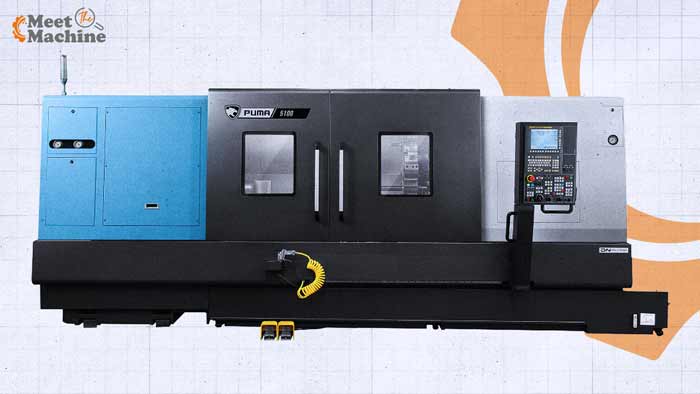
The Doosan Puma 5100LC is a heavy duty two-axis CNC turning center from the Puma 4100/5100 series, now built by DN Solutions. In the model name the letters do two separate jobs: L means the long bed, and C is the largest spindle tier in the range, which is the big-bore configuration. An LC therefore combines roughly 82 inches of turning length with a spindle through hole of about 10.5 inches, on a box way machine with a 25.6 inch maximum turning diameter, a 12-station turret and a programmable hydraulic tailstock. Spindle speed drops to 1,000 rpm in exchange for that bore, on a 45 kW motor rated 60 hp for 30 minutes and 50 hp continuous, with better than 3,200 ft-lb of torque. It is built for long, heavy, often tubular work that has to pass through the headstock, which is a different job from the standard-bed 5100 even though the two share a swing.
Somebody calls about a shaft. Twelve feet of bar comes in, the finished part is six feet long with a bore through the middle, and it needs to come out straight. You look at the print, you look at your lathe, and the problem is not the diameter. The diameter is nothing. The problem is that the part is longer than your bed and thicker than your spindle bore, and there is no clever workholding that fixes either one.
That is the job the Puma 5100LC exists for, and the two letters at the end of the model number are the reason. This is a working machinist's breakdown of what those letters actually mean, why almost every listing you read gets one of them wrong, what the machine gives up to do what it does, how it stacks against the other big-bore lathes you would cross-shop, and what to check before you buy one used.
The Suffix Is Doing Two Jobs
This is the part worth reading twice, because it is the single most misread thing about the 5100 family. The letters are not a trim level running from cheap to expensive. They are two independent axes of specification that happen to sit next to each other in the model name.
A, B and C are the spindle tier. This is the headstock, the chuck and, most importantly, the through hole. C is the top of the range and the big-bore configuration.
L and XL are the bed. Standard, long, extra long. This is Z travel and nothing else.
So the family fills out as 5100A, 5100B, 5100C on the standard bed, then 5100LA, 5100LB, 5100LC on the long bed, then 5100XLA, 5100XLB, 5100XLC on the extra long. Nine machines, not one line. A 5100LC is not "a bigger 5100." It is the biggest spindle on the long bed, which is two separate purchase decisions arriving in one machine.
The Number Nobody Reads: Swing Does Not Change
Here is where buyers get burned. Put a standard-bed 5100B next to a 5100LC and compare the two specs everyone looks at first.
| Specification |
Puma 5100B, standard bed |
Puma 5100LC, long bed |
| Max turning diameter |
650 mm, 25.6 in |
650 mm, 25.6 in |
| Max turning length |
1032 mm, 40.6 in |
2082 mm, 82 in |
| Spindle through hole |
166.5 mm, 6.6 in |
274 mm, 10.8 in |
| Spindle speed |
1,500 rpm |
1,000 rpm |
| Spindle torque |
4038 Nm, 2,978 ft-lb |
4463 Nm, 3,291 ft-lb |
| Spindle power |
45 kW, 60/50 hp, 30 min / cont. |
45 kW, 60/50 hp, 30 min / cont. |
| X travel |
362 mm, 14.3 in |
362 mm, 14.3 in |
| Z travel |
1105 mm, 43.5 in |
2155 mm, 84.8 in |
| Machine weight |
10,600 kg, 23,365 lb |
12,100 kg, 26,675 lb |
Read the first row again. The maximum turning diameter is identical, and so is X travel. A 5100LC will not swing one thousandth more than a 5100B. If a job is too big around for the standard machine, the LC does not solve it, and no amount of money spent on the suffix will.
What the LC actually buys is length and bore. Turning length roughly doubles. The through hole grows from 6.6 inches to nearly 11. Those are the two constraints that stop a shop from quoting long tubular work, and this machine removes both of them at once.
Buyers hear a bigger model designation and picture bigger parts. On the 5100 the suffix never touches swing. It buys length and it buys bore, and if the job that beat you was a diameter problem, this is not the machine that fixes it.
What Ten Inches of Bore Is Worth
A spindle bore is the one dimension on a lathe you cannot work around. Everything else has a trick. Too long for the chuck, use a steady rest. Too heavy, use a tailstock. Awkward shape, build a fixture. But if the bar is bigger than the hole, the bar does not go in, and the conversation is over. That is why bore is the spec that decides what work a shop can even bid on.
At roughly 10.5 to 10.8 inches, the C spindle takes material most turning centers cannot look at. Heavy wall pipe and casing. Large hydraulic cylinder tube. Long shafts that need to feed through and be gripped near the cut rather than hanging out in space. When the stock passes through the headstock, the spindle bearings carry the weight and the part is supported where it matters, which is the difference between turning a long part and fighting one.
The trade is speed. The C spindle turns 1,000 rpm against 1,500 on the B. That is not a defect, it is physics: a bigger bore means a bigger bearing bore, and bigger bearings do not spin as fast. You get torque back in exchange, better than 3,200 ft-lb, which is what you actually want when you are hogging heavy wall material at low surface speed. If your work is small diameter and finish-speed dependent, the C spindle is the wrong end of that trade.
Box Ways, and Why the Weight Matters
The 5100 rides on box guideways rather than linear rails, and on a machine doing this work that is the correct answer rather than an old-fashioned one. A box way has a large contact area between the moving element and the bed, which damps vibration instead of transmitting it, and which carries heavy off-center loads without complaint. Linear rails are faster and lower friction, and they are the right choice on a production turning center chasing cycle time on small parts. They are not the right choice under a 26 inch part hanging off a chuck.
The weight tells the same story. A long bed 5100LC runs about 26,675 pounds against 23,365 for the standard bed. Fifteen hundred kilos of extra iron, most of it bed casting, is what keeps an 82 inch cut from turning into a chatter problem. When you are looking at rigging and floor loading on a used purchase, that number is also the one that decides whether the machine goes where you want it to go.
The Machine on Our Floor
Resell CNC currently has a 2022 DN Solutions Puma 5100LC in Maitland, and it is worth walking through because it shows how these get specified in the real world rather than in a catalog.
Capacity. 26 inch maximum turning diameter, 82 inches between centers, 10.5 inch spindle bore, X travel 14.23 inches and Z travel 84.84 inches.
Spindle. 1,000 rpm, 50 hp, with a two-speed headstock delivering 3,294 ft-lb. The two-speed gearbox is the detail to notice. It gives you real torque down low for heavy roughing and still lets the spindle wind out for finishing, which a single-range headstock cannot do as well.
Workholding. A Bison 24-3/4 inch four-jaw hydraulic power chuck. Four-jaw rather than three is a meaningful choice on this class of machine, because a lot of what runs on a big-bore long-bed lathe is not round, not concentric, or needs to be dialed in deliberately.
Support and tooling. Programmable hydraulic tailstock and a 12-station turret. On an 82 inch part the tailstock is not an accessory, it is half the setup, and having it programmable means it moves in cycle instead of by hand.
Control and periphery. Fanuc i Series Plus with the EZ Work conversational interface, box way construction, LNS Turbo HB chip conveyor, full dual-door enclosure, work light and foot pedal. Fanuc matters here for the same reason it always does on a used purchase: the control is supported, the parts exist, and you can hire somebody who already knows it.
U.S. Parts and Service
Doosan Machine Tools became DN Solutions in 2022, which means machines from this era carry either badge depending on build date and market, and both are the same company and the same support network. The installed base is what matters here. The machine tool business goes back to a Daewoo Heavy Industries factory completed in 1976 and passed 50,000 cumulative machine shipments by 2000, with a quarter century of volume since and a dense North American distributor and service footprint behind it. On a heavy two-axis lathe with a Fanuc control, that combination is about as low-risk as used machine tool support gets. There is no proprietary control to strand you and no shortage of people who have worked on a Puma.
How the Puma 5100LC Compares
| Machine |
Builder / HQ |
Distinctive Strength |
| Puma 5100LC |
DN Solutions, formerly Doosan, South Korea |
Long bed and big bore combined in one catalog model, on box ways with a Fanuc control and a very large support base |
| Doosan Puma 800 series |
DN Solutions, South Korea |
The larger big-bore platform above the 5100, for heavier oil country work than this machine is sized for |
| Okuma LB4000 series |
Okuma, Oguchi Japan and Charlotte, North Carolina |
Box-bed rigidity with Okuma's own OSP control, drives and spindles, and Thermo-Friendly thermal compensation |
| Mazak M-5 and similar |
Mazak, Oguchi Japan and Florence, Kentucky |
Big bore on a long bed with Mazatrol conversational programming and the largest U.S. parts inventory in the group |
Each one argues something different. The Puma 800 is the answer if your work is genuinely heavier than a 26 inch swing, and buying up into it costs real money and real floor. Okuma sells control ownership and thermal stability, which is the pitch when you are holding tolerance across a long shaft in a shop that warms up through the day. Mazak sells Mazatrol and a service network that is hard to argue with. The 5100LC's argument is that it delivers the long bed and the big bore as a standard catalog configuration on a Fanuc control, which keeps both the purchase and the support simple, and it does it at a size that fits a shop rather than a plant.
Used-Market Value
Big-bore long-bed lathes hold value for a simple reason: the shops that need one have almost nowhere else to go, and the machines are scarce because nobody buys one speculatively. Pricing tracks configuration and hours far more than calendar age. As a rough guide to current secondary-market activity, with the usual caveat that many dealer listings are request-price rather than posted:
Standard-bed 5100A or 5100B. The volume machines in the family and the entry point into the platform. Priced well below a long-bed unit and a completely different capability, so compare carefully rather than by model number.
Long-bed LA and LB. The long bed with a conventional spindle. Right for long work that does not need the bore, and priced between the standard bed and the LC.
LC and XLC, the big-bore variants. The top of the family and the scarcest on the used market. Fewer were built, fewer come up, and the buyers who want one usually cannot substitute.
Configuration moves the number more than the year. A programmable tailstock, a steady rest, a live chuck of the right size, a chip conveyor and a supported Fanuc generation are the items that separate two machines with the same nameplate. A near-new unit like the 2022 on our floor sits outside most of the wear discussion entirely.
What to Check on a Used Puma 5100LC
These are the inspections Resell CNC handles before one of these ships, and the same list applies to any big-bore long-bed lathe you are considering.
Confirm the suffix against the machine, not the listing. Measure the bore and the distance between centers yourself or get photos of both. A 5100LB and a 5100LC look identical from ten feet and differ by more than four inches of through hole.
Bed wear across the full Z. Eighty-four inches of travel means most of the work happened in one zone, usually near the chuck. Check for a step or hollow in the first two feet and compare it against the tailstock end, which is often nearly unused.
Spindle bearing condition at the bore. Run it through the speed range and listen at the top. Indicate the spindle nose and check the bore itself for scoring from bar stock that was fed carelessly.
Two-speed headstock shift. On a geared machine, shift between ranges repeatedly under power and listen. Gearbox trouble on a big lathe is expensive and it does not announce itself in a five minute demo.
Tailstock alignment and function. Bring the quill up to a center in the spindle and check both planes. On a programmable tailstock, cycle it under program and confirm it holds position and pressure.
Turret index and repeatability. Cycle all twelve stations several times. Listen for a hard, consistent seat. Check for any station that hesitates, and inspect the boring bar positions for damage.
Chuck, jaws and draw tube. Confirm the chuck actuates at pressure and holds, check jaw condition, and verify the draw tube matches the bore you are paying for. A big-bore machine fitted with a small draw tube is not the machine you think it is.
Steady rest, and whether one is included. On an 82 inch machine a steady rest is not optional equipment, it is how the work gets done. Ask directly whether one comes with it and what capacity it covers, because buying one afterward is a real line item.
Control generation and backup. Identify the exact Fanuc generation, boot it cold, pull the alarm history and get a parameter backup in your hands before the machine leaves.
Chip and coolant handling. Look at the conveyor, the tank and under the pans. Heavy turning makes heavy chips, and a neglected chip system tells you how the rest of the machine was treated.
Rigging, floor and power. Roughly 26,675 pounds, 231 inches long and 90 inches wide, and it needs a path in. Confirm floor loading, door width and your electrical service before you commit, not after the truck is scheduled.
Who Runs One
Oil and gas service shops turning couplings, subs, mandrels and heavy wall tubulars. Hydraulic cylinder manufacturers and rebuilders, where the tube goes through the spindle and the rod is long. Power generation and heavy equipment work on shafts, rolls and pins. Mining and marine repair. Large valve and pump bodies. Fabricators and machine shops that took on one long-part family and discovered their existing lathes could not hold it. The common thread is not an industry, it is a shape: long, often hollow, heavy, and needing support at both ends. If your parts are short and small in diameter, there is a better and cheaper machine for the money.
Resell CNC Take
The call we take most often on machines like this starts with a part the shop already lost. Somebody quoted a long shaft, found out mid-job that the bar would not pass the spindle, and now needs a machine before the next PO. Bore and length are the two specs that decide whether you can bid the work at all, and they are the two that get skimmed in a listing. Measure them. On a used big-bore lathe, the nameplate is a starting point, not an answer.
Frequently Asked Questions
What is the Doosan Puma 5100LC?
The Puma 5100LC is a heavy duty two-axis CNC turning center in the Puma 4100/5100 series, now built by DN Solutions. The L designates the long bed and the C designates the largest spindle tier, which is the big-bore configuration, so an LC pairs roughly 82 inches of turning length with a spindle through hole of about 10.5 inches. It runs on box ways with a 25.6 inch maximum turning diameter, a 12-station turret, a programmable hydraulic tailstock and a 45 kW spindle motor rated 60 hp for 30 minutes and 50 hp continuous at 1,000 rpm.
What is the difference between the Puma 5100, 5100L and 5100LC?
The letters describe two separate things. A, B and C are the spindle tier, with C being the largest and the big-bore option. L and XL describe the bed length. So a 5100B is a standard bed with a conventional spindle, a 5100LB is the long bed with that same spindle, and a 5100LC is the long bed with the big-bore spindle. The full family runs 5100A through 5100XLC, nine configurations in total, and none of the suffixes change the maximum turning diameter.
Does the LC swing bigger parts than a standard 5100?
No. Maximum turning diameter is 650 mm, about 25.6 inches, on both the standard bed and the long bed, and X travel is identical at 362 mm. The LC buys turning length, roughly 82 inches against 40.6, and spindle bore, roughly 10.8 inches against 6.6. If a job is too large in diameter for a standard 5100, the LC will not take it either.
Why does the big-bore spindle run slower?
A larger through hole requires larger spindle bearings, and larger bearings have a lower safe operating speed. The C spindle tops out around 1,000 rpm against 1,500 on the B, and it gives back torque in exchange, better than 3,200 ft-lb. That is the right trade for heavy roughing on large diameter and heavy wall material at low surface speed, and the wrong trade if your work is small diameter and depends on spindle speed for finish.
What control does the Puma 5100LC use?
Fanuc, with recent machines running the Fanuc i Series Plus and the EZ Work conversational interface alongside standard G-code programming. For a used buyer that is a meaningful advantage over a proprietary control, since Fanuc parts and service are widely available and most experienced turning programmers already know it. Confirm the exact generation on any specific machine and get a parameter backup before it ships.
Is a used Doosan Puma 5100LC worth buying?
For long, heavy or tubular work, yes. Big-bore long-bed lathes are scarce on the used market because nobody buys one without a reason, and the shops that need one rarely have a substitute, which supports values. The platform is box way construction with a Fanuc control and a very large installed base behind it. Verify bore and distance between centers physically rather than from the listing, check bed wear near the chuck and the two-speed headstock shift, and confirm whether a steady rest is included before you agree on a price.
Looking for a Doosan?
See what we have on the floor.
Every machine we sell is backed by a team with 200+ years of combined industry experience and four AMEA and CEA certified equipment appraisers on staff. Browse our used Doosan and DN Solutions inventory.
See Used Doosan Machines
About the Author
Bill Murphy is the Marketing and Content Lead at Resell CNC, covering used machine tools, the brands behind them, and the history of the trade.
About Resell CNC
Resell CNC has bought and sold used CNC machinery since 2008. Based in Maitland, Florida, with warehouses in Winter Springs and Longwood, the team brings more than 200 years of combined industry experience and four AMEA and CEA certified equipment appraisers on staff. Resell CNC has been an MDNA member since 2009 and is the only used CNC dealer in North America with Official Mazak Trade-In Center status.