Meet the Machine
Used Doosan Puma 800: The Big-Bore Lathe Built for Oil Country
What is the Doosan Puma 800?
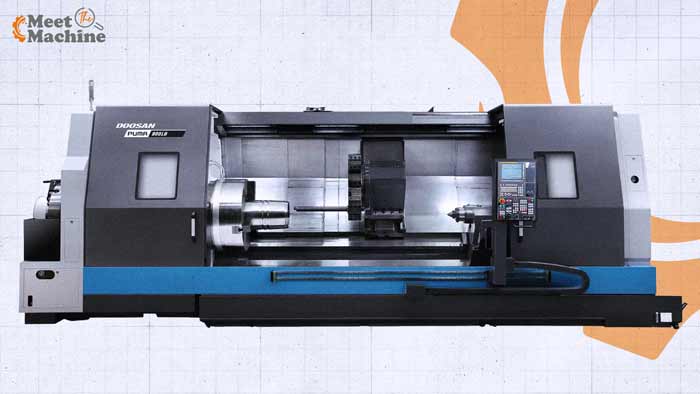
The Doosan Puma 800 is a large, heavy-duty horizontal CNC turning center built for big, long, and heavy parts. Made by Doosan Machine Tools, now DN Solutions, it runs a 32-inch chuck, roughly 40 inches of swing over the bed, a big-bore spindle around 12.6 inches (320 mm), up to about 126 inches between centers, a 60 HP main spindle, and a 12-station turret on rigid box-style roller guideways, under a FANUC control. That big through-bore is the defining feature: oil-country tubular, pipe, couplings, and long shafts feed straight through the spindle, which is why the Puma 800 is a fixture in oil and gas, energy, and heavy-equipment shops. It comes in long-bed (800L), live-tooling (800M), and other variants, and used examples hold steady demand for large-part turning.
Most lathes are sized for parts you can lift. The Doosan Puma 800 is not. This is the machine a shop buys when the work is a length of oil-country pipe, a generator shaft, a mill roll, or a coupling too big to chuck in anything else, and the deciding number is not spindle speed or tool count. It is how much part the machine can swing, how long it can hold between centers, and how much diameter can pass through the spindle. On all three, the Puma 800 is built for the big end of the trade. Oil and gas made its name, but it is not the only home for it. Energy and power generation lean on it for large shafts and rotors, aerospace for big structural and engine components, and heavy-equipment, mining, and industrial repair shops for the large shafts, rolls, and cylinders that keep those industries running.
This is a working machinist's breakdown of the Puma 800: where it comes from, why the big bore and the box ways define what it does, how the family is laid out, the U.S. support picture, how it compares to the machines it is cross-shopped against, and what to check before you buy a used one. If your work is large-diameter, long, or tubular, this is the piece that tells you whether this is your machine.
Where the Puma 800 Comes From
The Puma is Doosan's turning line, and it earned a reputation as dependable, well-priced production iron across three decades and a couple of name changes, from Daewoo roots to the Doosan Group to DN Solutions, the name the machine tool business took in 2022. The used market still overwhelmingly calls these machines Doosan, which is how buyers search for them. The Puma range runs from compact chuckers up through big-bore giants, and the 800 sits at the large, heavy end of that range.
That placement is the whole point of the machine. Doosan built the Puma 800 for the shops whose problem is size: turning large shafts and rolls, and running oil-country tubular through a big spindle bore in volume. It is not a finesse machine chasing a mirror finish on a tiny part. It is a heavy production lathe built to take a serious cut on a large piece and hold it rigid, all day, and every design choice on it serves that job.
On a machine this size, the numbers that matter are not RPM and tool count. They are swing, length between centers, and how much diameter fits through the spindle. That last one, the big bore, is what puts a Puma 800 in an oil-country shop.
The Big Bore Is the Whole Story
Start with the spindle bore, because it is the feature that defines the machine. The Puma 800 carries a big-bore spindle in the range of 12.6 inches, about 320 mm, and that is not a spec for bragging rights. It is what lets a long piece of tubular pass all the way through the spindle so the machine can work on the end of a pipe far longer than the machine itself. In oil and gas, that is the entire job: threading and machining the ends of drill pipe, casing, couplings, and collars, where the stock is long, heavy, and hollow, and has to feed through the headstock. A lathe without a big bore simply cannot do that work. A Puma 800 was built for it.
Around that bore is a machine sized to match. A 32-inch chuck grips large-diameter work, roughly 40 inches of swing over the bed clears big parts, and up to 126 inches between centers holds long shafts. A 60 HP spindle turning up to about 750 RPM delivers the low-speed torque that heavy, large-diameter cutting demands, because a big part turns slowly and needs grunt, not high rpm. It is a machine built around one honest idea: make room for the big part, then give it the power and rigidity to cut it.
Box Ways and Rigidity
A heavy lathe lives or dies on rigidity, and the Puma 800 is built on rigid box-style roller guideways rather than the lighter linear rails you find on smaller, faster machines. That matters because a big roughing cut on a large-diameter part throws enormous force into the machine, and box-type ways have the contact area and damping to absorb it without chatter, hold the tool where it belongs, and take that load year after year without wearing out quickly. The tradeoff is that box ways favor heavy, stable cutting over high rapid speeds, which is exactly the right tradeoff for this work. Nobody buys a Puma 800 to move fast between tiny features. They buy it to stand in and take a heavy cut on a big part and not flinch.
Reading the Family
The Puma 800 comes in several configurations, and the suffix tells you the job. The base 800 is the large turning machine. The 800L is the long-bed version, with more distance between centers for longer shafts and pipe. The 800M adds live tooling and a C-axis, turning the lathe into a mill-turn machine that can drill, mill, and cross-bore a large part in one setup instead of moving it to a second machine, a big deal on parts this size and weight, where every re-fixturing is a crane lift. There are also longer and larger variants such as the 800LB. Big-bore configurations are common across the line, since the through-bore capacity is the main reason to buy this size of machine.
Reading a used listing, the things that matter most are the bore size, the distance between centers, whether it is an L or an M, and what heavy-part tooling comes with it, particularly steady rests, which are essential and expensive on a machine turning long, heavy shafts. An 800M with live tooling and a couple of steady rests is a very different, far more capable machine than a base 800, and it prices accordingly.
U.S. Parts and Service
Doosan, now DN Solutions, has sold machines in the United States for more than thirty years and supports them through DN Solutions America and a dealer network, with Ellison Technologies a major distributor. The Puma 800 runs a FANUC control, the most widely supported control platform in the world, so service techs and control parts are broadly available. For a big, expensive production lathe that a shop intends to run hard, that support depth is a real part of the value. A large machine that goes down and cannot get parts is a very expensive paperweight, and the Puma 800 sits inside a mainstream support system rather than being an orphan.
How the Puma 800 Compares
In the big-bore heavy-lathe class, the Puma 800 is cross-shopped against a short list of serious machines.
| Machine |
Origin |
Distinctive Strength |
| Doosan Puma 800 |
South Korea |
Big bore and heavy box ways at a strong value, deep U.S. support, FANUC control |
| Mazak (Slant Turn / big lathes) |
Japan |
Broad large-turning range, huge support network, strong multitasking options |
| Okuma (big-bore lathes) |
Japan |
In-house control and thermal stability, respected heavy turning |
| Hyundai WIA (large L-series) |
South Korea |
Value-focused large turning, the other Korean price-performance option |
Mazak and Okuma are the premium Japanese names in large turning, deep ranges, excellent support, and in Okuma's case an in-house control and strong thermal management. Hyundai WIA is the other Korean builder making the price-performance case on big lathes. The Puma 800 wins the order where a shop wants genuine big-bore, heavy-box-way capacity without a premium price, backed by a widely supported FANUC control and a deep U.S. service network. For oil-country and heavy production work, where the machine has to earn its keep turning big parts reliably rather than winning a spec sheet, the Puma 800 is a value-heavy choice, and even more so used.
Used-Market Pricing
The Puma 800 holds value because big-bore heavy lathes are always in demand somewhere, particularly wherever oil and gas and energy work is active, and because the machines are built to run for a long time. The following ranges are orientation from current secondary-market activity, not quotes, and variant, bore size, hours, tooling, and any live tooling move the number far more than year alone. Dealer listings are frequently request-price.
- Older or higher-hour standard and 800L machines: often close to $60,000 to $110,000, depending on condition, bore, and tooling.
- Newer, lower-hour machines, or 800M live-tooling and long-bed configurations: often close to $110,000 to $200,000 and up.
- Included steady rests, big-bore chucks, and a live-tooling C-axis add substantial value, since they are expensive and slow to source separately.
On a machine this size, market swings in oil and gas move used prices noticeably, so timing and the specific configuration matter. Hours and how hard the machine was run count for more than model year.
What to Check When Buying a Used Puma 800
Spindle, bearings, and bore. Check the spindle for runout, bearing noise, and heat, and confirm the big bore is true and undamaged. On a big-bore lathe the spindle is the most expensive thing to fix, so make it the first check.
Box way wear. Inspect the box ways for wear and scoring, especially near the chuck where the heaviest cutting happens. Check that the carriage is not loose over the worn zone, since way wear on a heavy lathe is costly to correct.
Chuck, jaws, and big-bore setup. Confirm the large chuck and its jaws are in good shape and sized for your work, and that the big-bore drawtube and any pass-through tooling are intact. These are large, expensive components.
Steady rests. Confirm what steady rests are included and that they function. On a machine turning long, heavy shafts, steady rests are essential, and a matched hydraulic steady is a real cost to add later.
Tailstock and quill. Check tailstock alignment, that it locks solidly, and that the quill is not worn or leaking, since long-part work leans hard on the tailstock.
Turret and, on an M, live tooling. Run the 12-station turret and confirm reliable indexing. On an 800M, verify the C-axis and every live-tooling station work, since that capability is much of the value.
Control generation. Confirm the FANUC control is a supported generation with parts available, and power the machine up to check for faults before committing.
Coolant, chip handling, and hydraulics. Confirm the coolant system, chip conveyor, and hydraulics work, since a heavy production lathe makes chips fast and depends on its hydraulics for chuck and steady clamping.
Rigging, foundation, and power. This is a very large, heavy machine. Budget serious rigging, a proper foundation, the floor space, and the power requirement into the real cost, not just the purchase price.
Who Actually Runs Them
The Puma 800 lives wherever the parts are big and often hollow. Oil and gas leads the list, drill pipe, casing, couplings, collars, and tool joints machined by feeding tubular through the big bore. Energy and power-generation shops turn large shafts, rotors, and other heavy rotating components. Heavy-equipment, mining, and industrial shops make and repair large shafts, rolls, cylinders, and pins. General large-part job shops and repair shops keep one as the machine that can take on the work nobody else can chuck. What they all share is a workload defined by size and weight, where the deciding question is simply whether the part fits and the machine can hold it and cut it, which is exactly what the Puma 800 was built to answer.
Resell CNC Take
The Puma 800 is a workhorse for anyone in the big-part business, and used, it is a lot of capacity for the money. We tell buyers to be clear about two things: the big bore and the steady rests. Confirm the bore size actually fits the tubular or stock you run, and make sure the steady rests you need come with it, because sourcing them after the fact gets expensive fast. Check the spindle and the box ways, confirm the control is supported, and a used Puma 800 will turn big iron reliably for years. For oil-country and heavy production work, it is one of the best value buys in its size class.
Frequently Asked Questions
What is the Doosan Puma 800?
The Doosan Puma 800 is a large, heavy-duty horizontal CNC turning center for big, long, and heavy parts, built by Doosan Machine Tools, now DN Solutions. It runs a 32-inch chuck, about 40 inches of swing, a big-bore spindle around 12.6 inches, up to roughly 126 inches between centers, a 60 HP spindle, and a 12-station turret on rigid box-style roller guideways with a FANUC control. The big through-bore is its defining feature.
Why does the big bore matter?
The big-bore spindle, around 12.6 inches or 320 mm, lets long tubular stock pass all the way through the spindle, so the machine can work on the end of pipe far longer than the machine itself. That is essential for oil and gas work like drill pipe, casing, and couplings, where the stock is long and hollow. A lathe without a big bore cannot do that work.
What is the difference between the Puma 800, 800L, and 800M?
The base 800 is the large turning machine. The 800L is the long-bed version with more distance between centers for longer shafts and pipe. The 800M adds live tooling and a C-axis, so it can drill, mill, and cross-bore a large part in one setup instead of moving it to a second machine, which is valuable on parts this heavy. Larger variants such as the 800LB also exist.
What industries use the Puma 800?
Primarily oil and gas, for drill pipe, casing, couplings, and collars run through the big bore. Also energy and power generation for large shafts and rotors, and heavy-equipment, mining, and industrial shops turning big shafts, rolls, and cylinders. The common thread is large, heavy, and often hollow parts.
What should I check when buying a used Puma 800?
Prioritize the spindle, bearings, and bore condition, box way wear near the chuck, the chuck and big-bore setup, and the included steady rests, which are essential and expensive. On an 800M, verify the C-axis and live tooling. Confirm the FANUC control generation is supported, and budget for serious rigging, foundation, and power.
How much does a used Puma 800 cost?
As orientation, older or higher-hour standard and 800L machines often land close to $60,000 to $110,000, while newer, lower-hour or 800M live-tooling and long-bed machines often run close to $110,000 to $200,000 and up. Included steady rests, big-bore tooling, and live tooling add substantial value, and dealer listings are frequently request-price.
Looking for a Doosan?
See what we have on the floor.
Every machine we sell is backed by a team with 200+ years of combined industry experience and four AMEA and CEA certified equipment appraisers on staff. Browse our used Doosan inventory.
See Used Doosan Machines
About the Author
Bill Murphy is the Marketing and Content Lead at Resell CNC, covering used machine tools, the brands behind them, and the history of the trade.
About Resell CNC
Resell CNC has bought and sold used CNC machinery since 2008. Based in Maitland, Florida, with warehouses in Winter Springs and Longwood, the team brings more than 200 years of combined industry experience and four AMEA and CEA certified equipment appraisers on staff. Resell CNC has been an MDNA member since 2009 and is the only used CNC dealer in North America with Official Mazak Trade-In Center status.
Sources
- DN Solutions and Doosan, Puma 800 large turning center specifications
- Used Doosan Puma 800 and 800L listings, CNCMachines.com, Machinio, Revelation Machinery
- Doosan Puma 800M specifications, Exapro and Kitmondo
- Doosan Machine Tools renamed DN Solutions, 2022; Ellison Technologies U.S. distribution