Meet the Machine
Used Matsuura MAM72-35V : The Pallet Pool That Runs the Weekend | Meet the Machine
What is the Matsuura MAM72-35V?
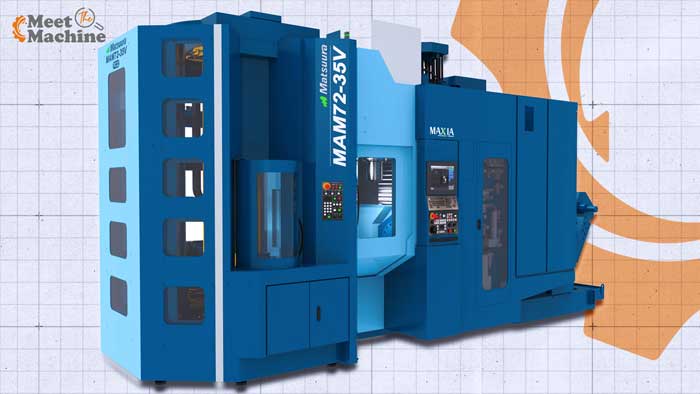
The Matsuura MAM72-35V is a 5-axis vertical machining center built around deep pallet automation for small, complex parts run unmanned. It handles workpieces up to roughly 350 mm in diameter by 300 mm tall and about 60 kg, on a 40-taper spindle offered up to 20,000 rpm, fed by a tool magazine commonly configured around 320 stations and a rotary pallet pool of 32 pallets standard, expandable toward 40. The B and C rotary axes ride direct-drive motors that are sealed and maintenance-free, with the B axis swinging from roughly +65 to -125 degrees at 0.001 degree resolution. Paired with the pool and tool magazine, the machine is designed to run lights-out for up to 72 hours, making it a fixture in aerospace, medical, and high-mix precision shops where the same small part comes back again and again. It is the most widely deployed model in Matsuura's MAM72 family, which runs from the smaller MAM72-25V up through the larger 42V, 52V, and 63V and the horizontal-spindle 100H, all sharing the same pallet-pool automation.
The MAM72-35V is not the machine you buy to cut one big part. It is the machine you buy when you have forty small, complicated parts that all need 5-axis work, tight tolerances, and a finish you can ship, and you do not have forty operators to babysit them. The whole design points at one problem: keeping a 5-axis spindle cutting when nobody is standing in front of it.
This is a working machinist's breakdown of the platform, the model line, what the iron is actually good at, what it costs on the used market, and what to check before you wire money. If you are weighing a used MAM72-35V against a Makino, a DMG Mori, or a Mazak, this is the context that tells you whether it wins your order.
Where Matsuura Comes From
Matsuura started in Fukui, Japan in 1935, building and selling lathes, moved into milling machines by 1957, and incorporated as Matsuura Machinery Corporation in 1960. The company stayed in Fukui and built a reputation around one idea more than any other: automation for unmanned and lights-out machining. Long before the rest of the industry made pallet pools a headline feature, Matsuura was building machines designed to run after the lights went off.
That focus is why the MAM72 exists in the shape it does. It is not a general-purpose mill that had a pallet changer bolted on. It is a 5-axis platform designed from the table out around a multi-pallet system, which is a different animal to live with on the floor.
What Defines the Machine
Direct-drive rotary axes. The B and C axes are driven by sealed direct-drive motors rather than worm gears, so there is no gear backlash to compensate and no lubrication to maintain on those axes. The B axis swings from about +65 to -125 degrees, a range Matsuura extended over earlier versions to reach under and around taller parts, and it positions to 0.001 degree. For 5-axis work where the rotary accuracy is the whole game, that drivetrain is the heart of the machine.
The pallet pool. A rotary pool of 32 pallets comes standard, with configurations reaching toward 40, and pallet changes happen in the range of seven to eight seconds. That is what turns the machine from a spindle into a small unmanned cell. You fixture and stage jobs across the pool, and the control works through them in sequence while the shop is dark.
The tool magazine. Configured commonly around 320 tool stations, the magazine is sized to match the pallet pool. There is no point in queuing forty pallets of varied work if the machine runs out of tools on pallet twelve, so the tool count is built to feed a long unattended run with sister tools and redundancy.
The 72-hour target. Matsuura builds the MAM72 to sustain continuous production for up to 72 hours. That number is the design brief made plain: the machine is meant to be loaded Friday and still cutting good parts Monday.
The MAM72 Family in Shop Language
The MAM72 is a series, and the model number tracks roughly with how much machine you are getting. The 35V is the small-part workhorse, the one most shops mean when they say MAM72.
MAM72-35V. The compact 5-axis vertical, built for parts up to about Ø350 x 300 mm and 60 kg. This is the high-volume, small-complex-part model, common in medical and aerospace component work.
MAM72-42V. A step up in envelope and rigidity, with travels in the range of 20 x 29 x 20 inches and the option of a tailstock for longer parts and tall tombstone fixtures. Pallets and tooling are compatible with the 35V, so shops often run both.
MAM72-52V and 63V. Larger vertical models for bigger or heavier workpieces, same automation philosophy scaled up. The 52V is the productivity-focused mid-size of the line.
MAM72-100H. The horizontal-spindle member of the family, aimed at larger and heavier 5-axis work where a horizontal configuration sheds chips better and supports more mass.
The Problem It Was Built to Solve
The economics of a small precision part are brutal. Setup time and operator attention swamp the actual cutting time, and a 5-axis part with multiple operations can spend more of its life waiting on a human than under the spindle. The MAM72-35V attacks that directly. Stage the work across the pallet pool once, prove out the programs, and the machine converts a high-mix workload into spindle hours that accumulate overnight and over the weekend without a body in the building.
That is the entire value proposition: not the fastest single cut, but the most cutting per calendar week per operator. For a shop running families of small aerospace brackets, medical implants and instruments, or repeat precision components, that math is the difference between bidding a job and winning it.
U.S. Service and Support
Matsuura Machinery USA is headquartered in St. Paul, Minnesota, as the U.S. subsidiary of the parent company in Japan. The St. Paul facility runs a showroom and demonstration area, training and conference space, spare parts and accessory storage, and administrative, service, and applications engineering support. For a buyer of used Matsuura iron, that matters: parts availability and factory-trained support in North America are part of what protects the machine's value and your uptime.
How It Compares
| Machine |
HQ |
Drive / Control |
Distinctive Strength |
| Matsuura MAM72-35V |
Fukui, Japan |
Direct-drive B/C, G-Tech 31i-B |
Deep 32-40 pallet pool for unmanned small-part 5-axis |
| Makino D200 / D300 |
Aichi, Japan |
High-speed spindle, Pro control |
Surface finish and thermal stability for die-mold and aerospace |
| DMG Mori DMU 50 |
Bielefeld, Germany / Japan |
CELOS, broad options |
Versatility and integration across a wide model range |
| Mazak VARIAXIS i-600 |
Oguchi, Japan |
SmoothAi control |
Multi-tasking ecosystem and strong U.S. service network |
Each of those makes a real argument. Makino wins the order when finish and thermal stability on hard materials are the whole point. DMG Mori wins on breadth and integration when a shop wants one platform that does a little of everything. Mazak wins on its control ecosystem and the density of its U.S. support footprint. The MAM72-35V wins when the job is high-mix small precision parts that need to run unmanned for days, because no one in this group was designed around the pallet pool as completely as Matsuura was. If the deciding question is "how many good parts can one operator pull out of one machine over a weekend," the MAM72-35V is hard to beat.
What the MAM72 Family Costs on the Used Market
The MAM72 holds value because the automation is the expensive part, and a pallet pool does not go obsolete the way a bare 3-axis mill does. A complete machine with its full pallet pool, tooling, and a current control is worth a real premium over a stripped one. Across the family, used price tracks model size, year, control generation, spindle hours, and how much of the pallet and tool capacity is intact. Dealer listings are frequently request-price rather than posted, so treat the figures below as close-to orientation, not quotes. The exact number always moves with options.
- MAM72-25V, the entry small-part 5-axis: close to $90,000 to $200,000, depending on year, spindle hours, pallet count, and options.
- MAM72-35V, the core model: close to $150,000 to $350,000, depending on control generation, pallet count, and tooling.
- MAM72-42V and 52V, larger envelope: close to $250,000 to $450,000, depending on configuration and automation.
- MAM72-63V with full pallet automation: close to $450,000 and up, depending on the pallet system and options.
Treat these as orientation, not a quote. A machine missing pallets, short on tooling, or with a tired spindle is a different purchase than a complete one, and the gap between the two is where buyers either save real money or inherit a project.
What to Check Before You Buy
Pallet count and condition. Confirm how many pallets are actually included against how many the machine is configured for. Missing pallets are expensive to replace and quietly gut the machine's whole purpose.
The direct-drive B and C axes. Check rotary positioning accuracy and listen for anything rough. These sealed axes are reliable, but a damaged direct-drive motor is a major repair, not a tune-up.
Spindle hours and condition. Ask for spindle runtime and cutting hours, not just power-on hours, and check for play and noise. The spindle is the most expensive wear item on the machine.
Tool magazine and ATC. Run the changer through a full cycle. With a magazine this size, a flaky ATC or missing tool pots take real time and money to sort out.
Pallet changer cycle. Watch several pallet changes. The handoff between the pool and the table is the mechanism that makes the unmanned run possible, and it should be clean and repeatable.
Control generation and parameters. Identify the control (16i-class versus 31i-B) and get a full parameter backup and the access to it. A locked or undocumented control is a problem the day you need a deep adjustment.
Way and axis condition. Check for wear and backlash on the linear axes and the state of the way covers and wipers, especially on a machine that lived in heavy production.
Coolant, chip, and through-spindle systems. Confirm the coolant, chip auger or conveyor, and any through-spindle coolant system all work. On a 72-hour run, a coolant or chip failure stops everything.
Maintenance records and provenance. A documented service history and a known prior owner are worth paying for on a machine this complex.
Who Actually Runs Them
You find MAM72-35V machines wherever the work is small, complex, repeating, and unforgiving on tolerance. Aerospace component shops run them on brackets, housings, and fittings. Medical shops run them on instruments and implant components where 5-axis access and finish are required. Defense, motorsport, and high-mix contract shops use them to hold contracts that would otherwise need far more floor space and far more labor. The common thread is a shop that competes on throughput per operator, not on the size of any single part.
Resell CNC Take
The MAM72-35V is one of the cleaner used-market buys in 5-axis automation, as long as you buy a complete one. The value lives in the pallet pool and the tool capacity, so a machine with its full pool, healthy spindle, and a documented control is worth chasing, and a stripped one is worth walking away from. We see both come through. Buy the cell, not just the spindle.
Frequently Asked Questions
What is the Matsuura MAM72-35V?
It is a 5-axis vertical machining center built around a multi-pallet pool for unmanned production of small, complex parts up to about Ø350 x 300 mm and 60 kg. It pairs a 40-taper spindle offered up to 20,000 rpm with a roughly 320-tool magazine and a 32-pallet pool, expandable toward 40, and is designed to run lights-out for up to 72 hours.
How many pallets does the MAM72-35V hold?
It comes standard with a 32-pallet rotary pool, with configurations reaching toward 40 pallets. The pallet pool is the defining feature of the machine, so confirming the actual pallet count on a used unit is one of the most important checks a buyer can make.
What control does the MAM72-35V use?
Recent machines use Matsuura's G-Tech control built on the FANUC 31i-B platform, while older units carry earlier 16i-class controls. The control generation is a major factor in both capability and used value, so identify it before you buy and get a full parameter backup.
What does a used MAM72-35V cost?
As a rough guide, earlier mid-2000s units often fall in the $90,000 to $160,000 range, mid-life units around $160,000 to $320,000, and late-model 31i-B machines $320,000 and up. Price depends heavily on year, spindle hours, pallet count, and tooling. Dealer listings are frequently request-price.
What is the MAM72-35V used for?
It is used for high-mix, small, complex 5-axis parts that need to run unmanned, common in aerospace components, medical instruments and implants, defense, motorsport, and precision contract work. Its strength is throughput per operator rather than machining a single large part.
How does the MAM72-35V compare to Makino, DMG Mori, and Mazak 5-axis machines?
Makino leads on finish and thermal stability, DMG Mori on versatility and integration, and Mazak on its control ecosystem and U.S. service density. The MAM72-35V wins when deep pallet automation for unmanned small-part production is the priority, because Matsuura designed the machine around the pallet pool more completely than its rivals.
What models are in the Matsuura MAM72 series?
The MAM72 family includes the entry MAM72-25V, the core MAM72-35V, the larger 42V and 52V, the 63V for bigger and heavier work, and the horizontal-spindle 100H. All share the same multi-pallet automation philosophy. The 35V is the most common on the floor and the used market, which is why it is the model most shops mean when they say MAM72.
Buying or Selling a Matsuura?
Resell CNC buys and sells used Matsuura machining centers, with four AMEA and CEA certified appraisers on staff who know what a complete pallet pool is actually worth. If you are evaluating a MAM72, we can help you read the machine before you buy.
See Matsuura Inventory
About the Author
Bill Murphy is the Marketing and Content Lead at Resell CNC, where he writes about used machine tools, the economics of the shop floor, and where manufacturing is headed.
About Resell CNC
Resell CNC has bought and sold used CNC machinery since 2008, with more than $1 billion in equipment transactions and over 200 years of combined industry experience. The company is headquartered in Maitland, Florida, with warehouses in Winter Springs and Longwood, and staffs four AMEA and CEA certified equipment appraisers. Resell CNC has been an MDNA member since 2009 and is the only used CNC dealer in North America with Official Mazak Trade-In Center status. Simple. Reliable. Trusted.®