Meet the Machine
Used Mazak Integrex 100-IV ST : The Suffix Is the Machine
What is the Mazak Integrex 100-IV ST?
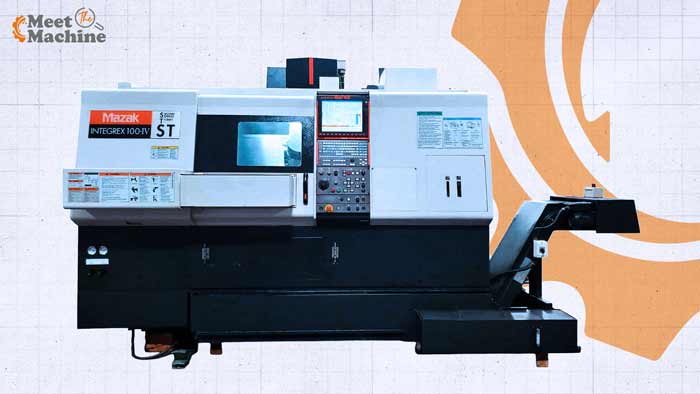
The Mazak Integrex 100-IV ST is the smallest machine in Mazak's Integrex multi-tasking line, a bar-capacity turn-mill center built to finish a complex part complete in one setup. The ST suffix is the specification: S adds a second spindle, and T adds a nine-station lower turret, so a 100-IV ST carries a main spindle, an opposed sub spindle, a tilting B-axis milling spindle with a 40-tool changer, and a lower turret, all on one machine. Typical configurations run 2.00 inch bar capacity through both spindles, 6,000 rpm main and sub spindles at 15 hp each, a 12,000 rpm milling spindle, roughly 21.5 inches of swing and around 29 to 30 inches between centers, under Mazatrol Matrix control. It is the size of Integrex where a shop doing small, complex, multi-operation parts can buy the Done In One idea without buying a machine the size of a car.
You know the part. It starts as bar stock, it needs turning on both ends, it needs a cross hole and a flat and a slot that are not on any single face, and the print calls out a position tolerance between a turned diameter and a milled feature. On a lathe and a mill you are looking at three or four setups. Every one of those setups is a fixture, a re-clamp, an indicate, a first article, and a fresh chance to stack error between features that the customer expects to be related. The turning is twenty minutes. The handling is two days.
That is the part the Integrex was built for, and the 100-IV ST is the size of Integrex that fits it. This is a working machinist's breakdown of what the machine actually is, what the letters after the model number mean and why they change the price by a lot, what the lower turret buys you that the milling spindle does not, how it compares to the other multi-tasking machines you would cross-shop, and what to check before you write a check on a used one.
Where the Integrex Comes From
Yamazaki Mazak dates to 1919 in Japan, and it has spent the last three decades making one argument louder than any other: the setup is the enemy. Mazak calls it Done In One, and the Integrex line is that argument expressed in iron. Not a lathe with live tooling bolted on as an afterthought, but a machine designed from the ground around the idea that a part should go in as raw material and come out finished, having been turned, milled, drilled, tapped and parted without a human touching it in between.
The Integrex family runs from this 100 class up through the 200, 300, 400 and beyond, with the number tracking capacity. The IV generation sits in the middle of the model's history, ahead of the earlier machines and behind the current i and i-NEO series, and it is the generation that shows up most often on the used market right now at a price a small shop can actually reach. Mazak builds in Oguchi, Japan, and in Florence, Kentucky, which matters more for this machine than it might for others, and we will come back to that.
The Suffix Is the Machine
This is the single most useful thing to know before you shop one, because a 100-IV, a 100-IV S and a 100-IV ST photograph almost identically and are not the same machine or the same money.
| Model |
What It Has |
What That Means on the Floor |
| 100-IV |
Main spindle, B-axis milling spindle, tool changer |
Turn and mill one end complete. The back end still needs a second operation somewhere. |
| 100-IV S |
Adds an opposed sub spindle |
Hand the part off in cycle and finish the back end on the same machine. Done In One becomes real. |
| 100-IV ST |
Adds a nine-station lower turret on top of the sub spindle |
Two cutting units working at once. The turret turns while the milling spindle mills, or the turret works the sub spindle side while the main side keeps cutting. |
Read a listing carefully. Sellers abbreviate, auction catalogs get it wrong, and "Integrex 100" on a line item can mean any of the three. The turret is the expensive part and the part most often missing. If the photos do not clearly show a turret below the main spindle line, assume it is not there until somebody proves it is.
The Lower Turret and Why It Changes the Cycle
A milling spindle on a B-axis is a wonderful thing and it is also one tool at a time. It swings, it indexes, it puts an end mill or a drill exactly where the geometry needs it, and while it is doing that, nothing else on the machine is cutting. That is still a huge win over four setups, but it is one cutting point.
The lower turret is a second cutting point that can run at the same time. Rough a diameter with the turret while the milling spindle drills a cross hole. Have the turret finish the front while the sub spindle side gets worked. On a part with a lot of turning content, that overlap is where the cycle time actually comes out, and it is why an ST will beat an S on the same part by a margin that is not subtle. The tradeoff is programming. Two cutting units in the same envelope means synchronization, and it means somebody has to think about where the tools are relative to each other at every moment. This is not a machine you hand to someone on their first week.
The B-Axis Milling Spindle
The milling spindle tilts on a B-axis and indexes in very fine increments, with a coupling clamp that locks it rigidly at the common positions for heavy cuts. That combination is the whole trick. Fine positioning lets you put a feature at an odd angle without a fixture built to hold the part at that angle. The clamp means that when you are hogging, the head is not relying on a servo to hold position against cutting force.
Paired with the C-axis on the spindles, which positions the workpiece rotationally to the same fine resolution, you can put a hole anywhere on the part. Angled cross holes, flats at a specified rotation off a keyway, features on a taper. All of it referenced back to the same workholding, which is the entire point. Every feature cut in one setup is a feature that cannot drift relative to the others, and on a print full of relational tolerances that is worth more than raw accuracy.
Reading the Spec Sheet
Configurations vary and listings disagree, so treat these as the numbers that show up consistently on 100-IV ST machines in the used market rather than as a single factory sheet.
| Specification |
Typical 100-IV ST |
| Max swing / turning diameter |
About 21.5 in |
| Max turning length |
About 29.5 in, roughly 30 in between centers |
| Bar capacity |
2.00 in, both spindles |
| Main and sub spindle |
6,000 rpm, 15 hp each, A2-5 nose |
| Milling spindle |
12,000 rpm, 40-taper class, 40-tool ATC |
| Lower turret |
9 stations, drum type |
| Travels |
X about 16.1 in, Y about ±2.75 in, Z about 31.7 in |
| Control |
Mazatrol Matrix, later units Matrix with High Smoothing |
| Weight |
Roughly 17,000 lb |
Two numbers deserve a second look. The Y-axis is small, roughly plus or minus 2.75 inches, and that is not a defect, it is the class. Y on a turn-mill exists to get a feature off centerline, not to give you a machining center. Bring a job with real milling envelope requirements and you will run out of Y before you run out of anything else. And the milling spindle taper is worth confirming per machine, because listings show more than one interface across the generation. Ask the seller for the tool taper before you price tooling, since a full set of holders is real money.
The Problem It Was Designed Around
Multi-tasking is usually sold on cycle time, and cycle time is not really the argument. The argument is everything that surrounds the cut. Four setups means four fixtures to build and store, four programs to maintain, four first articles to inspect, four opportunities to load a part crooked, and a work-in-process pile sitting between operations tying up cash and floor space. It also means four chances for tolerance to stack, which is why a print that relates a milled flat to a turned diameter within a couple of thousandths turns into an argument with the customer on a multi-setup process.
Run it complete in one setup and most of that disappears. The relational tolerance is held by the machine rather than by the fixture and the operator. The part goes from bar to finished without touching a bench. For a job shop, the practical effect is that you can quote work you would otherwise pass on, because the labor content that made it unprofitable is gone. That is the case for the machine, and it is also the case against buying one for simple parts. A machine like this earns its keep on complexity, not volume.
Mazatrol Matrix and Who Should Run It
The 100-IV runs Mazatrol Matrix, with later machines carrying the Matrix High Smoothing variant. Mazatrol is conversational, and on simpler Mazaks it is famous for letting a machinist program at the control without a CAM seat. On a machine with a sub spindle, a B-axis milling head and a lower turret, that reputation needs an asterisk. You can absolutely program at the control, and plenty of shops do, but a full ST part with synchronized turret and milling spindle work is a job for someone who understands the machine, and most shops running these seriously have CAM behind them. The control also takes EIA/ISO, so you are not locked into Mazatrol.
The honest version for a buyer: this machine is only worth what your people can get out of it. An ST run like an S, one cutting point at a time, is an expensive way to own an S. Budget for training or for a programmer who has done multi-tasking before, and budget for the first few months being slower than you expect.
U.S. Service and Parts
This is a real part of the buying decision on a complex machine, not a footnote. Mazak has manufactured in the United States since 1974, first on Long Island and then at Florence, Kentucky, where the campus now runs close to a million square feet across twenty expansions and builds more than seventy different machine models. The company reports maintaining over 450 million dollars in parts and unit inventory with 97 percent same-day shipping, backed by a network of regional Technology Centers and Technical Centers across North America.
On a two-spindle, turret-equipped, B-axis machine with a proprietary control, that network is a large fraction of what you are buying. A machine this integrated is not one your maintenance guy figures out from a wiring diagram on a Saturday, and the difference between a support call answered Monday and a part shipped Friday is measured in a week of a machine not making money.
How the Integrex 100 Compares
| Machine |
Builder / HQ |
Distinctive Strength |
| Integrex 100-IV ST |
Mazak, Oguchi Japan and Florence, Kentucky |
Sub spindle, B-axis milling spindle and lower turret in a bar-size envelope, with the largest U.S. parts and service footprint of the group |
| Okuma MULTUS B series |
Okuma, Oguchi Japan and Charlotte, North Carolina |
Okuma builds its own OSP control, drives, motors and spindles, and adds Thermo-Friendly thermal compensation |
| DMG MORI NTX series |
DMG MORI, Japan and Germany |
Compact high-torque B-axis milling spindle and a precision-first reputation in small turn-mill work |
| Nakamura-Tome multitasking turning centers |
Nakamura-Tome, Japan |
Architecture built around twin spindles and twin turrets cutting simultaneously rather than around a single milling head |
Each one makes a different argument. Okuma's is control ownership and thermal stability, which is the pitch if you are holding tight tolerance across a long run and a warming shop. DMG MORI's is the milling spindle itself, which is the pitch if the part is more milling than turning. Nakamura-Tome's is simultaneous cutting from a turret-first design, which can beat everyone on the right high-turning-content part. Mazak's argument on the 100-IV ST is that it does all three jobs adequately in one bar-size machine and that when it stops, somebody with the part is a phone call away. For a small shop taking on complex work without a service department, that last clause carries more weight than any spec on the sheet.
Used-Market Value
Integrex machines hold value because the alternative to owning one is owning three machines and the people to run them, and because Mazak support keeps older units viable far longer than an orphan brand would. Pricing is driven less by year than by configuration, control generation, spindle hours, and above all by the suffix. As a rough guide to current secondary-market activity, with the caveat that many dealer listings are request-price rather than posted:
100-IV, single spindle. The entry point onto the platform and the cheapest way to own an Integrex. Also the least capable, since the back end of the part still has to go somewhere else. Priced accordingly.
100-IV S, with sub spindle. A significant step up, because this is the configuration where Done In One is actually true for most parts. The volume seller on the used market.
100-IV ST, sub spindle plus lower turret. The top of the 100 class and priced above the S by a clear margin. Fewer of them were built and fewer come up, so a clean one with low hours tends to move.
Control generation and hours. Within any suffix, a later Matrix machine with lower spindle hours commands more than an earlier one, and documented maintenance history moves the number more on a machine this complex than it would on a two-axis lathe. Tooling matters too. A machine that comes with a working set of turret and milling holders is worth meaningfully more than a bare one, because replacing that set is a real line item.
What to Check on a Used Integrex 100-IV ST
These are the inspections Resell CNC handles before one of these ships, and the same list is worth running anywhere you are looking.
Confirm the suffix physically, not from the listing. Look for the lower turret and the sub spindle with your own eyes or in clear photos. This is the single most expensive thing to get wrong, and it is the thing most often described incorrectly.
Both spindles under power. Run main and sub through the speed range and listen at the top. Check bearing noise, check thermal growth after it has been running, and confirm both draw bars and chucks or collet systems actuate correctly.
Spindle synchronization. Have them demonstrate a part handoff from main to sub in cycle. Sync is the feature you are paying for and it is the one that exposes drive and encoder problems.
B-axis clamp and repeatability. Index the head, clamp it, and confirm it holds. A B-axis that will not clamp solidly turns a multi-tasking machine into a light-duty one.
Turret index time and repeatability. Cycle all nine stations repeatedly. Listen for a hard, consistent seat each time. A turret that hesitates or indexes slower than spec is telling you about the coupling.
Tool changer, all forty pockets. Run a full carousel exercise, not three tools. Changers fail in specific pockets and a short test will miss it.
Way and ball screw condition on Z. Z is long on this machine, roughly 31 inches, and wear concentrates where the machine spends its life. Check backlash and check for a worn band mid-travel.
Through-spindle coolant and filtration. These run high-pressure through-tool coolant. Confirm pressure at the tool, inspect the filtration, and look for the tank condition that tells you how the machine was treated generally.
Control boot, alarms and parameter backup. Power it up cold and watch it boot. Pull the alarm history. Confirm parameters are backed up and get a copy, because reconstructing them on a machine this complex is a nightmare you do not want.
Spindle hours versus calendar age. A twelve-year-old machine with light hours and a service record beats an eight-year-old machine that ran three shifts. Ask for hours on both spindles and the milling spindle separately.
What tooling and documentation come with it. Turret holders, milling holders, collets, chucks, steady rest, bar feeder interface, manuals and parameter sheets. On this machine the accessories are a large fraction of the value and they are routinely left out of the conversation until after the sale.
Who Runs an Integrex 100
Medical is the obvious one. Bone screws, instrument bodies, implant components, all small, all complex, all needing features related across turned and milled surfaces with paperwork behind them. Aerospace fittings, hydraulic and fluid power components, valve bodies, connectors and couplings. Firearms and defense small parts. Contract job shops that took on a family of complex bar parts and needed to stop moving them between machines. High-mix, low-to-medium volume, tight prints, and parts small enough to live inside two inches of bar. If your work is big, simple, or genuinely high volume of one part, there is a better machine for the money.
Resell CNC Take
Nothing on the used market gets mis-listed as often as an Integrex suffix, and nothing costs a buyer more when it happens. We have seen a 100-IV sold as an ST by somebody who was not lying, just reading a nameplate wrong. Verify the turret and the sub spindle before you talk price, and ask for spindle hours on all three spindles separately. Buy the right suffix and this is one of the best-supported complex machines you can own. Buy the wrong one and you paid ST money for a machine that still sends the part down the aisle for a second op.
Frequently Asked Questions
What is the Mazak Integrex 100-IV ST?
The Mazak Integrex 100-IV ST is the smallest machine in Mazak's Integrex multi-tasking line, a bar-capacity turn-mill center built to finish a complex part in one setup. The ST suffix means it carries both an opposed sub spindle and a nine-station lower turret in addition to the main spindle and the tilting B-axis milling spindle with a 40-tool changer. Typical machines run 2.00 inch bar capacity through both spindles, 6,000 rpm main and sub spindles, a 12,000 rpm milling spindle, and Mazatrol Matrix control.
What is the difference between the Integrex 100-IV, 100-IV S and 100-IV ST?
The letters are the configuration. A 100-IV has a main spindle and the B-axis milling spindle. The S adds an opposed sub spindle, which allows the part to be handed off in cycle so both ends are finished on one machine. The ST adds a nine-station lower turret on top of the sub spindle, giving a second cutting unit that can work at the same time as the milling spindle. The three look similar in photographs and differ substantially in capability and price.
Why choose a multi-tasking machine over a separate lathe and mill?
Setups. A part needing turning on both ends plus off-axis milled features takes three or four setups across a lathe and a mill, and each setup adds a fixture, a re-clamp, an inspection and another chance for tolerance to stack between related features. A multi-tasking machine cuts all of it referenced to one workholding, which holds relational tolerances the machine controls rather than the operator, and removes the work-in-process between operations. The tradeoff is programming complexity and a higher purchase price, so the machine pays off on part complexity rather than on simple volume work.
What control does the Integrex 100-IV use?
Mazatrol Matrix, with later machines in the generation carrying the Matrix High Smoothing variant. Mazatrol is conversational and can be programmed at the control, and it also accepts EIA/ISO code. On an ST with synchronized turret and milling spindle work, most shops running the machine hard use CAM alongside the control rather than relying on conversational programming alone.
Can an Integrex 100-IV ST run bar work unattended?
Yes, that is a common way they are used. With 2.00 inch bar capacity through both spindles and a sub spindle to receive the finished part, a machine fed by a bar feeder and equipped with a parts catcher can run complete parts with limited attention. Confirm the bar feeder interface, the parts catcher or conveyor, and the coolant and chip handling on any specific machine, since those are options rather than universal equipment.
Is a used Mazak Integrex 100-IV ST worth buying?
For a shop with genuinely complex small parts and someone who can program multi-tasking work, yes. The machine replaces multiple setups and the labor around them, Mazak's U.S. parts and service network keeps older units supportable, and the platform holds value. The cautions are that the machine only pays back on complexity rather than simple volume, that the Y-axis travel is small by machining center standards, and that the suffix must be verified physically before price is discussed, since a 100-IV and a 100-IV ST are frequently confused in listings.
Looking for a Mazak?
See what we have on the floor.
Every machine we sell is backed by a team with 200+ years of combined industry experience and four AMEA and CEA certified equipment appraisers on staff. Browse our used Mazak inventory.
See Used Mazak Machines
About the Author
Bill Murphy is the Marketing and Content Lead at Resell CNC, covering used machine tools, the brands behind them, and the history of the trade.
About Resell CNC
Resell CNC has bought and sold used CNC machinery since 2008. Based in Maitland, Florida, with warehouses in Winter Springs and Longwood, the team brings more than 200 years of combined industry experience and four AMEA and CEA certified equipment appraisers on staff. Resell CNC has been an MDNA member since 2009 and is the only used CNC dealer in North America with Official Mazak Trade-In Center status.