Meet the Machine
Used Okuma LB4000 : Box-Bed Rigidity Meets Big-Bore Turning
What is the Okuma LB4000?
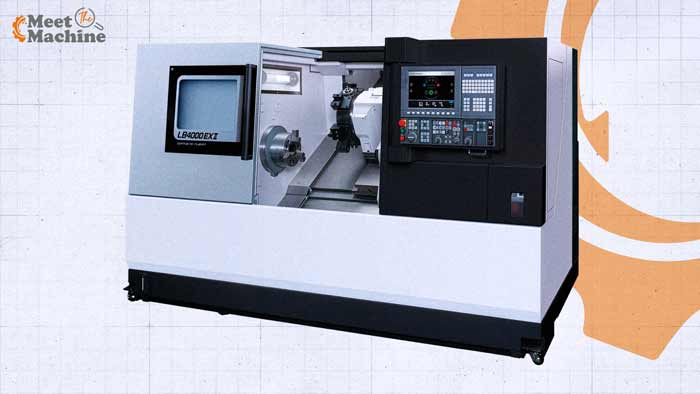
The Okuma LB4000, sold as the SPACE TURN LB4000 EX and its later EX II and EX III generations, is a large horizontal CNC turning center built for rigid, accurate production turning on medium-to-large parts. It uses Okuma's box slant-bed construction for rigidity, a high-torque PREX spindle, and a large through-hole with big-bore options for pipe, shaft, and oil-country work. Its signature is the Thermo-Friendly Concept, Okuma's thermal-stability design that lets the machine hold size through long runs without warmup or constant compensation. It runs Okuma's own OSP control, and like every Okuma, its control, drives, and spindle are built in-house. For a buyer, the name signals a rigid, thermally stable lathe that holds tolerance on big work all day.
Turning a big part is a fight against two things at once: the force of the cut and the heat it makes. A large diameter or a long shaft puts real load on the machine, so it has to be rigid enough not to flex or chatter. And a long production run heats the machine up, and as the iron grows, the size you set this morning is not the size you get this afternoon. Fight both and you can hold a big part to a tenth. Lose either one and you make scrap.
The Okuma LB4000 was built to win both fights, and it is Okuma's answer that makes it interesting. It attacks rigidity with a box slant bed and heat with a thermal design that is one of the things Okuma is most known for. This is a working breakdown of what the LB4000 is, how it holds size on big work, who runs it, and what to check before you buy a used one.
Box-Bed Rigidity
Start with the bed, because on a lathe the bed is the foundation of everything. The LB4000 uses Okuma's box slant-bed construction. A box way carries load across a broad, flat contact surface rather than a narrow rail, which makes the machine stiffer under a heavy cut and better at damping the vibration that turns a good finish into chatter. The slant lets chips fall clear and keeps the machine compact. On the big-diameter and long-shaft work the LB4000 is built for, that rigidity is not a luxury, it is the difference between taking a real depth of cut and nursing the part.
Paired with the bed is Okuma's PREX spindle motor, a high-power, high-torque design that delivers grunt at the low end for heavy cuts and holds up at speed for finishing. Rigidity in the structure and torque in the spindle are what let a machine hog metal off a large part and still leave a clean, accurate surface. The LB4000 has both, which is why it earns its place on heavy production work rather than just light turning.
Thermo-Friendly: It Holds Size All Day
This is the trait that sets an Okuma apart, and it is the reason a shop running long jobs pays attention. Every machine grows as it heats up. The spindle warms, the ways warm, the whole structure expands, and the part that measured on size at 8 a.m. measures different at 2 p.m. The usual answers are to warm the machine up before you trust it, to stop and re-measure and re-offset through the day, or to let the shop climate do the compensating. All of that is lost time and lost parts.
Okuma's Thermo-Friendly Concept is designed to make the machine grow in a predictable, controlled way and compensate for it automatically, so the LB EX series holds dimensional change over time to within a few microns. In plain terms, the machine you set in the morning is still holding size in the afternoon, without a warmup cycle and without babysitting the offsets. On a long production run of big parts, that stability is worth as much as the rigidity, because it turns a machine you have to watch into one you can trust to keep making good parts while you do something else.
Rigidity lets it take the cut. The Thermo-Friendly design lets it hold the size while it takes that cut a thousand times in a row. On big production parts, you need both, and the LB4000 was built for both.
Big-Bore Turning
The LB4000 is a large-capacity machine, and one of its most useful traits is the through-hole in the spindle. A base machine runs a 10-inch chuck class, but the LB4000 is available in big-bore configurations with a large spindle through-hole, on the order of seven inches or more, which lets a shop pass long bar or pipe straight through the spindle. That is exactly what oil-country, energy, and pipe work needs: the ability to feed a long length of stock through the machine and turn it without hanging it all out in front of the chuck.
Between the big bore, the rigid bed, and the torque, the LB4000 sits in the sweet spot for medium-to-large production turning: couplings, shafts, flanges, oil-country tubulars, and the kind of parts that are too big for a compact lathe but do not need a giant. It is available in a range of bed lengths, so between-centers capacity scales to the length of the parts you run. Match the bore and the bed to your work and it is hard to beat for the money.
The OSP Control and the In-House Machine
One thing separates Okuma from almost every other builder: it makes its own control. The LB4000 runs Okuma's OSP control, an open-architecture system Okuma designs and builds itself, along with its own drives, motors, and spindle. Most builders buy a control from an outside supplier and integrate it. Okuma builds the whole machine, control included, so the pieces are engineered to work together.
For a used buyer, that in-house approach cuts both ways, mostly in your favor. The upside is a machine whose control, drives, and mechanics were designed as one system, which is part of how Okuma gets its reliability and its thermal behavior. The practical note is that the OSP is its own ecosystem, so it is worth confirming the control generation, that it is supported, and that your programming and any CAM post fit it. Okuma has strong support and a large installed base, so this is rarely a problem, but it is always worth checking on a used machine.
Reading the Configuration
The LB4000 comes in more than one flavor, and the letters on the tag tell you what a specific machine can do. The base machine is a 2-axis turning center. An M adds live tooling on the turret, so it can mill and drill as well as turn. A Y adds a Y-axis for off-center milling. A W adds a sub-spindle for finishing the back of the part in the same cycle. Those combine, so an MYW machine turns, mills with a Y-axis, and finishes the back side, a full done-in-one lathe, while a base machine is a straight turning center.
The other part of the name is the generation: EX, then EX II, then EX III, each a refinement of the platform. For a used buyer the decode matters, because an M, Y, or W machine is worth considerably more than a base turning center, and it is worth confirming the machine actually has, and works, the capability its tag implies before you buy. As a rule, a later generation and a fuller options package cost more on the used market, so knowing exactly what the letters and the EX number mean is how you avoid overpaying for a badge or underbuying for the job.
The Value of Buying One Used
A new Okuma is a premium machine at a premium price, and that is exactly why the used market is where a lot of shops get into one. A well-kept used LB4000 puts Okuma rigidity, thermal stability, and the OSP control on a floor for a fraction of new-machine money. Because these machines are built to run hard for a long time, a used one often has plenty of life left if it was cared for, and the traits that make an Okuma worth buying, the box bed and the thermal design, are the traits that age well.
As with any production lathe, the value lives in the condition and the configuration. Hours and maintenance matter as much as model year, because these machines earn their keep in heavy, continuous work. And the configuration has to match the job: the right bore, the right bed length, and the right M, Y, or W options for your parts. Buy a clean, well-matched LB4000 and it is one of the more dependable big-turning values on the used market.
What to Check on a Used LB4000
Spindle and through-hole. Check the spindle for runout, bearing noise, and heat, and confirm the through-hole size matches the bar or pipe you intend to run. On a big-bore machine the spindle is the heart of the value.
Box ways and geometry. Inspect the box ways for wear and scoring and confirm the machine still holds its geometry. Well-maintained ways are the sign of a machine that was respected.
Turret and live tooling. Index the turret and, on an M or Y machine, test the live tooling and Y-axis for backlash and noise. On a W machine, check the sub-spindle the same way you check the main.
OSP control. Confirm the OSP control generation, that it is supported, and that your programming and CAM post work with it.
Hours, tooling, and configuration. Ask for spindle hours and maintenance history, confirm the tooling and chuck come with the machine, and verify the configuration matches the parts you plan to run.
Who Runs an LB4000
The LB4000 lands wherever medium-to-large parts are turned in production. Oil and gas and energy shops run the big-bore versions for tubulars, couplings, and downhole components fed through the spindle. General production shops use it for shafts, flanges, hubs, and housings that are too big for a compact lathe. With the M, Y, and W options it moves into done-in-one work, finishing complex turned-and-milled parts complete. The common thread is a shop that needs rigidity, big capacity, and dimensional stability across long runs, and wants the reliability and thermal behavior Okuma is known for. That is the shop the LB4000 was built for.
Resell CNC Take
A used LB4000 is one of the safer big-turning buys out there, because Okuma builds a machine that ages well and holds its accuracy. The box bed and the Thermo-Friendly design are exactly the traits that stay valuable a decade in. The whole decision comes down to condition and configuration, so before you buy we match the bore, bed length, and any M, Y, or W options to the parts you run, then confirm the spindle, ways, and OSP control are right. Tell us the parts and the volumes, and we will tell you whether a used LB4000 is the machine, and which configuration.
Frequently Asked Questions
What is the Okuma LB4000?
The LB4000, sold as the SPACE TURN LB4000 EX and its EX II and EX III generations, is a large Okuma horizontal CNC turning center for medium-to-large production parts. It combines box slant-bed rigidity, a high-torque PREX spindle, big-bore options, and Okuma's Thermo-Friendly thermal stability, running Okuma's own OSP control.
What does Thermo-Friendly mean on an Okuma?
Thermo-Friendly Concept is Okuma's thermal-stability design. It makes the machine grow in a predictable way as it heats and compensates automatically, holding dimensional change over time to within a few microns. In practice, the LB4000 holds size through a long run without a warmup cycle or constant re-offsetting.
What do the M, Y, and W letters mean on an LB4000?
They mark configuration options. M adds live tooling on the turret for milling and drilling, Y adds a Y-axis for off-center milling, and W adds a sub-spindle for finishing the back of the part in one cycle. They combine, so an MYW machine turns, mills with a Y-axis, and back-works, while a base machine is a straight 2-axis turning center.
Is the LB4000 good for big-bore or pipe work?
Yes. The LB4000 is offered in big-bore configurations with a large spindle through-hole, on the order of seven inches or more, which lets a shop pass long bar or pipe through the spindle. That, plus the rigidity and torque, makes it well suited to oil-country, energy, and shaft work. Confirm the exact through-hole size on the specific machine.
What control does the LB4000 use?
The LB4000 runs Okuma's own OSP control, an open-architecture system Okuma designs and builds in-house along with its drives, motors, and spindle. On a used machine it is worth confirming the OSP generation, that it is supported, and that your programming and CAM post fit it.
Is a used Okuma LB4000 worth buying?
Often yes. A new Okuma is premium-priced, so the used market is how many shops get the rigidity, thermal stability, and OSP control for far less. Because the machine ages well, a clean, well-maintained used LB4000 can be a strong value. The keys are checking spindle and way condition, confirming the OSP control, and matching the bore, bed, and options to your work.
Shopping a Used Okuma?
See our used Okuma inventory.
Every machine we sell is inspected by a team with 200+ years of combined industry experience and four AMEA and CEA certified equipment appraisers on staff, spindle, ways, and control included.
See Used Okuma Machines
About the Author
Bill Murphy is the Marketing and Content Lead at Resell CNC. The Meet the Machine series breaks down specific machines, what they do, who runs them, and what to look for when buying one used.
About Resell CNC
Resell CNC has bought and sold used CNC machinery since 2008. Based in Maitland, Florida, with warehouses in Winter Springs and Longwood, the team brings more than 200 years of combined industry experience and four AMEA and CEA certified equipment appraisers on staff. Resell CNC has been an MDNA member since 2009 and is the only used CNC dealer in North America with Official Mazak Trade-In Center status.
Sources
- SPACE TURN LB4000 EX II and EX III product pages, Okuma America
- LB4000 EX III horizontal lathe launch, Okuma America
- SPACE TURN LB4000 EX specifications and options, Okuma
- Okuma Thermo-Friendly Concept and OSP control overviews, Okuma