Meet the Machine
Amada HG-1003: The Bend Lives in the Ram
What is the Amada HG-1003?
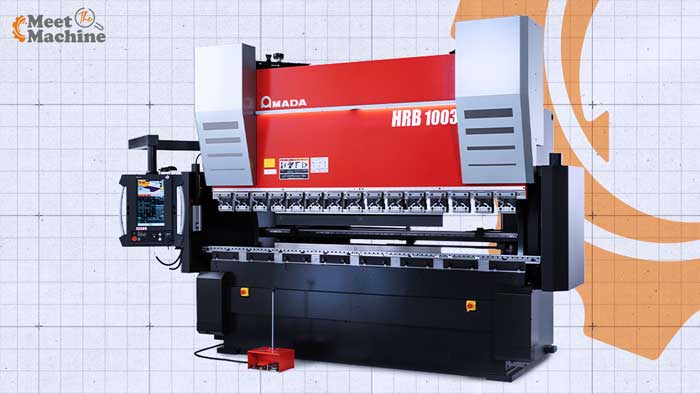
The Amada HG-1003 is a 110 US ton servo-hydraulic CNC press brake built by Amada Co., Ltd. in Japan, with a 118.1-inch (3,100mm) bending length and 106.2 inches between the side housings. It uses Amada's Dual Servo Power hybrid drive, two hydraulic crowning cylinders, ram repeatability of plus or minus 0.00004 inches, and the AMNC 3i touchscreen control. The model sits in the middle of Amada's HG series, which spans roughly 56 to 247 US tons, and is offered as a standard machine, an HG-1003 ATC with Amada's patented automatic tool changer, and as the base of the HG-1003 ARS robotic bending cell. It is one of the most widely installed high-precision production press brakes in North American sheet metal fabrication and one of the deepest used-market bending platforms Amada America supports through its national service network.
Walk the floor of a sheet metal shop running enclosures, brackets, chassis, or contract fabrication work, and there is a strong chance the brake doing the precision bending is an Amada HG. Often the HG-1003. Often with an operator who trusts it to hit the same angle on part one and part four hundred without re-checking every piece against a protractor. That trust is not loyalty to a badge. It is the result of one engineering decision: the HG-1003 is built so the ram returns to exactly the same depth on every stroke, and in air bending, ram depth is the bend angle.
This is a working fabricator's breakdown of the HG-1003. Where it came from, how the drive and the control actually produce a repeatable angle, where it sits in Amada's bending lineup, how it stacks up against the press brakes American shops cross-shop it against, what a used unit really costs across its configurations, and the specific items to inspect before you sign for one. No marketing language. Just what shop owners, fabrication managers, and brake operators need to know before they buy.
Where the HG Platform Came From
Amada was founded in 1946 by Isamu Amada, who started with a small machine repair shop built around a lathe salvaged from a burned-out wartime factory. The company moved into building its own band saw machines, then made its name in sheet metal. In 1970 Amada launched what it describes as the world's first automatic bending machine, and bending has been central to the company ever since. Today Amada is widely regarded as the largest press brake manufacturer in the world by volume, and the company's defining advantage is that it builds the machine, the tooling, and the control software as one integrated system rather than three parts bolted together.
The HG series is the modern expression of that history. Amada markets it as a high-precision hybrid press brake, and the HG-1003 is the 110 ton, 3-meter member of the family. It replaced earlier Amada hydraulic brake platforms with a servo-driven hydraulic system, a stiffer frame, and a control built specifically for repeatable angle production. The machine has been in continuous production and continuous improvement long enough that there is a deep population of used HG-1003 units in American shops, which is exactly why it earns a Meet the Machine entry.
The Engineering Philosophy Behind the HG-1003
A press brake forms sheet metal by driving a punch into a V die. The operator sets tonnage, speed, and back gauge position, but the variable that decides the finished angle is how far the ram descends. In air bending, the most common method on a machine like this, the punch never bottoms the material against the die. The angle is produced purely by ram depth, which means the machine has to know its own position with extraordinary precision and return to that position on every single stroke. The case for the HG-1003 rests on three engineering features, and all three serve that one requirement.
The first is the drive. The HG-1003 uses Amada's Dual Servo Power system, a hybrid servo-hydraulic drive in which servo motors govern the hydraulic cylinders that move the ram. The hybrid arrangement gives the machine the raw forming force a hydraulic brake delivers while adding the position control of a servo system. The result is ram repeatability of plus or minus 0.00004 inches, roughly a thousandth of a millimeter, returned to stroke after stroke. That number, not the 110 tons of capacity, is the headline. It is what lets the machine produce a consistent 90 degree bend across a run without an operator re-measuring every part.
The second is crowning. When a long bed takes load in the center, both the bed and the ram deflect, and an uncorrected brake produces a bend that is tighter at the ends than in the middle of a long part. The HG-1003 uses two hydraulic crowning cylinders that apply compensating force along the bed so the gap between punch and die stays uniform. On a 118 inch flange, that crowning system is the difference between a straight bend line and a part that bows.
The third is the control. The AMNC 3i is a touchscreen control that handles bend sequencing, tooling layout, collision checking, and angle correction in one interface, with a 2D and 3D view of the part and the tool setup. Combined with Amada's angle measurement and bend indication options, the control closes the loop between programmed angle and produced angle, which is what shortens setup on a new part from a trial-and-error process to a near first-part-good operation.
A press brake that returns to bottom dead center within a thousandth of a millimeter is doing the quality control work that used to require a skilled operator, a protractor, and a stack of scrap test bends at the start of every job. A used HG-1003 with a healthy drive and clean crowning system keeps doing that work. One with a tired pump, sticky valves, or a drifting ram becomes a project. Resell CNC's inspection team checks ram repeatability and crowning function on every Amada brake we appraise, because the gap between those two machines is the entire purchase decision.
The HG Family in Shop Language
Amada's HG series is a full family of press brakes built on a common architecture and scaled by tonnage and bending length. Amada's model numbers encode both: the first two digits indicate the metric tonnage class and the last two indicate the bending length in meters. Knowing where the HG-1003 sits keeps a buyer from purchasing a brake that is too small to reach the part or far more machine than the work needs.
HG 5020: about 56 US tons, 2-meter bed. The compact entry. Built for small precision parts, electronic enclosures, brackets, and light-gauge work where the part envelope is short and the tonnage demand is modest.
HG 8025: about 88 US tons, 2.5-meter bed. A step up in both force and length, common in shops bending mid-size enclosure and chassis panels where a 2-meter bed runs out of room.
HG 1003: 110 US tons, 3-meter bed. The production workhorse and the subject of this guide. It covers the largest share of typical North American fabrication work: enclosure and cabinet panels, structural brackets, chassis components, HVAC and ductwork parts, and general contract bending in mild steel and stainless. The 110 ton capacity and 118 inch bed land in the zone where most high-mix shops do the majority of their bending.
HG 1303 and HG 1703: about 143 and 187 US tons, 3-meter bed. The step up when material thickness or bend length pushes past what 110 tons will form. Heavier plate work, thicker structural parts, longer flanges in heavier gauge.
HG 1704, HG 2203, and HG 2204: roughly 187 to 247 US tons, 3 to 4-meter beds. The heavy end of the line for large structural and plate fabrication, with the 4-meter beds reaching bend lengths above 160 inches.
Within the HG-1003 specifically, the configuration matters as much as the model on the used market. The base HG-1003 is the standard machine with manual tooling setup. The HG-1003 ATC adds Amada's patented automatic tool changer, which stores punches and dies and loads the required setup without an operator handling tooling. The HG-1003 ARS is a robotic bending cell built on the HG-1003 platform, where a bending robot loads, forms, and unloads parts for unattended production. A used HG-1003 ATC sells for a meaningful premium over a base machine of the same year, and an ARS cell is a different purchase entirely.
The Setup Problem the ATC Was Designed Around
The hidden cost in a bending department is not run time. It is setup. Every new part means pulling punches and dies, loading them into the holders, squaring them up, and dialing in the first bend, and on a 3-meter brake that tooling is heavy and the work is slow. For a shop running long batches of the same part, setup is a rounding error. For a high-mix, low-volume shop changing over several times a shift, setup is the bottleneck that decides how many jobs the brake can turn in a day.
The HG-1003 ATC attacks that number directly. The automatic tool changer stores the shop's tooling and loads the punches and dies for the next job to position without an operator touching them, which converts dead setup time into bending time and removes the variability of manual tooling alignment. For a fabricator whose economics live in changeover speed, the ATC is the spec that justifies the machine, and it is the single biggest reason a used HG-1003 ATC commands its premium. The ARS robotic cell takes the same logic further, removing the operator from the loading loop entirely so the machine can bend short runs unattended.
The U.S. Service and Parts Footprint
Amada America's corporate headquarters is in Buena Park, California. Its flagship demonstration and training facility is the AMADA Solution Center in Schaumburg, Illinois, a 133,000 square foot site that showcases the company's bending, punching, laser, and automation lines, including HG-series brakes with the ATC. Amada America runs field service and parts through a national network with locations including High Point, North Carolina; Brea and La Mirada, California; Batavia, New York; Lakewood, Colorado; Irving, Texas; and Columbus, Ohio, with Canadian coverage out of Mississauga, Ontario.
For a used buyer, that support footprint matters more than it sounds. A production brake that loses a hydraulic pump, a servo drive, or ATC function in the middle of a run is a serious problem if parts and a qualified technician are not within reach. Amada and Trumpf are consistently rated at the top of the press brake field for after-sales service depth in North America, and that support is one of the practical reasons used HG-1003 units hold value the way they do. It is also a recurring point Resell CNC's appraisal team weighs when valuing a machine.
Where the HG-1003 Fits Among Production Press Brakes
A shop cross-shopping a high-precision production brake in this class typically looks at four names: the Amada HG, the Trumpf TruBend, the Bystronic Xpress, and the LVD line. Each has earned its place, and the decision usually comes down to one or two specific arguments per brand.
| Brand |
HQ |
Drive / Control |
Distinctive Strength |
| Amada HG-1003 |
Isehara, Japan |
Servo-hydraulic, AMNC 3i |
Patented ATC tool changer, integrated tooling ecosystem, deep used-market base |
| Trumpf TruBend 5000 |
Ditzingen, Germany |
Hydraulic, TecZone / TruTops |
Deepest software and automation ecosystem, gold-standard lights-out bending cells |
| Bystronic Xpress |
Niederonz, Switzerland |
Electric / hybrid |
Fast and flexible on small to medium work, tight laser-to-bend workflow |
| LVD Easy-Form |
Gullegem, Belgium |
Hydraulic, adaptive laser |
Easy-Form Laser real-time in-process angle correction |
The Trumpf argument is the software and automation ecosystem, the deepest in the industry, and a track record as the reference for lights-out bending. The Bystronic argument is speed and flexibility on small to medium parts with a seamless handoff from laser cutting, though it is not the choice when high tonnage is the requirement. The LVD argument is the Easy-Form Laser system that measures and corrects the angle in real time during the bend. The Amada argument is the combination of three things at once: the patented ATC that no competitor matches on the used market at this scale, a machine-tooling-software ecosystem built as one system, and an installed base and service depth in North America that keeps resale value strong. For high-mix production shops, the ATC and the resale math are usually what win the order.
Why Used HG-1003s Hold Their Value
Used HG-1003 units trade strong relative to comparable used brakes of similar age and capability, and the gap holds across configurations. Build quality is part of it. The ATC is part of it. The real driver is the combination of Amada's North American support depth and the size of the installed base. A shop buying a used HG-1003 is buying into a machine that other shops know how to support, tool, and train operators on, which keeps demand on the secondary market tight.
Approximate ranges from current U.S. secondary-market activity. Treat these as starting points, since most dealer listings are request-price and exact numbers move with year, hours, control, tooling included, and configuration:
- Base HG-1003, standard tooling (roughly 2008 to 2015): approximately $60,000 to $130,000 depending on year, hours, and condition
- HG-1003 ATC with automatic tool changer (roughly 2015 to 2020): approximately $150,000 to $260,000, with low-hour units and large tooling packages pushing higher
- HG-1003 ARS robotic bending cell: approximately $250,000 to $350,000 and up, tracking the robot, tooling, and cell integration as much as the brake itself
For context, a new HG-1003 from Amada lands well into six figures and an ATC-equipped configuration climbs higher still. A well-maintained used unit that delivers most of the new machine's productivity at a fraction of the cost is the math that keeps the used market for these brakes active, and it is the same math that makes a careful pre-purchase inspection pay for itself.
What to Check When Buying a Used HG-1003
A used HG-1003 is a serious purchase, and the things that decide whether it is a good buy are not the things the listing photos show. From the inspections Resell CNC handles on Amada brakes coming through retail and auction, here are the items that move the appraisal number the most.
Ram repeatability and bend consistency. The whole value of this machine is repeatable angle. Run test bends at several points along the bed and confirm the angle holds end to end and part to part. Inconsistency points to a worn drive, hydraulic issues, or a crowning system that is not compensating correctly.
Hydraulic system health. Check the pump and valves for noise, heat, and pressure stability, and inspect for leaks at the cylinders, fittings, and hoses. Look at the oil condition and the reservoir. A drifting ram or a slow, surging stroke is a hydraulic warning sign and a meaningful repair on this class of machine.
Crowning system function. Confirm the hydraulic crowning cylinders are working and that long bends come out uniform. A failed or disabled crowning system shows up as a bend that is correct at the center and off at the ends.
Back gauge accuracy and axes. Cycle the back gauge through its travel and confirm it repeats to position on the X and R axes. The back gauge sets flange dimension, and a worn or drifting gauge scraps parts as surely as a bad angle.
ATC operation (ATC variants). If the machine has the automatic tool changer, run a full tool change cycle. Confirm the tooling magazine, the loading mechanism, and the clamping all function, because the ATC is a complex sub-system and the single most expensive thing to repair on these machines.
Tooling included. Amada-style tooling has real value, and a machine sold with a full set of punches and dies is worth materially more than a bare brake. Inventory exactly what comes with the machine, check the tooling for wear and damage, and confirm whether the holders are American Precision or Amada style.
Control generation and software. Confirm the control (AMNC 3i or an earlier Amada control on older builds) and its software level, and verify it networks and posts from the shop's CAM system. Control generation affects programming workflow and parts availability.
Frame, ram, and bed condition. Inspect the ram and bed faces for wear, damage, or signs of a past crash, and check the side frames for any indication of overload. The frame is the one thing on the machine you cannot economically fix.
Documentation and safety. Original manuals, parameter sheets, and electrical schematics add value and shorten future service. Confirm the laser guarding or light curtain safety system is present and functional, because retrofitting brake safety is real money.
Who Actually Runs HG-1003s
Contract sheet metal fabricators bending enclosures, cabinets, brackets, and panels in mild steel, stainless, and aluminum. Electrical enclosure and control cabinet manufacturers. HVAC and ductwork producers. Chassis, frame, and structural component shops. OEM and job shops running high-mix work where the brake changes over several times a day and angle tolerance has to hold across the full bed. Many of these shops pair an HG-1003 with the ATC specifically because their economics live in changeover speed, and a growing number run HG-1003 ARS cells for unattended short-run bending.
The common thread is precision production bending at volume, where the shop cannot afford to sort good parts from bad and cannot afford slow setups between jobs. It is not a manual brake for occasional work, and it is not a heavy plate brake for thick structural bending above its tonnage class. It is the machine a fabricator buys when the typical part fits inside 110 tons and a 3-meter bed and the work needs to come off the brake right the first time.
Resell CNC Take
The HG-1003 is one of the most dependable used bending investments on the North American secondary market because Amada's support depth keeps the machine serviceable for well over a decade after build, and the patented ATC gives the ATC-equipped versions a productivity story no competitor matches at this price on the used market. Resell CNC sees Amada HG brakes come through retail and auction regularly, and the math on a clean used unit at the right number, with tooling included and the ATC confirmed working, has held up across the transactions we have closed.
Frequently Asked Questions
What is the Amada HG-1003?
The Amada HG-1003 is a 110 US ton servo-hydraulic CNC press brake with a 118.1-inch (3,100mm) bending length and 106.2 inches between the side housings. It uses Amada's Dual Servo Power hybrid drive, two hydraulic crowning cylinders, ram repeatability of plus or minus 0.00004 inches, and the AMNC 3i touchscreen control. It is offered as a standard machine, an HG-1003 ATC with a patented automatic tool changer, and an HG-1003 ARS robotic bending cell.
How many tons is the Amada HG-1003 and how long is the bed?
The HG-1003 is rated at 110 US tons of pressing capacity with a 118.1-inch (3,100mm) bending length and 106.2 inches between the housings. In Amada's model naming, the first two digits indicate the metric tonnage class and the last two indicate the bending length in meters, so HG-1003 is the 100 metric ton class on a 3-meter bed.
What is the difference between the HG-1003, the HG-1003 ATC, and the HG-1003 ARS?
The base HG-1003 uses manual tooling setup. The HG-1003 ATC adds Amada's patented automatic tool changer, which stores tooling and loads the required punches and dies to position without an operator handling them, which is the key advantage for high-mix shops. The HG-1003 ARS is a robotic bending cell built on the same brake, where a robot loads, bends, and unloads parts for unattended production.
What does a used Amada HG-1003 cost?
Used pricing varies widely by configuration. Base HG-1003 machines with standard tooling run roughly $60,000 to $130,000, HG-1003 ATC units run roughly $150,000 to $260,000, and HG-1003 ARS robotic cells run roughly $250,000 to $350,000 and up. Final pricing tracks build year, hours, control generation, tooling included, and whether the ATC is confirmed functional. Most dealer listings are request-price, so these ranges are starting points.
Where is Amada America headquartered and is service available in the U.S.?
Amada America's corporate headquarters is in Buena Park, California, and its flagship demonstration and training site is the AMADA Solution Center in Schaumburg, Illinois. Amada America runs field service and parts through a national network including High Point, North Carolina; Brea and La Mirada, California; Batavia, New York; Lakewood, Colorado; Irving, Texas; and Columbus, Ohio, with Canadian coverage from Mississauga, Ontario.
How does the Amada HG compare to a Trumpf TruBend?
Both are top-tier production press brakes with the deepest North American service networks in the industry. Trumpf's strength is its software and automation ecosystem and its track record in lights-out bending cells. Amada's strength is its patented automatic tool changer, its integrated machine-tooling-software system, and a large used-market install base that supports strong resale value. For high-mix shops where changeover speed drives the economics, the Amada ATC is often the deciding factor.
Browse Used Amada Inventory
The HG-1003 and the full Amada lineup at Resell CNC.
Browse the current Resell CNC inventory of used Amada press brakes, ATC-equipped bending machines, and sheet metal fabrication equipment. Every appraisal is handled by our in-house team of AMEA and CEA Certified Equipment Appraisers.
VIEW USED AMADA MACHINES
About the Author
Bill Murphy is the Marketing and Content Lead at Resell CNC, where he covers used CNC equipment, auction strategy, and the buying side of the secondary machine tool market. He works directly with the appraisal, auction, and retail teams to translate machine-level detail into content for shop owners, plant managers, and acquisition buyers.
About Resell CNC
Founded in 2008 and headquartered in Maitland, Florida, Resell CNC carries 200+ years of combined industry experience, four AMEA/CEA Certified Equipment Appraisers on staff, MDNA membership since 2009, and is the only used CNC dealer in North America with Official Mazak Trade-In Center status. The company operates across retail, auction, appraisal, and finance divisions from warehouses in Winter Springs and Longwood, Florida.