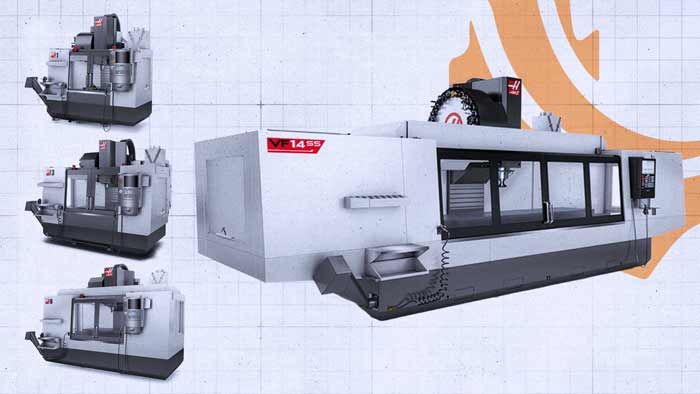
CNC Family Breakdown
Haas VF: Super Speed Halves the Table Load Nobody Reads
What is the Haas VF series?
The VF is Haas Automation's vertical machining center line and the most common used VMC in the world. It launched at IMTS in 1988 as the first American-built VMC under 50,000 dollars. The range runs VF-1 through VF-14 with no VF-13, in 40 and 50 taper, with SS for Super Speed, YT and XT for extended Y and X travel, and TR for a bolt-on two-axis trunnion. The model number tracks X travel only up to the VF-4. Above the VF-5 the numbers run in pairs that share an X travel and step the Y, so a higher number is not a bigger machine. Super Speed buys rpm and rapids but publishes identical torque and roughly halves the rated table load.
Haas publishes the table load rating for every VF it makes, and it publishes a different one for the Super Speed version of the same machine. A VF-2 is rated 3,000 lb. A VF-2SS is rated 1,500. On the VF-5 it goes 4,000 down to 1,750, a 56 percent cut, and the SS publishes the same 30 hp and the same 90 ft-lb of torque as the machine it is faster than.
So the Super Speed package buys you rpm and rapids, costs you half your fixture weight, and adds no cutting power at all. It is in Haas's own spec tables and we have not seen a used listing mention it.
This breakdown covers the whole roster and why a higher number is not a bigger machine, the suffix system, the specs that go backwards as you add capability, the two generation boundaries that decide what an old VF is worth, the red grease era and how to inspect for it, and what the used market actually pays as opposed to what it asks.
The roster, and the two numbers that are not machines
Haas currently lists VF-1, 2, 3, 4, 5, 6, 7, 8, 9, 10, 11, 12 and 14, in a long list of variants across 40 and 50 taper. The historical line adds the VF-0, VF-0E and VF-0E/EXT, and a VF-1YT that appears in Haas's 2014 shipping document and is gone from the catalogue today.
There is no VF-13. Not in the current catalogue, not in the 2014 weight document, not in the model list of the early-2000s operator's manual. Haas has never published a reason. One thing that will confuse you if you go looking: Haas service procedures list model coverage as VF-10/11/12/13/14, so the string does appear in Haas print. It is a range shorthand in a document that covers many families, not a machine. The superstition explanation is universal in the trade and we are treating it as inference rather than fact, because Haas has not said it.
And the VF-16 through VF-26 are racing cars. Haas F1 was founded in 2014 and first raced in 2016, and it names its chassis on the same Very First convention, so a search for a large VF number returns Formula One results. At least one dealer guide lists the cars in the same article as the mills. If a listing offers you a VF-17, it is not a machine tool.
One naming note Haas does publish: the V is vertical, and Gene Haas added F1 to mark the company's Very First One. That is the only part of the name Haas explains anywhere.
A higher number is not a bigger machine
At the bottom of the range there appears to be a clean rule. X travel equals ten times the model number plus ten, in inches.
| Model |
X travel |
What the rule predicts |
| VF-1 |
20 in |
20, correct |
| VF-2 |
30 in |
30, correct |
| VF-3 |
40 in |
40, correct |
| VF-4 |
50 in |
50, correct |
| VF-5 |
50 in |
60, and the rule dies here |
The VF-4 and the VF-5 have identical 50 inch X travel. What separates them is Y, 20 inches against 26. From the VF-5 upward the number stops being a travel figure and becomes an ordinal size index.
Above that, the numbers run in pairs that share an X travel and step the Y.
| X travel |
Narrow Y, 32 in |
Wide Y, 40 in |
| 64 in |
Haas VF-6 |
Haas VF-8 |
| 84 in |
Haas VF-7 |
Haas VF-9 |
| 120 in |
Haas VF-10 |
Haas VF-11 |
| 150 in |
Haas VF-12 |
Haas VF-14 |
The mistake this causes
A VF-7 has 84 inches of X. A VF-8 has 64. The higher number is the wider machine, not the longer one. A shop that needs length, sees a VF-8 listed above a VF-7, and buys the bigger number ends up with twenty inches less of exactly the thing it was buying. Haas publishes no explanation of the numeric ladder anywhere, so nothing on the machine or in the catalogue warns you.
The number does not track weight either. A VF-7/40 weighs 26,000 lb and a VF-8/40 weighs 24,800, per Haas document ES0428 Rev CA of September 2014. Treat those as period figures: that document stops at the VF-12 and does not contain a VF-14 at all.
The suffix system, and what Haas actually defines
The order is not consistent, and that is worth knowing before you try to parse a listing. A VF-5/40XT puts the taper before the travel suffix. A VF-3YT/50 puts it after. And an SS machine drops the taper token altogether: there is no VF-5/40SS, only a VF-5SS. Haas is not applying a grammar here, it is naming machines one at a time.
| Suffix |
Meaning |
Defined by Haas in print |
| /40, /50 |
Spindle taper, 40 or 50 |
Yes, it is the model name |
| SS |
Super Speed. Higher-rpm inline spindle, faster rapids, side-mount tool changer |
Yes, named and described |
| YT |
Extended Y travel. Haas: more Y than the standard machine |
Yes |
| XT |
Extended X travel. VF-5/40XT is 60 in against 50 |
Yes |
| TR |
A removable two-axis trunnion rotary table bolted to the table |
Yes |
| EC8 |
Eight inch extended Z clearance option |
Yes, as an option name |
| APC |
Automatic pallet changer |
Yes as an option name, no as a model suffix. Haas sells the pallet changer and an APC-ready control option, but VF-2APC is dealer shorthand |
| B, D |
Correlated with two-speed gearbox machines in listings |
No. Unverified |
| E |
Usually read as economy |
No. Four incompatible owner explanations exist |
SS and YT are orthogonal and they compose. A VF-2SS is a standard 16 inch Y with the speed package. A VF-2YT is a standard spindle with Y raised to 20 inches and the table widened from 14 to 18. A VF-2SSYT is both. They are not a ladder, they are two independent choices, and that is why the names get long.
One dealer definition to ignore. A published dealer guide defines TR as High Torque. Haas's own VF-2TR, VF-5/50TR and VF-6/40TR pages define TR as a two-axis trunnion rotary table for 5-axis work. The manufacturer settles it.
The spec ladder, 40 taper
Current-generation figures from Haas Automation UK product pages, retrieved September 2026.
| Model |
X |
Y |
Z |
Table |
Table load |
Max rpm |
ATC |
Rapids |
| VF-1 |
20 in |
16 in |
20 in |
26 x 14 |
3,000 lb |
8,100 |
20 carousel |
1,000 ipm |
| VF-2 |
30 |
16 |
20 |
36 x 14 |
3,000 lb |
8,100 |
20 carousel |
1,000 |
| VF-2YT |
30 |
20 |
20 |
36 x 18 |
3,000 lb |
8,100 |
20 carousel |
1,000 |
| VF-2SS |
30 |
16 |
20 |
36 x 14 |
1,500 lb |
12,000 |
30+1 SMTC |
1,400 |
| VF-2SSYT |
30 |
20 |
20 |
36 x 18 |
1,500 lb |
12,000 |
30+1 SMTC |
1,400 |
| VF-3 |
40 |
20 |
25 |
48 x 18 |
3,500 lb |
8,100 |
20 carousel |
1,000 |
| VF-3YT |
40 |
26 |
25 |
54 x 25 |
3,500 lb |
8,100 |
20 carousel |
710 |
| VF-3SSYT |
40 |
26 |
25 |
54 x 25 |
1,750 lb |
12,000 |
30+1 SMTC |
1,400 |
| VF-4 |
50 |
20 |
25 |
52 x 18 |
3,500 lb |
8,100 |
20 carousel |
1,000 |
| VF-4SS |
50 |
20 |
25 |
52 x 18 |
1,750 lb |
12,000 |
30+1 SMTC |
1,400 |
| VF-5/40 |
50 |
26 |
25 |
52 x 23 |
4,000 lb |
8,100 |
20 carousel |
710 |
| VF-5SS |
50 |
26 |
25 |
52 x 23 |
1,750 lb |
12,000 |
30+1 SMTC |
1,200 |
| VF-5/40XT |
60 |
26 |
25 |
62 x 23 |
4,000 lb |
8,100 |
20 carousel |
710 |
| VF-6/40 |
64 |
32 |
30 |
64 x 28 |
4,000 lb |
8,100 |
30+1 |
600 |
| VF-6SS |
64 |
32 |
30 |
64 x 28 |
2,000 lb |
12,000 |
30+1 |
1,200 |
| VF-7/40 |
84 |
32 |
30 |
84 x 28 |
4,000 lb |
8,100 |
24+1 |
600 |
| VF-8/40 |
64 |
40 |
30 |
64 x 36 |
4,000 lb |
8,100 |
30+1 |
600 |
| VF-9/40 |
84 |
40 |
30 |
84 x 36 |
4,000 lb |
8,100 |
24+1 |
600 |
| VF-10/40 |
120 |
32 |
30 |
120 x 28 |
4,000 lb |
8,100 |
24+1 |
X 360 |
| VF-11/40 |
120 |
40 |
30 |
120 x 28 |
4,000 lb |
8,100 |
24+1 |
X 360 |
| VF-12/40 |
150 |
32 |
30 |
150 x 28 |
4,000 lb |
8,100 |
24+1 |
X 360 |
| VF-14/40 |
150 |
40 |
30 |
150 x 28 |
4,000 lb |
8,100 |
24+1 |
X 360 |
Every 40-taper VF spindle is 30 hp with 90 ft-lb at 2,000 rpm as standard, Super Speed included. Haas also publishes an optional 40-taper two-speed gearbox at 250 ft-lb at 450 rpm, which is a genuine upgrade and should not be confused with the 250 ft-lb figure in the next section, where the same number is a 50-taper downgrade. The 50-taper machines are a different animal: 7,500 rpm, 340 ft-lb at 700 rpm, and a two-speed geared head rather than an inline direct drive.
One figure we are flagging rather than asserting. Haas's VF-11 and VF-14 pages both print a 28 inch table width alongside 40 inches of Y travel, the same width as the 32 inch Y machines they sit beside. Two differently framed reads returned the same thing. If that is right it means the extra Y carries the spindle past the table edge rather than over more table. Confirm it against a machine-specific quote before you plan a fixture around it.
Seven specs that go the wrong way
1. Super Speed halves your table load. VF-2, 3,000 lb. VF-2SS, 1,500. VF-3YT 3,500 to VF-3SSYT 1,750. VF-4 3,500 to VF-4SS 1,750. VF-5/40 4,000 to 1,750, a 56 percent cut. VF-6/40 4,000 to 2,000. A shop that buys a VF-5SS for cycle time and then loads a tombstone is more than 2x outside Haas's published rating.
2. Super Speed adds no torque at all. Every 40-taper SS model publishes the same 30 hp and the same 90 ft-lb at 2,000 rpm as the standard machine. You are buying spindle speed, rapids and a bigger tool changer. For heavy roughing in steel the SS gives you nothing the base machine does not have, while costing you half the table rating.
3. The high-speed 50-taper option removes a quarter of your torque. On a VF-6/50 the standard spindle is 7,500 rpm and 340 ft-lb. The optional 10,000 rpm spindle is 250 ft-lb at 700 rpm. That is 90 ft-lb gone, 26 percent, on a machine bought specifically for torque. A used VF-6/50 advertising 10,000 rpm as an upgrade is advertising a downgrade for most 50-taper work.
4. Choosing 50 taper costs you rpm, and rules out Super Speed entirely. VF-5/40 runs 8,100 rpm. VF-5/50 runs 7,500. You gain 340 ft-lb against 90, which is an enormous win for heavy cuts, but there is no 50-taper Super Speed VF anywhere in the catalogue. SS is a 40-taper-only package.
5. Bigger machines are dramatically slower, on the axis that grew. VF-1 through VF-4 rapid at 1,000 ipm. The VF-5 and VF-3YT drop to 710. The VF-6/40 through VF-9/40 run 600, though the VF-7SS and VF-8SS get 1,200. And the VF-10 through VF-14 traverse X at 360 ipm, 36 percent of a VF-2, on a machine with four times the travel. Air-cutting time on a long-bed VF is brutal, and it is worse inside Super Speed too: the VF-2SS gets 1,400 ipm while the VF-5SS and VF-6SS get 1,200.
6. YT costs the VF-3 nearly a third of its rapids, and costs the VF-2 nothing. A VF-3 rapids at 1,000 ipm. A VF-3YT rapids at 710, for six inches of Y, with the spindle, the table load and the tool capacity unchanged. The VF-2 and VF-2YT are both 1,000 ipm, so this is a VF-3-specific trap rather than a rule about YT.
7. Bigger machines hold fewer tools. VF-6/40 and VF-8/40 carry 30+1. The VF-7/40, VF-9/40, VF-10/40, VF-11/40, VF-12/40 and VF-14/40 all carry 24+1. The Super Speed versions of those frames go back up to 30+1, so this is a configuration fact rather than a size rule. The VF-7/40 has fewer pockets than the smaller VF-6/40, and a VF-11 with 120 inches of X holds fewer tools than a VF-2SS with 30. Tool capacity is not monotonic with size anywhere in this family.
And the trunnion is in a category of its own. A VF-2 table is rated 3,000 lb. The VF-2TR trunnion platter is rated 80 lb, with a 17.5 inch maximum swing. Bolting it on removes 97 percent of your usable part weight. It also eats Z clearance by sitting on top of the table, and Haas does not publish the resulting Z figure on any TR page, which is worth knowing before you plan a job around one. For scale, a UMC-750 platter takes 660 lb.
Thirty years of one model name
The VF-1 launched at IMTS in 1988 at 49,900 dollars, the first American-built VMC under fifty thousand. It is still in the catalogue. That means "Haas VF-1" in a listing spans nearly four decades of machine.
|
1995 VF-1 |
Current VF-1 |
| Travels |
20 x 16 x 20 in |
20 x 16 x 20 in, unchanged |
| Table |
26 x 14, 3,000 lb |
26 x 14, 3,000 lb, unchanged |
| Spindle |
7,500 rpm, 20 hp |
8,100 rpm, 30 hp |
| Taper |
CAT 40 |
BT or CT 40 |
Identical work envelope, 50 percent more spindle power, one model name. The same 20 to 30 hp story runs across the 40-taper line. A listing that says only Haas VF-1, or only Haas VF-2, has told you the travels and almost nothing else. The year matters more than the model number on this family, which is the opposite of how most listings are written.
Two generation boundaries, and only one is the one people talk about
The Next Generation Control arrived in 2016. The figures that follow come from dealer and monitoring-vendor documentation rather than from Haas, whose own control pages we could not reach. A Classic control is commonly cited at 1 to 16 MB of program memory and moves data over RS-232. NGC starts at 1 GB, goes to 8, runs a 15.6 inch touchscreen and has Ethernet with remote monitoring. On a modern 3D toolpath that difference decides whether the program fits in the machine at all.
You can tell them apart in thirty seconds. NGC has a wired network page under Settings and shows Setting 143 as a number. Classic shows RS-232 settings on the I/O page and Setting 143 as on or off. Machines older than either show neither.
But 2016 is not the obsolescence line, and this is the part that costs money. The boundary that matters is older and it is about the processor, not the screen. Owners reported from October 2016 that Haas had declared CRT-era main boards unavailable, with replacement quoted at 10,000 dollars. By July 2018 an owner account put the systematic electronics replacement at approaching 20,000 dollars, having been less than half that a year earlier.
Ask the right question
Not "is it Classic or Next Gen." Ask "is it CRT or LCD, and which processor generation." A late Classic machine from roughly 2005 to 2015 is not in the obsolete-board group and has a healthy parts aftermarket behind it. A CRT machine is the one carrying a five-figure repair that exceeds what the machine is worth.
The red grease era, and how to inspect for it in five minutes
This is the best-documented defect story in the family, and Haas dates it themselves. Their service alert of 7 November 2022 states that machines built from April 2014 to August 2022 used Haas Liquid Grease, that machines after August 2022 use Haas Axis Lubrication Oil, and that Liquid Grease cartridges and refills are no longer available.
| Lubrication |
Period |
How well established |
| Way oil |
Before roughly 2010, exact end unknown |
Owner reports only |
| Brown grease |
Somewhere between the way oil and red grease eras, dates unknown |
Owner reports only |
| Red grease |
Roughly 2010 to April 2014 |
Bracketed by the manufacturer date |
| Haas Liquid Grease, purple |
April 2014 to August 2022 |
Manufacturer, exact |
| Haas Axis Lubrication Oil |
After August 2022 |
Manufacturer, exact |
What owners in that window actually report. Lines plugging, and the signature symptom of grease following the path of least resistance: one axis flooded while another gets nothing. On a 2012 VF-2, a first-hand report describes one Y-axis rail pristine and the other showing rust and pitting. The forum thread carrying most of this ran in early 2016 and ended without resolution, so we are reporting it as owner experience rather than as an established failure rate.
The five-minute test, and it is the useful part. An owner running a 2014 VF-2SS on red grease alongside a 2016 machine on purple reported the 2014 showed no significant grease usage while the newer machine's canister was half gone at fewer hours. A grease reservoir that is not going down is not being economical. It is not delivering lubricant. Check the reservoir level against the machine's hours, then pull the Y-axis way covers and look at both rails directly.
What a documented conversion is worth. Haas publishes kit 93-2755A to convert red grease to oil and 93-2601B to replace the plastic reservoir with metal, along with procedure AD0659 for the red grease conversion and AD0629 for the Liquid Grease one, covering the VF line and much of the rest of the Haas catalogue. A machine with the conversion done and papered is genuinely worth more. Rail pitting is not economically repairable against the value of the machine, because it means rails and trucks on something worth 30,000 to 50,000 dollars.
One nuance on the dates. Haas's cutover is April 2014, but owner reports place red grease machines in the field on 2014 and even 2016-badged builds, including a 2016 VF-3 whose canister failed with no warning and no alarm. Treat model years 2010 through 2016 as the inspection window, with April 2014 as the point where the risk starts falling rather than ends.
The used market, and it is the deepest one there is
Everything we have written about thin families does not apply here. On one marketplace carrying 3,130 used vertical machining centers across all brands, surveyed in September 2026, 886 of them are Haas. That is 28 percent of the entire category, and 3.6 times the second brand on the same platform, which showed 246. For contrast the same platform listed 16 Chiron and four Yasda.
One finding cuts against expectation. By total listings, not by the priced sample in the table below, the single deepest model is not the plain VF-2. It is the VF-2SS, and across the VF-2, VF-3 and VF-4 the Super Speed variants outnumber their standard counterparts. The speed package was sold in enormous numbers and is now the volume used product.
Asking prices, and they are asks not sales
| Model |
Observations |
Median ask |
Range |
| VF-2, all years |
13 |
26,500 |
9,500 to 60,000 |
| VF-2, pre-2016 |
11 |
17,500 |
9,500 to 60,000 |
| VF-2SS, all years |
12 |
59,750 |
28,500 to 104,500 |
| VF-2SS, pre-2016 |
6 |
31,500 |
28,500 to 54,500 |
| VF-2SS, 2016 and later |
6 |
79,500 |
65,000 to 104,500 |
| VF-3, all years |
15 |
39,500 |
10,000 to 57,000 |
| VF-4, all years |
10 |
39,000 |
5,500 to 90,000 |
| VF-5 |
1 |
too thin to band |
one machine only |
The VF-5 and large-frame bands rest on one or two machines and we are not going to dress them up as bands. Everything above excludes machines listed as call for price, which pulls both the newest and the most tired machines out of the sample.
What the market actually pays
This is the number nobody publishes, and getting it required going to the one venue that reports completed sales, because the machine tool auction industry systematically withholds hammer prices. We checked six major auction platforms. One closed VF-2D lot states it plainly: the auctioneer has chosen not to publish the price of this lot. Anyone quoting Haas VF auction results from those platforms without an account is quoting asks.
| Comparison |
Dealer ask |
What it actually sold for |
Gap |
| VF-3, 1999 |
20,000 |
under 2,000 |
minus 90 percent |
| VF-4, 1999 |
15,500 |
6,900 |
minus 55 percent |
| VF-2SS, 2007 |
29,250 |
10,000 or less |
minus 66 percent |
| VF-4 with pallet changer |
35,000 |
12,500 or less |
minus 64 percent |
Median gap on an old machine is roughly 65 percent, across four comparisons. Read that carefully, because it is a channel gap and not purely a negotiation gap, and because four comparisons is a small sample to hang a rule on. It bundles together an as-is private sale against a dealer offering power-up and some recourse, the buyer carrying rigging and freight and risk, and real condition differences the listing never disclosed.
And it reverses at the good end. A well-specified VF-2D with a fourth axis and an advertised 30,000 rpm spindle, which is far above anything Haas publishes for a VF and so is either an aftermarket high-speed head or a listing error, cleared above the dealer ask for a plain contemporary VF-2. The honest summary: on a pre-2005 VF with no options and no service history, expect one-third to one-half of the ask. On a documented, well-optioned, low-hour machine the gap collapses to nearly nothing.
Where the curve flattens, and where it falls off
| Age |
Median ask, VF-2 family |
Step |
| 0 to 5 years |
89,500 |
- |
| 6 to 10 |
65,000 |
minus 27 percent |
| 11 to 15 |
47,250 |
minus 27 percent |
| 16 to 20 |
29,250 |
minus 38 percent |
| 21 to 25 |
23,000 |
minus 21 percent, the plateau |
| 26 to 35 |
12,000 |
minus 48 percent, the cliff |
There is a genuine plateau at roughly 16 to 25 years, where a VF is priced on capability rather than age: the step down across that span is 21 percent against 38 percent in the bucket before it. Then there is a cliff past about 26 years, and the cliff is the control, not the iron. A 1999 VF-4 asking 15,500 and transacting at 6,900 cannot absorb a 20,000 dollar electronics replacement. That arithmetic is what sets the floor.
The oldest VFs still commanding real money are the big ones. A 1999 VF-5 asks 33,000 at 27 years old, against 9,500 to 20,000 for contemporary VF-2s and VF-3s. A 2003 VF-7B/40 cleared under 29,500. The mechanism is replacement cost and scarcity of envelope: a new VF-6 was listed at 179,500 and a new VF-8/40 at 229,750, both dealer figures, and the VF-6 one does not say which taper or variant it is, so a large frame at 33,000 is roughly 14 to 18 percent of new, and a worn big machine still does work no VF-2 can do at any condition. A thirty-year-old VF-2 competes against fifty other VF-2s. A twenty-seven-year-old VF-5 competes against almost nothing.
Hours on a Haas are weaker evidence than you think
Haas controls carry three visible timers under CURNT COMDS, page down: power on time, cycle start time and feed cutting time. All three can be zeroed by any operator with the origin key. Non-resettable totals exist behind a service entry sequence, but an owner report confirms that installing a new control software version resets those too, and over a twenty year life a software update is routine maintenance rather than tampering.
The habit that actually tells you something is the ratio. Compare power-on hours against feed-cutting hours. A machine with 40,000 power-on and 4,000 cutting has led a completely different life from one with 12,000 and 9,000.
And here is the market fact behind all of it. Across the 53 priced dealer listings we examined, which includes a few models too thin to break out in the table above, hours were stated in zero of them. In the completed sales, zero. On this market age is the priced variable and hours are not, because hours are neither disclosed nor trusted. Which means a seller with genuinely low and verifiable hours has a real arbitrage, and a buyer who checks both counters himself is holding information nobody else in the deal has.
What holds value, and the one option that does not
| Option |
Association with ask |
Read |
| Probing |
plus 46 percent, n=9 |
Strongest in the data and the one dealers name most |
| Through-spindle coolant |
plus 44 percent, n=5 |
Thin sample, but hostile to retrofit, which is why it holds |
| Super Speed |
plus 36 percent, n=9 |
Measured on 2003 to 2010 machines, the one era with matched observations |
| Chip conveyor |
plus 33 percent, n=8 |
Partly proxy for a production machine that was maintained |
| Fourth axis |
plus 4 percent, n=3 |
The surprise. See below |
| Programmable coolant only |
minus 22 percent, n=14 |
Not a bad option. It is the marker of an otherwise bare machine |
These are associations in asking data, not option price lists. The dominant confound is that well-optioned machines are also newer and better cared for. That is also why the Super Speed figure here, plus 36 percent, is so far below the raw gap in the asking table above, where the VF-2SS median sits at 59,750 against 26,500 for the plain VF-2. That raw 125 percent gap is mostly age, because the SS machines in the sample are much newer. The 36 percent is what is left once you compare machines from the same era, and it is the number to trust.
The fourth axis is the finding worth acting on. Dealer guidance calls it a high-value option and the listing data does not support that at all. The likely mechanism is that a rotary table is portable: it unbolts and sells separately, and the used parts market confirms it, with rotary controllers, driver boards and conversion boxes all trading briskly on their own. Price the machine and the rotary separately rather than paying a bundled premium. The sample is three machines, so treat it as directional, but the mechanism is sound and it is the opposite of the received wisdom.
VF against the rest of the Haas catalogue
| Machine |
Travels |
Table |
Spindle |
Rapids |
| VF-2 |
30 x 16 x 20 |
36 x 14, 3,000 lb |
8,100 rpm, 30 hp |
1,000 ipm |
| VM-2 |
30 x 20 x 20 |
36 x 18, T-slots in both directions |
12,000 rpm standard |
710 ipm |
| Mini Mill |
16 x 14 x 15 |
36 x 12, 500 lb |
8,000 rpm, 7.5 hp |
800 ipm |
| Super Mini Mill |
16 x 14 x 15 |
36 x 12, 500 lb |
10,000 rpm, 15 hp |
1,200 ipm |
| TM-1 toolroom |
30 x 16 x 16 |
47.75 x 10.5, 1,000 lb |
4,000 rpm, 7.5 hp, one tool |
200 ipm |
| UMC-750 |
30 x 20 x 20 |
500 mm platter, 660 lb |
8,100 rpm, 30 hp |
1,200 ipm |
The thing a VF cannot be optioned into. The VM table carries T-slots running in both X and Y, and Haas lists a multi-fixturing table among the VM's standard features. A VF table has slots in one direction only. There is no VF option that adds cross-slots, because it is a different casting. The VM also ships the 12,000 rpm inline spindle and the side-mount changer as standard where a VF-2 gets a 20-pocket carousel.
The trade runs both ways though. A VM-2 rapids at 710 ipm, slower than a plain VF-2 at 1,000 and far slower than a VF-2SSYT at 1,400, on identical travels. The VM is not simply a better VF, it is a different job.
And a TM is not a cheap VF. One tool, 200 ipm rapids, a 4,000 rpm 7.5 hp spindle. It is a CNC-controlled toolroom machine. Any listing pricing one against a VF is mispositioned.
Resell CNC Take
We see more used VFs than any other machine, and the pattern is consistent: buyers shop the model number and the year, and the money is in neither. It is in the control generation, the lubrication era and the option list.
If we walk a VF for a client, the first three things are the processor and screen generation, the grease reservoir level against the hour meters, and the Y-axis rails with the covers off. None of those three are in the advert, and all three move the number more than the difference between a VF-2 and a VF-3.
Advice that costs us the sale
If you are looking at a pre-2005 VF, assume the control is the whole risk. The iron on these machines outlasts the electronics comfortably. A CRT-era machine carrying a five figure board replacement is worth what a running machine is worth minus that number, and on most of them the arithmetic goes negative. Do not let a low price talk you past it.
If you want speed, buy the SS. If you want to cut, do not. Same power, same torque, half the table rating. A standard VF-4 with probing and a conveyor will out-earn a bare VF-4SS in most job shops, and it will cost less.
And if you are selling one, the margin is in the three things nobody supplies. Verified dual-counter hours, a ballbar report, and for a 2010 to 2016 machine, paperwork showing the lubrication conversion. The market cannot get those and prices as if nobody has them.
The good news, and it is real: this is the deepest used market in machine tools. Eight hundred and eighty-six machines on one platform means you can wait for the right one, walk away from a bad one, and check a price against fifty comparables. That is worth more than any single spec on this page.
Frequently asked questions
What does SS mean on a Haas VF?
SS is Super Speed, and it is a package rather than a single option: a higher-rpm inline direct-drive spindle at 12,000 rpm with 15,000 optional, faster rapids, and a 30+1 side-mount tool changer in place of the 20-pocket carousel. What it does not buy is cutting power. Every 40-taper Super Speed VF publishes exactly the same 30 hp and the same 90 ft-lb of torque at 2,000 rpm as the standard machine. And it costs you table load capacity: a VF-2 is rated 3,000 lb, a VF-2SS is rated 1,500 lb. On the VF-5 the drop is from 4,000 lb to 1,750, a 56 percent cut. If you run heavy fixtures or tombstones, the SS is the wrong machine and almost nobody selling one will lead with that.
Is a Haas VF-8 bigger than a VF-7?
No, and getting it backwards costs you twenty inches of X travel. Above the VF-5 the numbers stop tracking size and start running in pairs that share an X travel and step the Y. A VF-7 has 84 inches of X and 32 of Y. A VF-8 has 64 inches of X and 40 of Y. The pairs are VF-6 and VF-8 at 64 inches of X, VF-7 and VF-9 at 84, VF-10 and VF-11 at 120, and VF-12 and VF-14 at 150. The higher number in each pair is the wider machine, not the longer one. A shop that needs length and buys the higher number gets 20 inches less of it.
Why is there no Haas VF-13?
The roster genuinely goes VF-12, then VF-14. There is no VF-13 in the current catalogue, in the 2014 Haas shipping-weight document, or in the model list of the early-2000s VF operator's manual. Haas has never published a reason. Note that Haas service procedures do print the string VF-10/11/12/13/14 as a coverage range, which is shorthand in a multi-family document rather than evidence of a machine. The obvious explanation is the same superstition that skips the thirteenth floor in a building, and that reading is universal in the trade, but it is inference rather than a manufacturer statement and we are not going to present it as one. Worth knowing separately: the Haas VF-16 through VF-26 that turn up in search results are Formula One cars built by the Haas F1 team, not machine tools. At least one dealer guide lists them alongside the mills.
What is the difference between a Haas Classic control and the Next Generation Control?
The Next Generation Control entered production in 2016. The figures that follow are the ones dealers and machine-monitoring vendors publish, because Haas's own control pages block automated reading. The practical gap is memory and connectivity: a Classic control is commonly cited at 1 to 16 MB of program memory and moves data over RS-232 serial, while NGC starts at 1 GB and goes to 8, runs a 15.6 inch touchscreen, and has Ethernet with remote monitoring. On a modern 3D toolpath that difference decides whether the program fits in the machine at all. But do not treat 2016 as the obsolescence line, because it is not. The boundary that actually costs money is older: owners reported from around 2016 that Haas had declared CRT-era processor boards unavailable, and were quoted 10,000 dollars for the replacement in 2016, rising toward 20,000 by 2018. Late Classic machines from roughly 2005 to 2015 are not in that group.
What is the red grease problem on a used Haas?
Haas changed axis lubrication several times, and one era has documented consequences. Haas's own service alert of 7 November 2022 states that machines built from April 2014 to August 2022 used Haas Liquid Grease, and that machines built after August 2022 use Haas Axis Lubrication Oil. The red grease that preceded Liquid Grease ran from roughly 2010 to April 2014. Owners in that window report lube lines plugging, with grease flooding one axis while another gets none, and one first-hand report on a 2012 VF-2 describes one Y-axis rail pristine and the other showing rust and pitting. Haas publishes conversion kits, 93-2755A for red grease to oil and 93-2601B for the plastic reservoir. Treat model years 2010 through 2016 as the inspection window.
How do you check hours on a used Haas VF?
Carefully, because the number on the screen is weaker evidence than most buyers assume. Haas controls show three timers under CURNT COMDS, page down: power on time, cycle start time, and feed cutting time. All three can be zeroed by any operator with the origin key. Non-resettable totals exist but are buried behind a service entry sequence, and an owner report confirms that installing a new control software version also resets those, which over a twenty year life is routine maintenance rather than tampering. The habit that actually tells you something is comparing power-on hours against feed-cutting hours. A machine with 40,000 power-on and 4,000 cutting has led a very different life from one with 12,000 and 9,000.
What is a used Haas VF-2 worth?
Asking prices on a VF-2 run from about 9,500 dollars for a late-1990s machine to about 60,000 for a well-optioned recent one, with a median around 26,500 across thirteen priced listings we could observe. But asks are not sales, and on this family the gap is measurable and large. Comparing like-vintage machines across channels, a 1999 VF-3 asking 20,000 sold for under 2,000, a 1999 VF-4 asking 15,500 sold at 6,900, and a 2007 VF-2SS asking around 29,250 sold for 10,000 or less. On a pre-2005 machine with no options and no service history, expect the real transaction number to be one-third to one-half of the dealer ask. On a documented, well-optioned, low-hour machine that gap collapses to almost nothing.
Which options actually hold value on a used Haas VF?
Probing shows the strongest association in the listing data, and it is the option dealers most consistently name. Through-spindle coolant is next, and it holds partly because it is hostile to retrofit. The Super Speed package carried roughly a 36 percent premium over a standard VF-2 in the one era where we had enough matched observations to measure it, across nine machines. A chip conveyor matters, though some of that is proxy for a production machine that was maintained. The surprise is the fourth axis, which shows almost no premium in the data, and the likely reason is that a rotary table and its controller are portable: they unbolt and sell separately, and they trade briskly on the used parts market. Price the machine and the rotary separately rather than paying a bundled premium.
Buying or selling a Haas
Check the control generation and the rails before you check the price.
Resell CNC has bought, sold and appraised used CNC machinery since 2008, with four AMEA and CEA certified appraisers on staff.
See Used Haas Machines
About the author
Bill Murphy is the Marketing and Content Lead at Resell CNC. The CNC Family Breakdown series maps out entire machine families, decoding the model numbers, suffixes and configurations so buyers can tell one version from the next. Every figure in this article is attributed to the source that publishes it, figures resting on a single source or a thin sample are identified as such, and specifications no manufacturer publishes are named rather than filled in.
About Resell CNC
Resell CNC has bought and sold used CNC machinery since 2008. Based in Maitland, Florida, with warehouses in Winter Springs and Longwood, the team brings more than 200 years of combined industry experience and four AMEA and CEA certified equipment appraisers on staff. Resell CNC has been an MDNA member since 2009 and is the only used CNC dealer in North America with Official Mazak Trade-In Center status.
Sources
- Haas Automation VF series pages and the Haas Automation United Kingdom regional site, retrieved September 2026. Source of the current roster, per-model travels, table sizes and load ratings, spindle speeds and powers, torque figures, tool changer capacities, rapid traverse rates, and the SS, YT, XT and TR definitions. Note that every individual model page on the United States site returned 403 to automated requests during this research, so the specification tables were taken from the United Kingdom regional site and cross-checked model by model against the United States series index.
- Haas Automation document ES0428 Rev CA, September 2014, Shipping Dimensions, Weight and Crating Information, obtained through a Haas Factory Outlet mirror. Source of every machine weight quoted, and of the confirmation that no VF-13 and no VF-14 appear in the 2014 roster.
- Haas Automation service alerts and procedures. The alert titled Axis Lubrication Has Changed From Grease to Oil, dated 7 November 2022, source of the April 2014 to August 2022 Haas Liquid Grease window and of the statement that cartridges and refills are no longer available. The alert titled Additional Haas Axis Lubrication Oil Conversion Kits Available, dated 10 February 2023, source of conversion kits 93-2755A and 93-2601B and of Setting 277. Procedures AD0659 for the red grease conversion and AD0629 for the Liquid Grease conversion, the latter being where kit 93-2601B is documented. Source of the model coverage and of the requirement for different fittings at the linear guide trucks and ballscrew. Haas also publishes separate spindle replacement procedures by taper, separate way cover and wiper procedures by frame size, and separate tool changer troubleshooting guides for the umbrella and side-mount architectures.
- The Haas page explaining that the V stands for vertical and that Gene Haas added F1 to designate the company's Very First One. This is the only part of the VF name that Haas explains anywhere; no explanation of the numeric ladder was found in any manufacturer source.
- Haas Factory Outlet published services information, source of the stated policy that factory service contract pricing applies to new machines only and that machines beyond five years from installation are not qualified for a service contract.
- Used machinery marketplaces, dealer aggregators and auction platforms, surveyed September 2026. Source of the supply depth figures including the count of 886 Haas machines among 3,130 used vertical machining centers on one platform, the per-model listing counts, all asking price bands and the observation counts behind them, the depreciation curve by age band, and the option association analysis. Every figure drawn from these sources is an asking price and is identified as such throughout.
- Completed sale records from the one marketplace that publishes them. Source of the transaction prices used in the ask-to-transaction comparison, and of the used parts prices for control boards, spindles, way covers and tool changer components. Six major auction platforms were checked and all withhold hammer prices from public view; one closed lot states outright that the auctioneer has chosen not to publish the price. Where a sale is recorded as an accepted offer rather than a bid or a fixed-price purchase, the figure shown is the seller asking price and the true transaction was at or below it, and those observations are labelled as ceilings rather than prices.
- Machinist forum threads, treated as first-hand owner reports rather than as established failure rates, and labelled individually in the text. The lubrication thread running January to February 2016 reporting lines plugging, one axis flooded and another starved, and rust and pitting on one Y-axis rail of a 2012 VF-2, which ended without resolution. A separate October 2018 report comparing grease consumption between a 2014 red-grease machine and a 2016 purple-grease machine. A December 2020 report of a canister failure on a 2016 VF-3 with no warning and no alarm. Threads from October 2016 and July 2018 reporting that Haas had declared CRT-era main boards unavailable and quoting replacement at 10,000 dollars rising toward 20,000. Owner threads on the three Haas hour timers, their resettability, and the report that a control software update also resets the hidden totals.
- Independent service providers and technical support documentation. Source of the statement that the Next Generation Control entered production in 2016, of the memory and connectivity comparison against the Classic control, and of the practical method for telling the two apart from the settings pages. Also source of spindle rebuild turnaround and warranty terms; no rebuild provider publishes dollar pricing, so spindle rebuild cost by taper is not established here.
- Trade press coverage of the VF-1 thirtieth anniversary, source of the 1988 IMTS launch, the 49,900 dollar introductory price and the description of the machine as the first American-built vertical machining center under fifty thousand dollars.
- Not established from any source and therefore not stated as fact in this article: any Haas explanation of the numeric model ladder; the reason the VF-13 is skipped; the meanings of the historical B, D and E suffixes and of the current regional suffixes that appear in Haas web addresses; whether APC was ever an official Haas model designation; the Z clearance lost to a TR trunnion, which Haas does not publish on any TR page; the exact year each 40-taper model moved from a geared or belt drive to an inline direct drive; the exact year of the 20 to 30 horsepower spindle change; serial number cutoffs for any of the lubrication changes; the Super Speed launch year, for which we have only a lower bound of 2003 from a machine in the used market; introduction years for the VF-5 through VF-12 and the VF-14; spindle rebuild cost by taper; Haas parts pricing and lead times; and any published Haas policy on how long an obsolete control generation is supported.
- Sources that disagree with each other and are reported as unresolved: the Haas United Kingdom VF-3SS page returns VF-2SS travels of 30 by 16 by 20 across two differently framed reads, contradicting the Haas United States series index, the VF-3 and VF-3SSYT pages and every dealer listing, all of which give 40 by 20 by 25, and we have used the majority figure while reporting the conflict; and a published dealer guide defines the TR suffix as High Torque where Haas defines it as a two-axis trunnion rotary table.
- Domains that blocked automated access during this research and were therefore not read: every individual model page and every service document PDF on the Haas United States site, which returned 403; practicalmachinist.com, which returned 403; machinio.com and machinetools.com, which returned 403; and the Internet Archive content pages, which means no dated historical snapshots of Haas pages were obtainable. Nothing was substituted for a blocked source.