Meet the Machine
Used Weiler E70: The Manual Lathe That Learned to Run Itself
What is the Weiler E70?
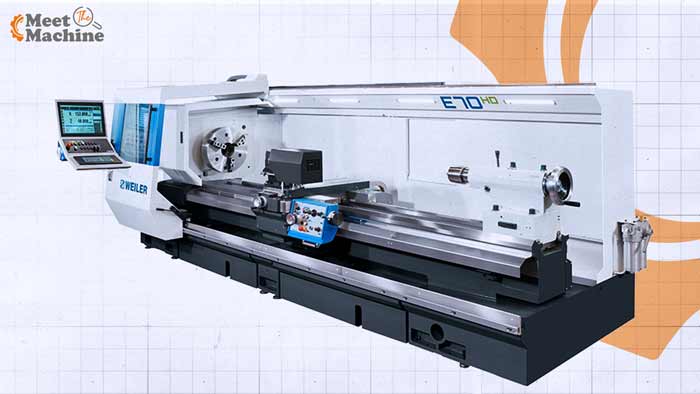
The Weiler E70 is a German-built flat-bed precision lathe that works two ways from the same controls: a machinist can crank it by hand like a conventional engine lathe, or teach it a cycle and let it run the cut on its own. Built by Weiler Werkzeugmaschinen in Emskirchen, Germany, the E70 pairs a heavy, rigid flat bed with center distances that run from roughly 80 inches out past 120 inches and a swing near 28 inches over the bed, which makes it a shaft-and-long-part machine. Cycle-controlled builds use Weiler's own teach control; later CNC builds run a Siemens 840D with Weiler teach software. It is the machine shops buy when the work is one-off, oversized, or too varied to justify a full production turning center, but too precise and too frequent to grind out by hand.
Most lathes make you choose. A manual engine lathe gives you feel and control for one-off work, but every part is only as repeatable as the hands turning the dials. A CNC turning center gives you repeatability, but it wants a program, a setup sheet, and enough volume to pay for the time it takes to get there. The shop that lives between those two worlds, running short runs of large or unusual parts, spends its life paying for the wrong machine one way or the other. The Weiler E70 was built for exactly that shop.
This is a working machinist's breakdown of the E70: where it comes from, how the teach-and-learn control actually changes the workflow, where it sits in Weiler's lineup, what U.S. parts and service look like on a German lathe in 2026, how it compares to the machines shops cross-shop against it, and what to check before you wire money for a used one. If you are weighing an E70 against a big engine lathe with a DRO or a full CNC flat-bed, this is the piece that tells you which problem each one actually solves.
Where the E70 Comes From
Weiler Werkzeugmaschinen builds lathes in Emskirchen, in Bavaria, and has done so for decades. In the German-speaking market Weiler is the name in conventional precision lathes, the builder that toolrooms, maintenance departments, universities, and jobbing shops reach for when they want a manual-capable lathe that holds a tight number. That reputation is the whole point of the brand. Weiler did not get there by chasing spindle counts or flashy control screens. It got there by building beds and headstocks that stay accurate under years of heavy, varied work.
The E series is the heart of that reputation. It is a family of flat-bed lathes designed around the idea that a machine can be a real conventional lathe and a cycle-controlled lathe at the same time, without forcing the operator to commit to one mode. The E70 sits toward the larger end of that family. It is the model shops choose when the parts get long and heavy: shafts, rolls, spindles, hydraulic rams, repair work on components that will not fit in the envelope of a compact machine. The flat bed is the signature. It is wider and more accessible than a slant bed, it takes heavy cuts without flexing, and it gives the operator room to work at the part the way a manual machinist expects to.
The Teach-and-Learn Control Is the Whole Story
The reason the E70 is worth a full profile is the control philosophy, not any single spec. Weiler calls it cycle control or teach-in, and what it means in practice is this: the operator can run the machine manually, exactly like an engine lathe, using the handwheels and the tool post to make a cut by feel. Then, when a feature needs to repeat, the operator can teach the machine that move and let it execute the cycle on its own. Turning a diameter, facing, cutting a taper, threading, a repeated shoulder, the machine remembers the sequence and runs it, while the operator stays in command of the parts that still want a human hand.
That changes the economics of small-batch work more than it sounds like it should. On a full CNC lathe, a run of three parts can cost more in programming and proving-out than the parts are worth. On a manual lathe, a run of thirty parts turns into thirty chances to be a thousandth off. The E70 lets a skilled machinist split the difference: set up and teach the moves once, then produce the batch with the repeatability of a cycle and the flexibility to intervene when the part calls for it. For a shop whose bread and butter is high-mix, low-volume turning, that is the difference between a machine that fits the work and a machine that fights it.
Cycle-controlled E70s use Weiler's own control. Later builds were offered as full CNC lathes running a Siemens Sinumerik 840D with Weiler's teach software layered on top, so the same machine can be programmed conventionally, taught at the handwheel, or run from code. When you shop a used E70, the control generation is one of the first things to pin down, because it drives both the workflow and the price.
A manual lathe is only as repeatable as the hands on it. A CNC lathe needs enough volume to pay for the program. The E70 was built for the shop that lives in the gap, where the run is too short to program and too precise to eyeball.
The Numbers That Matter
The E70 is a large-capacity flat-bed lathe, and the exact figures depend on the build and the center distance a given machine was ordered with. As an orientation, expect a swing over the bed in the neighborhood of 28 inches, a swing over the cross slide around 17 inches, and center height near 14 inches. Spindle bore runs up to roughly 6 inches on the larger builds, which is what lets the machine take pipe and hollow stock, not just solid bar. Center distances are where the range is widest: common builds run from about 80 inches between centers out past 120 inches, with longer beds available, because the whole reason to buy this size of machine is the long part. Main motor power lands in the 32 to 48 horsepower range depending on the build, enough to hog material off a large-diameter shaft without stalling.
None of those numbers are the headline on their own. Plenty of lathes swing 28 inches. What the E70 pairs with that capacity is the flat-bed rigidity and the manual-plus-cycle control, so the machine that can hold a shaft between centers over ten feet long is the same machine an operator can teach a repeatable cut to. That combination is rarer than the raw envelope suggests.
Where the E70 Sits in the Weiler Family
Weiler's E line scales by size. Smaller models in the family suit toolroom and maintenance work on shorter parts, and the numbers climb as the swing and bed grow. The E70 is the larger, heavier member built for long and heavy turning, with an E 70HD heavy-duty variant offered for the most demanding work. Alongside the cycle-controlled E series, Weiler also builds fully CNC flat-bed lathes, the V series and the DZ line among them, for shops that have crossed fully into programmed production. In the North American market, Weiler's representation has centered on the V series and E series.
Reading a used listing, the shorthand to watch for is the center distance and the control. An E70 tagged with a length like 2000 or 3000 is telling you the between-centers capacity in millimeters. A listing that names a Siemens 840D is a CNC build; one that names Weiler teach or cycle control is a conventional cycle machine. Both are E70s. They are different tools, and they price differently, so match the machine to the work before you fall in love with a photo.
The Problem It Was Designed Around
Think about the shop that keeps an E70 busy. It is not running ten thousand identical parts a month; a dedicated CNC turning center wins that job on cycle time. It is running a hydraulic cylinder repair today, a batch of six custom shafts tomorrow, a one-off roll for a paper mill next week, and a print that arrived an hour ago for a part that has to ship Friday. The common thread is variety and size, not volume. Every job is a little different, several of them are long, and almost none of them justify the setup overhead of full CNC.
That workflow punishes the wrong machine. Put that work on a pure CNC lathe and you spend the day programming and proving parts you will make three of. Put it on a pure manual lathe and you give up repeatability the moment a job needs more than a couple of identical pieces, and you tie up a skilled hand on every cut. The E70 was designed to absorb that whole mix on one machine: manual feel for the one-offs and the odd repairs, taught cycles for the short batches, and enough bed and power to handle the long, heavy parts that a compact machine cannot even chuck.
U.S. Parts and Service in 2026
The honest concern with any German lathe on a U.S. floor is support: who answers the phone when a control throws a fault or a spindle bearing needs to be sourced. On the E70 the answer got a lot better in recent years. Methods Machine Tools, one of the larger machine tool importers and service organizations in North America, began representing select Weiler products in North America effective January 1, 2022, and supports the E series with application engineering and service. There is also a Weiler North America presence in the market. That matters directly to a used buyer: a German machine with an established U.S. service and parts channel is a far safer purchase than an orphan brand with no domestic support, because parts availability and service coverage are what keep a machine earning after the sale.
It also shapes how you should think about older cycle-controlled machines versus newer Siemens 840D builds. The 840D is a widely supported control platform with a deep pool of technicians and parts, which is part of why CNC E70s command more money. Older Weiler-control machines are simpler and cheaper, but you want to confirm control-parts availability before you commit, the same as you would with any legacy control.
How the E70 Compares
Shops rarely cross-shop the E70 against another cycle lathe, because there are not many. More often the decision is between the E70 and one of three different answers to the same work: a big conventional engine lathe with a DRO, a full CNC flat-bed lathe, or another European heavy toolroom lathe. Here is how they line up.
| Machine |
Origin |
Control |
Distinctive Strength |
| Weiler E70 |
Germany |
Manual + cycle teach, or Siemens 840D CNC |
Manual feel and taught repeatability on one flat-bed machine, built for long, heavy parts |
| Conventional engine lathe + DRO |
Various |
Manual, digital readout |
Lowest cost and simplest to run, but no cycle repeatability |
| CNC flat-bed lathe |
Japan / Europe |
Full CNC |
Wins on volume and unattended running, needs programming and volume to pay off |
| European heavy toolroom lathe |
Germany |
Manual or cycle |
Comparable precision and heft, thinner U.S. support depending on brand |
The engine lathe with a DRO makes the cost argument: it is the cheapest way to turn a long part, and for a shop that only ever makes ones and twos by hand, it is often the right call. The full CNC flat-bed makes the volume argument: if the work is repeatable and steady, it will out-produce the E70 all day. The other European toolroom lathe makes the precision-and-heft argument, and on that count it can be a real peer. The E70 wins the order when the work is genuinely mixed, some one-off, some short-batch, most of it long or heavy, and the shop wants one operator and one machine to cover all of it without either programming everything or hand-turning everything. It also wins when U.S. support is a deciding factor, because the Methods service channel gives it an edge over thinner-supported European brands.
Used-Market Pricing
The E70 holds value for the same reasons it earns its keep: German build quality, a heavy rigid bed that stays accurate, and a control approach that keeps the machine useful across a wide range of work. It does not become obsolete the way a niche production machine can, because the jobbing and repair work it does never goes away. The following ranges are orientation from current secondary-market activity, not quotes, and configuration, center distance, control generation, hours, and condition move the number more than year alone. Dealer listings are frequently request-price rather than posted.
- Older cycle-controlled builds, 1990s to 2000s, with Weiler control: often close to $35,000 to $60,000, depending on center distance and options.
- Later CNC builds running Siemens 840D, 2010s and newer: often close to $75,000 to $130,000 and up, depending on length, tooling, and condition.
- Long-bed and heavy-duty E 70HD configurations carry a premium over standard builds because the capacity is harder to replace.
The control generation is the single biggest swing on price. A Siemens 840D machine costs more up front but is easier to support and to sell later. An older Weiler-control machine is a value buy for a shop that wants the flat-bed capacity and does not need CNC programming, as long as control parts check out.
What to Check When Buying a Used E70
These are the checks that matter on a large flat-bed lathe, the same ones a proper inspection covers before a machine changes hands.
Bed wear near the headstock. The heaviest cutting and the most travel happen close to the chuck, so that is where the ways wear first. Check for a step or ridge at the headstock end and confirm the carriage is not loose over the worn section.
Spindle runout and bearing condition. Indicate the spindle for runout and listen and feel for bearing noise or heat at speed. On a large-bore spindle, bearing replacement is a serious expense, so this is a make-or-break check.
Control generation and parts availability. Confirm whether it is a Weiler cycle control or a Siemens 840D, and verify that control boards, drives, and the operator interface can still be sourced. A dead control on an orphaned build can total an otherwise good machine.
Tailstock alignment and wear. On a long-bed machine the tailstock does real work supporting shafts. Check that it aligns to the spindle centerline, locks solidly, and that the quill is not worn or leaking.
Leadscrew and feed condition. Backlash in the cross slide and compound tells you about wear and about how repeatable the taught cycles will actually be. Test power feeds and threading in every axis.
Way covers and lubrication. Confirm the automatic lubrication system works and that the ways have been kept oiled. A machine that ran dry wears in a hurry, and the evidence shows in the ways.
Chuck, steady rest, and follow rest. Long-part work leans on steadies and follow rests. Confirm what tooling comes with the machine, because these accessories are expensive and slow to source separately.
Teach-and-learn functions under power. Do not accept "it works" on the cycle control. Teach a simple cycle and run it. Confirm the machine records, repeats, and holds the moves the way the seller claims.
Coolant and chip handling. Check the coolant system for leaks and pump condition, and look at how chips clear on a flat bed running long stock.
Foundation and leveling history. A machine this size needs to sit level and stable. Ask how it was installed and whether it has been releveled, because a lathe that turned a taper into its own bed will keep doing it until it is corrected.
Who Actually Runs Them
The E70 lives in the shops where variety and size are the norm. Machine and equipment repair shops use it to turn worn shafts, rebuild hydraulic cylinders, and remake components for machinery that is long out of production. Contract job shops use it for short runs of large custom parts that would clog a CNC turning center's schedule. Maintenance departments in paper, steel, mining, and heavy industry keep one to make and repair rolls, spindles, and rams without waiting weeks on an outside vendor. Universities and training programs value the E70 because it teaches conventional turning and cycle work on the same machine. What they all share is a workload that is too varied and too large-part for pure production CNC, and too frequent and too precise for a bare manual lathe.
Resell CNC Take
We like the E70 for the buyer who knows exactly what it is and is not. It will not out-produce a modern CNC turning center on a long steady run, and it is not trying to. What it does is let one skilled operator cover a floor's worth of mixed long-part work on a single rigid machine, with real German precision and, now, a real U.S. service channel behind it. The two things we tell every buyer to nail down before they wire money are the control generation and the bed wear near the headstock. Get those right and an E70 will earn for a very long time.
Frequently Asked Questions
What is the Weiler E70?
The Weiler E70 is a German-built flat-bed precision lathe that runs both as a conventional manual engine lathe and as a cycle-controlled machine that can be taught to repeat a cut. Built by Weiler in Emskirchen, Germany, it pairs a heavy rigid bed with center distances from roughly 80 inches out past 120 inches and a swing near 28 inches, which makes it a long-part and shaft machine for high-mix, low-volume turning.
Is the E70 a CNC lathe or a manual lathe?
It can be either. Cycle-controlled E70s run manually with a teach-in control for repeatable cycles. Later builds were offered as full CNC lathes with a Siemens Sinumerik 840D and Weiler teach software, so the same platform can be run by hand, taught at the handwheel, or programmed. Confirm which control a given used machine has before you buy, because it drives both the workflow and the price.
Can you still get parts and service for a Weiler in the United States?
Yes. Methods Machine Tools began representing select Weiler products in North America effective January 1, 2022, and supports the E series with service and application engineering, and there is a Weiler North America presence as well. Siemens 840D control parts are widely supported. On older Weiler-control machines, confirm control-parts availability before committing.
What size parts can an E70 handle?
Figures vary by build, but expect a swing near 28 inches over the bed, center distances from about 80 inches out past 120 inches, and a spindle bore up to roughly 6 inches on larger builds, which allows pipe and hollow stock. It is sized for long, heavy work such as shafts, rolls, spindles, and hydraulic rams.
What should I inspect on a used E70?
Prioritize bed wear near the headstock, spindle runout and bearing condition, the control generation and its parts availability, tailstock alignment, leadscrew and feed backlash, and the teach-and-learn functions run under power. Confirm included tooling like steady and follow rests, since those are expensive to source separately.
How much does a used Weiler E70 cost?
As orientation, older cycle-controlled builds often land close to $35,000 to $60,000, while later Siemens 840D CNC builds often run close to $75,000 to $130,000 and up, depending on center distance, tooling, hours, and condition. Dealer listings are frequently request-price. Control generation is the biggest single factor in the number.
Shopping for a Lathe?
See what we have on the floor.
Every machine we sell is backed by a team with 200+ years of combined industry experience and four AMEA and CEA certified equipment appraisers on staff. Browse our used Weiler inventory.
See Used Weiler Machines
About the Author
Bill Murphy is the Marketing and Content Lead at Resell CNC, covering used machine tools, the brands behind them, and the history of the trade.
About Resell CNC
Resell CNC has bought and sold used CNC machinery since 2008. Based in Maitland, Florida, with warehouses in Winter Springs and Longwood, the team brings more than 200 years of combined industry experience and four AMEA and CEA certified equipment appraisers on staff. Resell CNC has been an MDNA member since 2009 and is the only used CNC dealer in North America with Official Mazak Trade-In Center status.
Sources
- Weiler Werkzeugmaschinen GmbH, company and product information, weiler.de
- Methods Machine Tools, Weiler partnership announcement, effective January 1, 2022
- Modern Machine Shop, coverage of the Methods and Weiler North America partnership
- Weiler E70 used-machine listings, Machinio and Great American Equipment Company