CNC Family Breakdown
DMG MORI CLX: The Value Line Is Not Priced Like One
What is the DMG MORI CLX?
The CLX is DMG MORI's value line of universal turning centers, introduced in 2016 to replace the entry-level EcoTurn machines. It is four turret models, the CLX 350, 450, 550 and 750, each sold in four version codes from V1 turning to V6 with a counter spindle, plus two B-axis turn-mill models, the CLX 450 TC and CLX 550 TC. The four turret machines are built in Poland and Italy rather than Japan, and they run linear guideways rather than the box ways of the Japanese-built NLX. The CLX 550 and CLX 750 have been discontinued, and every used CLX turret machine carries a Siemens 840D solutionline or Fanuc iSeries control whose panel hardware has now entered spare-parts-only status.
The DMG MORI CLX is sold as the value line, and on a new-machine quote it is. On the used market that relationship stops holding. In the one matched pair we could find it runs the other way: a 2019 CLX 350 asking 116,910 dollars against a same-year NLX 2500/700, a full chuck class larger, asking 109,500. Two asking prices, hours unstated on both, in two countries.
That is one pair, and we will hold it to that. But it is not an isolated oddity, it is what a market with no transaction feedback looks like. There are zero published auction results for any CLX variant, anywhere, and the five CLX asking prices we could find come from three sources, because one dealer supplied three of them.
This breakdown covers all six models and the version codes that decide what each one can do, what the number does and does not encode, the specs that go backwards as you add capability, how a CLX actually compares to an NLX of the same chuck class, and the dated control problem that sits under every used example.
The roster is six machines in two families
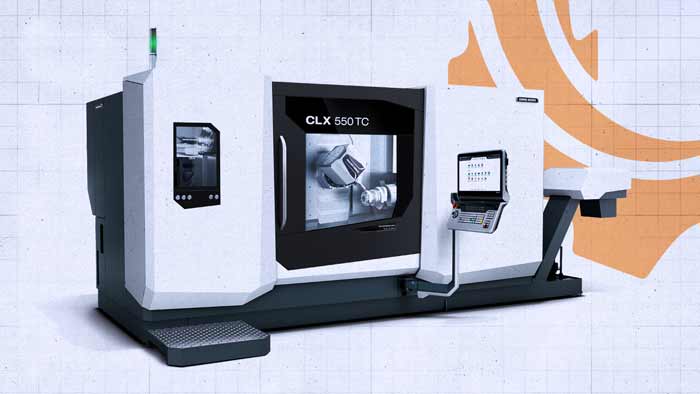
The CLX badge covers two architectures that have almost nothing in common. Four universal turning machines with a 12-station VDI turret, and two turn-mill machines where the turret is gone entirely, replaced by a swivelling B-axis carrying a compactMASTER spindle fed from a tool magazine.
| Model |
Family |
Launched |
Status as of Sept 2026 |
| CLX 350 |
Universal, 12 x VDI 30 |
February 2017 |
Listed, but see the conflict below |
| CLX 450 |
Universal, 12 x VDI 40 |
September 2016 |
Current |
| CLX 550 |
Universal, 12 x VDI 40 |
September 2017 |
Discontinued |
| CLX 750 |
Universal, 12 x VDI 50 |
2019 |
Discontinued |
| CLX 450 TC |
Turn-mill, B-axis |
February 2021 |
Current |
| CLX 550 TC |
Turn-mill, B-axis |
2024 |
Current, none used yet |
DMG MORI's live turning index now lists exactly four: the CLX 350, CLX 450, CLX 450 TC and CLX 550 TC. On the regional sites we checked, requests for the CLX 550 or the CLX 750 product page land on the CLX series overview, which lists only the 350 and the 450, and the United States path for the CLX 750 returns a 404 outright. Neither discontinuation was ever announced, so the roster page is the only notice you get.
Designations that do not exist. There is no CLX 320 and no CLX 400: those are the max turning diameters of the 350 and the 450, routinely mistaken for model numbers. There is no CLX 650, no CLX 350 TC, and no CLX alpha, beta or gamma, because the Greek letters belong to CTX. A CLX 2500 was reported by trade press ahead of JIMTOF 2016 and never existed; the likeliest explanation is a confusion with the Japanese-built NLX 2500 or with the CTX 2500. And CLX has no long-bed suffix. There is no CLX equivalent of the NLX /700 and /1250 or the CTX gamma 1250, 2000 and 3000. Length is stepped by the model number instead.
The V-number is the machine, and the ladder is rigid
Every universal CLX was ordered as one of four version codes, and unusually for this class, DMG MORI defines them in print in the CLX catalogue rather than leaving them to trade convention.
| Code |
What you get |
What it costs you |
| V1 |
Turning only. No driven tools, no Y, tailstock machine. |
Nothing, this is the base |
| V3 |
Turning plus driven tools in the turret. |
Turning diameter on some models |
| V4 |
Adds the Y-axis. Keeps the tailstock. |
Turning diameter, and X travel on the TC comparison |
| V6 |
Adds a counter spindle in place of the tailstock. |
X travel, Z travel, turret size and driven-tool speed |
There is no V2 and no V5. More usefully, the ladder is cumulative and strictly ordered. You cannot buy a Y-axis without driven tooling, and you cannot buy a counter spindle without both, at least as the catalogue prints it. Note that DMG MORI's current product pages present the Y-axis and the counter spindle as separate features without the version codes at all, so the test below is only as strong as the catalogue it comes from.
The free verification test
Because the ladder is ordered, a CLX with a sub-spindle always also has a Y-axis and driven tools. Any listing advertising a sub-spindle but no Y-axis is either wrong about the machine or is not describing a CLX at all. That takes ten seconds and it catches a real error class.
The number is a size class, and four rows prove it
The dealer shorthand is that the CLX number is the chuck or the swing. It is neither, and the brochure disproves it without any interpretation required.
| Spec |
CLX 350 |
CLX 450 |
CLX 550 |
CLX 750 |
| Nominal chuck |
210 mm |
250 mm |
250 mm |
315 / 400 / 620 mm |
| Swing over bed |
580 mm |
700 mm |
700 mm |
950 mm |
| Max turning diameter |
320 mm |
400 mm |
480 mm, 425 with Y |
700 / 640 mm |
| Max turning length |
530 mm |
800 mm |
1,225 mm |
1,290 mm |
It is not chuck size. The CLX 450 and CLX 550 take the same chuck range, and the catalogue reading we could confirm gives both a nominal 250 mm. Two model numbers, one chuck class. And the CLX 350's chuck is 210 mm, nowhere near 350.
It is not swing over bed. The same pair shares 700 mm. The 550 is the long-bed, higher-torque configuration of the same casting class, not a bigger machine in cross-section.
It is not max turning diameter. The 550 turns 480, not 550. The 350 turns 320. The 750 turns 700. Across the four turret machines the number overstates turning diameter every time, and not by a constant offset. The two TC models do not follow even that rule: the CLX 550 TC takes a workpiece of exactly 550 mm, while the CLX 450 TC turns 400.
And it does not survive crossing into CTX. A CLX 450 turns 400 mm; a CTX 450 turns 480 mm, and takes an optional spindle to 102 mm of bar where the CLX 450 stops at 80. A CLX 750 turns 1,290 mm long; a CTX 750 turns 2,040 mm. The same number, 750 mm more length. A CLX 450 is closer to a CTX 350 and a half than to a CTX 450.
One honest caveat: DMG MORI publishes no explanation of CLX numbering anywhere we could find. Not on any regional page, not in the catalogue, not in a press release. The reading above is inference from spec tables, not a statement of intent from the manufacturer.
The spec ladder, all four turret machines
Figures from CLX catalogue publication code P20180752_0819_EN, August 2019. Values in brackets are the V6 counter-spindle configuration, except on the turning diameter row where they are the figure with the Y-axis fitted.
| Spec |
CLX 350 |
CLX 450 |
CLX 550 |
CLX 750 |
| Bar capacity |
65 mm |
80 mm |
80 mm (102 opt) |
127 mm, part length standard |
| Spindle nose |
A2-6 |
A2-8 |
A2-8 |
A2-11 |
| Max spindle speed |
5,000 rpm |
4,000 rpm |
3,250 rpm |
2,000 rpm |
| Spindle power 40 / 100 pct |
16.5 / 11 kW |
25.5 / 17 kW |
33 / 22 kW |
46 / 36.8 kW |
| Max torque 40 / 100 pct |
168 / 112 Nm |
426 / 283 Nm |
630 / 420 Nm |
2,000 / 1,600 Nm |
| Max turning diameter |
320 mm |
400 mm (315 with Y) |
480 mm (425 with Y) |
700 (V1/V3) / 640 (V4/V6) |
| Max turning length |
530 mm |
800 mm |
1,225 mm |
1,290 mm |
| X travel |
242.5 mm (185) |
271 to 276 mm |
307.5 mm |
435 mm |
| Y travel |
plus or minus 40 mm |
plus or minus 60 mm |
plus or minus 60 mm |
plus or minus 80 mm |
| Z travel |
540 mm (465) |
830 mm (755) |
1,240 mm |
1,300 mm |
| Rapids X / Y / Z |
30 / 22.5 / 36 m/min |
30 / 22.5 / 30 |
30 / 22.5 / 30 |
30 / 22.5 / 30 |
| Turret |
12 x VDI 30 |
12 x VDI 40 or 6 x BT |
12 x VDI 40 or 6 x BT |
12 x VDI 50 or 6 x BT (VDI 40 on V6) |
| Driven-tool speed |
5,500 rpm (5,000) |
4,000 rpm |
4,000 rpm |
4,000 rpm |
| Driven-tool torque |
20 Nm |
20 Nm |
20 Nm |
85 Nm |
| Tailstock stroke |
550 mm |
800 mm |
1,200 mm |
1,200 mm |
| Weight, no conveyor |
4,200 kg |
5,900 kg |
7,200 kg |
10,000 kg |
| Footprint |
4.9 sq m |
6.3 sq m |
7.4 sq m |
8.9 sq m |
Construction across all four: a 45 degree inclined cast iron bed with linear guideways, and a four-guideway design that lets the tailstock move without collision. That single line, linear guideways, is what separates a CLX from an NLX more cleanly than any number does. On ballscrews, be careful what you carry across models: DMG MORI states an IT 1 tolerance class in its February 2017 CLX 350 launch release, but the 2019 catalogue publishes only diameter and pitch, 32 by 10 mm on the 350, 40 by 10 on the 450 and 550 and 50 by 10 on the 750, and no accuracy class for any model.
Eleven specs that go the wrong way
1. The counter spindle costs 24 percent of your X travel on the CLX 350. X drops from 242.5 mm to 185 mm on V6. That is the harshest trade in the range, and the V6 loses Z as well, 540 down to 465 mm.
2. It costs 75 mm of Z on the CLX 450 too. 830 mm down to 755 mm on V6. A buyer sizing a shaft job off the headline 830 and then ordering a counter spindle is 75 mm short.
3. The Y-axis costs turning diameter on the CLX 450 and the CLX 550, and it is not optional. On the CLX 450, DMG MORI's own Famot release states a turning diameter with the Y-axis of 315 mm against the 400 mm headline, an 85 mm loss, and an earlier brochure prints the same pair. On the CLX 550 the catalogue prints 480 and 425 with a footnote reading V4 version with Y axis, so that 55 mm comes off too. A CLX 450 V4 or V6 is a 315 mm machine and a CLX 550 V4 or V6 is a 425 mm machine. Neither reduction is something a buyer can decline, and listings almost universally quote the headline.
4. The Y-axis costs 60 mm of turning diameter on the CLX 750. 700 mm on V1 and V3, 640 mm on V4 and V6. Stated by the brochure and by two separate DMG MORI press sources, which makes it the cleanest manufacturer-confirmed trade in the family.
5. The counter spindle costs you the turret size on the CLX 750. The base machine is 12 x VDI 50. The V6 is 12 x VDI 40. Less holder rigidity on the heaviest machine in the range, and an existing VDI 50 tool inventory will not fit a CLX 750 V6.
6. Buying a bigger CLX makes your milling slower. Driven tools run 5,500 rpm on the CLX 350 and 4,000 rpm on the 450, 550 and 750. The smallest machine has the fastest driven tools. Stepping up one size for part capacity costs 1,500 rpm, and small-diameter drilling is exactly where that hurts.
7. Buying a bigger CLX makes your turning much slower. 5,000 down to 4,000 down to 3,250 down to 2,000 rpm across the range. Expected for the size class, but the CLX 750 at 2,000 rpm is low enough that small-diameter finishing on it is genuinely compromised.
8. The headline turning diameters are not the factory's recommended working figures. The catalogue carries a separate recommended footnote: 250 mm on the CLX 350 against a 320 headline, and 300 mm on the CLX 450 against 400. That is 78 percent on the 350 and 75 percent on the 450. Keep both distinct from the Y-axis reductions above, which are a separate footnote, and on the CLX 450 come from a different document entirely. Nearly every used listing quotes the headline and none of them mention either figure.
9. Y is the slowest axis on every CLX. Rapids are 30 m/min in X and 30 to 36 in Z, but 22.5 m/min in Y on all four models. Y-heavy milling programs lose cycle time everywhere, not in one place.
10. The CLX 750 barely turns longer than the CLX 550. 1,290 mm against 1,225 mm. Sixty-five millimetres, for a machine 2,800 kg heavier and 1.5 square metres larger. The 750 buys diameter, torque and workpiece weight, not length. Anyone buying one for shaft length wants a CTX 750, which turns 2,040 mm.
11. The TC gives up almost all of its programmable tailstock range. A universal CLX 450 has an 800 mm tailstock stroke. The CLX 450 TC has 102.5 mm of hydraulic quill stroke against 1,100 mm of turning length, so the tailstock body has to be repositioned at setup. For long-shaft work in varied lengths, the cheaper universal machine is the more productive tool.
Two undated spec revisions, and why you measure instead of spec-sheet
Early CLX 350s may pass 51 mm bar, not 65. At launch in February 2017 DMG MORI stated 51 mm standard with 65 mm optional, corroborated by trade press and by the earlier brochure. The 2019 catalogue and the current product page both list 65 mm flat. A used early machine may be a 51 mm bar machine. Verify against the machine's own data sheet, never against today's web page.
Early CLX machines may have no direct measuring system on X and Y. The 2019 catalogue's wording is precise and revealing: all CLX machines are now equipped with a direct measuring system on X and Y as standard. The word "now" means it previously was not. For a used buyer that is a positioning-accuracy and thermal-drift difference between an early machine and a 2019-or-later one. The exact cut-over is not published, so it is a question to put to DMG MORI service with the machine number in hand.
There is also a broader, undated revision we are not going to resolve for you. Comparing an earlier CLX brochure against the 2019 catalogue, the CLX 450's Z travel reads 600 mm in one and 830 mm in the other, its tailstock travel 500 mm against 800 mm, and its weight roughly 4,950 kg against 5,900 kg. Those are not rounding differences. Either the CLX 450 was substantially revised mid-life, or one document restates the table differently. Measure a used CLX 450. Do not spec-sheet it.
CLX 450 against NLX 2500, at the same chuck size
This is the comparison that decides most CLX purchases, and the gap is wider than the badge suggests. Both are 10-inch chuck class machines.
| Spec |
CLX 450 |
NLX 2500 2nd Generation |
| Built in |
Poland or Italy |
Japan |
| Guideways |
Linear guideways |
Slideways, box ways |
| Bar capacity |
80 mm |
105 mm |
| Max spindle speed |
4,000 rpm |
5,000 rpm on the 10 inch |
| Max torque |
426 Nm |
843 Nm on the 10 inch, 1,273 on the 12 |
| Turret |
12 x VDI 40, gear driven |
BMT built-in motor turret, up to 20 stations |
| Driven-tool speed |
4,000 rpm |
12,000 rpm high speed |
| Driven-tool torque |
20 Nm |
86 to 100 Nm |
| Y travel |
plus or minus 60 mm |
plus or minus 60 mm |
| Bed length options |
None |
/700 and /1250 |
| Spindle warranty, new |
Not published |
36 months, unlimited spindle hours |
Three gaps do the work. Torque is roughly double in the NLX's favour at the same chuck size, and nearly triple with the 12-inch spindle. Driven-tool torque is four to five times higher, with three times the speed and up to eight more stations. And the way systems are different in kind: linear rails against box ways, which is a damping and heavy-cut decision, not a price one.
What the CLX genuinely gives back: slightly more X and Z travel than an NLX /700, a smaller footprint, and a lower price level. That last one is DMG MORI's own positioning, not ours. Launching the CTX 350 the company described it as combining the price level of the CLX series with CTX alpha performance, which tells you exactly where CLX sits in its maker's own mind.
One thing to treat with suspicion in a listing: we found no DMG MORI source offering MAPPS on a CLX. A trade-press launch report claimed MAPPS IV as a CLX control option and no manufacturer material supports it. Every DMG MORI source says Siemens 840D solutionline or Fanuc iSeries. The same report claimed a Heidenhain TNC 620 option, which we could not verify on any CLX either and which most likely belongs to the CMX milling machines announced alongside.
What CLX replaced, and what has quietly replaced CLX
CLX and CMX replaced the entry-level EcoTurn and EcoMill machines from around September 2016. That matters on the used market for one practical reason: an EcoTurn 450 is the CLX 450's direct predecessor, and it is one of the two machines most often mislabelled as a CLX.
Going the other way, DMG MORI has been unwinding the line. In January 2023 the CTX 350 launched as an explicit replacement for the CLX 350 and the CTX alpha 500. In September 2023 the CTX 450 and CTX 550 arrived in what DMG MORI called the premium segment of universal turning, and the CTX 550's work envelope, 480 mm by 1,225 mm on 102 mm bar, is identical to the discontinued CLX 550's with a much stronger drivetrain behind it.
One conflict we cannot resolve. DMG MORI said in 2023 that the CTX 350 replaces the CLX 350, yet the CLX 350 still sits on the live turning index with a full spec page as of this writing. One of the two is stale, or the CLX 350 continued in some regions after the CTX 350 launched. We are reporting it rather than picking.
The control is the dated risk, and it has calendar dates
Every used CLX universal turning machine we could document runs either Siemens SINUMERIK 840D solutionline or Fanuc iSeries on a 19 inch panel, while current CLX machines ship SINUMERIK ONE with CELOS X on a 24 inch panel instead. That is a hardware and software generation boundary rather than a version bump. DMG MORI does not publish the date of the changeover on the universal CLX, so treat the boundary as real but undated, and confirm which generation a specific machine carries from the machine itself.
The Fanuc option was only added at EMO in September 2017, and those machines were built at Tortona in Italy rather than Pleszew in Poland. So a pre-September-2017 CLX is a Siemens machine, and a Fanuc CLX has a different plant and a different parts history behind it.
The part that has actual dates on it: Siemens has begun retiring the 840D sl. More than 650 assemblies moved to spare-parts-only status on 1 October 2024, including four NCU models, and 42 further panel and HMI items on 1 October 2025, including the OP 010, 012, 015A and 022 operator panels and the MCP 466C-M and MCP 458-IE-T machine control panels. Siemens' nominal commitment runs about ten years from that status change, to roughly 2034, but the notice is explicit that this is stock-dependent and that low-value accessories can go end-of-life early.
Do this before you price it
Photograph and write down the NCU, PCU and operator-panel part numbers off the electrical cabinet of any CLX you inspect, then check each one against Siemens lifecycle status. A panel already at end-of-life is a dated liability with a real number attached, and not one CLX listing we read during this research mentions the control generation at all.
Assume no retrofit path across the SINUMERIK ONE boundary until DMG MORI service confirms one in writing. CELOS X apps and 3D shopfloor programming are not coming to an 840D sl machine.
There is almost no used market, and what there is misprices itself
We are not going to build a price band for this family, because there is nothing honest to build one from, and the reasons are more useful to you than a band would be.
Supply is roughly 20 to 25 distinct machines worldwide after de-duplication, and under a dozen in every individual model. The CLX 450 is the deepest at nine to eleven units, the CLX 350 next at five or six, and the discontinued 550 and 750 barely register at one or two each. No used CLX 550 TC exists anywhere, which is expected given a 2024 unveiling.
The number that matters most to an American buyer: we could place zero currently offered CLX 350 or CLX 450 in North America. The only US-located machines in the whole family were CLX 450 TCs, and of those, two were already sold. Domestic supply of this family is effectively one near-new turn-mill machine.
There are no auction results. Not thin, none. We searched the major US auction houses and aggregators, the European platforms including one named for CNC auctions, and the liquidator archives, and found no published hammer price for any CLX variant. Two European auction listings, a 2019 CLX 350 V6 with a gantry loader and a 2017 CLX 450 V4, both now read that the offer has ended with no bid history and no result. They ended unresolved as price signals.
And the asking prices contradict each other. One dealer listed three 2017 CLX 350s: 9,301 hours at 65,749 euros, 3,895 hours at 70,611 euros, and 2,778 hours with a bar feeder at 56,026 euros. Price moves inversely to condition and inversely to included automation. Separately, a 2023 CLX 350 with 750 hours asks 78,000 euros while that 2017 with 9,301 hours asks 65,749. Six years and 8,500 hours compress into about 12,000 euros.
That is not noise to average out. It is what a model with no transaction feedback looks like. For comparison, one marketplace we surveyed carried over 700 used Haas lathe listings against a single CLX, and while listings are asking prices rather than sales, a seller pricing into a pool that deep gets corrected by the market in a way that a seller with the only CLX on the platform never does.
Duplication is severe and we can show it. One 2018 CLX 350 V4 in central Europe appeared five times, including three entries on a single platform quoting 5,080, 5,080 and 5,500 hours for the same machine. One North American CLX 450 TC appeared across four separate URLs. Assume any two CLX listings you find are the same machine until you prove otherwise, and resolve hours and year from the serial plate rather than the advert.
Five listing errors we found on real CLX adverts
A 42-slot tool magazine on a machine with no magazine. A 2023 CLX 350 V3 was described on two separate platforms as having 42 tool stations. The CLX 350 has a 12-station VDI 30 turret and no magazine at all. The error propagated with the listing.
Thirteen holders in a twelve-station turret. A CLX 450 listing claimed 13 rotary tool holders. Physically impossible as described.
A three-axis lathe with a Y-axis. A CLX 450 V4 was headlined as a three-axis turning machine while the same page listed Y travel of plus or minus 60 mm. By DMG MORI's own code, V4 means turning plus milling plus Y.
A CLX 750 carrying an internal part number for a CLX 550. On the dealer's own product page. Model identity confusion at the source.
A CTX served under a CLX web address. One marketplace URL containing the words CLX 450 TC returned a page for a 2009 CTX beta 800 V4. That platform recycles listing addresses, so a search-indexed URL is not evidence that the machine in the address ever existed there.
The year screen, and what an old CLX actually is
Launch dates give you a hard identity test that needs no expertise at all.
| Model |
First shown |
Any listing older than this is not a CLX |
| CLX 450 |
15 September 2016, AMB |
2015 or earlier |
| CLX 350 |
February 2017 |
2016 or earlier |
| CLX 550 |
September 2017, EMO |
2017 or earlier |
| CLX 750 |
2019, EMO |
2018 or earlier |
| CLX 450 TC |
3 February 2021 |
2020 or earlier |
| CLX 550 TC |
2024, AMB Stuttgart |
Any used example at all |
The observed used population matches that calendar cleanly, which is a good sign for data quality: no CLX 350 earlier than 2017, no CLX 750 earlier than 2021 despite a 2019 launch. The most likely true identity of a too-old CLX is a CTX, which shares the letter pattern and the 840D control. Second most likely is the EcoTurn 450 or a NEF.
What to check on a used one
The control, before anything mechanical. This is the reversal of normal advice and it is deliberate. Part numbers off the cabinet, checked against Siemens lifecycle status. On this family the electronics have a published expiry conversation and the iron does not.
Which version code the machine actually is. Do not accept V4 or V6 off the advert; listings misuse the codes constantly. Confirm the Y-axis physically exists and positions repeatably, and confirm whether the tailstock or a counter spindle occupies the far end.
Turning diameter, measured, not quoted. If the machine has a Y-axis, the working turning diameter is 315 mm on a CLX 450, not 400, and 640 mm on a CLX 750, not 700. Check the swing against your actual largest part.
All twelve turret stations, indexed hot and cold. Index repeatability, clamp force, and hydraulic integrity. VDI 30 on the 350, VDI 40 on the 450 and 550, VDI 50 on the 750 except the V6, which drops to VDI 40. Confirm the interface before you assume your holders fit.
The spindle, understanding what a failure costs. The main spindle is an integrated motor spindle on three bearings and the counter spindle is an ISM-series motor spindle with active cooling. There is no belt and no gearbox to inspect, which sounds like good news and is actually the risk: a failure is a motor-spindle exchange, not a bearing swap on a cheap cartridge. Run cold and hot runout, watch growth and vibration, and check the cooling circuit.
Direct measuring on X and Y, present or absent. Standard from some point around 2019 and not before. Ask DMG MORI service with the machine number rather than guessing from the year.
Driven tool orientation and the tool library. One CLX 450 owner documented that axially mounted holders needed a counter-clockwise command to turn clockwise, because the holder gearing reverses direction. That was a tool-library and post-processor matter, correctly resolved by the CAM vendor, and not a machine fault. But on a used machine with no documentation it is a real commissioning cost. Find out which holders come with it.
The parameter backup and the ladder, on media, before the machine moves. The control is a genuine Siemens or Fanuc, but the PMC ladder, the parameter set and the machine data are the builder's. That is the part you cannot buy anywhere else.
What we could not find, and you should know we looked. There is no CLX-specific failure literature in public. No manufacturer service bulletin, no rebuilder case study on a CLX, and no CLX thread on any machinist forum we could reach. The one independent North American service firm that lists CLX 350, 450 and 550 coverage documents its actual DMG MORI turning failures on NLX, CTX and NTX machines instead. That cuts both ways: you are not locked to the OEM for service, but nobody has a CLX track record to hand you either.
Where it is built, and what that means for parts
The CLX catalogue states it plainly: the series is produced at DMG MORI's Graziano plant in Tortona, Italy and its Famot plant in Pleszew, Poland. Pleszew is the larger of the two for this line, a site DMG MORI describes as the biggest machine tool factory in Poland at over 58,000 square metres and up to 2,000 finished machines a year. Fanuc-control CLX machines came from Tortona.
So the CLX is a European-built value machine with a global parts network behind it, which is a materially different proposition from the Japanese-built NLX. DMG MORI claims more than 200 field service technicians in North America, a 24/7 hotline, and a North American parts stock in Dallas, along with in-region spindle rebuild capability in Davis, California. We could not independently verify any of those figures, and no guaranteed parts-availability window after end of production is published for the CLX or for anything else.
DMG MORI does not state where the two TC models are built. The catalogue statement above covers the four universal turning machines. The Pleszew site page names CLX turning centres among its products; no DMG MORI page we could reach names a build plant for the CLX 450 TC or CLX 550 TC at all. Since plant of origin affects parts logistics, lead time and resale, settle it per machine from the serial number rather than by assumption.
One genuine blank worth naming: we found no documented complaint that CLX parts or support are worse than the Japanese lines. That is an absence of evidence, not a clean bill of health. The forum where such reports would live blocked us.
Advice that costs us the sale
If you are shopping the CLX because it is the value line, check the price against the alternatives before you get attached. On the numbers we could observe, a 2019 CLX 350 asked 116,910 dollars. That is above a 2022 Haas ST-25Y or ST-35Y at 109,900, well above a 2022 Okuma GENOS L2000E at 91,500, roughly level with a 2022 Doosan Lynx 2100LMSB at 120,000, and above a same-year NLX 2500/700 a full chuck class larger at 109,500. It is one data point per comparison, and we are telling you that plainly, but the direction is consistent and it is not the direction the new-machine ladder predicts.
And if you are in North America, understand what you are shopping. There is currently no domestic used supply of the CLX 350 or CLX 450. Importing means freight, duty, commissioning and a control whose panel hardware is already in spare-parts-only status, against a machine whose asking price is not discounted for any of that.
Where a used CLX does make sense. A V1 or V4 with a tailstock, bought right, is a well-built European lathe on linear rails with a small footprint and a live service network, and the CLX 350 has the fastest driven tooling in its own family. If you already run Siemens 840D and have the shop knowledge, a low-hour CLX at a sensible number is a sound machine. The problem is not the iron. It is that this market has no mechanism to tell you what a sensible number is.
If you want a DMG MORI turning family with real transaction depth and real failure history behind it, the NLX 2500 and the CTX line both have what the CLX has not accumulated yet.
Resell CNC Take
We appraise machines for a living, and the CLX is the plainest example we have run into of a market that cannot price itself. The iron is fine. It is a European-built lathe on linear rails with a rigid cast bed and a real service network behind it.
What is not fine is the information around it. Twenty-odd machines worldwide, no auction results anywhere, asking prices that move backwards against hours, and a control generation with published retirement dates. If somebody brings us a CLX to appraise, the first two things we look at are the version code and the panel part numbers, in that order, and neither of them is in the advert.
Frequently asked questions
How many DMG MORI CLX models are there?
Six, in two families that share nothing but the badge. The universal turning machines are the CLX 350, CLX 450, CLX 550 and CLX 750, each sold in four version codes: V1 turning, V3 turning plus milling, V4 adding a Y-axis, V6 adding a counter spindle. The turn-mill machines are the CLX 450 TC and CLX 550 TC, which replace the turret with a swivelling B-axis and a tool magazine. As of September 2026 DMG MORI lists only the CLX 350, CLX 450, CLX 450 TC and CLX 550 TC. The CLX 550 and CLX 750 are gone from the roster. There is no CLX 320, no CLX 400, no CLX 350 TC and no CLX 2500.
What do V1, V3, V4 and V6 mean on a DMG MORI CLX?
They are the capability ladder, and DMG MORI defines them in print in the CLX catalogue. V1 is turning only. V3 adds driven tools in the turret. V4 adds a Y-axis. V6 adds a counter spindle in place of the tailstock. The ladder is cumulative and strictly ordered, which is unusual: you cannot buy a Y-axis without driven tooling, and you cannot buy a counter spindle without both. That gives you a free verification test. Any listing advertising a CLX with a sub-spindle but no Y-axis is either wrong about the machine or is not describing a CLX. There is no V2 and no V5. One caveat: the ladder is how the catalogue prints it, and DMG MORI's current product pages list the Y-axis and the counter spindle as separate features without the codes, so treat the test as a prompt to look twice rather than as proof.
Is a DMG MORI CLX cheaper than an NLX on the used market?
Not reliably, and the one matched pair we found runs the other way. A 2019 CLX 350 carried a published asking price of 116,910 dollars while a same-year NLX 2500/700, a full chuck class larger, asked 109,500. That is one pair in two countries with hours unstated on both, so treat it as a direction rather than a spread. The wider pattern points the same way: that CLX asking price sits above 2022 Haas ST-25Y and ST-35Y machines at 109,900 and well above a 2022 Okuma GENOS L2000E at 91,500. Whatever the CLX is worth, its asking prices are not where a value-line shopper expects them.
What is the difference between a CLX and a CTX?
Different price class, and on some models different capacity behind the same number. DMG MORI's own words settle the positioning: launching the CTX 350 it described the machine as combining the price level of the CLX series with the performance of the CTX alpha machines, and it placed the CTX 450 and CTX 550 in the premium segment of universal turning. The numbers do not translate across the two lines. A CLX 450 turns 400 mm and passes 80 mm of bar; a CTX 450 turns 480 mm and reaches 102 mm with an optional spindle against 80 standard. A CLX 750 turns 1,290 mm long; a CTX 750 turns 2,040 mm. Cross-shopping a 450 against a 450 between these lines compares two different machines.
How old can a used DMG MORI CLX be?
Not as old as many listings claim. The CLX 450 launched at AMB in September 2016, the CLX 350 in February 2017, the CLX 550 at EMO in September 2017, the CLX 750 in 2019 and the CLX 450 TC in February 2021. The CLX 550 TC was only unveiled in 2024, so no used example exists. A CLX 450 can legitimately carry a 2016 build year because it launched that September, but anything earlier than that, or a CLX 350 from 2016 or before, is describing a different machine, and it is usually a CTX. We found the mechanism live in the wild: one marketplace served a 2009 CTX beta 800 under a URL containing the words CLX 450 TC. The other common substitution is the EcoTurn 450, which is the CLX 450's direct predecessor.
Does the Y-axis on a CLX cost turning diameter?
Yes, and by a lot more than most listings admit. On the CLX 450, DMG MORI's own FAMOT release states a turning diameter with the Y-axis of 315 mm against the 400 mm headline figure, and an earlier CLX brochure prints the same pair. That is an 85 mm loss, about 21 percent, and it means a CLX 450 V4 or V6 is a 315 mm machine rather than a 400 mm one. Listings almost universally quote 400. On the CLX 750 the same trade is stated by the brochure and by two separate DMG MORI press sources: 700 mm on V1 and V3, 640 mm once the Y-axis is fitted.
What control does a used DMG MORI CLX have, and is it a problem?
Every used CLX universal turning machine runs either Siemens SINUMERIK 840D solutionline or Fanuc iSeries on a 19 inch panel. The Fanuc option was only added in September 2017, and those machines were built in Tortona, Italy rather than Pleszew, Poland, so a pre-September-2017 CLX is a Siemens machine. The problem is dated rather than hypothetical. Siemens moved more than 650 840D sl assemblies to spare-parts-only status on 1 October 2024, four NCU models among them, and 42 further 840D sl panel and HMI items on 1 October 2025, against a stock-dependent horizon of roughly 2034. New CLX machines now ship SINUMERIK ONE. Photograph the NCU and operator-panel part numbers before you price any used CLX.
Where is the DMG MORI CLX built?
The universal turning machines are European, not Japanese. The CLX catalogue states plainly that the series is produced at DMG MORI's Graziano plant in Tortona, Italy and its Famot plant in Pleszew, Poland, and the Fanuc-control machines specifically come from Tortona. That matters because it is the whole basis of the CLX's position in the range: it is the value line that replaced the entry-level EcoTurn and EcoMill machines in 2016, while the NLX is a Japanese-built machine, although DMG MORI names no specific plant for it on any page we could read. The build plant for the CLX 450 TC and CLX 550 TC is not published anywhere we could reach, so settle that one per machine from the serial number.
Buying or selling a DMG MORI
Get the version code and the panel checked before you wire funds.
Resell CNC has bought, sold and appraised used CNC machinery since 2008, with four AMEA and CEA certified appraisers on staff.
See Used DMG MORI Machines
About the author
Bill Murphy is the Marketing and Content Lead at Resell CNC. The CNC Family Breakdown series maps out entire machine families, decoding the model numbers, suffixes and configurations so buyers can tell one version from the next. Every figure in this article is attributed to the source that publishes it, figures resting on a single source are identified as such, and specifications no manufacturer publishes are named rather than filled in.
About Resell CNC
Resell CNC has bought and sold used CNC machinery since 2008. Based in Maitland, Florida, with warehouses in Winter Springs and Longwood, the team brings more than 200 years of combined industry experience and four AMEA and CEA certified equipment appraisers on staff. Resell CNC has been an MDNA member since 2009 and is the only used CNC dealer in North America with Official Mazak Trade-In Center status.
Sources
- DMG MORI CLX series catalogue, publication code P20180752_0819_EN, August 2019, covering the CLX 350, 450, 550 and 750. Source of the V1, V3, V4 and V6 legend quoted verbatim, the full spec ladder including bar capacities, spindle nose designations, speeds, powers and torques, turret interfaces, travels and the V6 travel reductions, tailstock strokes, weights and footprints, the recommended turning diameter footnotes on the CLX 350 and CLX 450, the Y-axis turning diameter footnote on the CLX 550, the ballscrew diameter and pitch figures and the absence of any ballscrew accuracy class, the linear guideway and 45 degree cast iron bed construction, and the statement that direct measuring on X and Y is now standard.
- DMG MORI CLX 450 TC catalogue, publication code P20200819_0321_EN, March 2021. Source of the B-axis and compactMASTER specification, the 102.5 mm hydraulic tailstock stroke, the 30 and 60 station tool magazine, HSK 63 tool interface, travels, weight and footprint.
- An earlier, uncoded DMG MORI CLX 350 and CLX 450 brochure. Source of the 51 mm standard bar capacity on the CLX 350, the 315 mm turning diameter with Y on the CLX 450, and figures for Z travel, tailstock travel and weight that diverge materially from the 2019 catalogue. The divergence is reported as an unresolved conflict rather than merged.
- DMG MORI product pages for the CLX series, CLX 350, CLX 450, CLX 450 TC, CLX 550 TC, the CTX series, CTX 350, CTX 450, CTX 550, the NLX series and NLX 2500 2nd Generation, and the controls catalogue, across the United States, European, United Kingdom, global and Japanese regional sites, retrieved September 2026. Source of the current roster, the absence of the CLX 550 and CLX 750, the NLX slideway construction and torque figures, the BMT turret and driven-tool figures, and the panel and control family listing.
- DMG MORI production site page for Pleszew. Source of the plant size and output figures and of CLX turning centres being named among its products. The Iga Campus page attributes no specific machine series to the site in its own description, and the model names that appear on it sit in a site-wide product highlights module rather than in a statement of what is built there, so no build plant for the CLX turn-mill models could be established from it.
- DMG MORI press releases: the CLX 350 launch of 15 February 2017, the CLX 550 launch of 19 September 2017 including the addition of the Fanuc option for all CLX machines and the Tortona build statement, the Famot Grand Opening release of 8 October 2018 including the 315 mm turning diameter with Y on the CLX 450, the CLX 750 world premiere of 17 September 2019, the CLX 450 TC world premiere of 3 February 2021, the CTX 350 world premiere of 30 January 2023 stating that it replaces the CLX 350 and the CTX alpha 500, the CTX 450 and CTX 550 premiere of 18 September 2023, and the CLX 550 TC premiere of 2024.
- Trade press. Reports of the CLX 450 launch at AMB in September 2016 and of CLX and CMX replacing the entry-level EcoTurn and EcoMill machines, a report of a planned CLX 2500 that no manufacturer source confirms and that is treated here as an error, and launch claims of MAPPS IV and Heidenhain TNC 620 control options on CLX that no DMG MORI source supports and that are reported here as unverified.
- Independent Siemens service provider documentation on SINUMERIK 840D solutionline product discontinuation. Source of the 1 October 2024 status change covering more than 650 assemblies including four NCU models, the 1 October 2025 status change on 42 panel and HMI items including the named operator and machine control panels, and the stock-dependent spare parts horizon of roughly 2034.
- Independent North American CNC service and turret rebuild providers. Source of the stated CLX 350, 450 and 550 service coverage, and of the observation that the same provider documents its actual DMG MORI turning failure modes on NLX, CTX and NTX machines rather than on CLX.
- A CAM vendor forum thread, marked solved, in which a CLX 450 owner reported that axially mounted driven holders required a counter-clockwise command to rotate clockwise because of internal holder gearing, resolved by the vendor as a tool library and post-processor configuration matter rather than a machine fault.
- Used machinery marketplaces, dealer inventory pages and auction platforms, surveyed September 2026. Source of the de-duplicated supply count of roughly 20 to 25 machines worldwide, the absence of any currently offered CLX 350 or CLX 450 in North America, the individual published asking prices quoted in this article, the comparison asking prices for the NLX 2500/700, Haas ST-25Y and ST-35Y, Okuma GENOS L2000E and Doosan Lynx 2100LMSB, the two European auction listings that ended with no published result, the five listing errors described, and the marketplace URL containing the words CLX 450 TC that served a 2009 CTX beta 800.
- Not established from any source and therefore not stated in this article: any DMG MORI explanation of the CLX numbering system, the literal expansion of the TC suffix, whether the Siemens or Fanuc choice appears as a nameplate or order code suffix, the end of production dates for the CLX 550 and CLX 750, per model positioning accuracy for the CLX 350, 450 and 550, the CLX 550 tailstock centre taper, sub-spindle power on the CLX 350 where two manufacturer regional pages disagree, the build plant of the CLX turn-mill models, the serial or date cut-over for direct measuring on X and Y, the date on which the universal CLX moved from the 840D solutionline generation to SINUMERIK ONE, the specific production plant for the NLX, any guaranteed parts availability window after end of production, any auction hammer price for any CLX variant, and any market or transaction value.
- Sources that disagree with each other and are reported as unresolved: swing over bed on the CLX 350 and CLX 450, where an earlier brochure gives 610 and 650 mm against 580 and 700 mm in the 2019 catalogue; CLX 450 X travel, where the catalogue prints 271 mm with a larger V6 figure of 276 while the current product page gives a flat 276; the CLX 450 footprint at 6.3 square metres in the catalogue against 6.7 in a DMG MORI press release; driven-tool speed on the CLX 350 at 6,000 rpm and 15 Nm in an earlier brochure against 5,500 rpm and 20 Nm in the 2019 catalogue; the CLX 750 nominal chuck sizes, where repeated extraction passes of the catalogue split evenly between 315, 400 and 620 mm and a reading of 400 and 500 mm with no independent DMG MORI source confirming either; the CLX 350 Z travel, given as 530 mm in the February 2017 launch release against 540 mm in the catalogue; and the status of the CLX 350, which DMG MORI declared replaced by the CTX 350 in January 2023 yet still lists with a full product page.
- Domains that blocked automated access during this research and were therefore not read: DMG MORI Japan corporate press release PDFs, blocked by robots.txt; practicalmachinist.com, which returned 403 and which is the primary venue where CLX owner reports would live; Machinio, which returned 403; and several marketplace search paths that served bot blocks. Nothing was substituted for a blocked source.