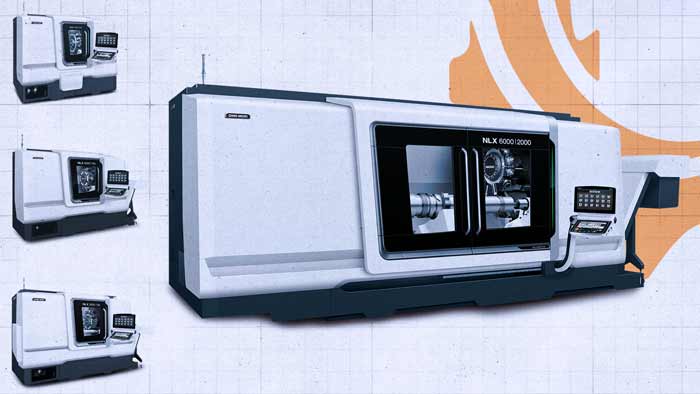
 CNC Family Breakdown
DMG MORI NLX 2500 Explained: The Turret Option That Costs You 88 mm of Swing
What is the DMG MORI NLX 2500?
The DMG MORI NLX 2500 is a universal CNC turning center launched in September 2010 as the first machine in what DMG MORI called its X class, evolved from the earlier Mori Seiki NL series. The number is the nominal chuck size in inches multiplied by 250, so the NLX 2500 is a 10 inch chuck machine. The letters after it set the configuration: MC adds driven tooling and a C axis, Y adds a Y axis and supersedes MC, and an S prefix adds a sub-spindle. The number after the pipe or slash is the nominal distance between centers in millimeters, and on this machine it changes your maximum turning diameter as well as your length.
The NLX 2500 is the most heavily traded DMG MORI turning center on the used market. In our survey it accounted for roughly two thirds of every used NLX on offer in North America. It is also a machine where three separate options quietly make it smaller, and where the same model number covers two different maximum turning diameters.
None of that is hidden. It is all printed in DMG MORI's own brochure. It just lives in bracketed footnotes and in columns most people do not read across, and it does not survive into a single used listing we looked at. This breakdown starts with the option that costs the most, then works through the rest of the name.
The turret option that costs 88 mm
The standard turret count depends on the specification. DMG MORI catalogues the two axis NLX 2500 with 10 stations and 12 optional, and the Y, SMC and SY machines with 12 stations standard and 10, 16 and 20 optional. More tools in the cycle, less setup, obvious upgrade. Here is what the brochure says the deeper turrets cost.
| Turret |
Max turning diameter |
Loss |
Tool shank |
| 10 or 12 station, standard |
ø366 mm |
baseline |
25 mm |
| 16 station |
ø348 mm |
18 mm |
20 mm |
| 20 station |
ø278 mm |
88 mm, 24 percent |
20 mm |
Figures from the DMG MORI NLX 2500 brochure carrying publication code NLX2500ND-EE01V, dated September 2017, for the NLX 2500 in 700 and 1250 bed forms. The turret figures appear inside square brackets in the maximum turning diameter row.
A 20 station turret takes 88 millimetres off your maximum turning diameter. That is nearly a quarter of the machine's swing, gone, in exchange for eight more pockets. And you do not only lose diameter. The standard tool shank on this machine is 25 mm, and on both the 16 and 20 station turrets it drops to 20 mm. So the machine that holds more tools holds smaller ones.
There is a third number in the same row that almost nobody quotes correctly. The ø366 mm figure assumes an outside diameter tool with 35 mm of overhang. At 40 mm of overhang the brochure gives ø356 mm. Both are printed as the specification. When a seller quotes you ø366, they are quoting the best case in the row.
None of this makes the 20 station turret a bad option. For a shop running small diameter parts through a long tool list, eight extra pockets is worth more than swing it never uses. The problem is that this is the single most consequential option on the machine and it is disclosed in a bracket. Count the stations on the machine in front of you, then work out which diameter figure actually applies to it.
The same model number swings anything from 460 mm to 278 mm
The turret table above is only the bottom half of the ladder. The top of it is the plain turning machine, and the full span on one model number is wider than most buyers would believe.
| Specification |
Max turning diameter |
| Plain turning, no driven tools |
ø460 mm |
| MC, Y, SMC or SY with the BMT milling turret |
ø366 mm |
| Same, with 40 mm of tool overhang |
ø356 mm |
| Same, with the 16 station turret |
ø348 mm |
| Same, with the 20 station turret |
ø278 mm |
From ø460 mm down to ø278 mm, a span of 182 millimetres, all on a machine badged NLX 2500 with the same 10 inch chuck and the same spindle. Every step down that ladder is turret geometry. Fitting driven tooling at all costs 94 mm, because the BMT milling turret occupies more of the work zone than the plain turning turret. Then the station count takes more.
That is worth pausing on if you are cross shopping a two axis machine against an MC. The plain turning NLX 2500 is not the lesser machine on the row that decides whether your part fits. It is the largest swinging NLX below the 4000, out-turning even the 12 inch NLX 3000 by 30 mm.
What the bed length does, and what it does not
DMG MORI calls the bed lengths Type 500, Type 700 and Type 1250. They change length, stroke, mass and floor space. They do not change your swing.
| Row |
NLX 2500 | 500 |
NLX 2500 | 700 |
NLX 2500 | 1250 |
| Max turning length |
450 mm |
705 mm |
1,255 mm |
| Z travel |
500 mm |
795 mm |
1,345 mm |
| Tailstock travel |
380 mm |
734 mm |
1,284 mm |
| Machine mass |
4,200 kg |
5,820 to 6,360 kg |
7,220 to 7,760 kg |
| Floor space |
2,200 x 1,898 mm |
3,347 x 2,106 mm |
4,414 x 2,370 mm |
Figures as published by DMG MORI for the NLX 2500. X travel is 260 mm on all three beds, though note this is a 2500 figure and not a family one, since the NLX 3000 publishes 280 mm of X and 120 mm of Y. The 705 mm and 734 mm figures on the 700 bed are the milling specification; the plain turning machine on the same bed publishes 728 mm of turning length with 650 mm of tailstock travel. Two DMG MORI figures exist for the 1250 floor space, 4,414 by 2,370 mm in the later spec tables and 5,049 by 2,200 mm in the April 2012 launch release. The 500 bed mass and footprint are the least corroborated figures in this table and worth reading off the plate. Bar capacity is ø80 mm standard with ø90 mm and ø102 mm printed as bracketed options, which is why DMG MORI web pages quote ø90 while the spec table quotes ø80.
Two things in that table are worth more than they look. The machine roughly doubles in mass and nearly doubles in floor length across the three beds, from 4,200 kg on the 500 to as much as 7,760 kg on the 1250, and from about 2.2 metres to about 4.4 metres of length before you fit a chip conveyor. That is a rigging and a floor loading conversation, not a footnote.
And the 500 bed is not offered with the 16 or 20 station turret at all. It is catalogued with 10 or 12 stations only, which means the deepest turret options and the shortest bed are mutually exclusive.
Reading the rest of the name
DMG MORI's grammar is strict and it never deviates from it. The number, then an optional spindle type letter on the large models only, then an optional S, then either Y or MC, then the bed length last.
The number is the nominal chuck size in inches times 250. The NLX 1500 is a 6 inch machine, the NLX 2000 is 8 inch, the NLX 2500 is 10 inch and the NLX 3000 is 12 inch. DMG MORI stated all four chuck sizes explicitly in its 30 November 2012 release announcing the full lineup. The multiplier itself is our arithmetic across those four figures, not DMG MORI's wording. Note what the number is not: it is not millimetres of anything. The NLX 2500 has a 920 mm swing over the bed.
MC is milling and a C axis, meaning driven tooling in the turret, with no Y axis.
Y is a Y axis, and it includes the driven tooling and C axis. Y supersedes MC rather than adding to it, which is why DMG MORI never writes YMC or MCY. On the first generation the Y axis travel is only 100 mm, published as plus or minus 50, and it is an option rather than standard.
S is a sub-spindle, and it always sits in front of the Y or MC. So an SY has a sub-spindle, driven tooling, a C axis and a Y axis.
Spindle type letters exist only on the two largest machines. The NLX 4000 is offered as A or B, and the NLX 6000 as B, C or D, with bores of 185, 285 and 375 mm. Below that there is one spindle per model number.
Which means some strings you will see cannot be machines. Sub-spindle capability stops dead at the NLX 2500. No S variant of the NLX 3000, 4000 or 6000 has ever been published, so an advertised NLX 3000SY or NLX 4000SY is either a wrong listing or a different machine. Neither can an NLX be both Y and MC. And an NLX 4000 advertised as just 4000/750 with no A or B has withheld a material spec, because that letter sets the chuck, the bore and the spindle speed.
One search note worth more than it looks. DMG MORI writes the bed length with a pipe, as NLX 2500 | 700, and calls them Type 700 and Type 1250. Every slash, hyphen and space you see is a dealer transliteration. Between that, the reversed suffix orders and the closed-up spellings, we counted seventeen distinct written forms of one machine, an NLX 2500 with sub-spindle and Y axis on the 700 bed. No single search string finds them all, so search the slash, the pipe, the hyphen and the space, and search with the suffix both before and after the bed length.
Where the chuck size rule breaks
Divide by 250 and the family lines up cleanly at 6, 8, 10 and 12 inches. Then you get to the NLX 4000, and 4000 divided by 250 is 16.
There is no 16 inch NLX 4000. DMG MORI's own launch release of 30 November 2012 gives it as two machines: the A type with a 15 inch chuck and a ø145 mm bore turning at up to 2,000 rpm, and the B type with an 18 inch chuck and a ø185 mm bore turning at up to 1,500 rpm. The arithmetic is tidy and the answer is wrong, and the letter you need in order to get it right is the one dealers most often leave off.
The 4000 follows the same pattern as the rest of the family rather than breaking it. Adding the Y axis there costs 100 mm of turning diameter, ø500 against ø600, because X travel drops from 365 mm to 315 mm. And bar capacity tracks the spindle letter rather than the axis suffix: ø117 mm on the A type with its 145 mm bore, ø164 mm on the B type with 185 mm. That row is printed as a merged cell in a single DMG MORI release, so treat the split as our reading of it rather than the builder spelling it out.
And the rule was never exclusive anyway. Even the first generation NLX 2500 catalogued a 12 inch chuck as an option, and an 8 inch on the two axis machine, and the second generation continues the 12 inch option with up to 1,273 newton metres of torque behind it. The number is the standard chuck size, not the only one available.
On an NLX 2500 the plain turning machine swings 460 mm and the twenty station machine swings 278. Same model number, same chuck, same spindle. Both figures are in the brochure. Neither is in the listing.
A sub-spindle costs 61 mm of Z and the whole tailstock
The sub-spindle is the option most used buyers want, because it finishes the back of the part in the same cycle. It is also the option with the least discussed consequences.
The brochure states the first one without comment. In the tailstock row, the columns for the sub-spindle machines carry a dash. On an NLX 2500 you cannot have a sub-spindle and a tailstock. It is not an either-or you configure, it is structural, because the second headstock occupies the tailstock position. On a base, MC or Y machine you get a servo driven programmable tailstock with an MT5 live centre. On an SMC or SY you get nothing at that end.
The second consequence is quieter, and it is easy to misread off a spec table. Z travel does not change: it stays 795 mm on the 700 bed and 1,345 mm on the 1250. What the sub-spindle brings is a separate B axis with 734 mm and 1,284 mm of stroke, which is the same stroke the tailstock would have had. So the sub-spindle does not reach as far down the bed as the turret does, and a part has to be inside that shorter envelope to be transferred at all.
Put those together and you get a spec sheet trap. An NLX 2500 Y and an NLX 2500 SY both publish the same maximum turning length. Those are not the same number in practice. On the Y you can support a long part between centres. On the SY you cannot support it at all.
One more figure worth knowing on early machines: at the 2010 launch the main spindle was 3,500 rpm as standard with 4,000 optional, so a 2010 to 2012 machine may well be a 3,500 rpm machine. For the record, the first generation sub-spindle is a 6 inch chuck as standard with an 8 inch option, running to 6,000 rpm on 11 over 7.5 kW, with a ø43 mm bore and a JIS A2-5 nose as standard. The ø73 mm bore on a JIS A2-6 nose at 5,000 rpm is the option that comes with the 8 inch chuck. It is a real second spindle, not a token one. It just costs you the tailstock and some stroke, and no listing will tell you that.
Four controls under one model name
This is the finding with the most money attached, and it is the reason the model name alone is not enough to price a machine.
Over the NLX 2500's production life the control has spanned two hardware platforms and three operating layers, and the same operating layer has shipped on both platforms. Early machines from roughly 2010 to 2016 are Mitsubishi machines, appearing in listings as M730BM, M730BL, M730UM or MSX-853IV, running MAPPS IV. Mid life machines add the CELOS front end, which sits on top of Mitsubishi or Siemens underneath depending on the machine. From roughly 2014 you find MAPPS V, which DMG MORI ships on Mitsubishi M730 hardware and, separately, on Fanuc, so the name tells you the operating layer and not the platform underneath. And the second generation announced on 10 September 2024 runs MAPPS X on a Fanuc 31i-B Plus, or Siemens SINUMERIK ONE.
So a buyer who assumes DMG MORI means Mitsubishi will be wrong on a large part of the pool, and two NLX 2500s from adjacent years can need different post processors, different service benches and different spare parts channels.
The listings do not help. Of roughly thirty North American NLX listings we could read, fifteen named no control at all. Several said only "CNC". So the practical instruction is short: never accept CELOS or "CNC control" as a control specification. Get a photograph of the control nameplate and the version screen before you talk price.
On support, be careful with confident claims in either direction. We found no published DMG MORI end of support or end of parts date for MAPPS IV, the M730 series or CELOS, so anyone telling you a generation is unsupported is guessing. What we can confirm is that a third party ecosystem still exists: Mitsubishi Electric Americas still sells DMG MORI specific maintenance training for the M700BM and M700UM controls. That is training availability, not a parts guarantee. Get the parts commitment in writing against the actual control serial number.
Where the 2500 sits in the family
| Model |
Chuck |
Max turn dia |
Max rpm |
Sub-spindle |
| NLX 1500 |
6 in |
ø386 mm |
6,000 |
Yes, SMC and SY |
| NLX 2000 |
8 in |
ø366 mm |
5,000 |
Yes, SMC and SY |
| NLX 2500 |
10 in |
ø460 two axis, ø366 with milling turret |
4,000 |
Yes, SMC and SY |
| NLX 3000 |
12 in |
ø430 mm |
3,000 |
No |
| NLX 4000 |
15 in A type, 18 in B type |
not compared here |
2,000 A, 1,500 B |
No |
| NLX 6000 |
B, C and D spindle types |
not compared here |
1,600 down to 500 |
No |
Figures as published by DMG MORI. On the NLX 6000, as on the rest of the family, the built-in motor turret arrives with the MC and Y specifications and is absent from the plain turning specification. Bed lengths differ by model too: the 2500 is offered at 500, 700 and 1250, the 3000 at 700, 1250, 2000 and 3000, the 4000 at 750 and 1500, and the 6000 at 1000 and 2000.
Read down the turning diameter column and the family is not ordered the way the numbers are. The 6 inch NLX 1500 turns 20 mm larger than the 8 inch NLX 2000, at ø386 against ø366, and it does so from the same brochure. It also turns 5 mm longer and spins 1,000 rpm faster.
So a two axis NLX 2500 carries the largest maximum turning diameter of any NLX below the 4000, out-swinging even the 12 inch NLX 3000 by 30 mm. Anyone sizing by model number alone gets that exactly backwards.
What DMG MORI publishes on accuracy, and what it does not
Every family we have decoded in this series has come back the same way: no published linear positioning accuracy, so the buyer has to set their own acceptance test. The NLX is the first one where that answer is not a flat no, and the exception is narrow enough to be worth stating precisely.
On the first generation NLX, across both brochures with publication codes, the current regional spec tables and seven dated press releases, DMG MORI publishes no linear positioning accuracy and no repeatability figure on X, Y or Z. The spec tables have no such rows.
On the second generation there is exactly one guaranteed figure. The 19 September 2025 release for the NLX 2500 | 1250 second generation gives C axis positioning of 0.001 degrees with a guaranteed 0.003 degrees. The word guaranteed is DMG MORI's own, which makes it the first holdable accuracy specification we have found in this entire series. It is also angular, on one rotary axis, on current machines only. It tells you nothing about how the linear axes land.
Three other figures get sold to buyers as accuracy and are not. The magnetic scale resolution of 0.01 microns is the one to watch: it is the finest increment the encoder can report, an optional full closed loop feedback package, and it says nothing about how close the axis gets to the commanded position. Radial displacement within 7 microns during continuous operation is a thermal stability claim under unstated conditions. And the surface roughness, circularity and thermal displacement figures in DMG MORI's 2016 marketing material are sample part demonstration results under the builder's own test conditions.
One practical note that has changed recently. DMG MORI has moved its full technical data posters behind account registration, so a prospective buyer can no longer reach the complete specification table without creating an account. If you are checking a machine against the factory table, expect to register first.
The consequence is unchanged for the linear axes. Write your own acceptance criteria, referencing ISO 13041 for turning centres, with Part 1 covering geometric tests and Part 6 covering the accuracy of a finished test piece. Agree the numbers before the inspection, not after.
NL to NLX, in DMG MORI's own words
If you are cross shopping the older Mori Seiki NL against an NLX, the succession is not in doubt. The 9 September 2010 launch release states that the NLX 2500 series evolved from the NL series, which had sold more than 10,000 units, and headlines the machine as the first of a new X class.
What changed, all from that release and the 2012 follow up. The NLX got a bed with coolant circulating inside it as standard, which DMG MORI describes as giving active control over thermal displacement from cutting heat and ambient temperature change. That is the clearest single hardware difference between the families. It also achieved roughly a 22 percent reduction in installation area against the NL on the turning specification machine, though DMG MORI's own later material puts the figure at 17 percent, so treat it as a fifth rather than a precise number. The built-in motor turret carried over and matured, reaching maximum speed in 0.45 seconds with a stated installed base of 12,000 units by 2012. DMG MORI claims thermal displacement of one third or less, and C axis positioning error of half, against the previous machines.
Note what did not change. The NLX kept slideways rather than switching to linear rails, and DMG MORI says so directly, describing them as offering longer tool life and heavy duty cutting capability. The second generation of 2024 then specifies 55 mm wide roller guides and double anchored ballscrews, which by implication is not what a pre-2024 machine has. Note that DMG MORI's 2025 release for the longer bed second generation describes sliding guideways on X, Y and Z alongside internal ballscrew cooling, so the two descriptions sit oddly together and are worth checking against the specific machine.
One item we are flagging rather than publishing as fact. Our piece on the NL family states that the BMT60 turret interface carries between NL and NLX, and a tooling supplier catalogues clamping units under a single combined NL and NLX family, which supports it. But a separate tooling distributor lists the Y and SY variants of the NLX as VDI40 Trifix rather than BMT60. If that is right, tooling does not carry freely between a base NLX and a Y axis NLX of the same size, which is a material thing for a shop with a drawer of BMT60 holders. It is a single distributor source and we could not confirm it against DMG MORI. Confirm the turret interface on the specific machine before you count on your existing tooling.
What the used market actually has
Our survey found roughly 25 to 35 distinct used NLX machines readable in North America at one point in time, with plausible true supply of 40 to 70 once you account for the two largest aggregators blocking automated access. Worldwide, roughly 45 to 75 readable and plausibly 55 to 90. Ranges rather than figures, on purpose.
The composition matters more than the total. The NLX 2500 is roughly two thirds of everything on offer, at about 18 to 24 distinct North American machines. The NLX 3000 runs 4 to 6, the 1500 and 2000 each 2 to 4, the 4000 one or two, and we found no NLX 6000 in North America at all. The only one anywhere was a 2017 machine in France. So if you are shopping anything other than a 2500, expect to wait or to import.
Year range on offer is 2010 to 2024. One data quality warning that will save you a phone call: we found listings for an NLX 2500 dated 2007 and another dated 2004. The NLX did not exist before 2010. Those are miskeyed NL machines or bad year fields, and any pre-2010 NLX listing should be treated as an error until the serial plate proves otherwise.
On configuration, more than half of the listings where options were itemised carried a Y axis, and roughly 40 to 45 percent a sub-spindle, almost always together as SY. Driven tooling appeared on about 60 percent. Tailstocks appeared on exactly one machine in our sample, which follows directly from the market skewing to sub-spindle machines that cannot have one. Steady rests appeared on none. And no used NLX listing we saw carried a robot or gantry loader, despite those being current factory options, because automation cells get stripped before resale rather than travelling with the machine.
On price, treat everything with suspicion including this. We recovered eight genuine seller asking prices, which is a small sample and not a market. They ran from $24,999 for a 2014 two axis machine, which is an outlier by a factor of four and should not anchor anything, up to $299,500 for a 2022 NLX 4000. Within the 2500 family the SY machines asked between $174,900 and $295,000, and the two axis machines well below that. Those are asking prices from public listings, never transaction prices, and we are not averaging them. What is safe to say is that configuration drives price harder than year does: a 2015 Y machine asked more than a 2019 two axis machine.
Two categories of number to reject outright. One specification aggregator publishes an estimated $150,000 to $220,000 new and $70,000 to $120,000 used, and self describes those as algorithmic estimates with a note that the specifications are not independently verified. Another site publishes an average and median across 366 DMG MORI listings of all machine types, which is arithmetic over a mixed population and tells you nothing about an NLX. Neither is a seller's ask and neither is a transaction.
And the single most useful market fact: North American NLX listings are effectively hour blind. Of roughly thirty we could read, exactly one disclosed hours. European listings disclose routinely, including a 2016 machine at 9,000 hours. So the absence of an hours figure in a North American listing is not a neutral fact, and "low hours" without a screen photograph means nothing.
Resell CNC Take
The NLX 2500 is the best traded DMG MORI lathe on the used market and the hardest one to buy off a spec line. Three options make the machine smaller and all three are disclosed in brackets. The bed length changes the swing. The sub-spindle takes the tailstock. And the model name does not tell you whether you are buying a Mitsubishi machine, a Fanuc machine or a Siemens machine, which decides your post processor, your service bench and your parts channel for the next decade. Get the control nameplate photographed, count the turret stations, read the bed length off the plate rather than the advert, and get all three hour counters on camera. Then price the machine you are actually looking at, because on this family the badge and the machine are not the same thing.
What to demand before you wire funds
The control nameplate and version screen, photographed. First thing, before anything mechanical. Establish whether it is a Mitsubishi M730 series, CELOS over Mitsubishi or Siemens, MAPPS V on Mitsubishi or on Fanuc, or MAPPS X. This decides parts, programming, post processor and who can service it. Half the listings will not tell you.
Count the turret stations and read the bed length off the machine. Those two facts together determine your actual maximum turning diameter, which can be anything from ø278 mm to ø460 mm on a machine all called NLX 2500. Then check the tool shank size, because a 16 or 20 station turret takes 20 mm shanks rather than 25.
Rotate both spindles by hand, cold, and listen. A documented NLX 2500 spindle rebuild found brinelling of the front bearing after the spindle was bumped, with no contamination and no dimensional deviation anywhere else. The presenting symptom was audible noise when turned by hand. These spindles are grease lubricated and built in motor driven, so there is no oil mist trail to read history from. A crash damaged bearing can be quiet under power and announce itself only under load.
Inspect the seller's tooling too. In that same rebuild the contributing cause was runout in the customer's own tooling adapter plate. A chuck or adapter with runout will damage a healthy spindle, so a machine with a tired chuck is a machine with a story ahead of it.
Index the turret five times in each direction on every station, listening for a clamp pressure drop and re-establish. Turret clamp faults on CELOS era NLX 2500s are a documented owner complaint. While you are there, establish which turret is fitted, because owners report some NLX machines carrying Japanese built turrets and others German built ones. Both take the same 60 mm tooling, but turret spares are a different conversation.
Prove the C axis under live tool load. Mill an off centre feature with C and X interpolating and measure whether position holds. Owners have raised exactly this on the NLX, and it is precisely the capability a Y axis or MC buyer is paying for.
Warm the machine, then measure. This machine's thermal story rests on coolant circulating through the bed casting. Turn a diameter cold, then again at 30, 60 and 90 minutes of running. A cold machine flatters the seller.
Run a sub-spindle transfer check if it has one. Transfer a part and re-measure a datum over ten cycles. Then confirm the B axis stroke, which is 61 mm short of full Z travel and is what actually limits where a part can be handed over.
Then the paperwork. Photograph all three hour counters, power on, spindle rotation and cutting hours, and cross check them against each other, because 20,000 power on hours against 2,000 cutting hours is an idling machine and 12,000 of each is a working one. Export or photograph the alarm history, which is the machine's medical record and the most underused inspection artifact there is. Confirm the bar capacity off the machine given the brochure and the website disagree. And get a written parts availability commitment from DMG MORI against the actual control serial number, since no public lifecycle statement exists.
Frequently Asked Questions
What does the number in a DMG MORI NLX model name mean?
It is the nominal chuck size in inches multiplied by 250, inherited from the older Mori Seiki NL family. So the NLX 1500 is a 6 inch machine, the NLX 2000 is 8 inch, the NLX 2500 is 10 inch and the NLX 3000 is 12 inch, all four stated explicitly in DMG MORI's 30 November 2012 release announcing the full lineup. The number is not millimetres of anything, and the NLX 2500 has a 920 mm swing over the bed. The rule breaks once, at the NLX 4000, which is a 15 inch machine as the A type and an 18 inch machine as the B type rather than the 16 inch the arithmetic suggests.
Does a bigger turret reduce capacity on an NLX 2500?
Yes, substantially, and it is disclosed only inside brackets in the brochure's maximum turning diameter row. With the standard turret, which is 10 stations on a two axis machine and 12 on a Y or S machine, the NLX 2500 turns 366 mm with driven tooling fitted. With the 16 station option it turns 348 mm, and with the 20 station option it turns 278 mm, which is a loss of 88 mm or 24 percent of the machine's swing in exchange for eight more tool pockets. The tooling gets smaller at the same time, because the standard 25 mm tool shank drops to 20 mm on both the 16 and 20 station turrets. Count the stations on the machine before deciding which diameter figure applies to it.
Why does the NLX 2500 have two different turning diameters?
Because the turret changes it, not the bed. A plain turning NLX 2500 publishes a maximum turning diameter of 460 mm. Fit the BMT milling turret, which is what an MC, Y, SMC or SY has, and it drops to 366 mm, because the driven tool deck occupies more of the work zone. From there the station count takes more still, 348 mm with the 16 station turret and 278 mm with the 20 station. That is a 182 mm span on one model number with the same 10 inch chuck and the same spindle, and it makes a two axis NLX 2500 the largest swinging NLX below the 4000, out-turning even the 12 inch NLX 3000 by 30 mm. There is a second variable in the same row: the 366 mm figure assumes an outside diameter tool with 35 mm of overhang, and at 40 mm of overhang the brochure gives 356 mm.
Is the DMG MORI NLX 4000 a 16 inch machine?
No. Dividing 4000 by 250 gives 16, and that is the one place in the family where the arithmetic fails. DMG MORI's launch release of 30 November 2012 publishes the NLX 4000 as two machines: the A type with a 15 inch chuck, a 145 mm spindle bore and up to 2,000 rpm, and the B type with an 18 inch chuck, a 185 mm bore and up to 1,500 rpm. The spindle type letter is not optional on this model because it sets the chuck, the bore and the speed, so an NLX 4000 advertised without an A or a B has withheld a material specification. On the 4000, bar capacity follows the spindle letter rather than the axis suffix, at 117 mm on the A type and 164 mm on the B type, and adding the Y axis costs turning diameter there as elsewhere, 500 mm against 600 mm.
Does an NLX 2500 with a sub-spindle have a tailstock?
No. The brochure marks the tailstock row with a dash for the sub-spindle machines, because the second headstock occupies the tailstock position. So on an SMC or SY machine there is nothing at that end, where a base, MC or Y machine gets a servo driven programmable tailstock with an MT5 live centre. Z travel is unchanged at 795 mm on the 700 bed and 1,345 mm on the 1250, but the sub-spindle rides a separate B axis with 734 mm and 1,284 mm of stroke, the same stroke the tailstock would have had, so it does not reach as far down the bed as the turret does. An NLX 2500 Y and an NLX 2500 SY publish the same maximum turning length but only one of them can support a long part between centres.
What control is in a DMG MORI NLX 2500?
It depends entirely on the machine, and the model name does not tell you. Over the NLX 2500's life the control has spanned two hardware platforms and three operating layers. Machines from roughly 2010 to 2016 are Mitsubishi based, appearing as M730BM, M730BL, M730UM or MSX-853IV running MAPPS IV. Mid life machines add the CELOS front end, which sits on Mitsubishi or Siemens underneath. From roughly 2014 you find MAPPS V, which DMG MORI ships both on Mitsubishi M730 hardware and on Fanuc, so the name tells you the operating layer rather than the platform. The second generation announced in September 2024 runs MAPPS X on a Fanuc 31i-B Plus or Siemens SINUMERIK ONE. Fifteen of about thirty North American listings we read named no control at all, so demand a photograph of the control nameplate and version screen before discussing price.
What positioning accuracy does DMG MORI publish for the NLX 2500?
For the linear axes, none. Across both brochures with publication codes, the current regional spec tables and seven dated press releases there is no positioning accuracy or repeatability figure for X, Y or Z on the first generation NLX. The one exception is on the second generation, where DMG MORI publishes C axis positioning of 0.001 degrees with a guaranteed 0.003 degrees, and the word guaranteed is the builder's own. That is angular, on one rotary axis, on current machines only. Watch out for the magnetic scale resolution figure of 0.01 microns, which is the finest increment the encoder can report rather than an accuracy specification, and which is the number most often misquoted as one.
What is the difference between a Mori Seiki NL and a DMG MORI NLX?
The NLX is the successor and DMG MORI says so directly, stating in the September 2010 launch release that the NLX 2500 series evolved from the NL series, which had sold more than 10,000 units. The clearest hardware change is that the NLX has coolant circulating inside the bed casting as standard, for active control of thermal displacement, and it achieved roughly a 22 percent reduction in installation area against the NL. The built-in motor turret carried over and matured. Both families kept slideways rather than moving to linear rails. In market terms the NL is a 2004 to 2011 machine with one control lineage while the NLX is a 2010 to 2024 machine spanning four, which makes the NLX harder to shop despite being the newer machine.
Shopping a Used NLX 2500?
See our DMG MORI inventory.
Tell us the parts you want to run and our team, with 200+ years of combined industry experience and four AMEA and CEA certified appraisers on staff, will match you to the right NLX bed length, turret and control, and confirm a used one is built the way its tag claims.
See Used DMG MORI Machines
About the Author
Bill Murphy is the Marketing and Content Lead at Resell CNC. The CNC Family Breakdown series maps out entire machine families, decoding the model numbers, suffixes, and configurations so buyers can tell one version from the next. Every figure in this article is attributed to the source that publishes it, figures that exist on only one source are identified, and specifications no manufacturer publishes are named rather than filled in.
About Resell CNC
Resell CNC has bought and sold used CNC machinery since 2008. Based in Maitland, Florida, with warehouses in Winter Springs and Longwood, the team brings more than 200 years of combined industry experience and four AMEA and CEA certified equipment appraisers on staff. Resell CNC has been an MDNA member since 2009 and is the only used CNC dealer in North America with Official Mazak Trade-In Center status.
Sources
- DMG MORI NLX 2500 technical data documents, publication codes NLX2500-EA03V and NLX2500-EB16V, plus the May 2016 NLX 2500 specification sheet. Maximum turning diameter row including the 16 and 20 station turret figures and the tool overhang figures, turret station options, tool shank sizes, bed length comparison, sub-spindle specification and the no tailstock equipped statement, spindle bore and nose, machine mass and floor space.
- DMG MORI NLX 1500 and NLX 2000 brochure, publication code NLX1520ND-ED03D, September 2017. Chuck sizes, maximum turning diameter and length, spindle speeds and motor ratings, turret and tool shank, tailstock, mass and footprint.
- DMG MORI press release, 9 September 2010. NLX 2500 launch as the first X class machine, evolved from the NL series with more than 10,000 units sold, bed with coolant circulating inside, approximately 22 percent reduction in installation area, slideways retained.
- DMG MORI press release, 23 April 2012. Addition of the NLX 2500 on the 1250 bed, turning length 1,255 mm.
- DMG MORI press release, 30 November 2012. Full lineup announcement giving NLX 1500 as 6 inch, NLX 2000 as 8 inch and NLX 3000 as 12 inch alongside the 10 inch NLX 2500, plus built-in motor turret figures and thermal and C axis claims.
- DMG MORI press release, 30 November 2012, NLX 4000. A type with 15 inch chuck, 145 mm bore and 2,000 rpm, B type with 18 inch chuck, 185 mm bore and 1,500 rpm, and the Y against MC bar capacity figures.
- DMG MORI press release, 9 December 2015, with sales from 14 December. NLX 6000 launch with B, C and D spindle types.
- DMG MORI press release, 10 September 2024. NLX 2500 on the 700 bed, second generation. Turret options, Y axis 120 mm, bar capacity raised to 105 mm from 80 mm, driven tool ratings, 55 mm roller guides and double anchored ballscrews, control options.
- DMG MORI press releases, 19 and 22 September 2025. NLX 2500 on the 1250 bed, second generation. C axis positioning 0.001 degrees with a guaranteed 0.003 degrees, radial displacement within 7 microns in continuous operation, spindle and right spindle ratings, bar passage runout, control options.
- DMG MORI regional product pages for the NLX series and the NLX 2500, United States, Europe and Japan, cross checked against each other. Note that DMG MORI has moved its full technical data posters behind account registration.
- Independent spindle rebuild case study on an NLX 2500 main spindle documenting brinelling of the front bearing after impact, with no contamination or dimensional deviation found elsewhere, and runout in the tooling adapter plate identified as a contributing cause.
- Mitsubishi Electric Americas training catalogue listing DMG MORI specific maintenance courses for the M700BM and M700UM controls.
- Tooling supplier catalogues listing turret clamping units under a combined NL and NLX machine series family, and separately listing the NLX Y and SY variants as VDI40 Trifix. The latter is a single distributor source, flagged in the text as unconfirmed against DMG MORI.
- ISO 13041, Test conditions for numerically controlled turning machines and turning centres. Part 1, geometric tests. Part 6, accuracy of a finished test piece.
- Marketplace survey conducted August 2026 across marketplaces and aggregators including MachineTools.com, Exapro, CNCMachines.com, Machineseeker, Gindumac, Makinate, eBay and several dealer inventories, deduplicated on model and bed suffix, year, asking price, declared options and region. Asking prices only, never transaction prices. Two of the largest aggregators blocked automated access, so supply counts are floors.
- Owner and technician discussion threads on CNC community forums covering NLX turret clamp faults, C axis position holding during milling, spindle and chuck problems, control parameter access on Mitsubishi era machines, and the NL to NLX comparison including regional turret sourcing. Cited in this article as owner anecdote, not as verified fact.