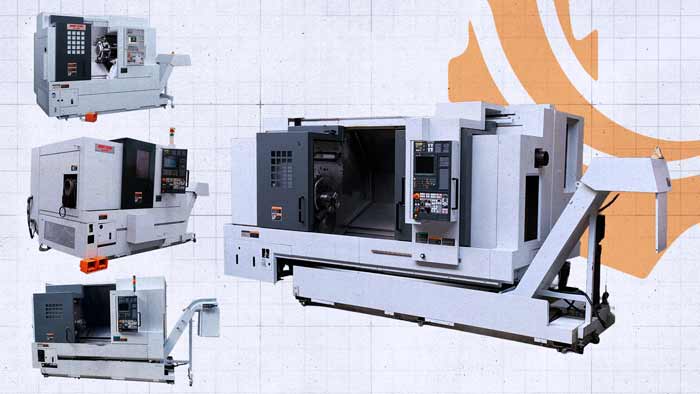
CNC FAMILY BREAKDOWN
How to Read a Mori Seiki NL Model Name: Why the Iron Outlives the Control
How do you read a Mori Seiki NL model name?
A Mori Seiki NL model name has three parts: the NL series designation, a four digit number, and optional letter suffixes, followed by a slash and a second number. The four digit number divided by 250 gives the nominal chuck size in inches, so NL1500 is a 6 inch machine, NL2000 is 8 inch, NL2500 is 10 inch, and NL3000 is 12 inch. The letters describe configuration: MC is live tooling with a C axis, Y adds a Y axis and always includes live tooling, S is a sub-spindle, and SY combines all three. The number after the slash is the distance between centers in millimeters, which sets the bed length, so an NL2500/700 and an NL2500/1250 are the same machine on different beds.
The Mori Seiki NL is one of the most quietly consequential turning centers on the used market. Mori Seiki put the series past 10,000 units sold, which means the installed base is enormous and the entire population is now secondhand. Ask owners about it and you get a strikingly consistent answer about the machine itself. One long forum thread asked specifically for the good, the bad and the ugly, and the ugly never showed up: no complaints about the castings, the headstock, the turret or the hydraulics, just repeated statements that the structure is about as rigid as it gets in its size class and that the milling is comparable to a small vertical machining center.
What does show up, over and over, is the control. That split is the reason this piece exists. The NL is a family where the iron will comfortably outlive the supportability of the electronics bolted to the front of it, and a buyer who understands that asymmetry can buy very well. A buyer who does not can end up with an excellent machine he cannot boot. Everything below is written around that, starting with what the name on the enclosure actually tells you.
The four parts of the name
NL is the series. It was Mori Seiki's mainstream slant bed turning center, launched in June 2004 at the company's Iga Campus with thirty machines covering 6 to 12 inch chucks, replacing the older SL series. The trade press at launch benchmarked the new NL2500 against the SL-253MC it displaced and reported a 47 percent cycle time reduction. As for what the two letters stand for, nobody at Mori Seiki ever published it. Not in the brochure, not in the press releases, not on the Japanese or U.S. sites. It is the third builder in this series whose marquee letters turn out to be undocumented, so treat "New Lathe" and every other confident expansion as folklore.
The number is a chuck size class, and the conversion is unusually clean: divide by 250 and you get the nominal chuck diameter in inches.
The letters are configuration: MC, Y, S, SMC, SY. They stack, and there are two commonly seen letter combinations that are not factory designations at all.
The slash number is bed length, expressed as distance between centers in millimeters. It is not part of the model, it is part of the machine's capacity, and it is the piece buyers most often drop when they write an ad.
The number is chuck size, and here is how you prove it
NL1500 is 6 inch, NL2000 is 8 inch, NL2500 is 10 inch, NL3000 is 12 inch. That holds across the whole family, and the same size class ladder gets reused on the NLX, NZX and ALX lines, where 1500, 2000 and 2500 again mean 6, 8 and 10 inch with matching 52, 65 and 80 mm bar capacities.
Two checks confirm the number is not measuring anything else. First, swing over bed is roughly 923 to 925 mm on the NL1500, NL2000 and NL2500 alike, identical across three different model numbers, so the number cannot be swing. Second, the NL1500 and NL2000 share the same published maximum turning diameter of 356 mm on a 12 station turret despite carrying different numbers and different chucks, so the number is not turning diameter either. It is a class index tied to workholding, nothing more.
| Model |
Chuck |
Max turn dia. |
Bar cap. |
Bore |
Max rpm |
Spindle |
Beds |
| NL1500 |
6 in |
14.0 in / ø356 |
2.05 in / 52 |
2.4 in / 61 |
6,000 |
15/10 hp |
/500 |
| NL2000 |
8 in |
14.0 in / ø356 |
2.56 in / 65 |
2.9 in / 73 |
5,000 |
20/15 hp |
/500 |
| NL2500 |
10 in |
16.5 in / ø420 |
3.15 in / 80 |
3.6 in / 91 |
4,000 |
25/20 hp |
/700, /1250 |
| NL3000 |
12 in |
16.5 in / ø420 |
3.54 in / 90 |
4.13 in / 105 |
3,000 |
30/25 hp |
/700 to /3000 |
Base machine, standard configuration, 12 station turret. Horsepower shown as 30 minute rating over continuous. Max turning diameter is the two axis turning specification; live tooling and Y axis machines are lower, see below. Higher spindle speeds were optional on the NL1500, NL2000 and NL2500 and generally reduce bar capacity. Optional larger chucks were available on the NL2500 and NL3000. Maximum spindle torque runs 200, 349, 599 and 1,025 Nm across the four classes.
Two things in that table deserve a second look. Torque more than quintuples from the NL1500 to the NL3000 while spindle speed halves, which is the normal trade but a steep version of it. And the NL3000 is the only class that was never offered with a sub-spindle, which surprises people shopping the 12 inch class for done in one work.
More tools means less diameter, and the spec sheet says so twice
Here is a detail that costs people real money because it hides inside two different numbers for the same machine.
The maximum turning diameter Mori Seiki publishes for an NL is the two axis turning figure. Add the live tooling turret and it drops. On the NL2500, the turning specification is 420 mm while the MC and Y specification lands in the 356 to 368 mm range depending on source. That is not a contradiction between dealers, it is the same machine measured two ways, and Mori Seiki did the same thing on the NLX where a 460 mm turning figure sits alongside a 366 mm milling figure on one product page.
The turret station count does the same thing more dramatically. Mori Seiki offered a 20 station turret on the NL1500 and NL2000 from July 2007, and choosing it drops maximum turning diameter from 356 mm to 278 mm. That is more than three inches of diameter traded for eight extra tool positions. If you are buying a 20 station machine because tool capacity matters to you, confirm your largest part still fits.
The castings will still be good in twenty years. The question is whether the control will still boot.
The slash number is between centers, not turning length
The number after the slash is the nominal distance between centers in millimeters, and it defines the bed. Maximum turning length is always slightly larger than the slash figure, which is why the two get conflated: an NL2500/700 turns to 705 mm, an NL3000/700 turns to 713 mm, and an NL3000/2000 turns to 2,123 mm.
Which beds were offered depends on the class. The NL1500 and NL2000 came only as /500. The NL2500 came as /700 and /1250. The NL3000 had the widest range by far, /700, /1250, /2000 and /3000, and the long bed NL3000 machines with the 2,000 and 3,000 mm beds were added later, with orders opening in February 2006. Those long bed machines also get a programmable carriage coupled tailstock as standard rather than an option.
A practical note for anyone reading listings: sellers drop the slash number constantly. "Mori Seiki NL2500" with no bed length tells you the chuck and nothing about whether the machine turns 27 inches or 49. Ask.
The suffix stack, and two suffixes that do not exist
No letters means two axis turning. No live tooling, no C axis. Tailstock optional.
MC is milling plus C axis: driven tools in the turret and a main spindle that positions and contours. This is the NL's factory designation for live tooling. Bare M is the older SL series convention, so a listing reading "NL2500M" is almost certainly an MC written carelessly.
Y adds a Y axis, ±50 mm on the NL1500, NL2000 and NL2500 and ±60 mm on the NL3000. Y always brings live tooling and a C axis with it. Mori Seiki never built a Y axis NL without driven tools, so a "Y, no live tooling" listing is describing something that was not made.
S is a sub-spindle, always with a 6 inch chuck regardless of the main spindle size. SMC is sub-spindle plus live tooling and C axis. SY is the full configuration: sub-spindle, Y axis and live tooling. Sub-spindle and tailstock are mutually exclusive, because the sub-spindle occupies that space. If you do shaft work, an SY machine is the wrong machine no matter how well specified it looks.
Now the two that are not real. SM is not a factory NL designation; sellers writing it mean SMC. SZ is not an NL designation at all, it belongs to the NT and NTX mill-turn machines where it indicates a sub-spindle plus a lower turret. And while we are correcting listings: there is no NL4000 or NL5000. Those numbers exist only on the NLX. Any listing offering an NL4000 is mislabeled, and you should find out what the machine actually is before you bid.
Mori Seiki or DMG MORI: the badge tells you nothing
You will see the same machine advertised as a Mori Seiki NL2500, a DMG Mori Seiki NL2500 and a DMG Mori NL2500. They are the same machine, and the reason is a matter of calendar rather than engineering.
Every NL was designed and built by Mori Seiki in Japan. Mori Seiki and Gildemeister signed their cooperation agreement in March 2009 and combined U.S. sales operations in April 2010, but the combined branding did not take effect until 1 October 2013, when Mori Seiki Co., Ltd. became DMG MORI SEIKI CO., LTD. By then the NL was already out of the catalog: the NLX2500 superseded the NL2500 in September 2010, and the NLX line completed with the NLX1500, NLX2000 and NLX3000 at JIMTOF in November 2012.
So the NL series ended before the DMG MORI name existed. A "DMG Mori NL2500" badge on a listing reflects when the seller wrote the ad, not what came off the line in Japan. Useful corollary: if a seller insists a DMG Mori NL is somehow a later or better machine than a Mori Seiki NL, they are describing their own web page, not the equipment.
The control is Mitsubishi, not Fanuc, and this is the single most important thing on the page
Multiple dealer content sites state that legacy Mori Seiki lathes run Fanuc controls. For the NL series that is wrong, and it is the kind of wrong that changes how you should price the machine.
An NL runs an MSX-850 or MSX-850III designation on a Mitsubishi M720BM platform, with MAPPS as the Mori Seiki operator overlay on top. MAPPS is Mori Advanced Programming Production System, and it is a front end, not a CNC in its own right. Early NL machines from 2004 to roughly 2006 carry MAPPS II, which moved onto Windows XP in April 2004. The bulk of the population, roughly 2005 to 2010, carries MAPPS III, announced in July 2005. Late long bed machines have been seen with MSX-701R. MAPPS IV was announced in July 2009 but arrived as standard on the NLX in September 2010, so an NL will not have been born with it.
Why this matters commercially: the reasoning that gets applied to Fanuc machines, that parts float everywhere and any independent can help you, does not transfer. This is Mitsubishi Meldas hardware wrapped in Mori proprietary software. A used MAPPS unit for the M720BM platform is catalogued by at least one broker in the four thousand dollar range with a six month warranty, and it was listed as not currently available when we checked. That is the real picture: a four figure, used only, intermittently stocked part.
What to demand before you wire funds
There is a documented case of an NL1500 that would not boot past code 0C after an SRAM clear, whose owner then needed the complete backup, the PMC and the ladder to recover it. Ladder is machine specific and not something you can borrow from another NL. There is a second documented case where an NL3000 lost turret clamp alignment because the control panel lost power during a backup battery replacement. Both are avoidable, and both tell you exactly what to ask for.
Demand a verified SRAM and full parameter backup taken under power while you watch, plus the PMC ladder and the machine specific parameter file, and confirm the media reads back. Get the MAPPS system media and a drive image. Photograph the exact control designation off the screen along with the serial number, so parts and ladder can be matched before money moves. Ask when the control backup battery was last changed and by whom. And power the machine up and cycle it in front of you. Reputable European sellers routinely advertise inspection under power by appointment; treat a refusal on a machine whose control is the main risk as the answer to your question.
What actually breaks
The spindle, and specifically through coolant. A published repair case study on an NL2500 spindle describes a grease lubricated built in motor spindle that felt rough and scratchy turned by hand, and on teardown showed rust on the shaft and under the stator, contaminated bearings, and significant out of round distortion of the front 130 mm housing. That last part is the expensive part, because it means the housing itself needed grinding, plating and regrinding rather than a bearing swap. Ask directly whether the machine ran flood coolant with a weeping spindle seal, or sat idle full of coolant.
Live tooling motors. At least one independent rebuilder stocks exchange units specifically for NL, NT and NZ live tooling motors. A shop does not inventory exchange units for a part that rarely fails.
Alignment and parameters, usually from a handling mistake rather than wear. See the turret clamp case above.
What is conspicuously absent from the complaint record: the structure. No forum source in this research reported systemic way or ball screw wear on an NL. That is consistent with the reputation, but note the corollary. Mori Seiki's own maintenance schedule for the NL2500/700 covers coolant tank and filter at 250 hours, hydraulic unit oil level at 500, cabinet fans and battery checks at 1,000, high pressure coolant filter at 1,500 and hydraulic line filter elements at 2,000, and it gives no way lube or ball screw wear procedure at all. So way and ball screw condition on a used NL is a measurement problem, not a records problem. Nobody can hand you paperwork that answers it. Run a reversal and backlash test in X and Z with an indicator, and bring a ballbar or laser if the deal justifies it.
For benchmarking, the machines currently on the market carry roughly 4,000 to 18,000 hours, with real listings observed from 3,858 up to 17,800. The hour meter is readable on the MAPPS screen, so a machine of this age advertised without an hours figure is a question worth asking twice.
Tooling: it carries to the NLX, and almost nowhere else
The good news is genuinely good. NL machines use a BMT style turret at Mori's 60 mm size, commonly written BMT60, with an 84 by 94 mm bolt pattern on the 12 station turret, and the NLX uses the same interface. A shop already running NLX2500 tooling can add a used NL2500 and re-tool nothing. That is a real financial argument, and it is the strongest reason an existing Mori shop should look at an NL rather than a competing brand.
The catch is that BMT60 at that pattern is Mori specific. The deep secondhand and aftermarket BMT pool is BMT55, BMT65 and BMT75, the sizes used by Doosan, Hyundai-Wia, Haas, Hwacheon and Nakamura. NL and NLX holders do not cross shop with any of it. So the common assumption that "it is BMT, tooling is everywhere" is wrong in this specific case, and the tooling budget for an NL should be built as a Mori decision, not a generic BMT decision.
One more item, and I am flagging it as unverified rather than stating it: a single vendor catalog indicates the 20 station turret uses a smaller BMT40 interface rather than BMT60. If that is right, a 20 station NL1500 or NL2000 is a completely different tooling proposition from a 12 station one. We could not corroborate it from a second source, and it is exactly the kind of thing that turns into a five figure mistake, so confirm the interface against the machine before buying holders.
NL or NLX
The NLX was a genuine engineering step, not a decontenting exercise. Owners who know both report that the spindle was redesigned, base cooling was added to the casting, the turret motor was matched to the NL2500 specification and the turret guides were made larger. The control moved from M720BM to M730BM, still Mitsubishi. Note that the redesigned spindle targets precisely the NL's best documented failure mode.
Buy the NL when price is the deciding factor, and it usually is. Public asking prices tell the story: a 2012 NL1500MC/500 advertised at $29,900, a 2007 NL2500/700MC at $42,500, and a 2009 NL2000 with a Y axis at $79,000, against NLX asks of $69,900 for a 2012 NLX2500 SMC/700 and $109,500 for a 2019 NLX2500/700. Those are asking prices from third party listings rather than transaction prices, and no published auction results were available to check them against, but the ratio is consistent. Buy the NL also if you already run Mori tooling, if the iron is what you are buying, and if you have enough in house control competence to take and verify your own backups. That last condition is the one that makes the discount rational rather than risky.
Buy the NLX when supportability outranks purchase price, when you want the spindle and turret revisions, or when you need a machine you can finance and resell easily. A 2004 to 2012 machine with used only control hardware is a harder future sale than a 2015 machine, and that shows up when you go to move it on.
Worth knowing either way: DMG MORI USA states it stocks parts for models from the 1970s onward, with roughly 37,000 parts in its Dallas facility, but publishes no lead times and no end of support statement in either direction. Mechanically, independent support for the NL is strong, with several credible shops publishing NL specific spindle rebuild work. Control electronics are where the thin ice is.
Reading a real listing, one piece at a time
Take "2008 Mori Seiki NL2500SY/700" and work through it. The year puts it in the MAPPS III era, so expect an MSX-850III on a Mitsubishi M720BM, and verify the exact string off the screen. NL places it in the 2004 to 2012 generation, built by Mori Seiki in Japan, not a DMG MORI machine regardless of what the ad says. The 2500 gives you a 10 inch chuck, 3.15 inch bar capacity, a 91 mm bore, 4,000 rpm and 25 horsepower. The S means an opposed sub-spindle with a 6 inch chuck, which also means there is no tailstock on this machine. The Y means ±50 mm of Y travel and, by definition, live tooling with a C axis, which puts a 12 station BMT60 turret on it. The /700 gives about 705 mm of turning length.
What the string cannot tell you: whether a verified backup and the PMC ladder exist, which is the single largest risk item. Whether the spindle has ever seen coolant intrusion. Whether the turret clamps cleanly through all twelve stations indexed hot in both directions. Hours on all available counters. Whether the bar feeder in the photo is interfaced to the control or just parked next to it. And whether the tooling in the deal is BMT60 and complete, because on this family that inventory is worth more than it looks.
RESELL CNC TAKE
The NL is one of the better buys on the used floor and one of the easiest to buy badly. The machines earned their reputation honestly, and the castings and headstocks on these are not the problem and never were. The problem is that the control is a Mitsubishi platform under Mori software, and a lot of people walk in assuming it is a Fanuc and price the risk accordingly. It is not, and they should not.
So we buy and sell these on one condition above all others: the backup. A verified SRAM and parameter backup with the ladder, taken under power, costs the seller nothing and is the difference between a repairable machine and an expensive paperweight. If a seller will not produce one, that tells you something about the machine or about the seller, and either way you have learned what you needed to know before the money moved.
Frequently asked questions
How do you read a Mori Seiki NL model name?
A Mori Seiki NL model name has three parts: the NL series designation, a four digit number, and optional letter suffixes, followed by a slash and a second number. The four digit number divided by 250 gives the nominal chuck size in inches, so NL1500 is a 6 inch machine, NL2000 is 8 inch, NL2500 is 10 inch, and NL3000 is 12 inch. The letters describe configuration: MC is live tooling with a C axis, Y adds a Y axis and always includes live tooling, S is a sub-spindle, and SY combines all three. The number after the slash is the distance between centers in millimeters, which sets the bed length, so an NL2500/700 and an NL2500/1250 are the same machine on different beds.
What does the number after the slash mean on an NL2500/700?
It is the nominal distance between centers in millimeters, which defines the bed length. Maximum turning length is slightly larger than the slash figure, so an NL2500/700 turns to about 705 mm and an NL3000/2000 turns to about 2,123 mm. The NL1500 and NL2000 were offered only as /500, the NL2500 as /700 and /1250, and the NL3000 as /700, /1250, /2000 and /3000. Sellers frequently omit the slash number, which leaves you knowing the chuck size and nothing about the turning length, so ask for it.
Is a Mori Seiki NL the same as a DMG Mori NL?
Yes. Every NL was designed and built by Mori Seiki in Japan. Mori Seiki Co., Ltd. did not become DMG MORI SEIKI CO., LTD. until 1 October 2013, and by then the NL was already out of the catalog, since the NLX2500 superseded the NL2500 in September 2010 and the NLX line completed in November 2012. A listing badged DMG Mori NL2500 is using retroactive labeling from whenever the ad was written. It is not a later or different machine.
Does a Mori Seiki NL have a Fanuc control?
No, and this is a common and costly misconception. The NL series runs an MSX-850 or MSX-850III designation on a Mitsubishi M720BM platform, with MAPPS as the Mori Seiki operator overlay. Early machines from 2004 to about 2006 carry MAPPS II and the bulk of the population carries MAPPS III. Because the hardware is Mitsubishi under Mori proprietary software rather than Fanuc, the usual assumption that parts and independent support are widely available does not apply. Verify the exact control designation from the machine's own screen before ordering parts or quoting a retrofit.
What do MC, Y, S and SY mean on a Mori Seiki NL?
MC is milling plus C axis, meaning driven tools in the turret and a positioning main spindle, and it is the NL's factory designation for live tooling rather than a bare M. Y adds a Y axis of ±50 mm on the NL1500, NL2000 and NL2500 or ±60 mm on the NL3000, and it always includes live tooling. S is an opposed sub-spindle, always with a 6 inch chuck, and a sub-spindle machine has no tailstock. SMC combines a sub-spindle with live tooling, and SY is the full configuration of sub-spindle, Y axis and live tooling. SM and SZ are not factory NL designations, and there is no NL4000 or NL5000.
Does Mori Seiki NL tooling fit an NLX?
Yes. Both use a BMT style turret at Mori's 60 mm size, commonly written BMT60, with an 84 by 94 mm bolt pattern on the 12 station turret, so a shop already running NLX tooling can add a used NL without re-tooling. The important limitation is that BMT60 at that pattern is Mori specific and does not interchange with the much larger BMT55, BMT65 and BMT75 aftermarket used by other builders. One vendor catalog also indicates the optional 20 station turret uses a smaller interface, which we could not corroborate, so confirm the turret interface against the specific machine before buying holders.
BUY THE IRON, VERIFY THE CONTROL
See what DMG MORI and Mori Seiki turning centers we have on the floor now
Every machine is evaluated by a team that includes four AMEA and CEA certified equipment appraisers, so you get the configuration, the turret interface, and the control generation confirmed before you commit.
Browse Used DMG MORI Machines
SOURCES
- Mori Seiki, NL Series turning centers brochure, specification and variations pages.
- Machinery magazine, coverage of the NL series launch at the Mori Seiki Iga Campus, 4 June 2004.
- Mori Seiki, press release announcing the NL3000/2000 and NL3000/3000 long bed machines, 31 January 2006.
- Mori Seiki, press release announcing the 20 station turret option for the NL1500 and NL2000, 5 July 2007.
- Mori Seiki, press release announcing the MAPPS III control, 15 July 2005.
- Mori Seiki, press release announcing the MAPPS IV control, 16 July 2009.
- Mori Seiki, press release announcing the NLX2500 as a full model change of the NL series, 9 September 2010.
- Mori Seiki, press release announcing the NLX2500/1250, 23 April 2012.
- Mori Seiki, press release announcing the completed NLX lineup at JIMTOF, 30 November 2012.
- Mori Seiki, X-class cumulative production announcement citing NL series volume, 23 October 2014.
- Mori Seiki, press release announcing the corporate name change to DMG MORI SEIKI CO., LTD., 30 September 2013.
- Machinery magazine, coverage of the Mori Seiki and Gildemeister cooperation, November 2010.
- Mori Seiki, NL2500/700 maintenance manual, periodic inspection schedule.
- Mori Seiki, NL Series programming manual.
- Northland Tool and Electronics, published NL2500 spindle repair case study.
- High Speed Technologies, Mori Seiki NL spindle repair and rebuild service listing, accessed August 2026.
- Endeavor Technologies, exchange unit program for NL, NT and NZ live tooling motors, accessed August 2026.
- DMG MORI USA, spare parts and customer service pages, accessed August 2026.
- CNCArena machining forum threads on NL ownership, NL versus NLX, NL3000 turret indexing, and Mori Seiki control backup procedure, 2009 to 2016.
- eMastercam forum thread on the Mori Seiki MAPPS control, owner commentary.
- Tooling manufacturer catalogs listing BMT60 84 by 94 mm turret holders for NL1500, NL2000, NL2500 and NL3000, accessed August 2026.
- Public dealer and marketplace listings for used NL and NLX machines, model year, control designation, hours and asking price, accessed August 2026.
ABOUT THE AUTHOR
Bill Murphy is the Marketing and Content Lead at Resell CNC. The CNC Family Breakdown series decodes model families so buyers can read a listing the way a dealer reads it.
ABOUT RESELL CNC
Resell CNC has bought and sold used CNC machinery since 2008. Based in Maitland, Florida, with warehouses in Winter Springs and Longwood, the team brings more than 200 years of combined industry experience and four AMEA and CEA certified equipment appraisers on staff. Resell CNC has been an MDNA member since 2009 and is the only used CNC dealer in North America with Official Mazak Trade-In Center status.