CNC Family Breakdown
Okuma MULTUS B and U: The Y-Axis on Half These Machines Is Not What You Think
What is the Okuma MULTUS?
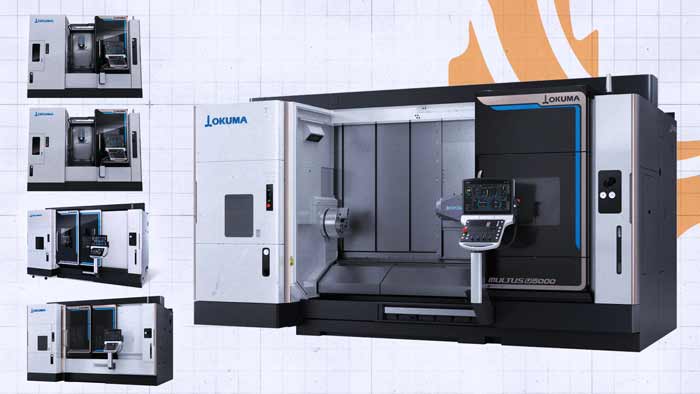
The MULTUS is Okuma's family of multitasking turn-mill machines, built around a B-axis milling head on a lathe. It runs in two branches that are not generations of each other. The BII machines, B200II through B400II, are single-saddle machines with a 225 degree B-axis, no lower turret available, and what Okuma calls a compound-motion Y-axis. The U machines, U3000 through U5000, use a traveling-column Y-axis and a 240 degree B-axis, and only the U series offers a second saddle with a lower turret. The large B550 and B750 share the 240 degree B-axis and the heavier class of construction. Both branches are current in 2026. Okuma has never published a meaning for the word MULTUS.
Every used MULTUS listing says the machine has a Y-axis. That is true on every model Okuma has built. It is also, on half the family, close to useless as information.
Okuma's own product pages for all four BII machines describe a compound-motion Y-axis on the H1 turret. It is in the B400II page title. The U series pages describe a traveling-column-type Y-axis feed instead. Those are not the same mechanism, and the difference is worth understanding before you shortlist anything.
That is the first of several places where the MULTUS badge tells you less than it appears to. The letter B covers two architectures that have almost nothing in common. The tool interface varies by region on the same model. Okuma's own page contradicts itself on the standard tool count. And one suffix, a single letter, decides whether the machine has a second spindle at all.
This breakdown works through the whole family with Okuma's published figures, then covers what to check on a used one. Because on the MULTUS, more than most families, the model name is the beginning of the question rather than the answer.
Compound-motion Y, and what it actually costs you
Okuma uses the phrase compound-motion Y-axis on the B200II, B250II, B300II and B400II product pages, and puts it in the B400II page title. It is Okuma's own language, not a dealer paraphrase. The U3000 page uses traveling column-type Y-axis feed instead, and the U brochure describes a highly rigid traveling column. Worth noting that the B550 and B750 brochure uses neither phrase.
A compound-motion Y is not an independent orthogonal slide. The Y position is produced by coordinating other motion rather than by a dedicated axis moving on its own way system. For most turn-mill work, cross-milling, off-centre drilling, flats and slots, it does the job and nobody notices.
The place buyers get caught is turning with the tool offset from centreline. A MULTUS B400W owner in a 2010 thread reported being told the machine cannot perform turning work with the Y-axis positioned anywhere other than zero. Experienced posters corrected the framing: offset-Y turning is possible, but only with a separately purchased option called Turning centre compensation, reached through a turning-position parameter and a system variable. One poster reported Okuma America telling him the function is not supported. Another in the same thread flatly disagreed, saying every Okuma Y-axis lathe supports it once the option is bought.
Two honest qualifications on that, because the distinction matters. First, this is owner and forum reporting from 2010 on a P200L machine, not an Okuma published specification, and we found no Okuma documentation of the option anywhere. Second, and more importantly, the poster who knew the option best described it as a general Okuma option gate across every Okuma Y-axis lathe, not a consequence of the compound-motion architecture. So do not read it the way we first did. The compound-motion wording is real and it is Okuma's own. The offset-Y turning gate is real too. What is not established is that one causes the other.
What is well documented is that the distinction affects buying decisions. A shop cross-shopping a B300W against competing turn-mills bought a competitor and named two reasons: the competitor machines have a true Y-axis rather than a compound Y, which they called major for maintenance reasons and which buys extended travel in Y and in X below centreline, and they offer 300 fixture offsets where they found Okuma's position to be, in their words, why would you need fixture offsets on a turning center.
None of that makes the MULTUS B a bad machine. It makes it a lathe that mills rather than a mill that turns, and those are different purchases. What it does mean is that "Y-axis: yes" in a listing has told you nothing. Get the travel figure, and find out which of the two mechanisms you are buying.
B is not an older U, and the B letter covers two different machines
The most common thing written about this family is that the U series replaced the B series. It did not. The BII brochure is dated August 2023, the B550 and B750 brochure March 2025, and the U series brochure June 2025. All three branches are current.
The deeper error is treating B as one thing. Okuma Japan's MULTUS B series page lists only the B550 and B750. The B200II through B400II sit under a separate BII series heading. And the architectures line up with that split, not with the letter:
| Group |
Models |
Architecture |
| MULTUS BII |
B200II, B250II, B300II, B400II |
Single saddle, compound-motion Y, 225 degree B-axis, no lower turret available |
| MULTUS B |
B550, B750 |
240 degree B-axis, big-bore, Capto C8 class, 520 to 660 mm of Y |
| MULTUS U |
U3000, U4000, U5000 |
Traveling column Y, 240 degree B-axis, optional second saddle with a 12-station lower turret |
Read that down the right-hand column and the real dividing line runs straight through the letter B. A B550 has more in common with a U5000 than it has with a B300II. Same 240 degree B-axis, same heavy class of construction, and 520 mm of Y travel against the B300II's 160. The BII machines are the compact single-saddle branch, and they are the odd ones out despite sharing the badge. One precision note: traveling column is Okuma's own phrase for the U series, and Okuma does not use it in the B550 and B750 brochure, so we are grouping those two by their specifications rather than by Okuma's wording.
This is not a nitpick. Okuma Europe files the B200II through B400II and the B550 together under one MULTUS B series URL path, while Okuma Japan reserves that name for the two large machines alone and Okuma America uses flat per-model URLs with no series segment at all. Three Okuma regional sites, three different groupings, and that inconsistency is almost certainly the source of every confused dealer page on this family.
There is also a pre-II generation that matters on the used market: the plain B200, B250, B300 and B400, with W sub-spindle variants, built roughly 2005 through 2012. The original brochure is no longer hosted by Okuma, so we cannot give you its publication number.
The BII spec ladder
Figures from Okuma product pages and the BII series brochure, retrieved August 2026.
| Spec |
B200II |
B250II |
B300II |
B400II |
| Max turning diameter |
600 mm / 23.62 in |
600 mm / 23.62 in |
630 mm / 24.80 in |
710 mm / 27.95 in |
| Max turning length |
550 mm / 21.65 in |
750 mm / 29.53 in |
900 mm / 35.43 in |
1,500 mm / 59.06 in |
| Spindle nose |
Ø140 flat [A2-6] |
A2-6 |
A2-6 [A2-8] |
A2-8 [A2-11] |
| Main spindle speed |
50 to 6,000 |
45 to 5,000 |
45 to 5,000 |
38 to 3,800 |
| Main spindle motor |
11/7.5 kW, 15/10 hp |
22/15 kW, 30/20 hp |
15/11 kW, 20/15 hp [22/15 opt] |
22/15 kW, 30/20 hp |
| Milling spindle, standard |
12,000 rpm [20,000 opt] |
12,000 rpm [20,000 opt] |
6,000 rpm [10,000 opt] |
6,000 rpm [10,000 opt] |
| Y travel |
160 mm / 6.30 in |
200 mm / 7.87 in |
160 mm / 6.30 in |
230 mm / 9.06 in |
| X travel |
500 mm / 19.69 in |
500 mm / 19.69 in |
580 mm / 22.83 in |
690 mm / 27.17 in |
| Z travel |
600 mm / 23.62 in |
800 mm / 31.50 in |
935 mm / 36.81 in |
1,550 mm / 61.02 in |
| B-axis |
225 degrees, 0.001 |
225 degrees, 0.001 |
225 degrees, 0.001 |
225 degrees, 0.001 |
| Rapids X and Z |
40 m/min / 1,575 ipm |
40 m/min |
40 m/min |
40 m/min |
| Lower turret |
None |
None |
None |
None |
| Mass |
7,000 kg |
7,900 kg |
10,000 kg |
15,500 kg |
One thing worth knowing before you compare a pre-II machine against a II. A 2008 B300-W data sheet gives 630 mm turning diameter, 900 mm turning length, X 580, Y 160, Z 935 and a 225 degree B-axis. That is the same working envelope as the current B300II, to the millimetre. The II is a spindle, control and tool-changer refresh. It is not a new bed and it is not more travel.
The U series and the two large machines
| Spec |
U3000 |
U4000 |
U5000 |
B550 |
| Max turning diameter |
650 mm |
650 mm |
650 mm |
830 mm / 32.68 in |
| Distance between centres |
1,000 or 1,500 mm |
1,500 or 2,000 mm |
1,500, 2,000 or 3,000 mm |
2,000 to 3,000 mm |
| Spindle nose |
A2-6 [A2-8] |
A2-8 [A2-11] |
A2-8 [A2-11] |
A2-11 std, Big-Bore option |
| Main spindle speed |
50 to 5,000 |
45 to 4,200 |
30 to 3,000 |
30 to 3,000 |
| Main spindle motor |
22/15 kW, 30/20 hp |
22/15 kW, 30/20 hp |
37/30 kW, 49/40 hp |
37/30 kW, 50/40 hp |
| Main spindle torque |
700/477 Nm |
700/477 Nm |
1,413/1,050 Nm |
1,413/1,050 Nm |
| Milling spindle |
12,000 rpm H1, 120 Nm |
12,000 rpm H1 |
12,000 rpm H1 |
5,000 std [10,000 opt] on the US page, 40 to 10,000 in the brochure |
| B-axis |
240 degrees, 0.001 |
240 degrees |
240 degrees |
240 degrees |
| Y travel |
250 mm / 9.84 in |
300 mm / 11.81 in |
300 mm / 11.81 in |
520 mm |
| Tool interface |
Capto C6 or HSK-A63 |
Capto C6 or HSK-A63 |
Capto C6 or HSK-A63 |
HSK-A100, Capto C8, BT50 |
| Lower turret |
Optional, 12 station |
Optional, 12 station |
Optional, 12 station |
None |
| Mass |
Not published |
Not published |
Not published |
29,500 to 34,000 kg |
The B750 sits above the B550: 1,050 mm maximum machining diameter, work lengths to 6,000 mm, 5,000 Nm of main spindle torque against the B550's 1,413, 660 mm of Y travel against 520, and 40,000 to 54,500 kg of machine. It is also the only machine in the family offered with a Super Big-Bore A2-20 nose. Same 240 degree B-axis, same tooling class.
The U-series mass and floor space cells say Not published because the only figures we could extract came from a table read that demonstrably misaligned its columns elsewhere. We would rather leave a hole than publish a number we do not trust.
Four specs that go the wrong way
1. The B250II has more Y travel than the larger B300II. Two hundred millimetres against 160. Step up a size class in the BII line and you lose 40 mm of Y. The B200II, two sizes down, has the same 160 mm as the B300II.
2. The B200II and B250II ship a 12,000 rpm milling spindle. The larger B300II and B400II ship 6,000. Buying up the BII ladder halves your standard milling speed. Ten thousand is available as an option on the bigger pair, and twenty thousand on the smaller pair, but the standard build moves the wrong way.
3. The U5000 has the same 650 mm maximum turning diameter as the U3000. Despite being the 37 kW, 1,413 Nm machine with the A2-11 nose option. Going up the U ladder buys torque, bar capacity and length between centres. It does not buy swing.
4. The newer, smaller BII has a narrower B-axis than the older-architecture large machines. Two hundred twenty-five degrees on the BII against 240 on the U series and on the B550 and B750. Fifteen degrees does not sound like much until it is the fifteen degrees your part needed.
A live error on Okuma's own page
Okuma's U5000 product page publishes two spindle specifications that contradict each other. The inch column reads 49/40 hp at 30 to 3,000 rpm. The metric column reads 22/15 kW at 45 to 4,200 rpm, which is the U4000's spindle. Okuma Japan's U series page and the brochure's 1,413 Nm torque figure both confirm the inch column is the correct one. Every dealer scraping that page is publishing an understated U5000 spindle. If you are comparing listings, this is why the numbers do not agree.
The suffix grammar, and the letter that costs you a spindle
Learn this before you read another listing. Nothing else on this page will save you as much money.
| Code |
What it means |
| W |
Opposing spindle. The machine has a sub-spindle. |
| C |
Centre, meaning a tailstock. No sub-spindle. |
| 1S / 2S |
One saddle or two. A 2S machine is the one that can carry a lower turret. Okuma prints no legend for these codes, so this reading comes from the configuration columns rather than from a definition. |
| BB / SB |
Big-Bore and Super Big-Bore, which Okuma prints as spec-table terms. The abbreviations themselves are trade usage, not Okuma grammar. |
| /750, /1500, /2000, /4000 |
Distance between centres in millimetres. |
| ARMROID |
Okuma's own words are a built-in robot packaged within the machine tool, rather than a bolt-on cell. |
So U3000-2SW/1500 is a two-saddle machine with a sub-spindle and 1,500 mm between centres. And B400-C has no sub-spindle at all.
That last one is the trap. Buyers assume every MULTUS is a W, because the done-in-one pitch depends on a second spindle. Okuma lists the W version as optional on every model in both brochures, and C-suffix machines are genuinely out there. We found a 2008 B400-C and a 2017 U4000 2SC in this survey. A MULTUS without a sub-spindle is a very expensive lathe with a milling head, and it cannot do the thing the category is famous for.
Tool interface, and the mistake that strands your tool crib
This is the one that costs the most money to get wrong, and it is genuinely ambiguous because Okuma's own sources disagree by region.
The BII brochure, the global document, lists HSK-A63 as standard with Capto C6 optional.
Okuma's United States product pages for the B250II, B300II and B400II say Capto C6.
The B550 and B750 brochure lists HSK-A100 standard, with Capto C8 and BT50 optional.
Every United States market used machine we inspected was specified with Capto: C6 on a 2006 B300-W, a 2007 B400-W and a 2019 U3000, and C8 on a 2010 B750-W.
Both are correct. They are regional standards, and Okuma never says so on either page. The consequence is simple and expensive: a grey-import European B300II on HSK-A63 will not accept one holder from a Capto crib, and stepping up from a B400II to a B750 changes you from a 63 class interface to a 100 class one. That is a tooling package, not an accessory.
Photograph the spindle nose. Do not take the interface from the advert.
The tool count Okuma cannot agree with itself about
The BII brochure says 20 tools standard, with 40, 60, 80 and 120 available depending on model. Okuma's United States product pages say the base offering is a 40-tool changer with a 60-tool option. On the B300II page, both statements appear on the same page in different sections.
We cannot resolve it, and we are not going to pretend otherwise. It is most likely a regional base configuration difference that neither document flags.
What the used market shows: 40 is the overwhelming norm. We also saw 60 and 80, and one anomalous machine with 12. The U series runs 40 standard with 80 and larger matrices optional, and the B550 and B750 run 40 standard with 80 and 160 optional.
A 20-pocket BII is a legitimate factory build and it would gut the done-in-one case, because a machine that has to be re-tooled between operations is not saving you setups. Count the pockets. Do not read the advert.
The B-axis head is the money, and a runout reading can lie to you
Okuma states the drive type in the U series brochure: With the NC-B axis, roller gears are used to achieve "0" backlash during B-axis drive, and highly accurate 5-axis machining. So it is a roller gear drive, not a worm set and not a torque motor. Minimum controlled increment is 0.001 degrees across the whole family.
Now the finding that changes how you inspect one. A MULTUS B300 milling spindle, oil-mist lubricated and stator driven, went to a rebuilder after a crash. The owner had measured shaft pilot runout in the machine at 0.0005 inch. On the bench, after teardown, the same spindle measured essentially zero. The rebuilder published both numbers and did not attribute the in-machine reading to anything. Read them together and the implication is that something other than the spindle, most plausibly the housing or the head it sits in, was contributing the error. That reading is ours, not the rebuilder's.
A bad runout reading on a MULTUS milling spindle does not prove a bad spindle. It may prove a bent or crashed head casting, which is a far worse and far more expensive problem. So indicate the taper with a certified test bar at several angular positions of the spindle, then rotate the bar 90 degrees in the taper and re-check. If the error follows the bar it is the bar. If it stays with the spindle clock position it is the spindle. If it changes with B angle, suspect the head or its mounting, and start asking about crash history.
Two owner-reported cost figures to calibrate what these repairs run. A gas-spring drawbar replaced at roughly ten thousand dollars, which failed again five months later. And a B-axis head realignment at six thousand five hundred dollars in labour alone, on a machine that kept losing alignment under light cuts. Those are single reports rather than a price survey, but they tell you the order of magnitude, and it is not small.
On construction, Okuma does publish something useful. The BII brochure specifies roller linear guides on X, Y and Z and claims roller linear guide rigidity 2.6 to 3.0 times that of a ball linear guide. The B550 and B750 brochure specifies large roller guides on the same three axes. The U series brochure does not carry an equivalent statement.
One thing we could not establish: Okuma publishes no B-axis clamping torque, for any MULTUS model, anywhere we could reach. So test the clamp rather than looking up a number. Clamp at a genuinely awkward angle, 45 degrees rather than 0 or 90 where the head may rest on a favourable load path, put an indicator on a test bar, and take a real milling cut with meaningful engagement in steel. Not an air pass. Then cycle clamp and unclamp twenty times at several angles and re-check. Intermittent clamp faults will not show in one cycle.
The sub-spindle handoff, and coolant in the head
Sub-spindle alignment is the failure that kills the entire done-in-one case, because a misaligned handoff puts every second-operation feature out of position. Put a test bar in the main spindle, indicate it from the sub-spindle, and traverse Z through the full approach range looking for parallelism in both planes and for the error to change with Z.
Then do it with a real part. Grip a turned bar in the main, hand it to the sub, and measure concentricity of the transferred feature. A transfer that works but shifts two thousandths is a machine that will make scrap on anything with a tight second-operation relationship.
And check the coolant path into the B-axis head, because this is the failure buyers do not look for. The milling head sits in the cut, rotates through 225 or 240 degrees, and is flooded. Every rotation works the seals. Owner reports on this family include hydraulic system contamination, thermal overheat alarms at idle, and a proposed repair involving five thousand dollars of coolant tubes.
Sample the head lubricant. Milky means water ingress, which means the seals are already gone. Confirm the seal air purge to the milling spindle is present and at pressure, because a machine that has run with the purge disabled has been drinking coolant for years. And run flood coolant for half an hour with the head at several B angles before you decide it is dry.
Turning-only history is a real question, and the answer is in MacMan
A lot of multitasking machines get bought for done-in-one and then spend a decade as expensive lathes. That history matters, because a milling spindle that never ran has unworn bearings but possibly dried grease and set seals, and a B-axis that only ever sat at zero has an unworn clamp face but an unexercised arc it never swept.
We want to be clear that the preceding sentence is mechanical reasoning, not a sourced finding. We looked for published data comparing wear on turning-only against done-in-one machines and found none.
What is sourced is where to look. Okuma OSP controls expose runtime counters, and comprehensive hour data lives under MacMan in the reports area, typically machine-on time, spindle run time and cutting time, plus per-part run times. From the P100 generation onward the control also carries spindle bearing service timers, and a machine with a tripped or reset bearing timer is telling you something.
Here is the honest gap, and it is the most useful question on this whole page: we could not confirm from Okuma documentation whether the OSP presents a separate hour counter for the milling spindle distinct from the main spindle on a MULTUS. Dealer buying guidance says to evaluate hours on both spindles separately and that imbalanced usage reveals how the machine was used, which implies the data exists. Ask an Okuma service technician before you rely on it.
Failing that, the physical tells: wear witness on the Capto or HSK coupling face, polish pattern on the B-axis arc, whether the tool magazine still holds live tooling or only turning blocks, and whether the sub-spindle jaws are worn at all. And read the program directory. A machine whose stored programs are all lathe-mode with no B-axis moves has already answered the question.
The OSP-P200 machines are Windows XP machines
Control generation, not model name, is the real age marker on this family. A 2019 B300II and a 2024 B300II are the same iron with different computers.
| Control |
Era on used MULTUS |
Notes |
| OSP-E100L |
2004 and earlier |
Rare on the used market |
| OSP-P200L |
2006 to 2012 |
Windows XP. Not listed as current on Okuma's controls page. |
| OSP-P300, P300S, P300SA |
2013 to 2021 |
Dual core, 15 or 19 inch panel |
| OSP-P300A |
Later revision |
Still listed as current alongside P500 |
| OSP-P500, P500S |
Fall 2023 onward |
Two dual-core processors, 15 or 21.5 inch touchscreen by machine size, security verification |
The bulk of the used B series sits on P200L, which puts most used MULTUS buyers in front of a Windows XP machine on a 2026 shop network. That is an IT segregation problem, not a theoretical one, and Okuma sells a virus protection subscription for OSP controls that most used buyers never budget.
On parts, the picture is better than the operating system suggests, and it is worth being precise. Okuma's electrical exchange programme covers control boards going back through the 2200, 3000, 5000, 5020, 7000, U100, E100, P100, P200, P200A and P300, which is every control on every used MULTUS. In September 2024 Okuma America announced a 35,000 square foot global service and repair facility, due to open in 2025, and stated a no-obsolescence policy, saying it is dedicated to providing service for the lifetime of all Okuma machines regardless of age. And the family is still in production, so a 2007 B400-W's direct descendant is still being built.
Against that, an independent OSP repair house assesses the P200 in 2026 as late-life: parts still supported through Okuma channels for most board items, but some components heading toward aftermarket only. Their most common single failure on these controls is the hard drive, with thermal-cycling failure of the MMC board second. Budget for a drive, and get whatever restore media exists with the machine.
Post processors are a line item, not a contingency
Okuma says it has developed post processors in cooperation with major CAM makers that can be used globally, and names eight partners. That is Okuma's framing. The CAM vendor's own support forum tells a more complicated story for these specific machines.
Documented problems on the public forum for MULTUS posts include default X-axis limits that are wrong out of the box, the OSP-200 three-line tool change sequence that current posts do not handle, significant differences in tool management between the OSP-200 and OSP-300 generations, users manually stripping codes, posts released in a gathering-support status, and one line that matters enormously if you bought a two-saddle machine: the post does not currently fully support a lower turret.
Read that last one against the earlier section. The lower turret is the U series' signature capability, the one thing the BII cannot do at any price, and it is the thing the generic post admits it cannot fully drive. If you are buying a 2S machine specifically for balanced cutting, get a written answer on the post before you wire funds.
The friction is worse on a used machine than a new one for three reasons. The used fleet is heavily P200, which the posts handle worst. A used machine arrives without distributor-led commissioning. And the two-saddle machines land exactly in the gap the posts acknowledge.
What is standard, what is optional, and what nobody will tell you about licences
Thermo-Friendly Concept is standard on every MULTUS, implemented as TAS-C for the structure and TAS-S for the spindle. That matters more than it sounds, because thermal drift over a shift is the specific complaint owners raise most often about competing turn-mills, and Okuma includes the countermeasure rather than selling it.
Collision Avoidance System is where it gets murky. The BII brochure lists CAS under optional specifications and accessories. The United States U3000 page lists it as standard. Another contradiction we cannot resolve, so verify per machine rather than assuming either way.
One caveat on CAS straight from Okuma that used buyers should read twice: if the entered tool, fixture or workpiece shapes differ from their actual dimensions, CAS will not accurately detect possible collisions. A used machine's collision model library is only as good as the last owner's discipline. Assume it is wrong and rebuild it.
Machining Navi and 5-Axis Auto Tuning are optional on both branches. The latter is the most valuable option on the list for a used buyer, because it compensates up to eleven geometric errors including volumetric accuracy in about ten minutes, and geometry is exactly what you are worried about on a used B-axis machine.
Then the gap. Nobody publishes whether these software entitlements transfer on resale. Okuma's app store publishes no licensing terms at all, no statement about serial binding or account binding or transfer. Okuma's service pages make no statement about second owners. We found no forum thread and no dealer page that addresses it either. What is established is that the technologies are machine options configured at build and they live on the control, so what the machine had it still has. Whether the associated entitlements follow the machine or the account is unknown, and we would rather tell you that than guess.
One thing we can put to rest: we found no evidence that Okuma restricts service, parts or parameters on machines that changed hands. We looked for it specifically. The parts exchange programme covers every control generation without an ownership condition, and the no-obsolescence statement carries no original-owner clause. Forum threads about locked parameter pages exist, and the answers given are about turning on display settings, not about ownership gates.
Why there is no price band in this article
Because the dispersion is the finding, and a range would hide it.
Two 2006-vintage B300-W machines carried asking prices of roughly one hundred fifty-seven thousand euros and sixty thousand euros. Same model, same year. That is a 2.6 times spread. A 2007 B400-W was asked at ninety-seven thousand five hundred dollars in North America and about one hundred fifty-nine thousand euros in Denmark. Four separate 2007 B400-W machines carried North American asking prices from ninety-seven thousand five hundred to one hundred twenty-nine thousand five hundred, and a 2008 B300-W went into a liquidation channel at twenty-eight thousand.
Every one of those is an asking price. None is a market value, an appraisal or a transaction record.
And there is nothing to anchor them against. We found no published auction result for any MULTUS. Two auctions we located, one in May 2017 and one in October 2023, both state the auctioneer chose not to publish the price of the lot. Anyone quoting a MULTUS auction figure is quoting something we could not find.
Supply, for what it is worth without pretending to a total: two independent marketplace datasets each returned roughly forty-odd MULTUS listing slots across two dozen different model spellings, and both reproduced the same rough three to one B-series to U-series ratio. The B machines cluster 2006 to 2012 and the U machines cluster 2014 to 2021, with 2013 and 2020 almost invisible. Anything from 2022 onward is an overcapacity resale rather than a worn-out machine.
Resell CNC Take
The MULTUS is a well-built machine whose badge does an unusually poor job of describing what you are buying. Two branches share a letter and do not share an architecture. A single suffix decides whether there is a second spindle. The tool interface changes by region on the same model. Okuma's own page argues with itself about the tool count, and its U5000 page publishes the wrong spindle in one column. None of that makes it a bad buy. It makes it a machine you cannot shop from a spec block. If your parts need op-one to op-two positional integrity that a re-fixture would destroy, this family earns its keep and the Thermo-Friendly package is a real advantage over the competition on a long shift. If they do not, buy a lathe and a mill and keep the difference, because most shops that buy a used mill-turn did not need one, which is exactly why so many of these machines spend their lives as expensive lathes.
The honest counter-case
Against a competing turn-mill with a true Y-axis. This is the comparison where the honest answer is often not the Okuma. For milling-heavy work with high tool-change counts and lots of fixture offsets, a machine with an orthogonal Y and a larger offset table is the better architecture, and at least one shop cross-shopping a B300W said exactly that and bought the other machine. For turning-heavy work with milling features, the MULTUS holds up.
Against a used machine from the largest-installed-base competitor. That competitor gives you more comparables, more independent technicians, more used tooling and easier resale. On a MULTUS you are often the only bidder, which cuts both ways. What the Okuma gives back is thermal control as standard equipment and a manufacturer with a published no-obsolescence policy and one global parts channel.
Against a used Okuma lathe plus a separate machining centre. The split is dramatically cheaper, has no single point of failure, needs no multi-channel post processor and no six to twenty-four month learning curve, and gives you two machines running two jobs. The one thing it cannot deliver is the positional relationship between first-operation and second-operation features. If the print requires a cross-hole located from the turned bore within a few tenths, the re-fixture introduces error the MULTUS never sees. That is the only argument for a mill-turn that a lathe and a mill cannot answer, and it is decisive when it applies.
Against a newer machine. The P200 problem is the whole argument. A 2006 to 2012 MULTUS is a Windows XP machine whose most common failure is its hard drive and whose boards an independent shop calls late-life in 2026. Meanwhile 2021 to 2023 machines exist on the used market right now.
What to demand before you wire funds
The full model string off the plate, not the advert. Suffixes decide the sub-spindle, the saddle count, the bore class and the length between centres. Listings garble all four.
A photograph of the spindle nose. Capto or HSK, and which size. This is a tooling package, not a detail.
The MacMan report screen, photographed. Machine-on time, spindle run time and cutting time. Ask specifically whether the milling spindle carries its own counter.
A pocket count on the tool magazine. Not the number in the advert.
A real milling cut with the B-axis clamped at 45 degrees, with an indicator watching. Then twenty clamp and unclamp cycles at several angles, re-checked.
Taper runout at several spindle clock positions and at several B angles. If the number moves with B, you are looking at the head, not the spindle.
A part-transfer test with a real part, measuring concentricity of the transferred feature, not just a demonstration that the handoff happens.
A sample of the B-axis head lubricant, and confirmation the seal air purge is live and at pressure.
The alarm history, and a direct question about B-axis service and any head realignment. A seller who has paid for one usually has the paperwork. A seller who will not discuss it has answered.
A written answer on the post processor, and on the lower turret specifically if the machine has one.
Shopping a Used MULTUS?
See our Okuma inventory.
Tell us the parts you want to run and our team, with 200+ years of combined industry experience and four AMEA and CEA certified appraisers on staff, will match you to the right MULTUS branch, suffix and control generation, and confirm a used one is built the way its tag claims.
See Used Okuma Machines
Frequently asked questions
What does MULTUS stand for on an Okuma?
Nothing that Okuma has ever published. We checked the BII series brochure, the U series brochure, the B550 and B750 brochure, Okuma Japan's product pages, Okuma America's model pages, the Multitasking Machining Guide, the 2014 and 2018 press releases and the control history pages, and none of them defines the word. The Latin word multus means many, and that is very likely the origin, but it is an inference and not an Okuma statement. Any dealer page giving you a confident expansion is giving you an unsourced one.
What is the difference between an Okuma MULTUS B and a MULTUS U?
Less than the letters suggest and more than most listings admit. The real split runs through the B letter. The BII machines, B200II through B400II, are single-saddle machines with a compound-motion Y-axis, a 225 degree B-axis and no lower turret available at any price. The U machines and the large B550 and B750 use a traveling-column Y-axis and a 240 degree B-axis, and only the U series offers a second saddle with a 12-station lower turret. Architecturally a B550 has more in common with a U5000 than with a B300II. Neither branch replaced the other and both are current in 2026.
Does the Okuma MULTUS B have a real Y-axis?
It has a Y-axis, and Okuma's own product pages for all four BII machines call it a compound-motion Y-axis rather than an independent orthogonal slide. That wording is Okuma's own and it appears in the B400II page title. For cross-milling, off-centre drilling, flats and slots the axis does the job. Separately, owners report that turning with the tool offset from centreline requires a purchased option called Turning centre compensation, with one poster saying Okuma America told him the function is not supported and another in the same thread saying every Okuma Y-axis lathe supports it once the option is bought. Note that the second poster described that gate as applying across all Okuma Y-axis lathes, so it is not established that the compound-motion design causes it. Get the Y travel figure and find out which mechanism you are buying.
What does the W mean on an Okuma MULTUS?
W means opposing spindle, so the machine has a sub-spindle. The letter that matters more is C, which means the machine has a tailstock and no sub-spindle at all. Okuma lists the W version as optional on every model in both brochures, and C-suffix machines genuinely exist on the used market. Buyers assume every MULTUS is a W because the done-in-one pitch depends on the second spindle. A C machine is a very expensive lathe with a milling head, and it cannot do the thing the category is famous for.
How many tools does an Okuma MULTUS hold?
Okuma's own documents disagree. The BII brochure says 20 standard with 40, 60, 80 and 120 optional depending on model. Okuma's United States product pages say the base offering is 40 with a 60 option, and on the B300II page both claims appear on the same page. It is most likely a regional base configuration difference that neither document flags. On the used market 40 is the overwhelming norm, with 60 and 80 also seen. A 20-pocket machine is a legitimate factory build and it would undermine the done-in-one case, so count the pockets rather than reading the advert.
Which Okuma MULTUS has a lower turret?
Only the U series, and only in a two-saddle configuration. It is a 12-station turret, available as a direct-mount turning turret or as a multitasking version with live tooling. No BII machine offers one at any price, and the B550 and B750 do not have one either. A listing advertising a lower turret on a MULTUS B is either wrong or is describing the H1 milling turret. One practical warning: the widely used generic CAM post for these machines states that it does not currently fully support a lower turret, so get a written answer on programming before you pay for that capability.
Is an OSP-P200 MULTUS still supported in 2026?
Yes, but it is late-life and you should price that in. Okuma's electrical exchange programme covers boards back through the P100 and P200 generations, and Okuma America announced a 35,000 square foot global service and repair facility in September 2024, due to open in 2025, stating a no-obsolescence policy covering all machines regardless of age. Against that, an independent OSP repair house assesses the P200 in 2026 as still supported for most board items with some components heading toward aftermarket only. Their most common single failure is the hard drive. The P200 is also a Windows XP platform, which is a network segregation problem on a 2026 shop floor.
Does a used Okuma MULTUS do simultaneous 5-axis machining?
Do not assume it does. Okuma's own 2018 U3000 press release describes optional 5-axis machining as available for complex milling operations, which makes it an option rather than a universal capability. The U series brochure references the NC-B axis in its feature text and also lists it among standard specifications, and one reading of the optional lists puts it there too, so Okuma's own material is not clean on the point. We are not going to build a rule out of that. What is clear is that Okuma itself calls 5-axis machining optional, which makes it a real money question. Confirm it on the specific machine's option list rather than on the model name.
About the Author
Bill Murphy is the Marketing and Content Lead at Resell CNC. The CNC Family Breakdown series maps out entire machine families, decoding the model numbers, suffixes, and configurations so buyers can tell one version from the next. Every figure in this article is attributed to the source that publishes it, figures that exist on only one source are identified, and specifications no manufacturer publishes are named rather than filled in.
About Resell CNC
Resell CNC has bought and sold used CNC machinery since 2008. Based in Maitland, Florida, with warehouses in Winter Springs and Longwood, the team brings more than 200 years of combined industry experience and four AMEA and CEA certified equipment appraisers on staff. Resell CNC has been an MDNA member since 2009 and is the only used CNC dealer in North America with Official Mazak Trade-In Center status.
Sources
- Okuma MULTUS BII series brochure, publication number MULTUS B2 Series-E-(14a)-300, August 2023, and the earlier MULTUS B2 series-E-(12a)-400, November 2019. Model roster, travels, turning diameters and lengths, spindle noses and speeds, milling spindle speeds, B-axis range of 225 degrees and 0.001 degree increment, Y travels, rapid traverse rates, machine masses, roller linear guides on X, Y and Z, tool magazine standard of 20 with options, HSK-A63 standard with Capto C6 optional, and the standard and optional equipment lists including Thermo-Friendly Concept as standard and Collision Avoidance System as optional.
- Okuma MULTUS U series brochure, June 2025, OSP-P500 edition. Turning diameters and distances between centres, spindle noses, speeds, motor ratings and torque figures, the 12,000 rpm H1 milling spindle, B-axis range of 240 degrees, Y travels, rapid traverse rates, tool magazine capacities, the configuration codes, the statement that roller gears are used to achieve zero backlash during B-axis drive, and the NC-B axis appearing in both the standard specification list and, on one reading, the optional list.
- Okuma MULTUS B550 and B750 brochure, publication number MULTUS B550/750-E-(12b)-100, March 2025. Maximum machining diameters, work lengths, chuck and nose options including big bore and super big bore, spindle speeds and motor ratings, main spindle torque figures, milling spindle speeds and torque, B-axis range, X, Y and Z travels, HSK-A100 standard with Capto C8 and BT50 optional, large roller guides on X, Y and Z, tool magazine capacities, machine masses and floor space, and the Super Big-Bore A2-20 nose offered on the B750.
- Okuma product pages for the MULTUS B200II, B250II, B300II, B400II, B550, U3000, U4000 and U5000, retrieved August 2026, plus Okuma Japan's MULTUS B series and MULTUS U series pages and Okuma Europe's B250II, B300II and U3000 pages. The compound-motion Y-axis wording on the B-series pages, the traveling-column Y-axis wording on the U-series pages, the Okuma Japan B series page listing only the B550 and B750, per-model spindle and travel figures, Capto C6 on the United States pages, the conflicting tool magazine statements on the B300II page, and the internally inconsistent U5000 spindle columns.
- Okuma press releases. The MULTUS U series announcement of 7 March 2014, the U3000 accuracy release of 13 March 2018 including the statement that optional 5-axis machining is available for complex milling operations, the OSP-P500 debut of 7 September 2023 with Americas availability from Fall 2023, and and the 11 September 2024 announcement of plans to construct a 35,000 square foot global service and repair facility to open in 2025, with the stated no-obsolescence policy.
- Okuma CNC control pages, the History of the P-Control article, and Okuma's parts exchange programme listings. Control generation sequence, the current controls page listing only OSP-P300A and P500, processor and panel specifications by generation, and the electrical exchange coverage spanning the 2200, 3000, 5000, 5020, 7000, U100, E100, P100, P200, P200A and P300 controls, plus the mechanical exchange categories covering B-axis units, spindle assemblies and tool changer components.
- Okuma technology pages for Thermo-Friendly Concept, Collision Avoidance System, Machining Navi and the 5-Axis Auto Tuning System, and the Okuma app store. The TAS-C and TAS-S implementations, the CAS caveat that entered tool, fixture and workpiece shapes differing from actual dimensions will prevent accurate collision detection, the 5-Axis Auto Tuning compensation of up to eleven geometric errors in approximately ten minutes, Okuma's statement that it has developed post processors in cooperation with major CAM makers, naming eight partners, and the complete absence of published licensing or transfer terms on the app store.
- CAM vendor public post-processor support forum threads for MULTUS machines, retrieved August 2026. Generic posts existing for the B200II, B250II, B300II, B400II, B550, B750, U3000 and U4000 in c and w variants, incorrect default X-axis limits, the OSP-200 three-line tool change sequence not being handled, significant tool management differences between the OSP-200 and OSP-300 generations, posts released in a gathering-support status, and the statement that the post does not currently fully support a lower turret.
- Independent spindle rebuilder case documentation on a MULTUS B300 milling spindle, described as oil mist lubricated and stator driven and capable of 10,000 rpm, recording shaft pilot runout of 0.0005 inch measured in the machine against essentially zero measured on the bench after teardown, with no attribution given for the in-machine reading, and noting tooling wear on the Capto insert. The inference that the housing or head contributed the error is ours.
- Independent OSP control repair house assessment, 2026. OSP-P200 parts still supported through Okuma channels for most board items with some components heading toward aftermarket only, hard drive failure identified as the most common single issue and MMC board thermal cycling failure second.
- Machinist forum threads on MULTUS ownership, accessed via public mirrors. The report that the machine cannot perform turning work with the Y-axis positioned anywhere other than zero, the Turning Center Compensation option and the associated turning-position parameter and system variable, the report that Okuma America said the function is not supported, and the rebuttal in the same thread that every Okuma Y-axis lathe supports offset-Y turning once the option is purchased, the shop that cross-shopped a B300W and cited a true rather than compound Y-axis, described as major for maintenance reasons, and a 300-offset fixture pool as deciding factors, the gas-spring drawbar replaced at approximately ten thousand dollars that failed again five months later, the B-axis head realignment at six thousand five hundred dollars in labour, Y-axis positioning drift of five to ten thousandths on a problem machine, hydraulic system contamination and thermal overheat alarms at idle, the MacMan reports area and the spindle bearing service timers carried from the P100 generation onward, and the confirmation that the OSP-P200 is a Windows XP platform.
- Used machinery marketplaces, aggregator model indexes, auction platforms and dealer inventory pages, surveyed August 2026. Per-platform MULTUS listing counts and model spellings, the approximate three to one B-series to U-series ratio reproduced independently on two platforms, model years observed from 2004 to 2023 with concentrations from 2006 to 2012 and 2014 to 2021, observed asking prices in North America and Europe, tool magazine and tool interface configurations observed on individual machines, the 2008 B400-C and 2017 U4000 2SC without sub-spindles, aftermarket through-spindle coolant installations, and two auctions where the auctioneer chose not to publish the price of the lot.
- Machine-specific data sheet for a 2008 MULTUS B300-W on an OSP-P200L control, giving 630 mm turning diameter, 900 mm turning length, 5,000 rpm, 15 kW, a 225 degree B-axis, X 580 mm, Y 160 mm and Z 935 mm, used here to establish that the pre-II working envelope matches the current B300II.
- Not established from any source and therefore not stated in this article: any Okuma published meaning for the word MULTUS, B-axis clamping torque, machine mass and floor space for the U series, launch and discontinuation dates for individual models, the publication number of the pre-II B series brochure, whether the OSP presents a separate hour counter for the milling spindle, whether Okuma software entitlements transfer on resale, whether an older OSP can be upgraded to a newer generation, through-spindle coolant pressure levels offered by Okuma for this family, any market or transaction value, any auction hammer price, and any unique unit count on the used market. Several manufacturer domains, one major machinist forum and one major listing aggregator returned 403 to automated requests during this research, and one brochure table extraction misaligned its columns badly enough that the affected figures were discarded rather than published.