Meet the Machine
Used Doosan DNM 500: The Belt-Drive DNM Before the Rename
What is the Doosan DNM 500?
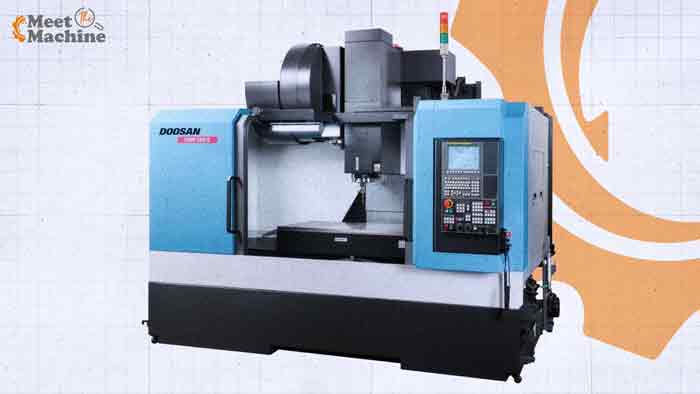
The Doosan DNM 500 is a 40 taper vertical machining center from the first two generations of Doosan's DNM series, with 1,020 by 540 by 510 mm of travel (40.2 by 21.3 by 20.1 inches), a 1,200 by 540 mm table rated for 800 kg, a belt driven spindle and a 30 tool changer. Doosan Infracore built it as the DNM 500 and, from 2014, the DNM 500 II. In 2016 the 40 taper line moved to four digit names, and the machine that took its place in the size class, the DNM 5700, is larger and uses a direct coupled spindle. It is a successor, not a renamed DNM 500.
In 2016 Doosan moved its 40 taper DNM machines to four digit names. The DNM 500 did not get a new badge. It gave way to the DNM 5700, a different machine in the same slot, and on a used listing the two are easy to confuse.
They share a family name, a Z travel of 510 mm and the same rapids. Then they part ways. The 5700 has 30 mm more X, 30 mm more Y, a direct coupled spindle and a newer control. The DNM 500 has a belt.
That belt is the first thing to understand about a used DNM 500. It shapes what the machine is good at, what goes wrong with it, and what a fair inspection looks like. Our breakdown of the whole DNM family decodes every model in the line. This piece is about one machine in it.
Two Generations, Then the Rename
The DNM series was on the market by 2009, the year DN Solutions says it was chosen as one of Korea's best in class technologies. At the time the builder was Doosan Infracore, the name the old Daewoo machine tool business carried from 2005. The DNM 500 was built through two generations before the line changed its naming.
| Generation |
Years |
Size class model |
Spindle drive |
Controls |
| First |
By 2009 to 2014 |
DNM 500 |
Belt driven, grease packed |
Fanuc 0i-MC, 0i-MD |
| Second |
2014 to 2016 |
DNM 500 II |
Belt driven, grease packed |
Fanuc 0iM, Heidenhain iTNC530 or Siemens 828D |
| Four digit |
From 2016 |
DNM 5700 |
Direct coupled |
Doosan Fanuc i, Siemens 828D or Heidenhain TNC620 on later machines |
The company name moved with the machines. The business became Doosan Machine Tools in 2016 and DN Solutions in 2022, so a DNM 500 dates to roughly the Doosan Infracore years, and a DNM 5700 can carry any of the later names.
One exception is worth knowing: the 50 taper DNM 500/50 II kept its three digit name through the switch and beyond. This article is about the 40 taper machine.
The important line in that table is the third one. Doosan did not rename the DNM 500. It replaced it with a bigger machine that sits in the same place in the catalog.
DNM 500 Against the DNM 5700
Here is the three digit machine next to the third generation machine that replaced it, from Doosan's published figures.
| Specification |
DNM 500 and 500 II |
DNM 5700 (third generation) |
| X travel |
1,020 mm (40.2 in) |
1,050 mm (41.3 in) |
| Y travel |
540 mm (21.3 in) |
570 mm (22.4 in) |
| Z travel |
510 mm (20.1 in) |
510 mm (20.1 in) |
| Rapids, X / Y / Z |
36 / 36 / 30 m/min |
36 / 36 / 30 m/min |
| Spindle drive |
Belt |
Direct coupled |
| Grease lubrication on roller guideways |
Not listed in the first generation catalog |
Standard, listed as new to the series |
The travel difference is small on paper and not small on a fixture. Thirty millimeters of Y is 1.2 inches, and a vise or fixture plate sized to the full Y of a 5700 will not fit a DNM 500. If you are replacing one with the other, measure what you run, not what the badge implies.
It also explains a common listing error. A DNM 500 described with 41.3 inches of X is carrying the 5700's figure, because 1,050 mm is 41.3 inches and 1,020 mm is 40.2. If a listing's X travel does not match its model, ask which one the numbers came from.
The current machine has moved further. DN Solutions lists the DNM 5700 4th at 42 m/min on X and Y and 36 m/min on Z, an 8,000 rpm direct coupled spindle at 18.5 kW and 117.8 N·m, and the same 510 mm of Z the DNM 500 had.
The Belt
The standard DNM 500 spindle is belt driven with grease packed bearings. When Doosan launched the third generation, its catalog introduced the direct coupled spindle as standard and said it reduces vibration and noise compared with the belt drive type. That is the builder describing its own previous machine.
It is worth being precise about what the belt does and does not cost you. Our DNM family breakdown lists 117.1 N·m as the top torque figure for the 40 taper three digit machines. DN Solutions lists 117.8 N·m for the current DNM 5700 4th. The torque figures sit within a newton meter of each other. What changed was how the motor reaches the spindle.
For a buyer, that makes the belt a maintenance item rather than a capability problem. A belt and pulleys are wear parts, and a belt driven spindle with grease packed bearings avoids the air and oil supply and the rebuild cost of an integral spindle. The trade is the vibration and noise Doosan pointed to when it changed the design.
The DNM 500HS is the exception. Its spindle is an integral motor design lubricated by air and oil, documented at 15,000 rpm. Doosan's first generation catalog lists 48 m/min rapids on all three axes for the HS models. It is a different machine to inspect and a more expensive one to rebuild, so read the HS on the plate before you read anything else.
Resell CNC Take
Buy a DNM 500 for what it is: a belt driven 40 taper VMC with a 540 mm Y and about the same published torque as the current DNM 5700. Do not pay 5700 money for it, and do not walk away from it because it is not a 5700. Check the belt, check the ballnut lubrication, measure the travels, and price it against other three digit DNMs.
What Doosan Published for the First DNM
Doosan's first generation catalog for the DNM 400, 500 and 650 is specific about what it changed from the machine before it.
Rapids went to 36 m/min on X and Y and 30 m/min on Z, 1,417 and 1,181 inches per minute, on linear guideways with high speed servo motors. The ballscrew nut got a cooling jacket, and the machine got an oil cooler. Tool change time dropped to 1.3 seconds tool to tool from 1.5 on the previous model, with 30 tools standard and 40 optional. In Doosan's own aluminum test with 14 tools, the DNM 500 cut non cutting time by 19 percent against the previous model.
The same catalog published machining tests on the DNM 500 itself.
| Operation |
Material |
Conditions |
Result |
| 80 mm face mill, 6 inserts |
Carbon steel (SM45C) |
1,500 rpm, 2,700 mm/min |
432 cm³/min (26.4 in³/min) |
| 80 mm face mill, 6 inserts |
Gray iron (GC25) |
1,500 rpm, 3,600 mm/min |
691 cm³/min (42.2 in³/min) |
| 51 mm U drill |
Carbon steel (SM45C) |
750 rpm, 84 mm/min |
172 cm³/min (10.5 in³/min) |
| M30 x 3.5 tap |
Carbon steel (SM45C) |
212 rpm, 742 mm/min |
Completed |
| Finish surface |
Not stated |
8,000 rpm, 1,000 mm/min |
Ra 0.12 µm |
Those are builder figures under builder conditions, and the catalog says as much. They are still useful for one thing: an M30 tap and a 51 mm U drill in carbon steel tell you this belt driven 40 taper machine was built to do real steel work, not just aluminum.
The Numbers Underneath
Specifications vary by year and build, so pull the sheet for the exact serial number in front of you. These are the published figures for the DNM 500 and DNM 500 II.
| Specification |
DNM 500 / 500 II |
| Travels, X / Y / Z |
1,020 / 540 / 510 mm (40.2 / 21.3 / 20.1 in) |
| Table |
1,200 x 540 mm (47.2 x 21.3 in) |
| Max table load |
800 kg (1,764 lb) |
| Taper |
No. 40 |
| Spindle |
Belt driven, 8,000 rpm standard on the DNM 500 II, 12,000 rpm spindles also found on used machines |
| Spindle motor |
15 kW (20.1 hp) on the DNM 500 II published spec |
| Max torque, 40 taper three digit machines |
117.1 N·m |
| Rapids, X / Y / Z |
36 / 36 / 30 m/min (1,417 / 1,417 / 1,181 ipm) |
| Tool storage |
30 tools, 40 optional |
| Tool change, tool to tool |
1.3 sec (first generation catalog) |
| Guideways |
Linear |
Two lines are worth confirming on any specific machine. The spindle speed, because 8,000 and 12,000 rpm machines both turn up and the listing does not always say which. And the tool count, because 30 and 40 pocket machines look alike from the front.
Which Control You Are Getting
The badged controls on the DNM are Fanuc. Early machines ran Fanuc 0i-MC or 0i-MD. The DNM 500 II, from 2014 to 2016, added Heidenhain iTNC530 and Siemens 828D as options alongside Fanuc 0iM. Later four digit machines moved to Doosan Fanuc i, Siemens 828D or Heidenhain TNC620.
On a used DNM 500, read the control off the screen and the cabinet, not the listing. Networking is the other line to know: MTConnect, OPC UA and 2 GB of program memory appear as explicit catalog options only from the fourth generation, so a DNM 500 will not have them from the factory.
It Is Not a Mynx Either
The other confusion on the used market is with the Mynx line, which Doosan built alongside the DNM and which can have near identical travels. The difference is the ways. The DNM runs on linear guideways, and the Mynx uses a box guideway structure. If a listing is vague about which one it is, the ways will tell you, and the travel numbers will not. The family breakdown has the side by side.
U.S. Parts and Service
Doosan machines are supported in the United States by DN Solutions America and a dealer network, with Ellison Technologies as a major distributor. The wear parts on a DNM 500 are the belt and pulleys, way covers and wipers, ballnut lubrication lines and tool changer components, so ask the seller what has been replaced and when. More on the company in our Doosan brand profile.
Used-Market Value
Five things move the number on a used DNM 500.
Generation. A first generation DNM 500 or a DNM 500 II, and which control it carries.
Spindle. 8,000 or 12,000 rpm on the standard belt driven machine, or the integral HS spindle, which changes both what the machine can do and what a rebuild costs.
Tool storage. 30 or 40 pockets.
What is fitted. Probing, a fourth axis or fourth axis wiring, through spindle coolant and a chip conveyor all add value on a machine this size.
Condition of the belt, the ballnuts and the changer. These are the parts that wear on this machine, and they are the ones a quick walkaround skips. Our family breakdown explains why we do not publish a price band for the DNM line: the public asking prices are too scattered and too thin to support one.
What to Check on a Used DNM 500
Read the plate and measure the travels. Confirm DNM 500, DNM 500 II or DNM 500HS, the year and the serial number. If the X travel is 1,050 mm, you are looking at a 5700.
Inspect the spindle drive. Look at the belt and pulleys for wear and glazing, check tension, then run the spindle from low speed to its maximum and listen for belt noise, vibration and bearing noise at the top.
Check the taper. Indicate taper runout and inspect the drawbar and grippers.
Listen in rapid traverse. Run each axis at full rapid. On this family a rough grinding noise in rapid has been traced to a pinched, bent or broken lubrication line starving the ballnut. It is cheap to fix early and expensive to fix late.
Cycle the tool changer. Every pocket, not a sample, and watch the arm at the swap.
Look at the ways and covers. Check the way covers for damage and the wipers for wear, and look for chips packed where they should not be.
Confirm the control and options. Probing, fourth axis and through spindle coolant should be shown working, not just listed.
Who Runs One
The DNM 500 is a general purpose job shop VMC. Doosan designed the later DNM series around high speed, high rigidity and suitability for universal applications, and the DNM 500's own cutting tests covered steel, gray iron and aluminum on the same machine.
It suits a shop that needs a 40 taper machine with a 47 inch table and a 540 mm Y for general work, and that would rather maintain a belt than pay for a newer spindle it does not need. It is a weaker fit for a shop whose parts need the 5700's extra 30 mm of Y, or that wants the lower vibration and noise Doosan claimed for the direct coupled spindle.
For another Doosan vertical built around a different idea, our Meet the Machine on the Doosan DMP 500/2SP covers the two spindle machine.
Looking for a used Doosan?
See what we have on the floor.
Every machine we sell is backed by a team with 200+ years of combined industry experience and four AMEA and CEA certified equipment appraisers on staff.
Browse Used Doosan
Frequently Asked Questions
What is the Doosan DNM 500?
A 40 taper vertical machining center with 1,020 by 540 by 510 mm of travel (40.2 by 21.3 by 20.1 inches), a 1,200 by 540 mm table rated for 800 kg, a belt driven spindle and a 30 tool changer with 40 optional. Doosan Infracore built it in two generations, the DNM 500 and, from 2014, the DNM 500 II, before the 40 taper line moved to four digit names in 2016.
Is the Doosan DNM 5700 the same machine as the DNM 500?
No. The DNM 5700 is the successor in the same size class, not a renamed DNM 500. It has 1,050 mm of X travel against 1,020, 570 mm of Y against 540, and a direct coupled spindle where the three digit machines are belt driven. A listing that gives a DNM 500 41.3 inches of X is quoting the 5700.
What are the travels of a Doosan DNM 500?
1,020 mm of X, 540 mm of Y and 510 mm of Z, or 40.2 by 21.3 by 20.1 inches. The table is 1,200 by 540 mm, 47.2 by 21.3 inches, rated for 800 kg or 1,764 lb. The DNM 500 and DNM 500 II share the same published envelope.
Is the Doosan DNM 500 spindle belt driven?
Yes, on the standard 40 taper machines. The three digit DNM machines are belt driven with grease packed spindle bearings. Doosan's third generation catalog introduced the direct coupled spindle as standard and said it reduces vibration and noise compared with the belt drive type. The DNM 500HS is the exception, with an integral motor spindle lubricated by air and oil.
What is the difference between the DNM 500 and the DNM 500 II?
The published travels and table are the same, 1,020 by 540 by 510 mm on a 1,200 by 540 mm table. The DNM 500 II is the second generation, built from 2014 until the move to four digit names in 2016, and it was offered with Fanuc 0iM, Heidenhain iTNC530 or Siemens 828D controls. Earlier DNM machines ran Fanuc 0i-MC or 0i-MD.
What is the Doosan DNM 500HS?
The high speed version of the DNM 500. Its spindle is an integral motor design lubricated by air and oil, documented at 15,000 rpm, rather than the belt driven spindle on the standard machine. Doosan's first generation catalog lists 48 m/min rapids on all three axes for the HS models, against 36, 36 and 30 m/min on the standard machines. Integral spindles cost materially more to rebuild.
What control does a Doosan DNM 500 have?
It depends on the generation. Early DNM machines ran Fanuc 0i-MC or 0i-MD. The DNM 500 II, from 2014 to 2016, was offered with Fanuc 0iM, Heidenhain iTNC530 or Siemens 828D. Confirm the exact control and its enabled options on the machine rather than from the listing.
Is the Doosan DNM 500 a Mynx?
No. The DNM and Mynx lines can have similar travels, but the DNM uses linear guideways while the Mynx uses box guideways. Check the ways, not the travel numbers, if a listing is unclear about which one you are looking at.
What should you check on a used Doosan DNM 500?
Confirm the model plate and generation, and measure the travels, since 1,020 mm of X means a DNM 500 and 1,050 mm means a DNM 5700. Inspect the spindle belt and pulleys, run the spindle through its range, and check taper runout. Listen in rapid traverse for ballnut noise, which on this family has been traced to a starved ballnut lubrication line. Cycle every tool pocket and confirm the control and options work.
About the Author
Bill Murphy is the Marketing and Content Lead at Resell CNC, where he writes about used CNC machinery, machine tool history and what the spec sheet does not tell a buyer.
About Resell CNC
Resell CNC has bought and sold used CNC machinery since 2008. Based in Maitland, Florida, with warehouses in Winter Springs and Longwood, the team brings more than 200 years of combined industry experience and four AMEA and CEA certified equipment appraisers on staff. Resell CNC has been an MDNA member since 2009 and is the only used CNC dealer in North America with Official Mazak Trade-In Center status.
Sources
- Doosan Infracore, DNM series catalog, DNM 400, 500 and 650 with HS versions, first generation.
- Doosan, DNM 4500, 5700 and 6700 series catalog, third generation, 2016.
- DN Solutions, DNM 5700 4th product page, dn-solutions.com, accessed September 2026.
- DN Solutions, company history, dn-solutions.com, accessed September 2026.
- DNM 500 II published specifications, as reproduced in distributor product data (Machine 500).
- Resell CNC, Doosan DNM: The Number Is the Table Width, and It Tells You Nothing Else.
- Resell CNC, Doosan and the Workhorse That Outlived Its Own Name, CNC Brand Profile.