Meet the Machine
Used Hurco VM10i: Nine Hundred Pounds Under the Same Name
What is the Hurco VM10i?
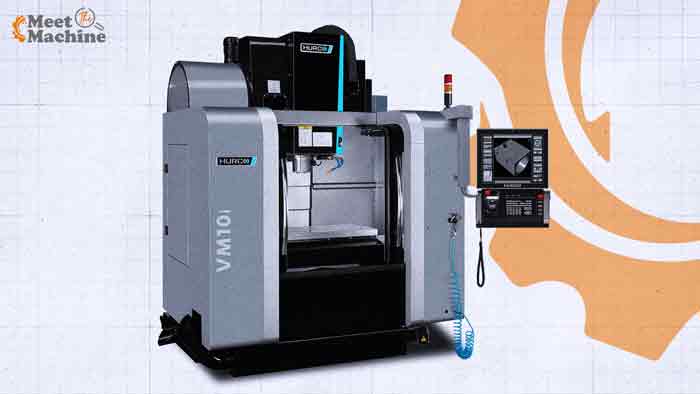
The Hurco VM10i is a compact three axis CNC vertical machining center with 26.02 inches of X travel, 16.02 of Y and 20 of Z, on a 30 by 15.98 inch table rated for 3,300 lb. It runs a CAT 40 spindle and a 24 station tool changer, and it carries WinMax on the MAX5 console, which is the argument the brand is built on. It sits in Hurco's VM line alongside the VM ONE, VM20i and VM30i, below the heavier VMX performance machines. Hurco has since dropped the i: the current product page for this machine reads VM10.
Go to Hurco's site today and look up this machine. The page is headed VM10. No i.
The machine is still there, still 26 by 16 by 20, still CAT 40, still 24 tools. Hurco just stopped putting the letter on it. Which would be a footnote, except that somewhere along the way the machine wearing that badge gained about nine hundred pounds without changing a single dimension of its work envelope.
Two used VM10i listings can sit side by side with the same three specs in the headline and be meaningfully different machines. Here is how to tell which one you are looking at.
Hurco Does Not Call It a VM10i Anymore
Hurco's current product page for this machine lives under vm10 and its headings read VM10 and VM10 Machine Specifications. The i is gone from the current model.
That is not unusual for Hurco. The letter has moved around the catalogue for years, and you can watch it happen across almost any Hurco floor. Here is ours, sorted by year.
| Year |
Model |
Carries an i |
| 2006 |
VMX42 |
No |
| 2006 |
VM-1 |
No |
| 2008 |
VMX64/50T |
No |
| 2010 |
TM8 |
No |
| 2011 |
VMX84/50T |
No |
| 2013 |
VMX84i |
Yes |
| 2014 |
VMX42Ui |
Yes |
| 2021 |
BX40i |
Yes |
| 2023 |
TMX8MYSi |
Yes |
Nine machines, a clean break somewhere between 2011 and 2013, and no i on anything older. That is one dealer's floor rather than a Hurco policy statement, so do not treat the date as a hard boundary. But it is consistent with what the catalogue shows, and it is enough to tell you the letter tracks era rather than capability.
For a buyer, the practical consequence is simple and annoying. The suffix does not reliably tell you the generation, the control or the spec. The year does, and the serial number does. The badge does not.
What Moved, and What Did Not
Set Hurco's earlier VM10i data sheet against the specification Hurco publishes for this machine today.
| Specification |
Earlier VM10i sheet |
Current published spec |
| X, Y, Z travel |
26 x 16 x 20 in |
26.02 x 16.02 x 20 in |
| Spindle taper |
CAT 40 Big Plus |
CAT 40 |
| Spindle power |
15 hp |
15 hp / 11 kW |
| Max spindle speed |
10,000 rpm |
12,000 rpm |
| Tool changer |
24 stations |
24 stations |
| Tool to tool time |
2.5 sec |
2.0 sec |
| Machine weight |
6,200 lb |
7,121 lb / 3,230 kg |
The work envelope is identical. The taper is the same, the horsepower is the same, the tool count is the same. What changed is the top spindle speed, the tool change time, and roughly nine hundred pounds of machine.
Nine Hundred Pounds Is Not a Spec Sheet Change
Two thousand more rpm is a spindle. Half a second off the tool change is a changer and a control. Nine hundred pounds is castings.
A machine does not gain fifteen percent of its own weight through options. That is base, column and saddle, and on a vertical machining center that iron is doing one job: absorbing the energy of the cut so it does not show up in the finish. Mass is the cheapest damping there is, and it is the one thing you cannot retrofit.
This matters most in exactly the work a VM10i gets bought for. Small parts in a compact machine, often steel, often with a cutter that is large relative to the machine. Chatter on a light machine is not a tooling problem you can always fix with feeds and speeds. Sometimes it is the machine telling you what it weighs.
There is a second consequence that only shows up on moving day. Nine hundred pounds changes the rigging quote, and on a machine in this price class the rigging is a real fraction of the total. Two VM10i listings at the same asking price are not the same money if one of them is 6,200 lb and the other is 7,121 and neither seller mentioned it.
None of which makes an earlier VM10i a bad machine. Plenty of them are cutting good parts right now. It means that when you are comparing two of them, weight is a real variable and not a footnote, and a seller quoting 26 by 16 by 20 has told you nothing about it.
How to Tell Which One You Are Looking At
None of this helps unless you can sort two listings apart, so here is the order that actually works.
Start with the year and the serial number. On this brand they do the job the model number does elsewhere. A seller who cannot produce both from the machine plate is a seller who has not looked at the machine.
Then ask for the maximum spindle speed off the control, not the listing. Ten thousand or twelve thousand is the fastest single tell between the earlier and later spec, and it is a number the machine itself will show you.
Then ask what the machine weighs. A dealer who has moved it knows, because the rigger charged for it. Six thousand two hundred and seven thousand one hundred are different trucks. If nobody can answer, the shipping documents from the last time it moved will.
Then get a photo of the control at its home screen. Ultimax and WinMax do not look alike, and a photograph settles in two seconds what a description can muddle for a week.
Four questions, none of which require you to be standing in front of the machine, and together they tell you more than the model badge ever will.
Resell CNC Take
On a Hurco, ask for the year, the serial number and a photo of the control screen before you ask about anything else. The model badge on this brand has moved more than the machines have. Those three things pin down the generation, the spec and what the control can still be supported with, and none of them are in the listing headline.
The Envelope, and What Actually Fits
Twenty six by sixteen by twenty is a compact envelope, and the VM10i is honest about being a small machine. Where buyers get caught is the table.
The table is 30 inches long and 15.98 wide. X travel is 26.02, so the spindle cannot reach the last two inches at either end of the table. Y travel is 16.02 against a table 15.98 wide, so in Y the spindle reaches the full width and a hair past.
The practical read: you have a 30 inch table, you can cut over about 26 inches of it, and the ends are for work holding rather than for cutting. That is a sensible layout on a machine this size and it is the opposite arrangement from a lot of larger VMCs, where travel matches or exceeds table length.
Spindle nose to table is 4 inches at minimum. Subtract your vise and your tool stickout from the Z travel and that is the real part height, which on a compact machine is usually the first dimension to run out.
Table load is 3,300 lb, which is generous for the size. The machine itself weighs 7,121 lb, so the table is rated at close to half the mass of the machine standing under it.
The Numbers Underneath
Specifications vary by year, so pull the sheet for the exact machine and serial number in front of you. These are the figures Hurco currently publishes.
| Specification |
Value |
| X, Y, Z travel |
26.02 / 16.02 / 20.00 in (661 / 407 / 508 mm) |
| Table size |
30.0 x 15.98 in (762 x 406 mm) |
| Max weight on table |
3,300 lb (1,500 kg) |
| Spindle nose to table |
4.0 in (101.6 mm) minimum |
| Spindle power |
15 hp (11 kW) |
| Spindle torque |
53.4 ft-lbf (72.4 Nm) |
| Max spindle speed |
12,000 rpm |
| Spindle taper |
CAT 40 |
| Tool capacity |
24 |
| Tool to tool time |
2.0 sec |
| Max tool diameter |
3.15 in (80 mm) |
| Max tool length |
9.8 in (250 mm) |
| Max tool weight |
15.4 lb (7 kg) |
| Machine weight |
7,121 lb (3,230 kg) |
| Control |
MAX5 console running WinMax |
Fifteen horsepower and 53.4 ft-lbf is the number to hold onto. It is a reasonable figure for a CAT 40 spindle in this class and it is enough for aluminium all day and for steel with sensible tooling. It is not a heavy roughing spindle, and the 15.4 lb maximum tool weight is the limit that bites first if you start reaching for large face mills.
The earlier sheet also published positioning accuracy of plus or minus 0.0002 inches, improving to plus or minus 0.00016 with optional linear scales. If scales matter to your work, that is another option to confirm rather than assume.
Ultimax, WinMax, MAX5, and Which One You Are Getting
Hurco is a control company that builds machines around its control, so on a used Hurco the control generation is not a feature question. It is most of the purchase.
Hurco says it invented conversational CNC programming in 1976. Mazak makes a competing claim for Mazatrol in 1981, which we have written about separately. We are not going to adjudicate that here. What matters for a buyer is that Hurco has made that claim since 1976 and has never stopped treating the control as the product rather than an accessory to it.
The generations you will meet on the used market run roughly in this order. Ultimax, in versions 2, 3 and 4, is the older single screen control. WinMax has been in production since 2006 and is what the brand is known for now, with dual screens and 10,000 block look ahead. MAX5 is the current dual screen console that WinMax runs on.
An older Ultimax machine can still be a working machine, but you are buying an interface that fewer operators have seen and a support picture that gets thinner over time. A WinMax machine on a MAX5 console is closer to what somebody trained recently will recognise, and it is the configuration the brand sells itself on.
Get a photograph of the running control screen, not a description of it, before you commit to anything. An orphaned control undercuts the entire reason to buy a Hurco.
VM or VMX
Hurco splits its verticals into two tiers and the VM10i sits in the lighter one.
The VM line, VM ONE, VM10i, VM20i and VM30i, is the compact value tier. The VMX line, running from the VMX24i up through the VMX84i, is the performance tier: heavier machines with 40 taper Big Plus spindles aimed at higher precision batch work, one offs, and die and mold.
The honest way to choose is to ignore the tier names and look at two things. First, does the part fit, which on a VM10i means inside 26 by 16 by 20 with your fixture already on the table. Second, what is the cut, because the VMX tier exists to put more iron and more rigidity under the same kind of tooling.
For a shop doing small production work, prototypes, fixtures and general job shop parts in a tight footprint, the VM10i is the right size of machine and the VMX would be paying for capability that sits idle. For steady steel work with heavier cutters, the extra mass in the VMX tier is what you are actually buying.
U.S. Support and Parts
Hurco Companies was founded in Indianapolis in 1968 and is still headquartered there. It is publicly traded on the NASDAQ under HURC, which means the company files its results in the open, and in 2015 it acquired Milltronics USA and Takumi.
For a used buyer, the domestic base matters in the ordinary ways: parts, service and a distributor network that has been in place for decades. The control is the thing worth checking hardest, because it is proprietary, and support for it is the difference between a machine you can keep running and one you cannot.
Resell CNC carries Hurco machines across the VM, VMX, BX and TM lines. More on the company and the control in our Hurco brand profile.
Used-Market Value
Four things carry the number on a used VM10i.
The control generation. The clearest line in the Hurco used market. WinMax on MAX5 sits at the top, older WinMax below it, Ultimax below that.
The year, and therefore the spec. Since the badge does not tell you whether you are looking at the 10,000 rpm machine at 6,200 lb or the 12,000 rpm machine at 7,121, the year is doing the work the model number does on other brands.
Spindle condition. On a 12,000 rpm CAT 40 spindle in a compact machine, a rebuild is a meaningful fraction of what the machine is worth, and it is the hardest condition item to judge from photographs.
What comes with it. Probing, a chip conveyor, a fourth axis, linear scales, a tooling package and coolant through spindle are all meaningful money on a machine in this price class. Get the list in writing.
One thing that does not carry the number the way buyers expect is the badge itself. A listing headed VM10i and a listing headed VM10 can be the same machine or eleven years apart, and the market has largely stopped pricing off the suffix because it stopped meaning anything consistent. Price off the year, the control and the spindle.
What to Check on a Used VM10i
Start with the three things the listing will not tell you: the year, the serial number and a photo of the control powered up and at its home screen.
Then confirm the control generation from that photo rather than the description, and ask what software version is on it and whether it has been updated.
Run the spindle through its full speed range and listen at the top. Twelve thousand rpm is where a tired bearing announces itself, and a spindle rebuild on this machine is a meaningful fraction of what the machine is worth.
Cycle the tool changer through all 24 stations rather than a sample, and if there are heavier tools still in the magazine, watch those specifically against the 15.4 lb limit.
Move all three axes through full travel and check backlash at reversal. Indicate the table and look at the T-slots around the middle, where the vise has lived.
Ask whether linear scales are fitted, since that changes the positioning specification and is not visible from outside.
Cut and measure a test part if the seller will allow it. On a compact machine the finish tells you about rigidity faster than any inspection you can do standing still.
Who Runs One
The VM10i is a job shop and small production machine. It shows up doing fixtures, prototypes, short runs, tooling components, brackets and general contract work, and it shows up in shops where floor space is the binding constraint rather than capability.
It is also a common first Hurco. Shops that buy one usually buy it for the control, because a machinist who can read a print can program a part at the machine without a CAM seat, and that is worth more to a small shop than a spec sheet advantage. It changes who can run the machine, which on a floor with one programmer and three machinists is the constraint that actually binds.
If your parts regularly push past 26 inches, or your work is steady steel with big cutters, look up the range at the VM20i, the VM30i or the VMX tier rather than making a VM10i do it.
Looking for a used Hurco?
See what we have on the floor.
Resell CNC has bought and sold used CNC machinery since 2008, backed by a team with 200+ years of combined industry experience and four AMEA and CEA certified equipment appraisers on staff.
Browse Used Hurco
Frequently Asked Questions
What is the Hurco VM10i?
A compact three axis CNC vertical machining center with 26.02 inches of X travel, 16.02 of Y and 20 of Z, on a 30 by 15.98 inch table rated for 3,300 lb. It runs a 15 hp CAT 40 spindle to 12,000 rpm with 53.4 ft-lbf of torque, carries a 24 station tool changer, and runs WinMax on the MAX5 console. It sits in Hurco's VM value tier alongside the VM ONE, VM20i and VM30i.
What does the i mean on a Hurco VM10i?
Hurco does not publish a definition, and it is not a reliable guide to what you are buying. The letter has moved through the catalogue over the years: older machines generally carry no i, machines from the 2010s onward generally do, and Hurco's current product page for this machine reads VM10 with the i dropped again. Use the year and the serial number to establish the generation, not the suffix.
How much does a Hurco VM10i weigh?
Hurco currently publishes 7,121 lb, or 3,230 kg. An earlier Hurco VM10i data sheet published 6,200 lb for the same model designation with the same 26 by 16 by 20 work envelope, so the machine gained roughly nine hundred pounds under one name. That weight is castings rather than options, and it is the difference that shows up as rigidity in the cut.
What is the difference between a Hurco VM and a VMX?
VM is the compact value tier, covering the VM ONE, VM10i, VM20i and VM30i. VMX is the performance tier, running from the VMX24i up to the VMX84i with 40 taper Big Plus spindles, aimed at higher precision batch production, one offs, and die and mold work. The practical difference is mass and rigidity rather than what the machine can be programmed to do, since both run WinMax.
What control is on a used Hurco VM10i?
It depends on the year. Older Hurcos run Ultimax in versions 2, 3 or 4, a single screen control. WinMax has been in production since 2006 and is the dual screen control the brand is known for, with 10,000 block look ahead, and it runs on the current MAX5 console. Ask for a photograph of the control powered up rather than a written description, because the control generation is most of what you are buying on this brand.
How big a part fits on a Hurco VM10i?
The table is 30 inches long and 15.98 wide, but X travel is 26.02 inches, so the spindle cannot reach the last two inches at either end. Y travel is 16.02 against a 15.98 inch table, so the full width is reachable. Spindle nose to table is 4 inches at minimum against 20 inches of Z, so subtract your vise height and tool stickout for the real part height. Table load is 3,300 lb.
Is a used Hurco VM10i worth buying?
For a shop that wants to program at the machine, yes. Hurco builds its machines around its own conversational control and a machinist who can read a print can program a part at the spindle without a CAM seat, which is the whole argument for the brand. The decision is about the control generation and the year rather than the model name: confirm the control is still supportable, establish whether you are looking at the earlier or later spec, and check the spindle carefully.
What should you check on a used VM10i?
Get the year, the serial number and a photo of the control at its home screen before anything else, since the badge does not pin down the generation. Run the spindle through its full range and listen at 12,000 rpm. Cycle all 24 tool changer stations rather than a sample. Move all three axes through full travel and check backlash at reversal. Indicate the table and inspect the T-slots where the vise has lived. Ask whether linear scales are fitted, and cut a test part if you can.
About the Author
Bill Murphy is the Marketing and Content Lead at Resell CNC, where he writes about used CNC machinery, machine tool history and what the spec sheet does not tell a buyer.
About Resell CNC
Resell CNC has bought and sold used CNC machinery since 2008. Based in Maitland, Florida, with warehouses in Winter Springs and Longwood, the team brings more than 200 years of combined industry experience and four AMEA and CEA certified equipment appraisers on staff. Resell CNC has been an MDNA member since 2009.