Meet the Machine
Used Kitamura Mycenter 3Xi: The Spindle Speed That Never Moved
What is the Kitamura Mycenter 3Xi?
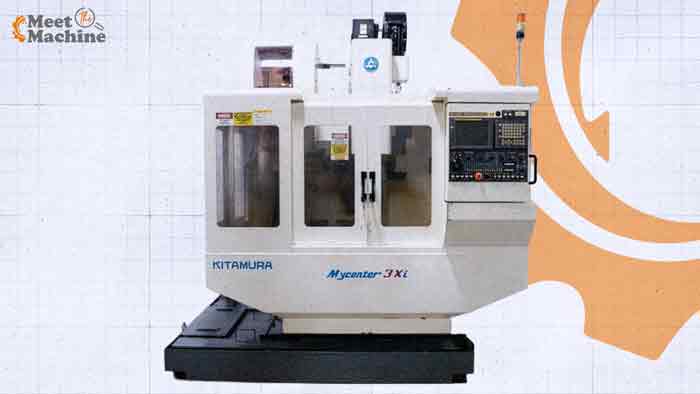
The Kitamura Mycenter 3Xi is a compact, high precision CNC vertical machining center from the early 2000s, built around a 40 taper spindle running to 15,000 rpm with roughly 30 inches of X travel. It is no longer in production: Kitamura's current vertical lineup runs the Mycenter-3020G and the XVII series instead. What makes it worth knowing about is that the machine replacing it, the Mycenter-3XVII, publishes the same 40 taper and the same 15,000 rpm ceiling on nearly the same X travel. The spec Kitamura chose for this machine has not needed changing.
Most twenty year old machine tools are twenty year old machine tools. You buy them knowing the spec has moved on and you are trading capability for price.
The Mycenter 3Xi is a harder case to make that argument about. Kitamura discontinued it, and the machine that took its place publishes the same spindle taper, the same 15,000 rpm ceiling and an X travel within a tenth of an inch of the old one. The envelope barely moved. The spindle speed did not move at all.
That does not make a 2004 machine equal to a new one, and this article is not going to pretend it does. It does change what you are actually evaluating when you look at one. You are not asking whether the spec has been left behind. You are asking whether this particular machine still holds what it was built to hold.
Kitamura Does Not Build It Anymore
Kitamura's current vertical machining centers are the Mycenter-3020G, the 2XVII, 3XVII, 4XVII and 5XVII, the 3XVTII and the Jigcenter-5G. There is no 3Xi on the list.
For a buyer that has two consequences, and they pull in opposite directions. The first is that used is the only way to get one, so you are shopping a fixed and shrinking pool with no factory floor to fall back on. The second is that a discontinued machine usually means a superseded machine, and on this one the supersession is narrower than the twenty year gap suggests.
Discontinued also raises the question every buyer of an out of production machine should ask, which is whether it can still be kept running. On this one the answer is more reassuring than usual, and it comes down to the control. More on that below.
Thirty Inches of X, Then and Now
Set the 2004 Mycenter 3XiF on our floor against the Mycenter-3XVII that Kitamura publishes today.
| Specification |
2004 Mycenter 3XiF |
Current Mycenter-3XVII |
| X travel |
30.0 in |
29.9 in |
| Y travel |
18.0 in |
20.1 in |
| Z travel |
18.0 in |
20.1 in |
| Table |
36.0 x 18.0 in |
33.9 x 19.7 in |
| Spindle taper |
CAT #40 |
NST No. 40 |
| Max spindle speed |
15,000 rpm |
15,000 rpm |
| Spindle motor |
20 hp |
41 hp |
| Tool capacity |
20 |
30 |
X travel is within a tenth of an inch across twenty two years. The taper is the same. The spindle ceiling is identical.
That is worth sitting with, because a twenty year old spec sheet usually reads like a different era. This one does not. Whatever Kitamura concluded about the right spindle speed for a 40 taper in this size class, they concluded it before 2004 and have not revised it since.
What moved is Y and Z, each gaining about two inches, and the tool magazine, which went from twenty pockets to thirty. Those are real improvements and they are the reason the new machine costs what it costs. They are not a different class of machine.
What Actually Changed: The Motor Doubled
The one number that moved hard is horsepower. Twenty on the 3XiF, forty one on the 3XVII.
That is the interesting part, because it tells you what Kitamura decided the machine needed. They did not chase a bigger rpm headline. They kept the spindle ceiling where it was and put twice the motor behind it.
For a buyer the practical read is straightforward. At the top of the range both machines will spin a small cutter at 15,000 rpm. Down in the range, where you are taking a real cut with a real tool, the newer machine has substantially more to give. If your work is small, fine featured and finish critical, the gap narrows. If you are removing metal, the gap is the whole argument for buying new.
Heat Is the Enemy of a Precision Machine
The 3XiF on our floor came with a CoolJet oil cooling unit, and it is worth understanding why that is on a machine like this rather than treating it as an accessory.
Every machine tool grows when it runs. Spindle bearings make heat, ballscrews make heat, the motors make heat, and cast iron expands. On a machine working to a few thousandths that growth is noise you can live with. On a machine sold to hold tenths it is the error budget.
A spindle running at 15,000 rpm makes considerably more heat than one running at 6,000, which is why the high speed spindle and the cooling unit belong to the same design decision rather than being separate options. Circulating temperature controlled oil through the spindle and the structure keeps the machine closer to the geometry it had when it was cold.
On a used example this matters twice over. A cooling unit that has failed or been bypassed means the machine has been running hot, possibly for years, and heat is cumulative on bearings and screws. So the question is not whether the unit is bolted to the machine. It is whether it works, and what the machine has been doing in the time since it stopped.
Resell CNC Take
Buy a used Kitamura for the geometry, not the spec sheet. The spindle speed and the envelope on a twenty year old Mycenter are close enough to current that they are not what you are choosing between. What you are choosing between is a machine whose ways and screws have been looked after and one that has not, and no listing photograph will tell you which is which.
Which Mycenter You Are Actually Looking At
The Mycenter-3 has been sold in enough variations that listings are not consistent, and the small ones sit close enough together that a number alone does not settle it.
You will see the 3X, the 3Xi, the 3XiF, the 3XD and the 3XiG on the used market, alongside the smaller 2X family and the 5-axis 3XV machines. Our own Kitamura inventory right now runs a 2Xi, two 2XiF, the 3XiF, an HX300iF, an HX1000i, an HX500G and a 2021 HX-250iG, which is a fair picture of what actually trades.
The practical difference between the 2 and the 3 class is size, and it is the first thing to settle. If your parts fit a 2X you do not need a 3, and a smaller machine on the same construction is cheaper to buy and takes less floor. Beyond that, treat the letters as a prompt to go get the real numbers rather than as an answer. Ask for travels, table size, spindle speed and taper off the machine plate, plus the serial number and the year.
The Numbers Underneath
Specifications vary across the Mycenter-3 family and by year, so pull the sheet for the exact machine and serial number in front of you. These are the figures on the 2004 Mycenter 3XiF currently on our floor.
| Specification |
2004 Mycenter 3XiF |
| X, Y, Z travel |
30.0 / 18.0 / 18.0 in |
| Table size |
36.0 x 18.0 in |
| Spindle taper |
CAT #40 |
| Max spindle speed |
15,000 rpm |
| Spindle motor |
20 hp |
| Tool changer |
20 pocket, side mount |
| Tool change time |
1.5 sec |
| Fourth axis |
Rotary table and trunnion fitted |
| Cooling |
CoolJet oil cooling unit |
| Other |
Chip conveyor, coolant through spindle |
Two entries on that list are worth pausing on.
A tool change time of 1.5 seconds on a machine of this age is quick, and it is the kind of figure that only holds up if the changer has been maintained. Verify it on the machine rather than reading it off a listing.
The CoolJet oil cooling unit is not decoration. On a machine sold on its ability to hold geometry, controlling thermal growth is part of the design rather than an add on, and a missing or dead cooling unit on a used example is a real gap rather than a missing convenience.
Why a Hand Scraped Machine Ages Differently
Kitamura builds nearly all major components in house and hand scrapes the mating surfaces. Scraping gets a flatness and a bearing pattern that grinding alone does not reach. It is slow, skilled hand work, which is why it tends to show up on machines sold on accuracy rather than on price.
The reason it matters on a used machine is simple. A machine that started more accurate has further to fall before it stops being useful. Two machines that have both lost the same amount of accuracy over twenty years do not end up in the same place if one of them started tighter.
That is the whole used Kitamura argument, and it is worth being clear about what it does and does not promise. It does not mean a neglected Kitamura is fine. It means a maintained one is likely to still be inside tolerance when a comparable machine from a volume builder is not. Maintenance is doing the work in that sentence.
We have written more about why mass and construction determine how a machine holds a cut in our piece on cast iron and damping.
Box Ways, Twin Ballscrews and Dual Feedback
Three Kitamura design decisions show up on this machine and all three are about resisting movement you did not ask for.
Box ways. A larger bearing surface than a linear guide, which trades some rapid speed for damping and load capacity. On a machine expected to hold tolerance under a cut rather than move quickly between them, that is the right trade.
Twin ballscrews. Kitamura's patented arrangement drives an axis from two screws rather than one, balancing the load and reducing deflection and thermal drift. A single screw pulls from one side and the machine has to absorb the moment that creates.
Dual feedback. A second measurement loop so the control reads the true axis position rather than inferring it from the motor. Backlash, screw wind up and thermal growth all live between the motor and the table, and dual feedback is how the control sees past them.
None of these are things you can add later, and all three are why a twenty year old example is still worth inspecting rather than dismissing.
Which Control You Are Getting
Kitamura runs its own Arumatik control on current machines, Arumatik-Mi on the larger ones and Arumatik-Jr on smaller models. Machines of the 3Xi era commonly came with Fanuc or Yasnac instead, and used 3Xi listings frequently show a Fanuc 16i-M.
For once this is good news on an older machine. A Fanuc control of that generation has been in service on a very large number of machines for a very long time, parts and service people are not hard to find, and most programmers have seen the screen. An older proprietary control would be the thing that worried you about a twenty year old machine. A Fanuc 16i-M largely is not.
Confirm what is actually fitted before you commit, because the answer changes parts availability, programming compatibility and who you can hire to run it. Ask for a photograph of the control powered up rather than a line in a description.
How to Verify the Geometry Claim
Everything above says a well kept Mycenter should still be accurate. Here is how to find out whether the one in front of you is, rather than taking the brand's reputation as the answer.
Indicate the table. Sweep it with a dial indicator on a long arm. You are looking for flatness and for any step where a vise has lived for fifteen years.
Check backlash at reversal on all three axes, at both ends and in the middle. On a twin ballscrew machine an inconsistency between positions is more telling than the absolute number, because it suggests one screw has worn differently from the other.
Look at the box ways directly. Pull the way covers if the seller allows it. Scraping leaves a visible bearing pattern, and where that pattern has been worn flat is where the machine has spent its life.
Run the spindle up to 15,000 and let it sit there. Listen, then feel the housing. Heat and noise at the top of the range are the two things that separate a good spindle from one that is about to become the largest line item in the purchase.
Confirm the cooling unit works rather than confirming it is present.
Cut and measure a test part. On a machine bought specifically for accuracy, this is not optional. Ask for a circle diamond square or a similar geometry test, cut on the machine, measured in front of you.
One thing worth saying plainly: none of this requires you to be a metrology expert, and a seller who resists all of it is telling you something. A machine that has been maintained to the standard this brand is bought for usually comes with somebody who is proud of it and happy to prove it. Reluctance to run a cut test on a precision machine is the single most useful signal in the whole inspection.
U.S. Support and Parts
Kitamura was founded in 1933 as Kitamura Iron Works in Takaoka City, Toyama Prefecture, Japan. It moved from paper pulp machinery into planers in 1960 and into machining centers through the 1970s, and it remains headquartered in Japan.
U.S. operations run through Kitamura Machinery of USA in Wheeling, Illinois, with additional offices in Germany. For a used buyer the domestic presence is what matters, because this is not a brand you trip over. Our own inventory runs 125 Haas machines against nine Kitamuras, which is a fair picture of the relative volume. A factory channel for parts and service counts for more when the machine is not common.
Resell CNC currently carries nine Kitamura machines across the Mycenter vertical and HX horizontal lines. More on the company and how it builds in our Kitamura brand profile.
Used-Market Value
Four things carry the number on a used Mycenter 3Xi.
Demonstrated accuracy. Not claimed accuracy. A machine with a recent geometry report or a cut test you watched is worth meaningfully more than an identical machine without one, because accuracy is the entire reason to buy this brand.
Spindle condition. A 15,000 rpm 40 taper spindle is the most expensive single thing that can be wrong mechanically, and age alone does not tell you its state. Hours at the top of the range do.
The control. A supported Fanuc keeps the machine in the mainstream. Confirm what is fitted and that it boots clean and holds parameters.
What comes with it. A fourth axis, a cooling unit, coolant through spindle, a chip conveyor and the tooling package are a large share of the value on a machine this size. Get the list in writing.
What does not carry the number is the year, at least not the way it does on other brands. A 2001 and a 2006 Mycenter of the same model are separated far more by how they were used than by when they were built, because the spec did not move much in between. Two machines four years apart with different maintenance histories are not close to the same purchase, and the older one is often the better machine.
Who Runs One
The Mycenter 3Xi is a precision job shop machine. It shows up in mold and die work, in medical and dental components, in aerospace at the small end, in fixture and gauge work, and anywhere the tolerance on the print is tighter than the shop's other machines can hold repeatably.
It is usually not a first machine. Shops that buy one already have general purpose capacity and need something they can trust for the parts that keep coming back out of tolerance. That is a specific need and this is a machine bought to answer it.
A fourth axis changes that calculation, and a good number of these were fitted with one. A rotary table or trunnion on a compact, accurate machine turns it into a small parts cell: multiple faces in one setup, which on tight tolerance work removes the biggest single source of error, which is the second setup. If a machine you are looking at has a fourth axis already fitted and proven, that is worth real money over one that does not, and worth more than the cost of adding one later.
If your work does not have that character, a newer general purpose VMC will serve you better and cost less to support. Buying a precision machine you do not need is paying for an attribute you will never measure.
Looking for a precision VMC?
See what we have on the floor.
Resell CNC has bought and sold used CNC machinery since 2008, backed by a team with 200+ years of combined industry experience and four AMEA and CEA certified equipment appraisers on staff.
Browse Used Kitamura
Frequently Asked Questions
What is the Kitamura Mycenter 3Xi?
A compact high precision CNC vertical machining center from the early 2000s, built around a 40 taper spindle running to 15,000 rpm with roughly 30 inches of X travel. The 2004 Mycenter 3XiF on our floor publishes 30 by 18 by 18 inches of travel on a 36 by 18 inch table, a CAT #40 spindle to 15,000 rpm, a 20 hp motor and a 20 pocket side mount changer at 1.5 seconds. It is no longer in production.
Is the Kitamura Mycenter 3Xi still made?
No. Kitamura's current vertical machining centers are the Mycenter-3020G, the 2XVII, 3XVII, 4XVII and 5XVII, the 3XVTII and the Jigcenter-5G. The 3Xi is available on the used market only. Its closest current descendant is the Mycenter-3XVII.
How does the Mycenter 3Xi compare to the current Mycenter-3XVII?
Closer than twenty years suggests. X travel is 30.0 inches against 29.9, the taper is 40 on both, and the maximum spindle speed is 15,000 rpm on both. Y and Z each gained about two inches on the newer machine and the tool magazine went from 20 pockets to 30. The largest change is the spindle motor, which went from 20 hp to 41. Kitamura kept the speed and added power.
What control is on a Kitamura Mycenter 3Xi?
Machines of this era commonly carry Fanuc or Yasnac controls rather than Kitamura's own Arumatik, and used 3Xi listings frequently show a Fanuc 16i-M. That is favorable on an older machine, since a Fanuc of that generation is widely supported and most programmers have seen it. Confirm what is actually fitted with a photo of the control powered up, because it determines parts availability and programming compatibility.
Is a twenty year old Kitamura worth buying?
It depends entirely on how it was maintained, and that is a more honest answer than the brand reputation alone. Kitamura hand scrapes mating surfaces and uses box ways, twin ballscrews and dual feedback, so a machine that started more accurate has further to fall before it stops being useful. That is an argument for inspecting one carefully rather than an argument for assuming it is fine. Demand a cut test.
What is the twin ballscrew design on a Kitamura?
A patented arrangement that drives an axis from two ballscrews rather than one, balancing the load across the axis to reduce deflection and thermal drift. A single screw pulls from one side and the structure has to absorb the moment that creates. Kitamura pairs it with dual feedback, a second measurement loop so the control reads the true axis position rather than inferring it from the motor.
What should you check on a used Mycenter 3Xi?
Indicate the table for flatness and for a step where a vise has lived. Check backlash at reversal on all three axes at both ends and the middle, since an inconsistency between positions matters more than the absolute number on a twin ballscrew machine. Pull the way covers if allowed and look at the scraping pattern. Run the spindle to 15,000 rpm and check heat and noise. Confirm the cooling unit works rather than that it is present. Then cut and measure a test part.
Who should buy a Mycenter 3Xi?
A precision job shop that already has general purpose capacity and needs a machine it can trust for tight tolerance work: mold and die, medical and dental, small aerospace components, fixtures and gauges. It is rarely a first machine. If your work does not demand that accuracy, a newer general purpose VMC will cost less to buy and less to support.
About the Author
Bill Murphy is the Marketing and Content Lead at Resell CNC, where he writes about used CNC machinery, machine tool history and what the spec sheet does not tell a buyer.
About Resell CNC
Resell CNC has bought and sold used CNC machinery since 2008. Based in Maitland, Florida, with warehouses in Winter Springs and Longwood, the team brings more than 200 years of combined industry experience and four AMEA and CEA certified equipment appraisers on staff. Resell CNC has been an MDNA member since 2009.